
EmbeddingGemma 2 – Review of Google's Open-Source Native Multimodal Embedding Model
Executive Summary:
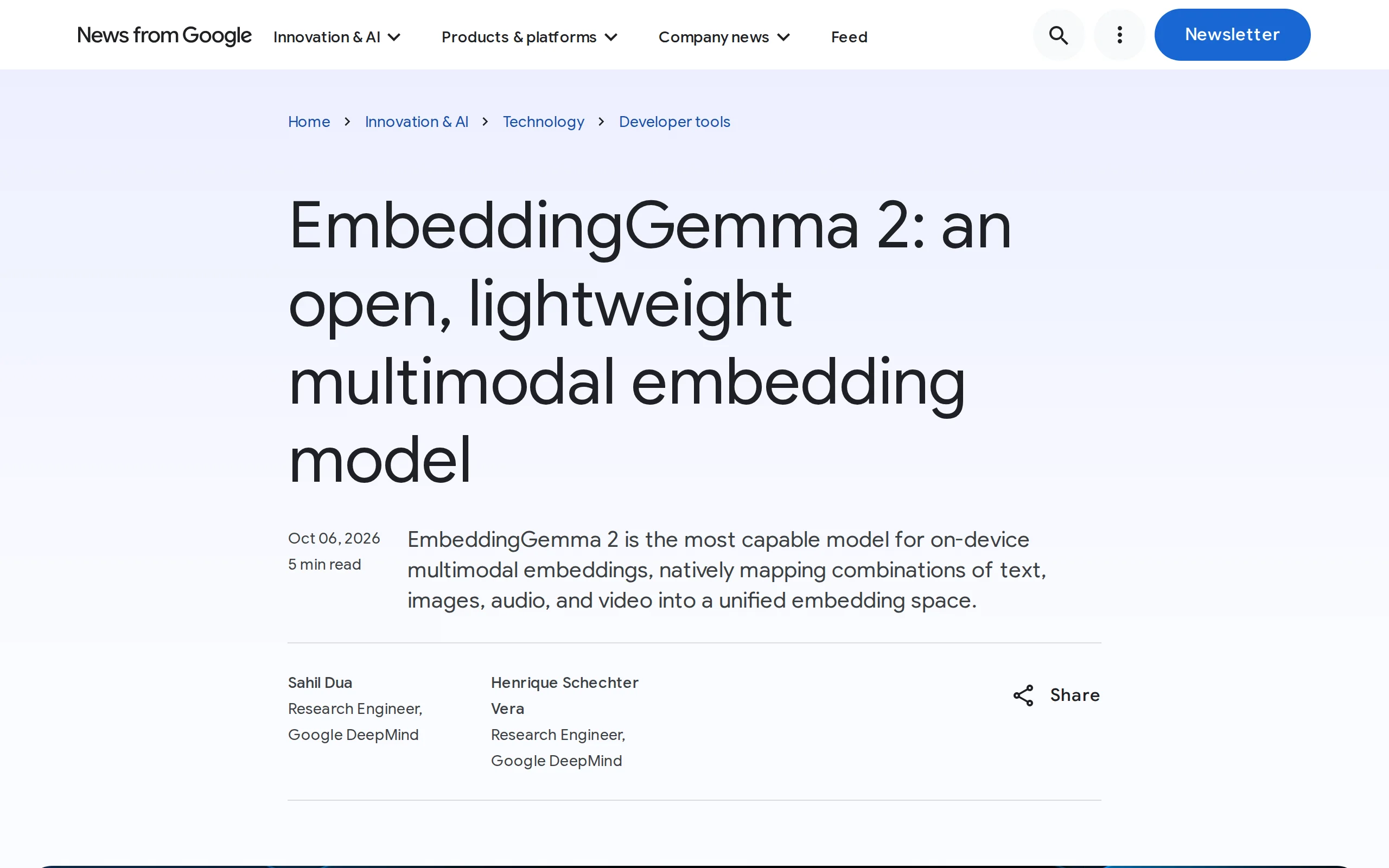
EmbeddingGemma 2 is an open-source native multimodal Embedding model developed by Google, built upon the Gemma 4 architecture. It unifies five modalities—text, code, images, video, and audio—into a si...
1. What is EmbeddingGemma 2
EmbeddingGemma 2 is an open-source native multimodal Embedding model developed by Google, built upon the Gemma 4 architecture. It unifies five modalities—text, code, images, video, and audio—into a single vector space, enabling cross-modal semantic retrieval. The model features a modular design with only 740M parameters for all modalities, and an 8K token context window. After quantization, it occupies approximately 567MB of memory on a Pixel 11 Pro. As a leading multimodal vector model with performance under 1B parameters, its code retrieval capability has improved by nearly 10 points compared to the previous generation, primarily targeting edge-side RAG, semantic search, and photo retrieval applications.
Technical positioning and domain: It belongs to the intersection of multimodal representation learning and information retrieval, with the core task of encoding heterogeneous modal data into a unified vector space, simplifying cross-modal retrieval to a vector nearest-neighbor search problem. The model differentiates itself in two dimensions: deployment on the edge and unified multimodal support, filling the market gap for lightweight multimodal embedding models.
Development background: This model was jointly developed by Google DeepMind and Google Research, continuing the technical approach of the Gemini Embedding series. The motivation for its development stems from the urgent need for lightweight multimodal retrieval capabilities in edge AI applications—previously, multimodal retrieval typically relied on a cascaded approach of multiple models, which incurred high memory costs and complex deployment. EmbeddingGemma 2 covers all modalities with a single model, significantly lowering the threshold for edge deployment.
Core value: It addresses three major pain points of multimodal semantic retrieval on mobile devices: first, the modality fragmentation issue, by unifying vector representations of text, images, audio, and video with a single model; second, the resource constraints issue, as 740M parameters combined with quantization technology allow it to run offline on a smartphone; third, the deployment complexity issue, with a modular architecture that enables on-demand loading of visual and audio encoders, requiring only 270M parameters for text tasks.
Technical features: The model is trained using Matryoshka representation learning, outputting 768-dimensional vectors and supporting dynamic truncation to 512/256/128 dimensions, reducing storage costs to as low as one-sixth of the original. Additionally, it shares the tokenizer and audio encoder with the generative model Gemma 4, allowing both to be seamlessly integrated into an edge-side multimodal RAG pipeline.
2. Key Features
Cross-modal Semantic Retrieval: Maps text, code, images, videos, and audio into a unified vector space, enabling retrieval across different modalities using any single modality. For example, inputting a textual description can retrieve matching images or video clips, without the need to maintain separate models for each modality, greatly simplifying the architecture design of multi-modal search systems.
On-device Local Inference: With only 740M parameters across all modalities, the model occupies approximately 567MB of memory after quantization and can perform inference on terminal devices like smartphones and laptops without requiring an internet connection. This feature allows privacy-sensitive scenarios (such as photo search and local document retrieval) to be processed entirely on the device, avoiding the risk of data leakage from uploading to the cloud.
Modular On-demand Loading: The model is composed of three parts: a 270M parameter text backbone, a 170M parameter visual encoder, and a 300M parameter audio encoder. The visual and audio modules can be independently removed, and during actual deployment, it supports four configurations: pure text (270M), text + image (440M), text + audio, and full modalities. This ensures that text tasks do not incur memory costs for unnecessary modalities.
Local RAG Pipeline: Shares the text tokenizer and audio encoder with Gemma 4. When combined, they can be used to build a multi-modal retrieval-augmented generation (RAG) system locally. EmbeddingGemma 2 is responsible for encoding and indexing local multi-modal files, while Gemma 4 handles context reasoning after retrieval. The shared components reduce the total memory usage during combined deployment.
Video Moment Localization: Supports automatically marking semantically matching video segments using text or audio queries. In the Video Moments Finder demo, users can input descriptions such as "turtle eating" to quickly locate the corresponding video segments. This is applicable to scenarios like surveillance video analysis, online course reviews, and meeting screen recordings.
Real-time Decision Engine: Performs real-time classification, routing, and prediction using the MediaPipe Decision Task API. In the demo, a single decision takes only 43 milliseconds, significantly faster than the 640 milliseconds required by LLMs. This capability enables the model to be embedded in real-time interactive systems, providing low-latency semantic routing and intent recognition for intelligent applications.
3. How to Use
Obtain model weights: Retrieve the model files for
google/embeddinggemma-2from Hugging Face or Kaggle. For edge-optimized versions, download the quantized mobile model from the LiteRT Community page, which is specifically optimized for mobile hardware.Select a runtime framework: The model supports mainstream inference tools such as transformers, sentence-transformers, MLX, vLLM, llama.cpp, SGLang, Ollama, and LM Studio. Developers can choose based on their deployment environment: for server scenarios, vLLM or SGLang is recommended for high throughput; for mobile devices, MediaPipe or LiteRT is recommended; and for browser-based environments, it can be run using transformers.js or WebGPU.
Write inference code: Taking sentence-transformers as an example, after loading the model, encode the query and document using
prompt_name="SearchQuery"and"Document"respectively. Then, use thesimilarity()function to calculate vector similarity. Text input supports a task prefix mechanism, allowing the same text to generate different vector representations for different tasks.Build a retrieval system: Store the generated embeddings in a vector database (such as Qdrant) to enable semantic search, codebase indexing, or multimodal retrieval. Based on Matryoshka representation learning, the 768-dimensional vector can be truncated to 256 dimensions with minimal performance loss, reducing vector database storage to as low as one-sixth of the original.
Edge deployment: On mobile devices, Google AI Edge MediaPipe can be used directly for embedding, retrieval, and decision-making tasks, or LiteRT can be used for custom integration. The 8K token context window can process approximately 5.5 minutes of audio, 29 images, 58 video frames, or a combination of the above in a single pass.
Set up a local RAG: When used in conjunction with Gemma 4, EmbeddingGemma 2 is responsible for local file retrieval, while Gemma 4 handles context reasoning. Both models share the tokenizer and audio encoder, and when deployed together, the total memory usage is lower, making it suitable for scenarios such as enterprise intranets or secure environments where cloud deployment is not possible.
4. Pros and Cons Analysis
| Pros |
|---|
| Native multimodal unification: A single model simultaneously covers five modalities—text, code, images, video, and audio—and maps them to the same vector space, replacing the previous "one model per modality" concatenation approach. This simplifies the system architecture and reduces maintenance costs. |
| Extremely lightweight and deployable on-device: Only 740M parameters for all modalities, and after quantization, it occupies approximately 567MB of memory on a Pixel 11 Pro. This allows for offline multimodal inference directly on the phone, meeting the local processing requirements for privacy-sensitive scenarios. |
| Modular and on-demand loading: The visual and audio encoders can be independently removed. Text tasks require only 270M parameters, avoiding memory costs for unnecessary modalities. This provides flexible deployment options to suit different hardware conditions. |
| Natural synergy with Gemma 4: Shares the tokenizer and audio encoder with Gemma 4, resulting in lower total memory usage when combining the two for local RAG setups. The synergy between components within the ecosystem is evident, significantly reducing the engineering complexity of combined deployment. |
5. Comparative Analysis with Similar Tools
| Comparison Dimension | EmbeddingGemma 2 (Google) | WeMM-Embedding (WeChat, Tencent) |
|---|---|---|
| Parameter Specifications | Single specification: 740M (270M for pure text, modularly splittable) | Family-based: 2B / 4B / 9B tiers |
| Base Architecture | Based on Gemma 4 architecture | Fine-tuned from Alibaba Qwen3.5 |
| Supported Modalities | Text, code, images, video, audio | Text, images, video, visual documents, interleaved input (no audio support) |
| Vector Dimension | 768 (MRL can be truncated to 128) | 2B: 2048 / 4B: 2560 / 9B: 4096 (MRL 64~4096) |
| Context Window | 8K token | 32K token (inherits from Qwen3.5) |
| MMEB-v2 Score | 59.01 | 77.9 (2B) / 79.2 (4B) / 80.6 (9B, first on the leaderboard) |
| Deployment Focus | On-device: Quantized full-modal version is about 567MB, can run on Pixel 11 Pro | Server-side: 2B requires about 4GB GPU memory, 9B about 18GB, relies on vLLM/SGLang for service deployment |
| Open Source License | Open source (Gemma license, allows commercial use) | Open source (Apache 2.0) |
| Production Validation | Official Demo (e.g., album search, video positioning) | Widely deployed in WeChat Video, Official Accounts, Moments, and e-commerce search, with over 1 billion daily calls and all 14 A/B tests showing positive results |
Selection Recommendations: If the core requirement is on-device multi-modal retrieval with strict privacy protection needs, EmbeddingGemma 2 is currently the most suitable option—it is the only model capable of running full-modal retrieval offline on a mobile device, and its synergy with Gemma 4 reduces the cost of setting up local RAG systems. However, if the goal is to achieve the highest retrieval accuracy and the deployment environment is a server, WeMM-Embedding demonstrates a clear advantage on the MMEB-v2 benchmark, especially for business scenarios requiring handling of ultra-long contexts (32K) and complex interleaved inputs.
For pure text retrieval scenarios, Cohere Embed v3 performs consistently well on multilingual tasks and supports over 100 languages, but lacks multi-modal capabilities and is commercially licensed. Overall, technical selection should prioritize alignment across three dimensions: modality coverage requirements, deployment environment constraints, and accuracy needs—rather than focusing on a single metric comparison.
6. Editor's Summary
The core innovation of EmbeddingGemma 2 lies in its ability to compress a multi-modal embedding model down to 740M parameters while maintaining full modal coverage. This achievement is made possible by the modular design of the Gemma 4 architecture—flexibly combining a 270M text backbone, a 170M visual encoder, and a 300M audio encoder—which allows the model to be trimmed as needed for on-device deployment. For example, text tasks can be executed with just 270M parameters. The introduction of Matryoshka-style learning further reduces storage costs, as truncating the 768-dimensional vector to 256 dimensions results in minimal performance loss, a feature that holds practical significance for resource-constrained mobile environments.
In terms of practical value, EmbeddingGemma 2's shared tokenizer and audio encoder design with Gemma 4 creates a synergistic effect within the ecosystem, enabling developers to build on-device multi-modal RAG systems at a low cost. The official demonstrations, including photo search, video moment localization, and a real-time decision engine, highlight the model's potential for consumer-grade applications. A decision latency of 43 milliseconds provides a solid technical foundation for real-time interactive scenarios. However, the model's score of 59.01 on the MMEB-v2 benchmark lags behind leading server-grade models, indicating that in scenarios requiring ultra-high retrieval accuracy, larger-scale alternatives should still be considered.
In terms of target users, EmbeddingGemma 2 is primarily aimed at mobile AI application developers, technical decision-makers in privacy-sensitive scenarios, and teams looking to build multi-modal retrieval systems at a low cost. For users requiring handling of ultra-long contexts or aiming for leaderboard-level accuracy, it is recommended to also evaluate server-grade alternatives such as WeMM-Embedding. Looking ahead, as Google continues to invest in the Gemma ecosystem, the technical advancements of the EmbeddingGemma series in the field of on-device multi-modal retrieval are expected to further translate into product competitiveness, making future versions worth watching for improvements in retrieval accuracy and context length.
7. Application Scenarios
On-device Multimodal Semantic Search: Search local media libraries using text or real-time photos on a smartphone gallery, entirely offline with no privacy data uploaded. Google AI Edge Gallery's Instant Media Search has already implemented this feature, allowing users to search their photo albums with text input or find similar photos by taking a real-time picture of an object. This is ideal for personal privacy protection and offline scenarios.
Video Content Retrieval and Moment Localization: Quickly locate target video segments (e.g., the scene of a turtle eating) using text or audio queries in surveillance footage, online courses, or meeting recordings, eliminating the need for manual frame-by-frame searching. Video Moments Finder supports this functionality, offering practical value for video review, content management, and educational scenarios.
Local RAG Knowledge Base: Pair with Gemma 4 to build an offline RAG system, unifying indexing of local documents, images, and audio for scenarios where cloud access is not possible, such as enterprise intranets or secure environments. The shared tokenizer and audio encoder design reduces the total memory usage of the combined deployment, lowering the hardware requirements for on-device knowledge bases.
Codebase Semantic Indexing and Agent Retrieval: Create a vector index for local code repositories to support semantic code search by coding agents. Code retrieval scores have improved by nearly 10 points compared to the previous generation, enabling developers to locate relevant code snippets through natural language queries, thereby enhancing code reuse efficiency and the accuracy of tool calling by agents.
8. FAQ
Q: What are the main differences between EmbeddingGemma 2 and the previous generation of EmbeddingGemma?
A: EmbeddingGemma 2 is built on the Gemma 4 architecture, with the context window increased from 2K tokens in the previous generation to 8K tokens (a 4x improvement). It can process approximately 5.5 minutes of audio, 29 images, or 58 video frames in a single pass. Code retrieval scores have improved by nearly 10 points compared to the previous generation, and it introduces a modular design, allowing the visual and audio encoders to be independently removed, offering more flexible deployment options.
Q: What modalities does the model support as input? Does it support audio?
A: The model natively supports five modalities: text, code, images, video, and audio. It is one of the few multimodal embedding models under 1B parameters that supports audio. All modalities are uniformly mapped into the same vector space, enabling retrieval across any modality using any other modality.
Q: How can EmbeddingGemma 2 be deployed on mobile devices?
A: Mobile deployment can be achieved by directly integrating embedding, retrieval, and decision-making tasks via Google AI Edge MediaPipe, or by custom integration using LiteRT. After quantization, the full-modal memory footprint is approximately 567MB, allowing offline operation on devices like the Pixel 11 Pro. On the browser side, inference is implemented using transformers.js / WebGPU.
Q: How does the Matryoshka truncation affect retrieval accuracy?
A: The model outputs 768-dimensional vectors, which can be dynamically truncated to 512, 256, or 128 dimensions during inference. Truncating to 256 dimensions results in minimal performance loss, and the vector storage can be reduced to as little as one-sixth of the original. Truncating to 128 dimensions leads to a noticeable drop in accuracy, so it is recommended to prioritize 256-dimensional truncation in storage-sensitive scenarios.
Q: How can EmbeddingGemma 2 be used in combination with Gemma 4?
A: Both models share the same text tokenizer and audio encoder, and can be cascaded into a unified on-device RAG pipeline. EmbeddingGemma 2 is responsible for encoding local multimodal files into the database, while Gemma 4 handles context reasoning after retrieval. The shared components reduce the total memory usage during combined deployment.
Q: What is the open-source license for the model? Is commercial use allowed?
A: The model is open-sourced under the Gemma license, which permits commercial use, subject to the corresponding usage terms. Model weights can be obtained from Hugging Face or Kaggle, and the on-device optimized version can be downloaded from the LiteRT Community page.
9. Project Links
- Project Website: https://blog.google/innovation-and-ai/technology/developers-tools/embeddinggemma-2/
- HuggingFace Model Library: https://huggingface.co/google/embeddinggemma-2
- Technical Paper / Model Card: https://ai.google.dev/gemma/docs/embeddinggemma/model_card_2
Related AI Model Articles
Mistral Large 4 – Mistral AI's Most Flagship Open-Source Large Model
Mistral Large 4 is the latest flagship open-source large model launched by Mistral AI, a French artificial intelligence company, and is nicknamed "Le Chonk" (the chubby cat). This model employs a fine...
Nano Banana 2.1: In-Depth Review of Google DeepMind's Image Generation and Conversational Editing Model
Nano Banana 2.1 (Model ID: gemini-nano-banana-2.1) is the second-generation image generation and conversational editing model officially released by Google DeepMind on October 6, 2026. It belongs to t...
Kling 4.0 – A New Generation AI Video Generation Model Launched by Kuaishou
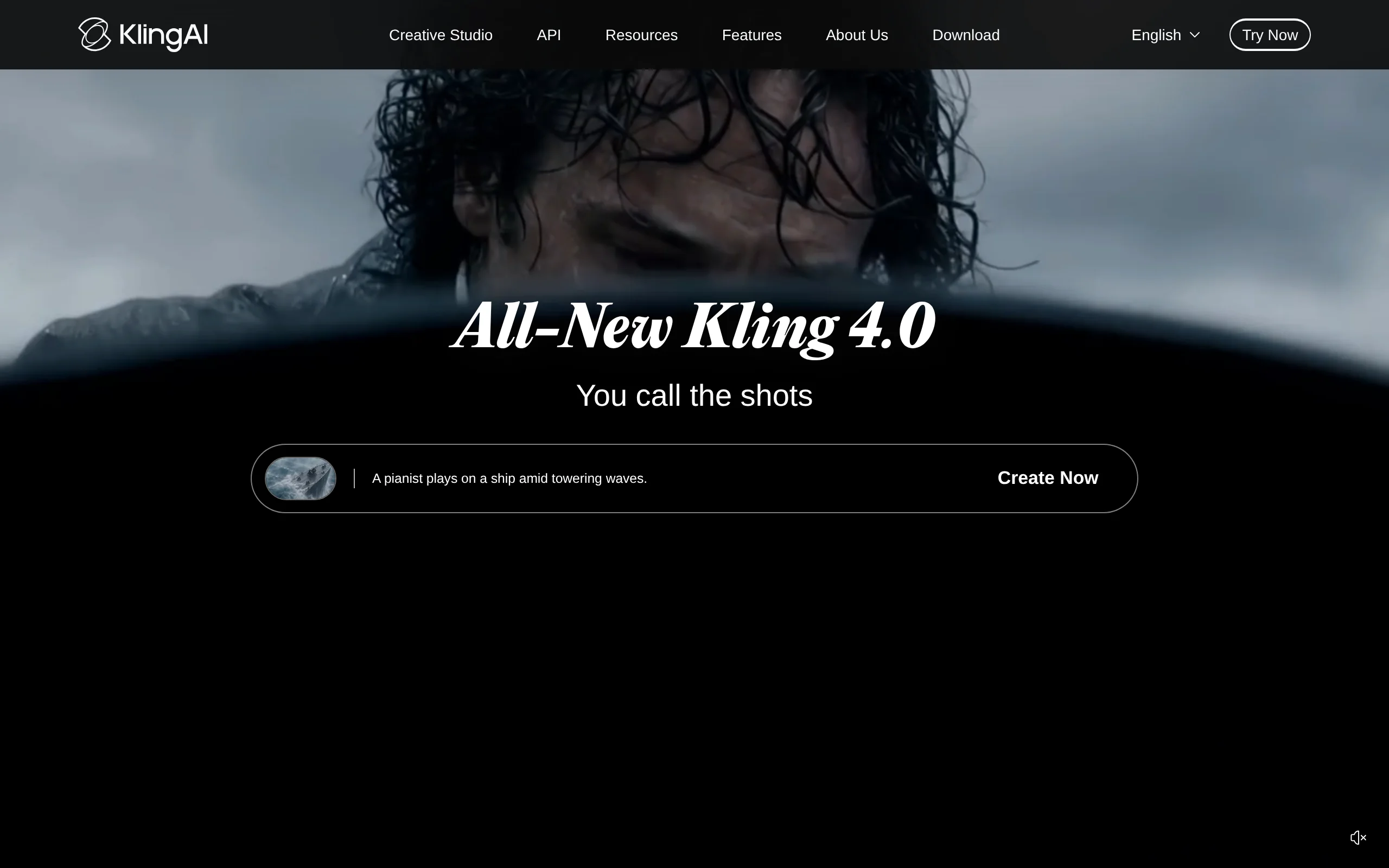
Kling 4.0 is the latest generation video generation model introduced by Kuaishou's Keling AI. The lightweight version, Kling 4.0 Flash, is now open for early access, with the full version expected to ...
In-Depth Review of M3.1-Flash-Preview: MiniMax's Text Programming Model for Everyday Development Scenarios
M3.1-Flash-Preview is the latest text programming model launched by MiniMax, initially released on the MiniMax Code intelligent programming client. Designed for everyday development scenarios, this mo...
© All Rights Reserved. Some content on this site is partially generated by AI with human review.