
MAI-Transcribe-2-Streaming: In-Depth Evaluation of Microsoft's Real-Time Streaming Speech-to-Text Model
Executive Summary:
MAI-Transcribe-2-Streaming is Microsoft's first real-time streaming speech-to-text model, capable of continuously outputting text while speech is being delivered. It supports 60 languages and automati...
1. What is MAI-Transcribe-2-Streaming
MAI-Transcribe-2-Streaming is Microsoft's first real-time streaming speech-to-text model, capable of continuously outputting text while speech is being delivered. It supports 60 languages and automatically detects language switching. The model has topped the Artificial Analysis streaming transcription leaderboard with a word error rate of 2.50% and a final transcription latency of 0.13 seconds. Initial text latency is as low as hundreds of milliseconds, with text appearing as quickly as 320 milliseconds after speech. Its core value lies in transforming traditional speech transcription from a "batch paradigm" of "recognize after speaking" to a "streaming paradigm" of "understand while speaking," providing a new technical foundation for latency-sensitive scenarios such as real-time subtitles, customer service agents, and voice assistants.
Technical Positioning and Domain: Belongs to the intersection of speech recognition (ASR) and real-time streaming processing, focusing on applying streaming speech transcription technology to real-time interactive scenarios. The model has established a new performance benchmark in the streaming ASR niche, with its two-stage output mechanism of "partial hypotheses and stable submissions" offering a reference architecture for the industry.
Development Background: Developed by Microsoft's MAI (Microsoft AI) team, it was launched during the Microsoft Build 2026 conference on the Microsoft Foundry (International Edition) platform. Microsoft has deep expertise in speech technology, having previously released non-streaming models such as MAI-Transcribe-1. This streaming version aims to complete the technical puzzle of real-time speech interaction and strengthen its product portfolio in the AI Agent and real-time communication domains.
Core Value: It solves the inherent latency issue of traditional batch speech transcription, which requires waiting for a full utterance before producing results, reducing transcription latency from seconds to the hundreds of milliseconds. At the same time, the single model covers 60 languages and supports automatic language detection and switching, eliminating the complexity and interruptions associated with multi-model routing. For speech Agent workflows, the immediate output of partial results enables the "listen-think-act" process to shift from a serial to a parallel structure, significantly shortening end-to-end response time.
Technical Features: Uses an incremental streaming processing architecture, processing audio in small chunks as they are received; balances speed and accuracy through a two-stage output mechanism of partial hypotheses and stable submissions; unified multilingual modeling allows language detection and transcription to be completed within a single model, eliminating the need for external language recognition modules.
2. Key Features
Real-time Streaming Transcription: The model processes audio streams in small chunks as they are received, continuously outputting text during speech without waiting for the entire utterance to finish. This feature fundamentally eliminates the waiting time inherent in batch transcription, which requires the speaker to finish before outputting results, making real-time subtitles and voice interaction possible.
Support for 60 Languages: A single model incorporates speech recognition capabilities for 60 languages, covering the majority of global languages. Compared to a multi-model routing approach, this unified modeling avoids the overhead and latency caused by model switching, while also reducing system complexity and resource consumption.
Automatic Language Detection and Switching: There's no need to predefine the language before a session; the model identifies the language based on the audio content itself and can seamlessly follow when a speaker switches languages. This capability is especially useful in multilingual meetings and cross-border customer service scenarios, eliminating the burden of manually configuring languages.
Ultra-low Latency Output: The first text output is generated within hundreds of milliseconds after receiving the audio, with the earliest text appearing as soon as 320 milliseconds after the speech. The final transcription latency is only 0.13 seconds, outperforming the closest competitors that require over 500 milliseconds. This performance metric ranks first on the Artificial Analysis streaming transcription leaderboard.
High-precision Transcription: The model leads the Artificial Analysis streaming transcription leaderboard (with 28 models in total) with a word error rate of 2.50%, achieving the top rank in both partial and final transcription accuracy. Leading in both precision and speed, it allows real-time applications to avoid compromising between quality and latency.
Agent-oriented "Listen and Understand" Design: Applications can infer user intent based on partial transcriptions even before the utterance is complete, allowing for early initiation of reasoning or tool calling. This design transforms the sequential process of transcription, understanding, and execution into a parallel workflow, significantly reducing the end-to-end response time of voice agents and minimizing waiting pauses in conversations.
3. How to Use
The integration process for MAI-Transcribe-2-Streaming is clear and straightforward. Developers can choose different deployment paths based on their specific application scenarios. Here are the standard integration steps:
Register for an Azure account and create a project: Visit the official Microsoft Azure website to register an account, and create a new project on the Microsoft Foundry platform to obtain an API key and endpoint (Endpoint). This is a prerequisite for calling the model, and you must ensure that your account has access permissions for the relevant services.
Choose an integration method: The model offers multiple integration paths: it can be directly called via the Azure Speech SDK or REST API streaming interface; or it can be accessed through third-party platforms such as OpenRouter, Vercel, and LiveKit. For teams already using Azure infrastructure, it is recommended to use the Azure Speech SDK; for rapid prototyping and validation, platforms like OpenRouter can be selected.
Establish a streaming audio channel: Continuously send audio chunks from a microphone or real-time audio stream to the model, rather than uploading a complete audio file. The size of the audio chunks and the sending frequency will affect latency and accuracy. It is recommended to adjust these based on network conditions and application scenarios, with typical audio data chunks ranging from 100 to 500 milliseconds.
Receive and process partial results: Listen for the partial text returned by the model, which arrives within hundreds of milliseconds after receiving the audio. Partials can be used for real-time subtitle display, UI updates, or early triggering of intent understanding logic. Note that partials may be revised later based on subsequent context and should not be used directly for final storage.
Submit stable transcription results: Obtain the final transcribed text from the model when a sentence ends. The final results have been corrected with subsequent context and are more accurate, suitable for use in scenarios requiring high-precision text such as storage, recording, or generating meeting minutes.
Handle multilingual scenarios: No pre-set language is required; the model automatically detects the speaker's language and continuously follows it when switching. In multilingual meetings or customer service scenarios, the system automatically adapts to changes in the speaker's language without requiring manual intervention or restarting the session.
4. Pros and Cons Analysis
| Pros |
|---|
| Streaming Architecture Advantage: The incremental processing architecture reduces transcription latency from seconds to the hundreds of milliseconds, achieving a final transcription latency of just 0.13 seconds, offering a significant edge in real-time interactive scenarios. |
| Balanced Accuracy and Speed: Achieves a 2.50% word error rate, ranking first in the streaming category on Artificial Analysis, and leads in both streaming and final transcription accuracy in some cases, eliminating the need to compromise between quality and latency. |
| Unified Multilingual Modeling: Supports 60 languages with a single model, automatically detecting and switching between them, eliminating the overhead of multi-model routing and language-switching interruptions. |
| Flexible Ecosystem Integration: Supports direct API integration with Microsoft Foundry and Azure Speech, as well as third-party platforms such as OpenRouter, Vercel, and LiveKit, offering diverse deployment options. |
5. Comparative Analysis with Similar Tools
| Comparison Dimension | MAI-Transcribe-2-Streaming | Qwen-Audio-3.0-ASR-Flash |
|---|---|---|
| Model Paradigm | Streaming (real-time transcription, partials → stable results) | Non-real-time (single audio file recognition, ≤5 minutes) |
| Transcription Accuracy | 2.50% word error rate (1st in streaming category on Artificial Analysis, third-party tested) | 7.8% error rate for Chinese industrial scenarios, 11.52% for English (vendor self-reported metrics) |
| Latency Performance | Final transcription in 0.13 seconds; text appears as fast as 320 milliseconds after speech | Non-streaming paradigm, no real-time latency metrics |
| Language Coverage | 60 languages, automatic detection and switching | 30+ languages, including seven major Chinese dialects and 20+ accents |
| Vertical Customization | Not provided | Hotword customization (real-time + precompiled), industry vocabulary, context enhancement, speech polishing |
| Pricing | $0.54/hour (discounted rate, valid until end of 2026) | Approximately $0.126/hour ($0.000035/second, long-term pricing) |
| Ecosystem Integration | Foundry / Azure Speech / OpenRouter / Vercel / LiveKit | Alibaba Cloud BaiLian / DashScope |
Selection Recommendations: For scenarios requiring extreme sensitivity to latency, such as real-time subtitles, voice agents, or customer service AI, MAI-Transcribe-2-Streaming's streaming architecture and 0.13-second latency offer clear advantages, making it the preferred solution in the streaming transcription market. If the primary use case involves Chinese and cost sensitivity is a priority, Qwen-Audio-3.0-ASR-Flash's support for dialects and accents, along with its lower pricing, is more appealing. For teams with the capability to build their own models and high data privacy requirements, considering fine-tuning and deploying the open-source Whisper series may be an option, though they will need to address the challenge of streaming adaptation themselves.
6. Editor's Summary
The emergence of MAI-Transcribe-2-Streaming marks a new stage in the development of real-time speech transcription technology. From a technological innovation perspective, this model combines an incremental streaming processing architecture with a two-stage output mechanism (partials → commit), achieving millisecond-level latency while maintaining transcription accuracy. This architectural design provides a reusable paradigm for the industry. With a word error rate of 2.50% and a latency of 0.13 seconds, it ranks at the top of the Artificial Analysis streaming leaderboard, and the data has been verified by third-party testing, ensuring a high level of credibility.
In terms of practical value, this model directly addresses the core pain points of speech agents and real-time interaction scenarios—end-to-end response time. By enabling immediate output of partials, applications can begin understanding and reasoning before the user finishes speaking, transforming the "listen-think-act" process from a serial to a parallel workflow. This capability represents a qualitative leap in user experience for applications such as customer service agents and voice assistants. The ability to uniformly model and automatically switch between 60 languages also gives it a natural deployment advantage in multilingual environments.
It is important to note, however, that the model has limitations in vertical customization capabilities, offering no support for hotword customization or industry-specific vocabulary libraries. In scenarios with dense technical terminology, additional post-processing may be required. In terms of pricing, the original price after the promotional period has not yet been disclosed, leaving long-term costs uncertain. Furthermore, its reliance on the Azure ecosystem may limit adoption by users outside of Azure.
Overall, MAI-Transcribe-2-Streaming is well-suited for teams with high real-time requirements, needing multilingual support, and already using or planning to adopt Azure cloud services. For scenarios such as real-time subtitles, speech agents, and multilingual meetings, this model is currently the benchmark solution in the streaming transcription space. In the future, if Microsoft can enhance vertical customization capabilities and release more competitive long-term pricing, its influence in the speech transcription market will further expand.
7. Application Scenarios
Real-time Subtitles and Accessibility Services: Achieve real-time text output in live streams, video conferences, and online classrooms, with a display speed of 320 milliseconds, approaching "what is said is what is seen." Hearing-impaired individuals can access dialogue content in real-time, significantly enhancing their sense of participation; content creators can directly obtain high-quality subtitle text, eliminating the need for post-production manual proofreading.
Intelligent Agent in Call Centers: The system begins identifying issues and retrieving knowledge base content to prepare responses even before the caller finishes their sentence, based on partial speech. This capability reduces average handling time, improves concurrent service capacity during peak hours, and minimizes customer frustration from waiting. The automatic multilingual detection feature also supports international call center scenarios, eliminating the need for separate model configurations for each language.
Voice Assistants and AI Agents: High-accuracy partial results enable the assistant to initiate reasoning and tool calling before the user finishes speaking, transforming the "listen-think-act" process from a serial to a parallel workflow. Before the user completes their request, the assistant has already begun understanding the intent and preparing a response, eliminating awkward pauses and making the interaction experience more natural, akin to human-to-human conversation.
Real-time Multilingual Meeting Translation: With automatic detection and switching among 60 languages, this model allows speakers to switch languages during international meetings without manual reconfiguration. The model can serve as the recognition frontend for simultaneous interpretation systems, feeding streaming transcription results into a machine translation module to achieve a complete end-to-end pipeline for real-time multilingual translation.
Real-time Documentation in Healthcare and Legal Settings: Enable real-time transcription during outpatient consultations, court proceedings, and other scenarios, allowing doctors or lawyers to obtain a complete transcription immediately after the conversation ends. Streaming output enables transcriptionists to review and annotate in real-time, significantly reducing documentation time and allowing professionals to focus on core tasks.
8. FAQ
Q: What is the core difference between MAI-Transcribe-2-Streaming and a regular speech-to-text model?
A: The core difference lies in the processing paradigm. Regular models use batch processing, which requires waiting until the user finishes speaking a full sentence or paragraph before outputting results; in contrast, MAI-Transcribe-2-Streaming employs an incremental streaming approach, generating text as it receives audio in small chunks. This enables the first text output to arrive within hundreds of milliseconds, with a final transcription latency of just 0.13 seconds, providing the technical foundation for real-time interactive scenarios.
Q: What is the difference between partials (partial results) and commit (final results)? How should they be used?
A: Partials are the preliminary text results generated by the model after receiving partial audio input, arriving within hundreds of milliseconds. They are suitable for real-time subtitle display, driving UI updates, or triggering intent recognition in advance. Commit refers to the stable final transcription submitted by the model after a sentence is complete, having been corrected based on subsequent context. It offers higher accuracy and is ideal for storage, logging, and generating formal documents. Developers should choose the appropriate output type based on their specific use case.
Q: Which languages does the model support? Is language preset required?
A: The model supports 60 languages, covering the world's major languages. No language preset is needed before a session; the model automatically detects the language based on the audio content and continuously adapts when the speaker switches languages. This capability is particularly useful in multilingual meetings and cross-border customer service scenarios.
Q: How can the model be used on non-Azure platforms?
A: In addition to being called via Azure Speech SDK and REST API, the model can be directly accessed on third-party platforms such as OpenRouter, Vercel, and LiveKit. These platforms offer unified API interfaces, allowing developers to quickly integrate the model without setting up Azure infrastructure. This is well-suited for prototyping and small-to-medium scale applications.
Q: What is the model's pricing? Is there a free tier available?
A: The current discounted rate is $0.54 per hour, with the discount valid until the end of 2026. The original price has not yet been announced. For specific details on the free tier and discount, please refer to the official Azure pricing page. Compared to some competitors' pricing of approximately $0.126 per hour, this model's long-term cost is relatively higher. It is recommended that users evaluate costs based on actual usage.
9. Project Links
- Microsoft Foundry Platform: https://foundry.microsoft.com/ (Official model service and API management platform)
- Azure Speech Service Documentation: https://learn.microsoft.com/azure/ai-services/speech-service/ (Official API reference and integration guide)
- Microsoft AI GitHub Organization: https://github.com/microsoft/ (Official Microsoft GitHub organization, containing code and examples related to the MAI series of models)
Related AI Model Articles
Vidu Q4 Preview: A Masterful Demonstration of Expressive Performance and Multi-Subject Consistency in ShengShu Technology's Flagship Video Generation Model
Vidu Q4 Preview is the first publicly available preview version of ShengShu Technology's next-generation flagship video generation model, launched on October 7, 2026. It emphasizes "expressive perform...
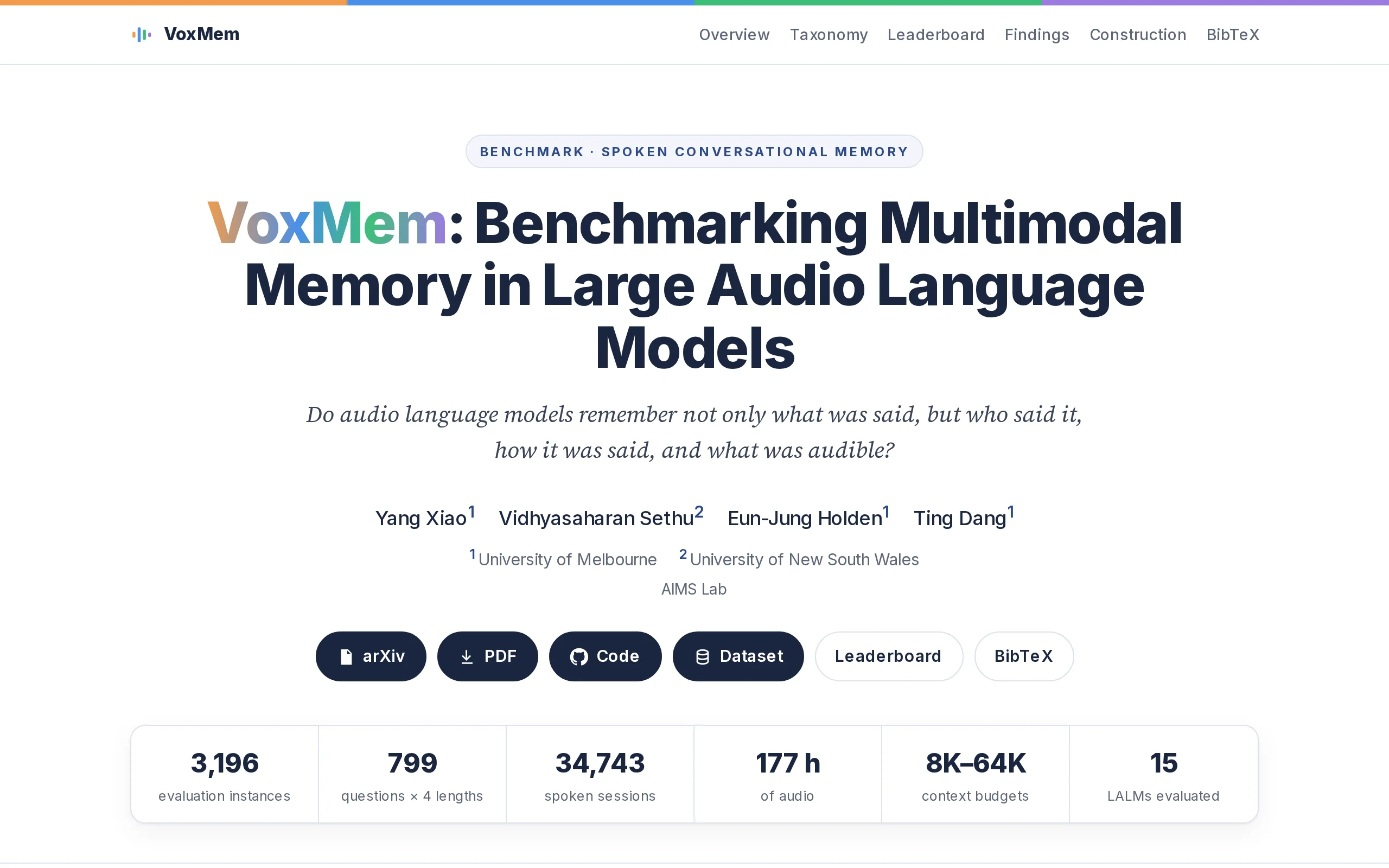
VoxMem – An Open-Source Audio Large Model Memory Benchmark from the University of Melbourne and Others
VoxMem is an audio large model memory benchmark introduced jointly by the research team from the University of Melbourne and the University of New South Wales. This benchmark pioneers a two-dimensiona...
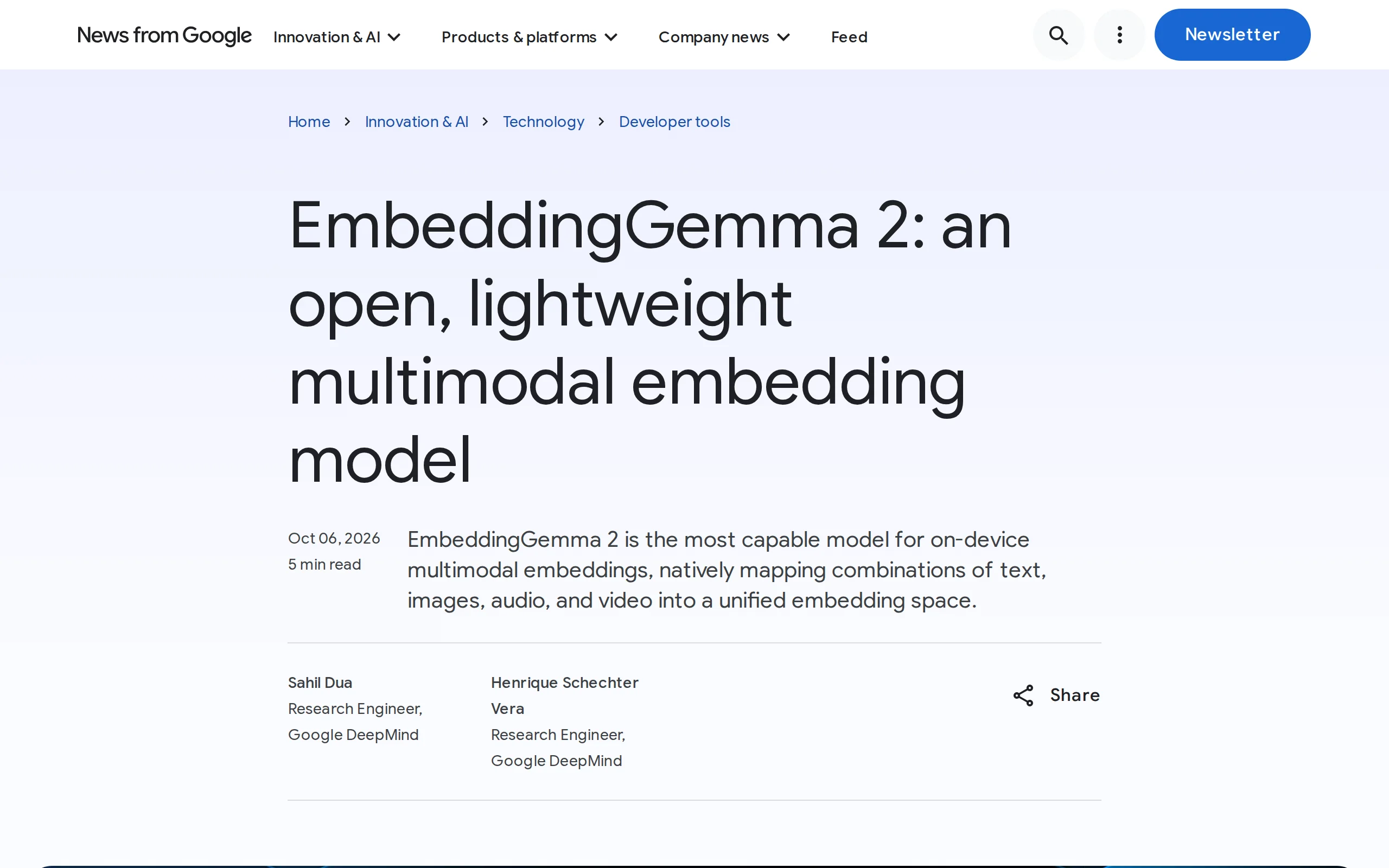
EmbeddingGemma 2 – Review of Google's Open-Source Native Multimodal Embedding Model
EmbeddingGemma 2 is an open-source native multimodal Embedding model developed by Google, built upon the Gemma 4 architecture. It unifies five modalities—text, code, images, video, and audio—into a si...
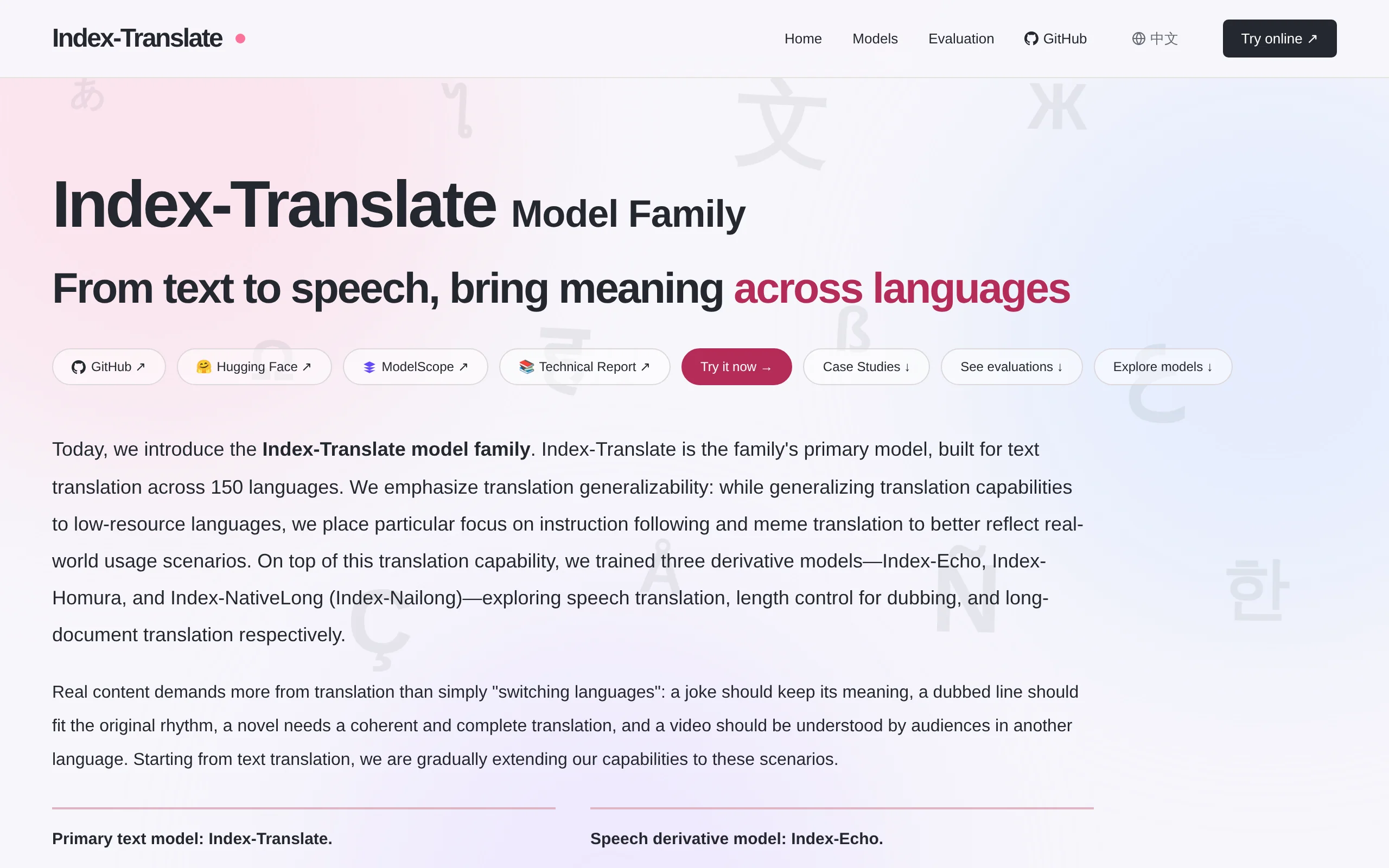
Index-Translate – Bilibili's Open-Source Multilingual Translation Model Family
Index-Translate is an open-source multilingual translation model family developed by Bilibili's Index LLM team. It is built upon the Qwen3.5 foundation and opens its weights under the Apache-2.0 licen...
© All Rights Reserved. Some content on this site is partially generated by AI with human review.