
FashionMind – Google's Open-Source Multimodal Real-Time AI Voice-Fashion Assistant
Executive Summary:
FashionMind is a multmodal real-time voice fashion assistant open-sourced by Google, built on the Google ADK agent framework and the Gemini Live 2.5 Flash model. This project centers on camera-based v...
1. What is FashionMind
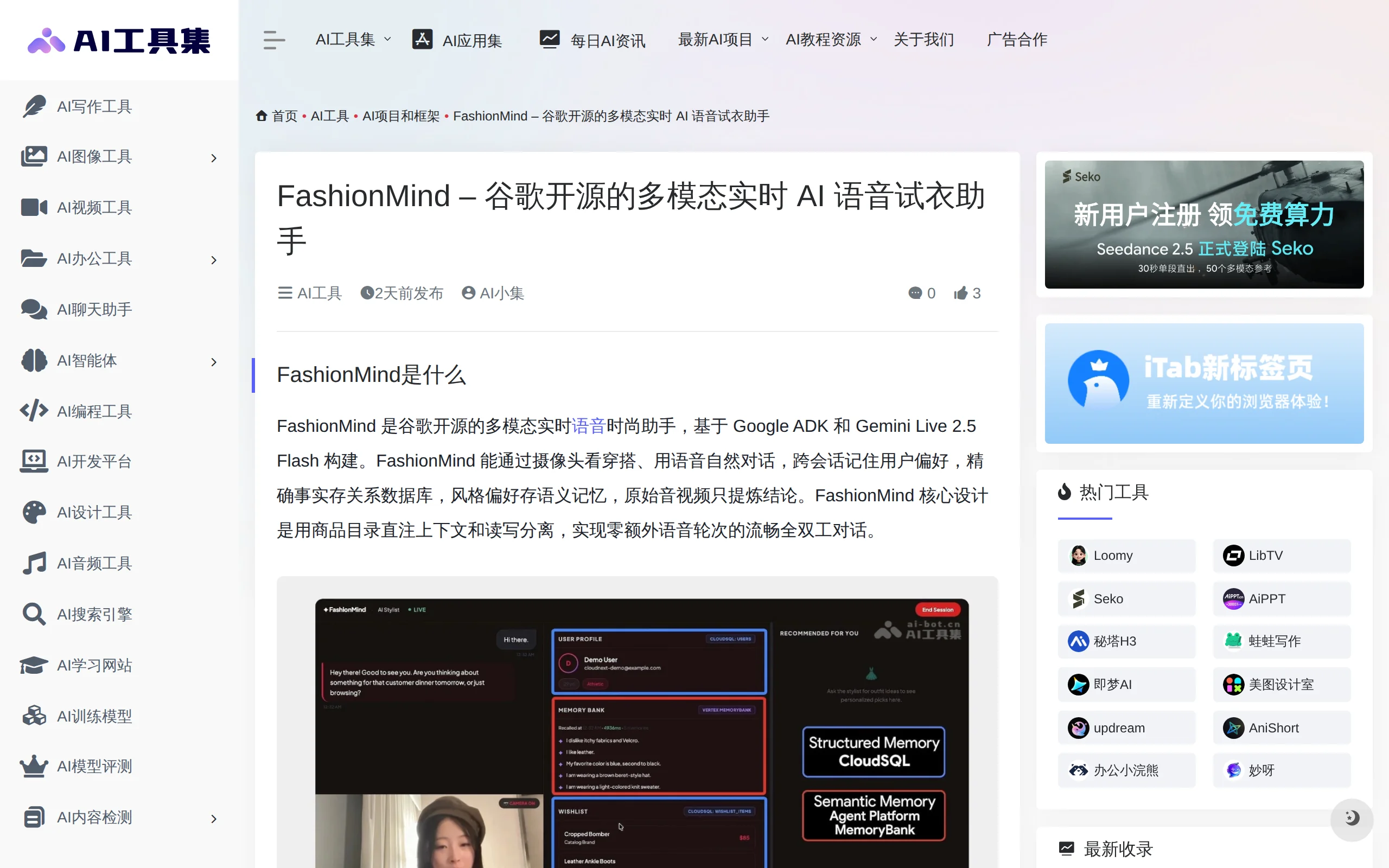
FashionMind is a multmodal real-time voice fashion assistant open-sourced by Google, built on the Google ADK agent framework and the Gemini Live 2.5 Flash model. This project centers on camera-based visual understanding and full-duplex voice dialogue as its core interaction methods, allowing users to engage in real-time conversations with the system using natural language to exchange styling advice, product recommendations, and fashion news. The core design philosophy of FashionMind lies in achieving a seamless conversational experience with zero additional voice rounds by pre-injecting product catalogs into the context and employing a read-write separation architecture strategy. It also remembers user preferences across sessions, storing precise facts in a relational database, extracting style preferences into semantic memory, and retaining only conclusive information from the original audio and video.
Technical positioning and domain: Belongs to the field of multimodal artificial intelligence applications, integrating computer vision, natural language processing, and voice interaction technologies. It focuses on the development of intelligent assistants for the fashion vertical scenario, providing a reusable engineering reference architecture.
Development background: Developed by the Google Research team, built upon the Google ADK (Agent Development Kit) and the Gemini Live 2.5 Flash model, and leveraging Google Cloud Platform (GCP) infrastructure to achieve a complete cloud deployment solution. It demonstrates the best practices of applying Gemini's multimodal capabilities in vertical domains.
Core value: Addresses the issues of high latency, fragmented context, and time-consuming tool calls that traditional voice assistants face in real-time interactions. Through architectural innovation, the product catalog is directly injected into the model's context, eliminating the 6-16 second cold start caused by tool retrieval, and significantly improving conversational fluency and user experience.
Technical features: Utilizes a FastAPI WebSocket dual-task concurrent architecture to enable real-time transmission of 16kHz audio, images, and text in a multimodal format. The system incorporates a three-tier memory separation mechanism—precise facts are stored in a relational database, style preferences are asynchronously refined into semantic memory, and only the conclusions from the original audio and video are retained—balancing query accuracy with the flexibility of preference understanding.
2. Key Features
Real-time Two-way Voice Conversation: Based on Gemini Live's native audio capabilities, this feature enables uninterrupted continuous dialogue between the user and the assistant in a full-duplex manner. Unlike traditional turn-based interaction models, the system does not need to wait for the user to finish speaking before responding. It can process and reply synchronously during the voice stream, significantly reducing interaction latency and enhancing the naturalness of the conversation.
Visual Outfit Commentary: By analyzing 1fps camera footage in real-time, the system can "see" the user's current outfit and naturally provide style commentary and suggestions within the same voice turn. This feature deeply integrates visual understanding with voice generation, enabling real-time cross-modal collaborative inference, and can accurately identify clothing styles, color coordination, and overall aesthetics.
Cross-Session Memory: The system can remember the user's schedule, wish list, purchase history, and style preferences. During the next conversation, the user does not need to restate background information. Precise facts (such as purchase history) are stored in a relational database for accurate retrieval, while style preferences (such as "prefers minimalist style") are asynchronously refined and integrated into semantic memory, ensuring both accuracy and flexibility.
Zero-latency Product Recommendation: The product catalog (approximately 300 tokens) is preloaded into the model context at the start of the session. When the Agent mentions a specific product, the frontend interface immediately highlights the corresponding card. This design eliminates the traditional three-step roundtrip required for tool calling (offer → confirm → result, approximately 6–16 seconds), achieving second-level synchronization between voice announcements and product displays.
Instant Interruption (Barge-in): As soon as the user begins speaking, the current voice playback is immediately stopped. The system performs local judgment via RMS threshold detection on the browser side, without waiting for a VAD signal to be returned from the server. This mechanism ensures that the user always retains control of the conversation, aligning with the expected flow of natural dialogue.
Three-tier Memory Separation Architecture: Precise facts are written into a relational database through SQL transactions. Dynamic preferences are asynchronously refined and integrated into semantic memory by backend coroutines. Original audio and video data only retain conclusive information during the session. Write operations do not block the voice stream, ensuring full-duplex conversations remain consistently smooth and uninterrupted, avoiding the accuracy risks associated with vector databases guessing precise answers based on similarity.
3. Application Scenarios
Online Fashion Shopping Assistant: Customers describe their needs using voice (e.g., "Find me a dark suit suitable for an interview"), and the Agent instantly recommends appropriate products by combining the pre-injected product catalog with the user's purchase history, while simultaneously highlighting the product cards on the frontend interface. Voice announcements and visual displays are synchronized, significantly improving the efficiency of information transmission compared to traditional text-based searches.
Personal Styling Consultant: Users open their camera to show their outfit for the day, and the Agent provides real-time feedback on style, color coordination, and appropriateness for the occasion, along with improvement suggestions. Based on cross-session memory capabilities, the system can remember the user's style preferences and past recommendations, offering more coherent and personalized guidance in subsequent conversations.
Outfit Planning for Events: By integrating with the relational database of schedules (e.g., dinners, client meetings, weddings), the Agent proactively recommends suitable outfit options for the occasion and adds relevant products to the user's wish list. Users simply need to describe the upcoming event in natural language, and the system will automatically provide comprehensive planning suggestions throughout the process.
Smart Wardrobe Management: Users can verbally query at any time, such as "What coats have I bought?" or "What's on my wish list?", and the Agent accurately retrieves structured records and manages purchase status. The relational database ensures the accuracy of factual queries, avoiding the ambiguity that can arise from semantic memory-based matching.
Accessibility Shopping Assistance: Visually impaired or mobility-challenged users can complete the entire process of browsing products, inquiring about details, and adding items to the shopping cart using voice alone, without needing screen interaction. Full-duplex voice communication and local interruption mechanisms ensure a smooth and efficient communication experience for these users.
4. How to Use
Environment Preparation: You need a GCP project with billing enabled, ensure that the gcloud CLI is logged in and authenticated, and install Python 3.11+ and Node.js 18+ runtime environments on macOS/Linux systems.
One-Click Cloud Infrastructure Setup: Run the command
./setup_gcp.sh YOUR_PROJECT_ID us-central1. The script will automatically create a Cloud SQL PostgreSQL database instance and a Vertex AI Agent Engine, and generate the backend/.env configuration file.Start the Backend Service: Navigate to the backend directory, create a Python virtual environment, and install dependencies. Execute
alembic upgrade head(apply database migrations), thenpython seed_products.py(import product catalog seed data), and finally runuvicorn main:app --reload --port 8080to start the backend service.Configure Environment Variables: Copy backend/.env.example to backend/.env and fill in the database connection string, GCP project ID, region, and Agent Engine ID. Set
USE_MEMORY_BANK=trueto enable cross-conversation semantic memory functionality.Launch the Frontend Application: Navigate to the frontend directory, run
npm installto install frontend dependencies, and then executenpm run devto start the development server. Access the application in your browser athttp://localhost:5173.Begin the Conversation Experience: After authorizing camera and microphone permissions on the webpage, you can directly interact with the fashion assistant using voice. When showcasing outfits, the camera feed will be transmitted in real-time at 1fps for the Agent to perform visual analysis.
5. Pros and Cons Analysis
| Pros |
|---|
| Zero Additional Voice Rounds: Product catalog context is pre-injected, eliminating the 6-16 second dead air caused by tool calling. Audio announcements and product highlighting are synchronized, significantly improving interaction smoothness. |
| Three-Layer Memory Separation: Precise facts are stored using relational databases with SQL transactions to ensure accuracy, while dynamic preferences are asynchronously refined through semantic memory, balancing precise queries with flexible understanding and avoiding potential issues with single vector database solutions. |
| Read-Write Separation Architecture: Clear instructions are synchronously written on-site, while preference summaries are silently processed by backend coroutines. Asynchronous processing ensures uninterrupted full-duplex conversations, with no interruption to the voice stream due to database operations. |
| Local Interruption Mechanism: RMS threshold detection on the browser side enables immediate interruption of audio playback, without waiting for the server's VAD signal to return, ensuring users always maintain control over the conversation rhythm and achieving a more natural human-machine interaction experience. |
| Open-Source Reusable Architecture: As a complete vertical application engineering template, it provides a full-stack reference from cloud infrastructure setup to frontend and backend implementation. Developers can quickly build voice Agent applications in other domains based on this model. |
6. Comparative Analysis with Similar Tools
| Dimension | FashionMind | Pinterest Assistant |
|---|---|---|
| Product Positioning | Open-source reference architecture for developers, a reusable engineering template for vertical voice applications | Finished features for consumers, embedded within the Pinterest platform, currently in beta |
| Voice Interaction Mode | Full-duplex continuous conversation: 16kHz continuous audio stream, no wake-up word, can be interrupted at any time (barge-in) | Button-activated voice: press the microphone to speak (similar to sending a voice message), non-continuous streaming, audio playback cannot be turned off |
| Visual Capabilities | 1fps real-time camera continuously observes outfit, provides style and color commentary within the same voice turn | Multimodal "vision-first" model, can generate outfit recommendations based on posters or screen images, not real-time video stream |
| Memory Architecture | Three-tier separation: precise facts stored in relational databases, style preferences asynchronously refined into semantic memory, original audio/video only stores conclusions | Relies on Pinterest user behavior signals (saved Pins, browsing history) for personalization, no publicly disclosed tiered memory mechanism |
| Product Integration | Self-built product catalog fully injected into context, highlights corresponding cards in real-time when products are mentioned | Recommends its own platform Pins, briefly describes the outfit via voice and displays visual results |
| Latency Engineering | Deeply optimized: asynchronous injection of catalog/memory, signal tools eliminate round trips, local interruption, local session state | No official disclosure of latency optimization details, audio playback is intentionally kept short to compress response time |
| Open Source License | Fully open-sourced under the Apache 2.0 license, code hosted on GitHub for community use and secondary development | Closed-source commercial feature, users cannot access underlying implementation code or architecture documents |
| Deployment Method | Cloud deployment: relies on GCP (Cloud SQL, Vertex AI Agent Engine), provides one-click configuration scripts | Platform-managed, users do not need to deploy infrastructure themselves |
Selection Recommendations: For technical teams and research institutions with cloud development capabilities, FashionMind's open-source reference architecture offers significant value—its design concepts, such as dual-task concurrency, catalog injection, and signal tools, can be directly applied to the development of voice agents in other vertical domains like finance, education, and healthcare, significantly shortening the prototype validation cycle. For ordinary consumers seeking plug-and-play experiences, finished features like Pinterest Assistant eliminate deployment and maintenance costs, making them particularly suitable for users who have accumulated substantial collections and browsing behaviors on the Pinterest platform. Traditional e-commerce voice assistants, on the other hand, have advantages in maturity and stability, making them ideal for commercial platforms with strict control requirements over the recommendation pipeline.
7. Editor's Summary
FashionMind's technical innovations are noteworthy, with its core contribution lying not in breakthroughs of individual models, but in meticulous system engineering architecture considerations. The project abandons the common tool calling pattern found in general voice agents, instead directly pre-injecting the product catalog into the model's context, while downgrading recommendation actions to pure signal events—these two decisions collectively eliminate the largest source of latency in voice interactions (tool round-trip time consuming 6–16 seconds), significantly improving response speed to near human-conversation levels. The three-tier memory separation architecture demonstrates refined governance of information types: the relational database ensures the determinism of factual queries, semantic memory supports the flexibility of preference understanding, and raw data is promptly dimensionality-reduced while preserving conclusions. This approach offers a practical alternative to the inherent limitations of vector databases, which typically "guess accuracy based on similarity." Read-write separation and background asynchronous processing further ensure that full-duplex voice streams are not blocked by database operations.
In terms of practical value, the project uses fashion shopping as an entry point, while also providing complete GCP cloud infrastructure setup scripts and front-end and back-end implementations, forming an auditable, reproducible end-to-end engineering template. The interaction paradigm combining camera vision, voice dialogue, and synchronized product highlighting has clear productization potential and is not limited to the fashion domain; the methodology has a controlled migration threshold.
The target audience mainly includes: application developers working with the Google Cloud Platform (GCP) technology stack, engineers and researchers focused on multimodal Agent architecture, and technical product teams aiming to quickly build vertical scenario voice assistants. The project's reliance on open-source ecosystems and the rapid iteration of cutting-edge models provides the interaction architecture with potential for horizontal scaling. Continued attention is warranted for its future applications across more vertical industries.
8. FAQ
Q: Does FashionMind require a paid Gemini API key to operate?
A: Yes, FashionMind relies on the Google ADK and the Gemini Live 2.5 Flash model to provide voice understanding and generation capabilities. It requires calling the Gemini API during operation, so users must have a GCP project with billing enabled. The open-source code itself is free, but the use of the base model service will incur costs based on Google Cloud pricing.
Q: How does the method of directly injecting product catalogs into the context handle large product libraries?
A: Currently, the project injects the entire product catalog (approximately 300 tokens) into the model context at the start of a session. This design is optimized for small or medium-sized product libraries. For ultra-large product libraries, a hierarchical directory strategy can be considered—first injecting product categories and popular items, then supplementing with specific subdirectories based on user voice intent, or combining it with vector retrieval pre-filtering techniques for scalability.
Q: What model does FashionMind's camera visual analysis use, and can it run offline?
A: The visual analysis capability is provided by the multimodal features of the Gemini Live 2.5 Flash model, which is a cloud-based inference service and does not support full offline operation. The camera feed is transmitted to the backend at 1fps via WebSocket and processed by the Gemini model for visual understanding. Therefore, the system has some dependency on the quality of the network connection.
Q: How does the system ensure the accuracy of cross-session memory, and could the vector database produce incorrect answers?
A: The project uses a three-tier memory separation architecture to avoid issues with memory accuracy: precise facts (such as purchase records and list details) are written into a relational database using SQL transactions, ensuring deterministic retrieval during queries. Semantic memory, used for style preferences and abstract tendencies, is asynchronously refined. The clear division of responsibilities between the two prevents scenarios where similarity matching is used to answer precise factual questions.
Q: What is the technical principle behind the immediate interruption (Barge-in) mechanism, and is the probability of false triggering high?
A: The system uses RMS threshold detection on the browser side to determine voice activity—when the amplitude of the audio input exceeds a preset threshold, the frontend immediately stops the current voice playback without waiting for the server's VAD signal to return. This mechanism enables extremely low-latency interruption responses. The specific threshold parameters can be adjusted in the frontend code to accommodate different levels of ambient noise.
9. Project Links
- GitHub Repository: https://github.com/cuppibla/fashionmind
Related
Bookworm-S2.1 Flash: In-Depth Review of the Scientific Multimodal Large Model Open-Sourced by the Shanghai AI Lab
Bookworm-S2.1 Flash is a scientific multimodal large model open-sourced by the Shanghai AI Lab, built upon the Bookworm-Yuanzheng unified representation architecture. It is capable of understanding ov...
Nex-N2.6 – A Multimodal Agent Model Open-Sourced by Nex-AGI, Shanghai Chuangzhi Academy
Nex-N2.6 is a multimodal agent model open-sourced by Nex-AGI, Shanghai Chuangzhi Academy. It is post-trained based on Zhipu AI's GLM-5.3-Flash and has a total parameter count of approximately 321B, su...
nanoMuse – An Open-Source Personal Agent from Zhejiang University, the Open-Source Version of Muse
nanoMuse is an open-source personal agent project developed by the Zhejiang University team. Its core concept is to allow users to run a complete AI Agent on their own devices, achieving a cross-devic...
MapFlow – An Open-Source Cross-Model LLM Inference Acceleration System from Peking University
MapFlow is a cross-model LLM inference acceleration system developed by the PKU-DAIR team at Peking University, aimed at addressing the pain points of repeated prefill computation when sharing long co...
© All Rights Reserved. Some content on this site is partially generated by AI with human review.