
Duo v1 – Full-duplex Audio-Visual Interaction Model Open-sourced by Ant Group and West Lake Heart
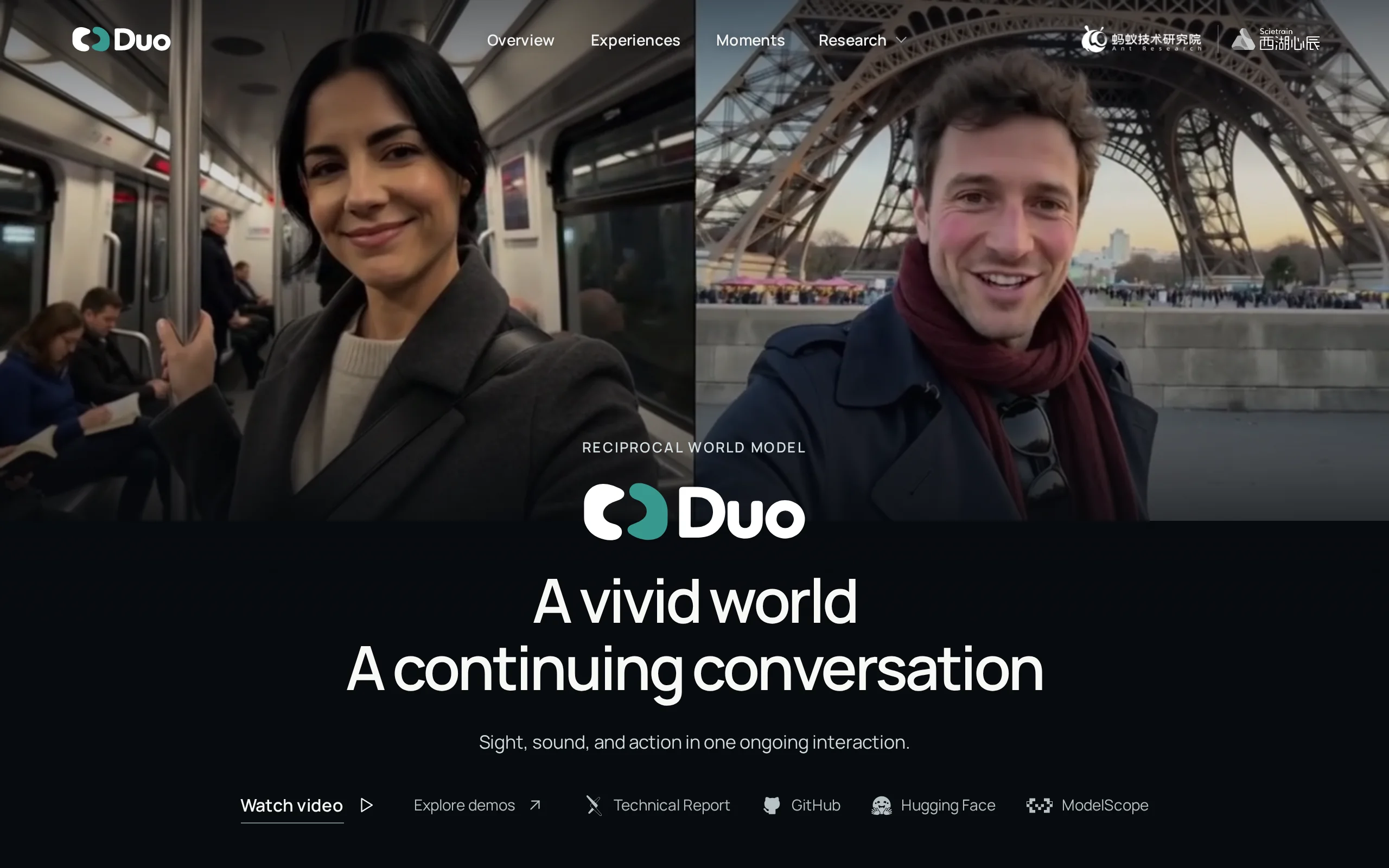
Executive Summary:
Duo v1 is a full-duplex audio-visual interaction model open-sourced jointly by Ant Group's Technology Research Institute and West Lake Heart. It is also the first complete implementation of a Reciproc...
1. What is Duo v1
Duo v1 is a full-duplex audio-visual interaction model open-sourced jointly by Ant Group's Technology Research Institute and West Lake Heart. It is also the first complete implementation of a Reciprocal World Model (bidirectional world model) in the industry. The model consists of two coupled modules: Intent and Realization. Intent functions as the "brain" of the virtual agent, autonomously deciding when to speak or listen and generating content approximately every 0.7 seconds. Realization, on the other hand, generates consistent audio-visual outputs based on its hidden state causality. Through a three-stage training process and Dual Rollout strategy, the model addresses the issue of distribution shift during inference, and is finally distilled into a 4-step real-time generator, achieving a paradigm shift in interaction from "passive response" to "active participation" at the open-source level.
Technical Positioning and Domain: Duo v1 belongs to the field of multimodal interaction generation, focusing on the construction of full-duplex audio-visual dialogue systems. Unlike traditional voice assistants driven by large language models, Duo v1 unifies the generation of audio and video within a causal framework, enabling the virtual agent not only to "understand" and "respond," but also to autonomously decide when to speak and when to listen during interaction, expressing itself through synchronized lip movements, expressions, and speech content. This model breaks away from the existing "cascaded" (ASR → LLM → TTS → virtual avatar driving) paradigm and shifts toward an end-to-end joint generation architecture.
Development Background: This model was jointly developed by Ant Group's Technology Research Institute and West Lake Heart. Ant Group's Technology Research Institute has deep expertise in large models and multimodal technologies, while West Lake Heart specializes in affective computing and virtual human interaction. The collaboration aims to address core pain points in current AI virtual humans during real-time conversations, such as "slow response," "stiff expressions," and "inability to naturally interrupt." The release of Duo v1 marks the first time the open-source community has access to an audio-visual interaction model with reciprocal world model capabilities. Its training strategy and causal architecture design provide significant reference value for future research.
Core Value: Duo v1 solves the fundamental issue of "lack of autonomy" in traditional interaction models, where the virtual agent is controlled externally. Within the Reciprocal World Model framework, the virtual agent is no longer a passive NPC waiting for instructions, but an active participant sharing the same interactive space and time with the world. The model can perceive user input, autonomously decide on the interaction rhythm, and generate visual outputs highly consistent with the audio content, offering broad application potential in scenarios such as AI companionship, online education, intelligent customer service, and remote collaboration. It provides a new technical foundation for building AI interaction experiences with "warmth" and naturalness.
2. Key Features
Full-duplex real-time interaction: The model supports a conversational mode where it can speak and listen simultaneously, autonomously deciding when to speak and when to listen while processing audio and video inputs. This capability breaks through the limitations of traditional "press to speak" or "turn-based" dialogue, making the interaction rhythm closer to natural human conversation. Users can intervene at any time without waiting for the model to finish speaking.
Autonomous decision-making in interaction: The Intent module autonomously outputs
<speak>or<wait>decisions based on the conversation context and interaction history, rather than passively executing external commands. This mechanism allows the virtual agent to determine when it should respond and when it should remain silent, thereby enhancing the sense of natural participation in multi-party conversations or complex interaction scenarios.Joint audio-visual generation: The Realization module unifies the generation of audio and video, ensuring a high degree of consistency between lip movements, expressions, and spoken content. Compared to the traditional "synthesize speech first, then drive lip movements" cascaded approach, joint generation avoids issues such as audio-visual asynchrony and rigid expressions, significantly improving the realism of the virtual agent.
Interrupt response: The model can process natural interruptions from users and adjust its response in real time, rather than playing back content in a pre-defined script order. When a user interjects or changes the topic during a conversation, Duo v1 will re-plan its output based on the latest interaction state, making the conversation flow more flexible and natural.
Consistency in identity and emotion: During extended interactions, the model maintains a stable visual appearance of the character and ensures consistency in audio-visual emotional expression. Regardless of how the conversation shifts, the visual characteristics and emotional expressions of the virtual agent remain coherent, avoiding "breaking character" or emotional disconnection.
Support for multiple roles and scenarios: The model supports various character types, including animals and virtual characters, and covers four core interaction scenarios: conversation, guidance, collaboration, and companionship. Developers can adjust input conditions to allow Duo v1 to adapt to different roles and interaction styles, meeting diverse application requirements.
Strict causal consistency guarantee: Through module-specific causal attention masks, the model ensures that no future inputs can be accessed at any moment, enforcing consistent causal dependencies along a unified timeline. This design ensures consistency between training and inference behavior, preventing performance degradation during inference caused by "peeking into the future."
Real-time generation capability: After three-stage training and distribution-matching distillation, the model is compressed into a 4-step generator, paired with a chunk rhythm of approximately 0.7 seconds, meeting the latency requirements for real-time interaction. With hardware equipped with dual GPUs, the model can run smoothly while maintaining low end-to-end latency.
3. Application Scenarios
AI Companionship and Emotional Interaction: Users can engage in daily conversations with virtual companions generated by the model, such as cats or anime girls. These virtual characters exhibit a wide range of expressions and emotional fluctuations, and can autonomously adjust their response styles based on the conversation content, offering companionship to individuals living alone or those in need of emotional support. This scenario requires high levels of emotional consistency and natural interaction, which the joint generation mechanism of Duo v1 can effectively meet.
Online Education and Intelligent Tutoring: Virtual teachers can provide real-time explanations of key concepts and observe students' facial expressions and body language through the camera. Based on students' questions, confused expressions, or interruptions, the virtual teacher can autonomously adjust the teaching pace. For example, when a student shows confusion, the virtual teacher can proactively slow down the speaking rate or re-explain the content in a different way, achieving an interactive experience close to that of a real human teacher.
Intelligent Customer Service and Digital Guide: Digital human customer service representatives can "observe user demonstrations and provide real-time answers," allowing users to interrupt and ask follow-up questions at any time. When showcasing products or operational procedures, virtual guides can monitor users' actual actions and provide targeted recommendations, delivering an interactive experience similar to face-to-face conversations with a real person. This is suitable for scenarios such as e-commerce live streaming and in-store navigation.
Remote Collaboration and Co-Planning: Virtual colleagues can participate in solution discussions and collaboratively modify plans, such as "modifying a birthday plan together" or "collaborating on design around materials." Duo v1's autonomous decision-making capability allows it to proactively offer suggestions and respond to questions, rather than merely executing commands, making it well-suited for team-based remote brainstorming or design review scenarios.
Accessible Interaction Services: Provide real-time bidirectional communication interfaces that combine voice and visual avatars for visually impaired or hearing-impaired users. Visually impaired users can interact with the virtual avatar through voice, while hearing-impaired users can understand the content through lip-reading and expressions. The emotionally consistent audio-visual output effectively reduces communication barriers and enhances information accessibility.
4. How to Use
Environment Preparation and Dependency Installation: Requires a Linux operating system, Python 3.10 or higher, FFmpeg, and at least two GPUs that support CUDA. After cloning the GitHub repository, create two separate virtual environments:
.venv-model(first install PyTorch that matches the CUDA version, then runpip install -e '.[realization]') and.venv-speech(runpip install -e '.[speech]'). These two environments are responsible for model inference and speech processing, respectively.Download Model Weights: Execute
hf download inclusionAI/Duo-1.2-causal-base --local-dir weightsto download the full model package (which includes ASR and alignment models). If you need the 4-step real-time generation capability, first downloadDuo-1.0-causal-base, then overlay the distilled weights fromDuo-1.0-distill. The model weights are large, so it is recommended to reserve sufficient disk space.Copy and Fill the Configuration File: Run
cp configs/inference.example.json configs/inference.jsonto copy the configuration template. Ininference.json, you need to fill in the paths to three Python executable files (realization / intent / speech, which belong to two different virtual environments) and the directory paths for each model weight, ensuring that all modules can be correctly loaded.Start the Inference Service: Run
.venv-model/bin/python run_demo.py --config configs/inference.json --port 4173to start the service. After the service starts, accesshttp://127.0.0.1:4173/video/index.htmlthrough your browser to enter the Web-based interactive interface.Begin Interactive Usage: Record or upload a video in MP4/WebM format through the Web interface. The model will generate and play Duo's audio and video responses based on the video content. Users can input real-time video via a webcam or use pre-recorded videos for testing. It is recommended to use this in a stable network environment to ensure smooth audio and video transmission.
Notes and Best Practices: Since the model requires dual GPU operation, it is recommended to use professional-grade GPUs with at least 24GB of VRAM (such as NVIDIA A10/A100). The first run will require downloading the model weights, which may take a long time. If you encounter insufficient GPU memory during inference, try adjusting the batch size or using gradient checkpointing techniques. Additionally, the model's training data is primarily bilingual in Chinese and English, so its performance may be reduced in non-Chinese and non-English scenarios.
5. Pros and Cons Analysis
| Pros |
|---|
| Bidirectional World Model Paradigm Innovation: Duo v1 is the first implementation of a Reciprocal World Model that internalizes intelligent agents as part of the world. Virtual agents are no longer passive NPCs controlled externally but active participants with perception, decision-making, and expression capabilities, providing a new theoretical framework for interactive AI. |
Native Full-Duplex Interaction Capability: The Intent module autonomously decides between <speak>/<wait> every approximately 0.7 seconds, naturally supporting simultaneous speaking and listening, as well as interruption responses. This interaction rhythm closely resembles human natural conversation, significantly outperforming traditional turn-based dialogue models. |
| Strict Causal Consistency Design: Module-specific attention masks enforce causal dependencies on a unified timeline, ensuring that no module can access future inputs. This mechanism guarantees consistency between training and inference behavior, preventing performance degradation during inference. |
| End-to-End Joint Audio-Visual Generation: Audio and video are jointly generated by the Realization module, ensuring consistency in lip movements, expressions, and speech content. This design avoids common audio-visual synchronization issues in cascaded approaches, enhancing the realism of the virtual agent. |
6. Comparative Analysis with Similar Tools
| Comparison Dimension | Duo v1 | Gemini Live | GPT-6.2 Astra |
|---|---|---|---|
| Core Paradigm | Reciprocal World Model (bidirectional world model), intelligent agents are internalized as part of the world | Real-time multimodal voice/video interaction API, focused on dialogue understanding | Multimodal interaction model, emphasizing voice dialogue and tool calling |
| Output Form | Joint audio-video output, generating the visual and voice of the virtual agent with synchronized lip movements and expressions | Only audio output, can "understand" video but does not generate a virtual avatar | Primarily audio output, does not generate visual virtual avatars |
| Interaction Decision Mechanism | The Intent module autonomously decides to speak or listen every 0.7 seconds, with decisions generated internally by the model | Full-duplex natively supported, interaction rhythm is controlled by server-side strategies | Supports interruptions, decisions are managed by an internal state machine of the model |
| World Simulation Capability | The scene is jointly modeled as part of the interaction's spatiotemporal context, supporting multiple roles and scenarios | None, does not simulate the physical world, focuses on dialogue understanding | Limited, emphasizes task execution rather than world modeling |
| Openness | Fully open-sourced: report + code + weights (Apache 2.0), supports self-hosting | Closed API, billed by token (starting at approximately $0.01 per minute) | Closed API, accessed via official platform |
| Latency Performance | 4-step distillation generation + approximately 0.7 seconds chunk rhythm | End-to-end latency of approximately 300–500 ms | End-to-end latency of approximately 400–600 ms |
| Deployment Threshold | High, requires self-hosting with 2 CUDA GPUs | Low, simply call the API | Low, simply call the API |
| Language Support | Primarily Chinese and English, with bilingual training data | 90+ languages, the broadest industry coverage | Multilingual support, focusing on mainstream languages |
Selection Recommendations: For research institutions and university laboratories, Duo v1 is an ideal choice for exploring bidirectional world models and full-duplex interaction paradigms. Its fully open-sourced nature (Apache 2.0 license) allows researchers to deeply analyze the model architecture, training strategies, and causal attention mechanisms, and to perform further development based on these. Particularly for research teams working on virtual human avatar generation and multimodal emotion computing, the end-to-end joint generation framework provided by Duo v1 offers significant experimental value. However, the team must have dual GPU hardware capabilities and invest certain engineering costs to complete the environment setup and model optimization.
For commercial applications aiming for rapid deployment and stable service, closed-source API solutions such as Gemini Live or GPT-6.2 Astra are more suitable. These solutions do not require building infrastructure from scratch and can provide low-latency full-duplex interaction capabilities through API calls, with broader language coverage and lower maintenance costs. However, the trade-off is the lack of customization capabilities, inability to generate visual virtual avatars, and increased long-term usage costs with growing API call volumes. For teams that require a virtual avatar and have engineering capabilities, considering Duo v1 as a self-hosted solution can provide a complete audio-video interaction experience while maintaining cost control.
7. Editor's Summary
The release of Duo v1 marks a significant technical milestone in the field of interactive AI. From an architectural innovation perspective, the introduction of the Reciprocal World Model breaks free from the traditional paradigm of "external control" in world models, truly internalizing intelligent agents as components of the interactive spatiotemporal environment. The modular coupling design between Intent and Realization ensures the flexibility of cognitive decision-making while maintaining strict consistency in audio-visual generation through causal attention masking. This approach of "separating concerns and unifying causal chains" is worthy of reference in future research.
In terms of practical value, Duo v1's full-duplex interaction capability and end-to-end joint generation mechanism directly address the core pain points of current AI virtual agents in real-time conversations—slow response, stiff expressions, and inability to naturally interrupt. The three-stage training combined with the Dual Rollout strategy effectively resolves the engineering challenge of distribution shift between training and inference, and through distillation compression, it achieves acceptable real-time performance, demonstrating a complete technical path from research to deployment. The open-source strategy under the Apache 2.0 license also contributes a reproducible and scalable baseline implementation to the community.
In terms of target users, Duo v1 is primarily aimed at research institutions, university laboratories, and AI product teams with self-hosting requirements that have deep learning infrastructure. For individual developers, the hardware requirement of dual GPUs and the complex deployment process present certain usage barriers, but these are common constraints for current high-quality audio-visual generation models. As inference optimization techniques advance and consumer-grade hardware performance improves, this threshold is expected to gradually decrease.
Looking ahead, the bidirectional world model framework established by Duo v1 has broad potential for development. At the model level, larger-scale training data, more diverse character types, and finer-grained emotional control are all promising directions for exploration. At the application level, the effectiveness of implementing AI companionship, online education, and intelligent customer service will directly test the practical value of this paradigm. As the first full-duplex audio-visual interactive model in the open-source community, Duo v1 lays a solid foundation for future research, and its technical approach and engineering practices will provide valuable references for the entire industry.
8. FAQ
Q: What is the fundamental difference between Duo v1 and the traditional "ASR + LLM + TTS" cascaded approach?
A: The cascaded approach breaks down the interaction process into multiple independent modules, with information passed between them via intermediate text, leading to issues of information loss and accumulated latency. Additionally, the expressions and lip movements of the virtual avatar are typically driven by external systems, making it difficult to synchronize precisely with the audio content. Duo v1 employs an end-to-end joint generation architecture, where the Intent module directly outputs a hidden state as a conditional signal for the Realization module. Audio and video are generated within the same causal framework, ensuring consistency between audio and video and maintaining the coherence of the interaction at the mechanism level.
Q: What hardware configuration is required to run Duo v1?
A: The official recommendation is to use two GPUs that support CUDA, with a minimum of 24GB of VRAM per card (such as NVIDIA A10/A100 level). The model requires the simultaneous loading of the Intent, Realization, and audio processing modules, which results in high VRAM demands. Consumer-grade GPUs (such as RTX 3080/4090) may be able to run the model if the resolution or batch size is reduced, but the inference speed will significantly decrease, affecting the real-time interaction experience.
Q: Which languages does Duo v1 support? How does it perform in non-English and non-Chinese scenarios?
A: Duo v1 is primarily trained on a mix of Chinese and English data, so it performs best in Chinese and English scenarios. For other languages, the model may not accurately generate lip movements or audio content, resulting in a decline in interaction quality. If you need to use it in specific low-resource language scenarios, it is recommended to fine-tune the model on corresponding language data, or consider commercial solutions like Gemini Live that support over 90 languages.
Q: What input formats does the model support? Can video files be uploaded?
A: The model supports two input formats: one is real-time video input captured via a webcam, and the other is uploading a local video file in MP4 or WebM format. After uploading a video, the model will analyze the audio and visual content within the video and generate a corresponding audiovisual response for Duo. It should be noted that the uploaded video should not be too long, and the video quality will affect the model's recognition and generation performance.
Q: How can I obtain the 4-step real-time generation capability? What is the difference from the base model?
A: You need to download the Duo-1.0-distill distilled weights and apply them on top of the Duo-1.0-causal-base base model. The distilled model is compressed into a 4-step generator through distribution matching, significantly improving inference speed and meeting the latency requirements for real-time interaction. While the base model may offer slightly higher generation quality, it is slower and more suitable for offline processing scenarios. The complete Duo-1.2-causal-base model package already includes distillation optimization and can be used directly.
9. Project Links
- Project Website: https://duo-v1.github.io/
- GitHub Repository: https://github.com/inclusionAI/Duo
- Hugging Face Model Library: https://huggingface.co/collections/inclusionAI/duo-v1
- arXiv Technical Paper: https://arxiv.org/pdf/2611.15131
Related
Bookworm-S2.1 Flash: In-Depth Review of the Scientific Multimodal Large Model Open-Sourced by the Shanghai AI Lab
Bookworm-S2.1 Flash is a scientific multimodal large model open-sourced by the Shanghai AI Lab, built upon the Bookworm-Yuanzheng unified representation architecture. It is capable of understanding ov...
Nex-N2.6 – A Multimodal Agent Model Open-Sourced by Nex-AGI, Shanghai Chuangzhi Academy
Nex-N2.6 is a multimodal agent model open-sourced by Nex-AGI, Shanghai Chuangzhi Academy. It is post-trained based on Zhipu AI's GLM-5.3-Flash and has a total parameter count of approximately 321B, su...
nanoMuse – An Open-Source Personal Agent from Zhejiang University, the Open-Source Version of Muse
nanoMuse is an open-source personal agent project developed by the Zhejiang University team. Its core concept is to allow users to run a complete AI Agent on their own devices, achieving a cross-devic...
MapFlow – An Open-Source Cross-Model LLM Inference Acceleration System from Peking University
MapFlow is a cross-model LLM inference acceleration system developed by the PKU-DAIR team at Peking University, aimed at addressing the pain points of repeated prefill computation when sharing long co...
© All Rights Reserved. Some content on this site is partially generated by AI with human review.