
gBench – Review of Google's Open-Source AI Benchmarking Framework
Executive Summary:
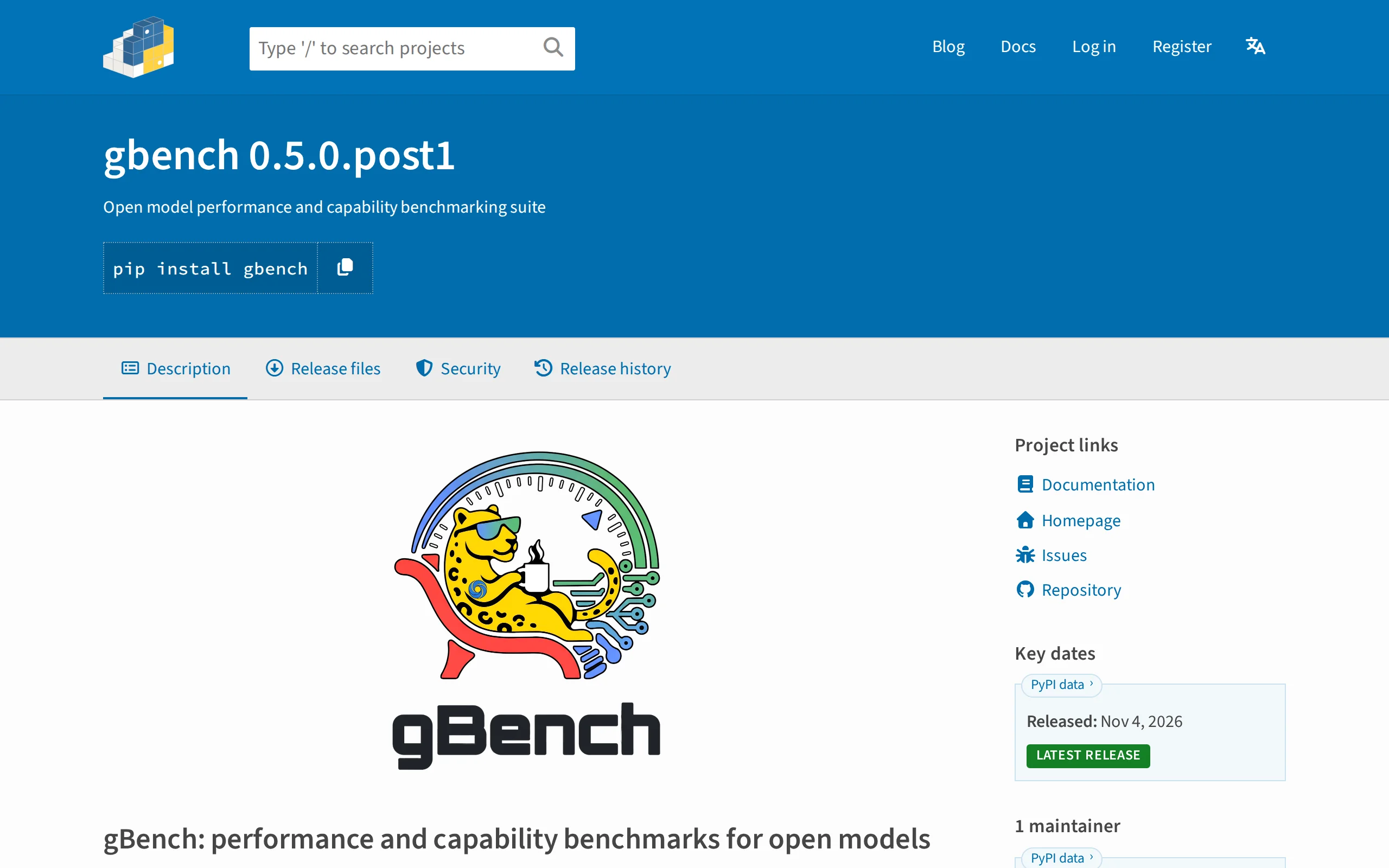
gBench is a full-stack AI benchmarking framework open-sourced by the Google DeepMind team, specifically designed to evaluate the production readiness of open-weight models such as Gemma. The framework...
1. What is gBench
gBench is a full-stack AI benchmarking framework open-sourced by the Google DeepMind team, specifically designed to evaluate the production readiness of open-weight models such as Gemma. The framework includes 86 academic benchmark suites and 16 deterministic smoke tests, and supports evaluation of both large language models (LLM) and vision-language models (VLM). It covers three major dimensions: academic capabilities, agent quality, and service performance. gBench uses an OpenAI-compatible API interface as a unified access standard. Users can install it via pip with one command and use it with mainstream inference engines such as vLLM and Ollama, enabling seamless transitions from rapid smoke testing to comprehensive capability evaluation and production-level stress testing.
Technical positioning and domain: gBench belongs to the AI model evaluation and benchmarking domain. Its unique positioning lies in combining traditional academic benchmark testing with production-readiness verification in an engineering context. Unlike purely capability-focused evaluation frameworks used in academia, gBench emphasizes the model's performance in real deployment environments. It serves as a "pre-deployment health check" tool for engineering teams, rather than a simple "leaderboard" framework.
Development background: gBench was developed and open-sourced by the Google DeepMind team, closely integrated with the Gemma series of open models they released. Google DeepMind has deep expertise in language model research and evaluation. Their motivation for developing gBench was to provide the open model community with a unified, reproducible, and comprehensive evaluation standard that spans the entire validation pipeline, addressing the industry pain point of inconsistent evaluation criteria across different models and the difficulty of comparing results horizontally.
Core value: gBench solves three long-standing issues in the model evaluation domain: first, the fragmentation of evaluation standards, where custom tests used by different teams lead to a lack of comparability in results; second, traditional benchmark tests often neglect engineering validation during the deployment phase, resulting in high model scores but frequent integration errors; third, agent-based applications lack standardized tools for tool calling and multi-turn interaction evaluation. This framework integrates capability evaluation, integration verification, agent testing, and performance stress testing into a single, complete process, filling the gap in validation between model scores and actual production deployment.
Technical features: gBench employs a three-tier evaluation architecture. The 81 academic suites are responsible for in-depth capability assessment, while the Golden Set provides deterministic smoke tests. Containerized agent suites validate tool calling and session memory capabilities in isolated environments. Its open-loop Poisson stress testing model can accurately measure system performance under overload conditions. Additionally, it estimates memory requirements by reading Hugging Face configuration files and provides hardware recommendations, reflecting its engineering-oriented design philosophy.
2. Key Features
Academic Capability Evaluation: Built-in with 86 academic evaluation suites, the system covers six major areas: general knowledge, mathematical reasoning, programming ability, long-context understanding, tool calling, and visual comprehension. Each suite employs standardized evaluation protocols and scoring mechanisms, ensuring strict horizontal comparability of scores across different models on the same dimension, and providing quantitative basis for model selection and capability profiling.
Golden Set Smoke Testing: Includes 16 deterministic verification tests, focusing on four key areas: code execution correctness, function calling standardization, structured output formatting, and chat template sensitivity. These tests use bidirectional existence assertions to ensure the stability of the testing itself, enabling rapid confirmation of model integration within 5 minutes and preventing the waste of significant resources on full evaluations when configuration errors occur.
Agent Quality Testing: Based on the GemmaClaw/OpenClaw suite, this feature runs multiple rounds of QA scenarios involving tool calling and session memory in a containerized isolated environment. It specifically evaluates the core capabilities of models in Agent scenarios: the ability to correctly select and invoke tools, and the ability to maintain contextual consistency across multi-turn interactions, filling the gap left by traditional benchmarking in assessing agent capabilities.
Service Performance Stress Testing: Utilizes an open-loop Poisson stress testing model, where the client schedules requests according to a Poisson distribution, continuously increasing the load at a multiple rate without waiting for the previous request to complete. The test report outputs P50/P95/P99 latency and coefficient of variation (CV), supports users in setting thresholds for release readiness judgment, and automatically generates GPU hardware configuration recommendations based on the model's parameter count.
Unified Access Standard: Connects to the model under test via any
/v1endpoint compatible with the OpenAI protocol. It has been verified to support three mainstream deployment methods: vLLM, Ollama, and Cloud Run. gBench itself does not load model weights, but instead communicates with the tested service as a standard API client, allowing it to evaluate any model service that conforms to the interface specification without code modifications.Local and Remote Dual Modes: Supports remote evaluation of API endpoints (e.g., remote Ollama instances), as well as local execution of the full test workflow by automatically launching a vLLM service. Before starting the local service, the framework reads the model's Hugging Face
config.jsonfile to estimate the parameter count, architecture type, and memory requirements, thereby automatically matching a reasonable inference configuration.Modular Hierarchical Control: Three evaluation levels can be independently enabled or disabled, and flexibly combined using the
--evals-only,--golden-only, and--quality-onlyparameters. Users can choose to run only the minimal smoke verification, the full academic evaluation, or a specialized agent test, depending on their evaluation goals and resource constraints, enabling on-demand customization of the evaluation process.
3. Application Scenarios
Open Model Technology Evaluation: When enterprises are evaluating open-weight models such as Gemma, Qwen (Tongyi Qianwen), and Llama, they can use a unified set of 86 evaluation benchmarks to test all candidate models under the same standards. The test results are presented using consistent metrics, allowing for direct comparison of performance differences across dimensions such as mathematics, programming, and long context handling. This approach prevents being misled by each vendor's "customized testing" promotional data and provides a reliable technical basis for decision-making.
Pre-Deployment Integration Verification: Before deploying a model into a production environment, teams can run
gbench --golden-onlyto perform 16 items of Golden Set smoke tests, quickly verifying whether the model's chat template configuration, function calling capabilities, and structured output formats are correct. This step can capture most integration configuration errors within 5 minutes, preventing difficult-to-diagnose production failures after deployment and significantly reducing delivery risks.Post-Fine-Tuning and Quantization Regression Testing: After a model has undergone fine-tuning, quantization, or distillation, gBench can be used to conduct a full evaluation round, systematically confirming that the model has not introduced degradation in its fundamental capabilities while improving performance. This scenario can be integrated into CI/CD pipelines as a quality gate, automatically triggering evaluations with each model update to ensure controllable and traceable output quality, providing automated support for iterative releases.
Agent Application Capability Verification: Development teams building Agent products use the GemmaClaw/OpenClaw suite to simulate real tool calling scenarios and session memory requirements within containers, assessing whether the model can maintain contextual consistency and correctly perform multi-step reasoning and tool selection in complex interactions. This scenario is particularly critical for ensuring quality in agent applications such as customer service chatbots, programming assistants, and data analysis agents.
Inference Service Capacity Planning: Operations teams use the open-loop stress testing feature to measure the model's P99 latency and stability metrics under target concurrent loads. Combined with GPU memory recommendations estimated by the framework based on parameter count, this enables a scientific determination of the required number and type of GPUs for deployment, achieving a balance between cost and performance, and avoiding service quality degradation due to insufficient hardware configuration or resource waste from over-provisioning.
4. How to Use
Environment Requirements: To install gBench, you need a runtime environment with Python 3.11 or higher. It is recommended to use a dedicated virtual environment (e.g.,
python3.11 -m venv gbench-env) to avoid conflicts with existing Python dependencies. As a pure client-side tool, gBench has low hardware requirements and can run the benchmark scheduling process on a CPU.Installation Framework: Install gBench by running
pip install gbenchin the terminal. If you want to use the development version or contribute to the project, you can clone the source code usinggit clone https://github.com/google-deepmind/gbench.gitand then runpip install -e .to install it in development mode.Prepare Model Server Endpoint: Ensure that the model under test exposes its service through a
/v1endpoint that is compatible with the OpenAI protocol. This endpoint can be a local inference service started with vLLM, a remote Ollama instance, or a cloud API deployed on Cloud Run. Record the base URL (Base URL) of the service and the API key (if applicable).Run Smoke Test: Execute
gbench --golden-only --base-url http://localhost:8000/v1 --api-key your-keyto run 16 deterministic checks from the Golden Set. This step usually completes within 5 minutes and mainly verifies whether the basic integration configurations, such as chat templates, function calling, and structured output, are correctly set up. It is a necessary prerequisite validation before conducting a full evaluation.Run Full Evaluation: Choose the evaluation level based on your target:
--evals-onlyruns 86 academic evaluation suites for in-depth capability assessment;--quality-onlyperforms containerized agent quality testing;--stress-testconducts open-loop stress performance testing. These three parameters can be used in combination (e.g.,gbench --evals-only --quality-only), enabling full end-to-end validation.Interpret Evaluation Results: After the evaluation is complete, review the terminal output report and the detailed result files generated. The stress testing section will report P50/P95/P99 latency, coefficient of variation, and throughput metrics. Compare these metrics with the predefined thresholds to determine whether the model meets the deployment standards. The academic evaluation section outputs detailed scores for each suite, which can be used for capability profiling and horizontal comparative analysis.
5. Pros and Cons Analysis
| Pros |
|---|
| End-to-end validation system: Integrates smoke checks, academic evaluations, agent testing, and performance stress testing into a complete workflow, covering all validation stages for model deployment, avoiding efficiency losses and inconsistency issues caused by switching between multiple tools. |
| Engineering-focused design: The open-loop Poisson stress testing can accurately reflect system overload behavior, and the P50/P95/P99 latency metrics and hardware recommendations directly support production deployment decisions, offering greater practicality than purely academic scoring frameworks. |
| Agent evaluation capability: The GemmaClaw/OpenClaw suite verifies multi-turn tool calling and session memory within containers, filling the gap in traditional benchmark testing for evaluating agent capabilities, providing a differentiated competitive advantage. |
| Deterministic reproducibility: Code execution-based evaluations hardcode version dependencies within containers, and the Golden Set employs a deterministic assertion mechanism, ensuring reproducibility of evaluation results across different environments, making it suitable for CI integration and regression testing. |
6. Comparative Analysis with Similar Tools
| Comparison Dimension | gBench (Google DeepMind) | LM Evaluation Harness (EleutherAI) | lmms-eval (Community Project) |
|---|---|---|---|
| Core Focus | End-to-end pre-deployment validation for open models: a unified solution for capability evaluation, agent testing, and performance stress testing | A unified academic benchmark evaluation framework, focusing on standardized horizontal comparison of model capabilities | A specialized framework for evaluating multimodal models, deeply optimized for vision-language tasks |
| Evaluation Scale | 86 academic suites + 16 smoke tests + agent suite | 60+ standard academic benchmarks, covering hundreds of subtasks and variations | Focuses on multimodal tasks, supporting benchmarks such as VQA, image captioning, and visual reasoning |
| Model Integration Method | Only through OpenAI-compatible /v1 endpoints (vLLM, Ollama, Cloud Run) |
Multi-backend support: HF Transformers, vLLM, SGLang, llama.cpp, commercial APIs, etc. | Supports Hugging Face Transformers and OpenAI-compatible API |
| Multimodal Evaluation | Native support for LLM + VLM evaluation, with built-in visual understanding suites | Multimodal is a prototype feature; the official recommendation is to use lmms-eval for complex multimodal tasks | Native multimodal evaluation framework, fully covering image, video, and audio tasks |
| Agent/Tool Calling Testing | Yes, with multiple rounds of tool calling and session memory QA scenarios running in containers | No dedicated containerized agent testing suite | No specialized agent evaluation capabilities |
| Service Performance Stress Testing | Yes, with open-loop Poisson pressure testing, reporting P50/P95/P99 latency and providing hardware recommendations | No, only generates benchmark scores, without service performance validation | No built-in stress testing functionality |
| Extensibility and Customization | Suites are relatively fixed, primarily out-of-the-box, with customization requiring additional development | YAML declarative task customization, supports plugin mechanisms for registering backends and metrics | Supports custom tasks and dataset registration, with an active ecosystem |
| Open Source License | Apache License 2.0 | MIT License | MIT License (depending on specific components) |
| Community Ecosystem | Backed by Google DeepMind, tightly integrated with the Gemma ecosystem, with guaranteed updates | Community-driven by EleutherAI, with many contributors and widespread use in academia | Active multimodal research community, continuously tracking new benchmarks |
Selection Recommendations: For engineering teams looking to deploy open models into production environments, gBench's full-chain validation system combining "smoke tests + academic evaluation + agent testing + performance stress testing" is highly attractive. It enables a complete process from integration verification to performance evaluation with a single command, especially suitable for teams using the Gemma series of models or requiring containerized agent validation. If the team is deploying multiple models and needs to compare capabilities across different vendors, LM Evaluation Harness or OpenCompass can be used for broader academic capability horizontal evaluations.
For research teams and model developers, LM Evaluation Harness provides a more flexible YAML-based custom task mechanism and broader backend support, making it easier to integrate new model architectures and custom benchmarks. Researchers focusing on multimodal model evaluation should prioritize lmms-eval, which has significant advantages in the depth of vision-language task coverage and the speed of community updates. OpenCompass has unique value in terms of Chinese support and domestic community ecosystem, making it suitable for large-scale evaluation and benchmark tracking needs of domestic teams.
7. Editor's Summary
The launch of gBench reflects a structural shift worth noting in the field of AI model evaluation: the focus is moving from "academic capability scores" to "production-readiness verification." Traditional evaluation frameworks like LM Evaluation Harness address the question of "how to measure model capabilities," while gBench aims to answer a more advanced question — "is the model truly ready for deployment?"
The technical innovation of this approach lies in the design of a three-tier evaluation architecture. The Golden Set smoke test layer quickly filters out configuration errors in a deterministic manner, the academic evaluation layer provides a capability profile, and the containerized agent testing fills the assessment gap in Agent scenarios. The open-loop stress testing layer provides performance metrics and hardware recommendations. This four-tier validation system integrates the traditionally fragmented "benchmark evaluation" and "engineering validation" into a single toolchain, significantly reducing the complexity of verification before model deployment.
The greatest value of gBench lies in its engineering practicality. The open-loop Poisson stress testing mode can accurately measure system overload behavior, while P99 latency and the coefficient of variation directly support capacity planning decisions. The feature that reads the Hugging Face config.json file and automatically estimates memory requirements lowers the threshold for hardware configuration. These designs indicate that gBench is not merely an academic accessory, but a practical tool aimed directly at frontline engineering teams.
In terms of target audience, gBench is most suitable for three types of teams: first, engineering teams looking to deploy open models, who can gain one-stop verification capabilities; second, developers building Agent products or tool calling applications, for whom containerized agent testing is a key differentiator; and third, operations teams that need to establish CI quality gates for model releases. For academic teams focused on model research and leaderboard performance, gBench is not the optimal choice — the flexibility and broader ecosystem coverage of LM Evaluation Harness better align with such needs.
Looking ahead, the future direction of gBench depends on two key factors: first, the long-term investment from Google DeepMind in this project. If it can maintain an iterative pace aligned with the Gemma ecosystem, its influence will continue to grow. Second, the development of the community ecosystem. Currently, the 86 available toolkits are primarily ready-to-use, with relatively weak extensibility mechanisms. If it can enhance scalability while maintaining usability, gBench has the potential to become one of the standard tools in the model evaluation domain.
8. FAQ
Q: What is the fundamental difference between gBench and traditional model evaluation frameworks (such as LM Evaluation Harness)?
A: The design goals differ. LM Evaluation Harness is a purely academic evaluation framework, aiming to standardize the measurement of model capabilities and output benchmark scores for research comparisons. gBench, on the other hand, is an engineering-oriented end-to-end validation tool that includes not only academic evaluations but also smoke tests, agent testing, and performance stress testing. Its goal is to determine whether a model is ready for deployment. gBench outputs more than just scores—it also provides engineering decision-making references such as latency distribution, stability metrics, and hardware configuration recommendations.
Q: Does gBench support evaluating models other than the Gemma series, such as Qwen or Llama?
A: In theory, yes. gBench connects to the model under test via an OpenAI-compatible /v1 API endpoint and does not impose any restrictions on the model architecture. Any model that can provide services through an OpenAI-style API—whether using vLLM, Ollama, or other inference engines—can be integrated with gBench for evaluation. However, it should be noted that the framework was primarily developed with Gemma models in mind, and some configuration parameters may need adjustment when using other models, depending on the specific circumstances.
Q: What specific aspects does the Golden Set smoke test's 16-item check cover?
A: The 16 deterministic checks in the Golden Set focus on four technical dimensions: code execution correctness (whether the model can generate executable code with correct results), function calling compliance (whether the model can initiate function calls according to the Schema), structured output formatting (the validity and completeness of outputs in formats like JSON), and chat template sensitivity (the stability of the model's performance across different chat templates). These checks use bidirectional existence assertions to ensure test determinism, allowing for stable and reproducible results.
Q: How does gBench's stress testing mechanism differ from conventional stress testing tools (such as k6, Locust)?
A: gBench employs an open-loop stress testing model, where the client schedules requests according to a Poisson distribution and increases the load at a multiple rate, sending new requests without waiting for the previous one to complete. This fundamentally differs from the closed-loop model used by conventional stress testing tools, which wait for a response before sending the next request. The open-loop model can realistically simulate uncontrolled user access scenarios, measuring the system's actual performance under overload conditions rather than testing its processing capability under ideal response cycles. This makes gBench's latency data more reflective of real-world traffic spikes.
Q: How long does it take to evaluate the 86 academic suites using gBench?
A: The exact time depends on the inference speed of the model under test and the total volume of evaluation tasks. For example, running a mid-to-low parameter open model (such as Gemma 7B) on a single A100 GPU, it typically takes several hours to over a dozen hours to complete all 86 suites. It is recommended to first run the Golden Set (which completes in under 5 minutes) to confirm that the basic configuration is correct before proceeding with the full evaluation, to avoid wasting time due to incorrect setup. Evaluations can be interrupted at any time, and results from completed suites will be retained in the output directory.
Q: Can the evaluation results from gBench be used for academic publications or comparisons?
A: Yes, but with some considerations regarding applicability. The 86 academic suites in gBench use standardized evaluation protocols, and their results can be used for capability comparisons in academic papers. However, the unique value of gBench lies in its engineering validation. In academic research scenarios, the traditional LM Evaluation Harness might be more suitable, as it has a deeper history of use in custom tasks and is more widely accepted in the academic community. It is recommended to choose the appropriate evaluation framework based on the specific use case.
9. Project Links
- Project Homepage (PyPI): https://pypi.org/project/gbench/
- GitHub Repository: https://github.com/google-deepmind/gbench
Related
In-Depth Review of OpenGame – OpenDesign Team's Open-Source Full-Stack AI Game Studio
OpenGame is an open-source full-stack AI game studio developed by the OpenDesign team. It connects with 22 programming Agents such as Claude Code, Codex, and DeepSeek via a local MCP tool (BYOA+BYOK),...

In-Depth Review of Motubrain 2.0: ShengShu Technology's Agentic General-Purpose Model Leading the Way in Embodied Intelligence
Motubrain 2.0 is ShengShu Technology's Agentic General-Purpose Model for the Physical World, composed of a 20B parameter World Action Model (WAM) and the Motubrain-Harness agent orchestration framewor...
ShellBench – An Agent Benchmark Launched by OpenClaw and Other Institutions
ShellBench is an agent capability benchmarking platform introduced jointly by the OpenClaw Foundation, HuggingFace, Red Hat, UC Berkeley, and other organizations. It focuses on evaluating the task com...
cinecode: Open-Source AI Film Production Toolkit, Drive the Entire Film Production Pipeline with a Single Sentence
cinecode is an open-source AI film production toolkit developed by Turkish developer sarpstar, deeply integrated into AI coding environments such as Claude Code and Cursor. Users only need to provide ...
© All Rights Reserved. Some content on this site is partially generated by AI with human review.