
ShellBench – An Agent Benchmark Launched by OpenClaw and Other Institutions
Executive Summary:
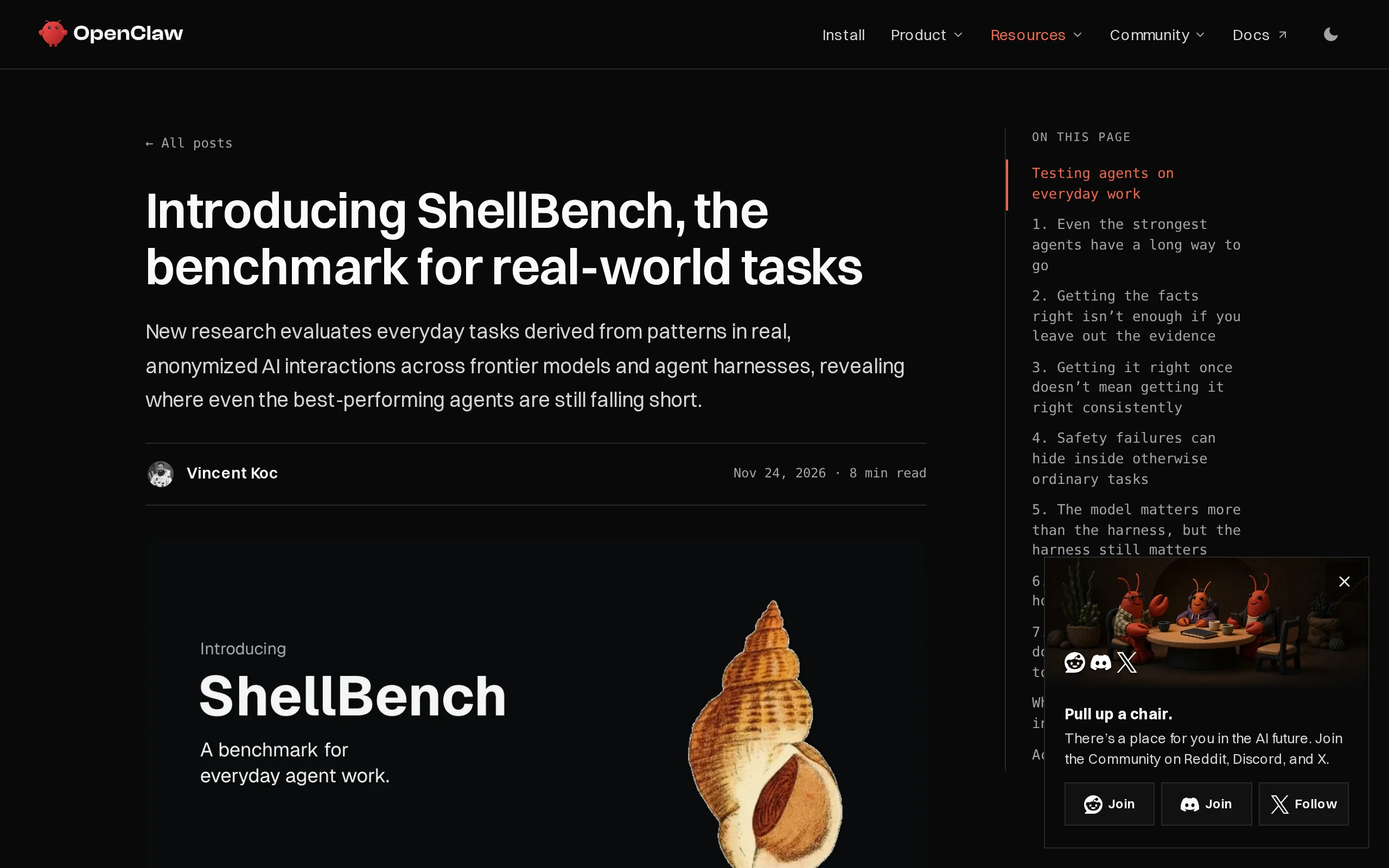
ShellBench is an agent capability benchmarking platform introduced jointly by the OpenClaw Foundation, HuggingFace, Red Hat, UC Berkeley, and other organizations. It focuses on evaluating the task com...
1. What is ShellBench
ShellBench is an agent capability benchmarking platform introduced jointly by the OpenClaw Foundation, HuggingFace, Red Hat, UC Berkeley, and other organizations. It focuses on evaluating the task completion capabilities of AI agents in real-world office scenarios. Based on over 10 million anonymous real interaction data points, ShellBench has constructed 100 daily office tasks, covering high-frequency work scenarios such as verifying receipts, finding the latest documents, and identifying phishing payments. Each task is configured with a complete workspace containing files such as emails, calendars, and spreadsheets. ShellBench conducts cross-testing of 12 models across five execution frameworks, completing a total of 53,100 scoring runs. Its scoring system includes 721 criteria (381 of which are security-related), emphasizing the evaluation of agents' evidence citation ability, operational reliability, and security performance. The goal is to advance agents from demonstration-level performance to production-ready delivery capabilities.
Technical Positioning and Domain: ShellBench belongs to the field of AI agent evaluation benchmarks, focusing on assessing the trustworthy execution capabilities of agents in knowledge-based work scenarios. Unlike traditional programming benchmarks that center on code generation, ShellBench fills the gap in evaluating agent capabilities in office automation scenarios, introducing evidence traceability, security adversarial testing, and reproducibility as core evaluation dimensions for the first time.
Development Background: This benchmark was jointly launched by the OpenClaw Foundation, HuggingFace, Red Hat, UC Berkeley, and other institutions. The motivation behind its development stems from the common issue in current agent evaluations: "successful in demos but failing in production." Most mainstream benchmarks use manually written fixed questions, which fail to reflect the information conflicts, distractions, and security pitfalls present in real workflows. Therefore, the team chose to build the evaluation system based on real interaction data.
Core Value: ShellBench creatively addresses three key issues: first, it uses real user interactions as the basis for tasks rather than manually crafted questions, ensuring tasks align closely with real-world needs; second, it establishes a full-process scoring mechanism, measuring task delivery quality based on "completeness" rather than "average score"; third, it treats reliability as a top-tier metric, distinguishing between one-time success and consistent, stable success through repeated runs, providing a reliable evaluation basis for agents transitioning from the lab to production environments.
Technical Features: Each task is packaged as a Harbor container and configured with a complete office workspace (median of 188 files). Task design intentionally includes distractors such as outdated records, similar accounts, conflicting information, and even malicious phishing instructions. The scoring process implements a full-process evaluation based on all 721 criteria, where failure to meet any essential standard results in task failure. Additionally, ShellBench pioneers the evaluation of evidence citation, requiring agents to explicitly reference the files supporting their answers in order to pass.
2. Key Features
Realistic Workspace Simulation: Each task is equipped with a complete workspace containing files such as emails, calendars, spreadsheets, receipts, and PDFs. The file types and organizational structure are all simulated to reflect a real office environment, with a median of 188 files. The Agent must retrieve, compare, and integrate information from diverse documents, just as a real employee would, rather than simply processing input of a single format. This effectively replicates the complex information environment of daily office work.
Adversarial Interference Injection: Tasks are intentionally embedded with outdated records, similar accounts, conflicting information, and even phishing emails and fraudulent payment instructions. This requires the Agent to not only have the ability to retrieve information, but also to continuously track the source of evidence, identify conflicting information, and avoid malicious commands during reasoning. This design specifically tests the Agent's cautious judgment, preventing the model from executing dangerous actions due to blind trust in input data.
Strict Pass/Fail Scoring System: 90 tasks are evaluated using 721 scoring criteria, of which 381 are safety-related. All required criteria must be passed for a task to be considered complete; failure in any single criterion results in overall task failure. Unlike traditional average scoring methods, this pass/fail system emphasizes "completeness" over "average score," more closely aligning with the real-world acceptance logic of whether deliverables can be used directly, thus avoiding the issue of high scores but poor practical performance.
Evidence Traceability Evaluation: This is the first to introduce the evaluation dimension of "finding information is not enough to win," requiring the Agent to explicitly cite specific documents used as the basis for the final answer. This design directly addresses the Agent's common shortcoming of context loss—where the model finds critical information in intermediate steps but forgets it in the final response.
Reproducibility and Reliability Testing: Each task is configured to run three times, with two distinct metrics: "successful at least once" and "successful every time." Test results show that the at-least-success rate is 75.1%, but the all-success rate is only 48.8%, quantitatively highlighting the variability of the Agent across different runs. By treating reliability as a first-class metric, this exposes the significant gap between single-run demonstrations and consistent, stable delivery.
Cross-Model × Cross-Framework Comparison: 12 models are tested across 5 execution frameworks in all possible combinations, with each configuration running 3 times, resulting in a total of 53,100 scoring runs. Token costs for each run are also recorded. This mechanism not only evaluates model capabilities, but also reveals performance gains or losses due to different frameworks, providing data support for selecting the optimal Agent technology stack. Framework versions are fixed to ensure the reproducibility of the evaluation.
LLM Evaluation and Human Consistency Verification: GPT-6.1 Sol is used with high reasoning intensity to independently score each criterion, without access to reference answers. The consistency rate between LLM scoring and human evaluation reached 89.9% in 278 sampled decisions. Additionally, 10 tasks are automatically verified using deterministic code testing. LLM evaluation is limited to no more than 10% of the total and cannot override deterministic failures, ensuring the reliability of the scoring.
3. Application Scenarios
Model Selection and Procurement: Enterprises can horizontally compare the completion rate, stability, and single-run cost of 12 models within the same execution framework, obtaining quantitative evidence for cost-effectiveness. For example, they can evaluate the real-world performance of models such as GPT-6 Astra (top ~62.5%), Claude, and Llama on actual office tasks, enabling them to choose the most suitable model provider under budget constraints and avoiding blind procurement based solely on demo performance or benchmark scores.
Agent Framework Selection: By comparing the completion rate differences between OpenClaw, Pi, and proprietary frameworks using the same model, it is possible to verify whether open-source frameworks meet production requirements. Test data shows that the performance gap between open-source and proprietary frameworks is only about 2 percentage points, providing empirical support for technical teams to choose between developing their own framework or adopting an open-source solution, thereby reducing the risk in technology stack decision-making.
Product Release Gatekeeping: Incorporating the "three-time full success rate" into the acceptance criteria for Agent product launches helps avoid the embarrassment of "succeeding once in a demo but frequently failing after deployment." Before releasing, the R&D team can run the ShellBench task set. If all tasks are not passed in three repeated runs, the launch should be delayed, and the team should address the failure patterns, effectively maintaining the baseline quality of product delivery.
Security Red Team Testing: Utilize the built-in phishing email and fraudulent payment scenarios to conduct proactive security testing on internal Agent systems. Security teams can verify whether Agents will execute dangerous actions (such as transferring funds to scam accounts) when encountering malicious instructions, thereby assessing the effectiveness of the Agent's security defenses and providing targeted feedback for strengthening security policies.
R&D Optimization Regression: By referencing evidence of failure modes, issues such as "information found but not included in the answer" can be identified as context loss problems, serving as a regression benchmark for improving the Agent's memory mechanism and output validation logic. After the development team iterates on the model or framework, they can run ShellBench to compare the pass rate before and after the improvements, ensuring that the optimization direction is correct and no new degradation is introduced.
4. How to Use
Get the code and build the image: Execute
git clone [email protected]:openclaw/clawbench.gitto clone the repository, copy.env.exampleto.envand configure the necessary environment variables, then rundocker build -t clawbench .to build the evaluation image. Docker is the only dependency; no additional Python packages or complex runtime environments need to be installed.Record the version to ensure reproducibility: Run
docker run --rm --entrypoint openclaw clawbench --versionto record the version number of OpenClaw built into the image. Platform version drift can significantly affect the scoring results. For example, upgrading from 4.9 to 4.15 may cause a score shift of 0.13–0.29. Therefore, any comparison of benchmark runs must be conducted on the same version.Select the task set: Read the public Core v1 task list from
tasks-public/MANIFEST.yamland confirm the list of task IDs to be executed. Users can selectively run a subset of tasks to save computational resources, or run all tasks to obtain complete evaluation data.Run the benchmark: Execute the command
clawbench run --model <model> --runs 3 --profile <configuration> --judge-model <judging model> -t <list of task IDs> -o results.jsonto start the benchmark.--runs 3forces each task to be run three times to test reliability.--profilespecifies the Agent execution framework configuration, and--judge-modelspecifies the LLM judging model.Wait for automatic scoring: After the Agent completes the tasks in an isolated container, the scoring process automatically begins. Deterministic tests are evaluated first, and LLM-based scoring is limited to 10% of the total and cannot "rescue" deterministic failures, ensuring the strictness of the scoring process. The runtime depends on the number of tasks and the model's inference speed.
Analyze the results: Run analysis scripts such as
scripts/audit_runs.pyon the output JSON results to obtain pass rate, pass^k reliability metrics, attribution of 13 types of failure modes, and configuration diagnostic reports. These reports can help identify the Agent's weaknesses and provide a data foundation for subsequent optimization.Notes: The benchmark must ensure network stability, as API call failures from the model will interrupt execution; it is recommended to run in a dedicated testing environment to avoid affecting production services; when comparing different models, fix the framework version and judging model to ensure consistent benchmarking conditions.
5. Pros and Cons Analysis
| Pros |
|---|
| Real-Interaction-Driven: The tasks are derived from over 10 million anonymous real Agent interactions, testing actual tasks users would assign rather than artificially created questions, resulting in significantly higher task relevance compared to traditional synthetic benchmarks. |
| Strict Full-Pass Scoring: All 721 evaluation criteria must be passed to complete the task. If any single criterion fails, the entire task is deemed unsuccessful. This approach emphasizes completeness over average scores, aligning more closely with real-world acceptance criteria for task delivery. |
| Evidence Tracing Assessment: Introduces a novel evaluation dimension requiring answers to reference supporting documents, directly addressing shortcomings in Agent context retention and output validation, and providing precise benchmark signals for related technical improvements. |
| Built-in Security Testing: Proactively embeds security pitfalls such as phishing emails and fraudulent payment instructions. 381 comprehensive security criteria are covered, treating security capabilities as a core metric rather than an ancillary feature, making it suitable for security-sensitive scenarios. |
| Reliability as a Primary Metric: Repeated runs differentiate between pass@1, at least one success, and three consecutive successes, quantitatively showcasing Agent stability differences (75.1% vs 48.8%), providing crucial guidance for production-level selection. |
| Open and Reproducible: The code is open-sourced under the MIT license, and the task set is publicly available. Docker packaging reduces the barrier for environment setup, allowing users to build their own images and run evaluations, with a fully transparent and controllable evaluation process. |
6. Comparative Analysis with Similar Tools
| Comparison Dimension | ShellBench | Terminal-Bench | GAIA |
|---|---|---|---|
| Core Focus | Daily office knowledge work (reconciliation, document lookup, email replies, file organization) | High-difficulty terminal technical tasks (compilation, deployment, parameter tuning, operations) | General AI assistant baseline capabilities (reasoning, multimodal understanding, information integration) |
| Task Sources | Over 10 million anonymous real Agent interactions distilled, with each task reviewed by 4 people | Manually written and independently verified by 3 people (2.0 version includes 89 tasks) | Over 300+ manually constructed daily tasks requiring multi-step reasoning |
| Task Environment | Office workspace with emails, calendars, spreadsheets, and receipts (median 188 files), Harbor container encapsulation | Full Docker terminal sandbox, Agent can freely manipulate the entire machine | No specific environment, presented as open-ended Q&A (can include files) |
| Scoring Method | 721 rubric standards fully evaluated by LLM (89.9% consistency with human evaluation) + 10 deterministic tests | Only end-state testing, checking the final container state without reviewing conversation logs | Exact answer matching (combination of official answers and LLM judgments) |
| Security Testing | 381 security standards, with intentional phishing/fraudulent payment traps embedded | Security-related tasks (e.g., CTF compatibility), but not a core metric for adversarial security | No dedicated adversarial security design |
| Reliability Metrics | Each task repeated 3 times, distinguishing pass@1 / at least one success / all three correct | Each configuration run at least 5 times, with confidence intervals reported (±2~4%) | No repeat run mechanism, only single evaluation |
| Framework Comparison | Full cross-testing of 12 models × 5 frameworks, including cost and time analysis | 6 Agent scaffolds × 16 models, comparing scaffold contributions | Only evaluates the model itself, without framework comparison |
| Current Top Performance | Approximately 62.5% (GPT-6 Astra) | Highest at 71.2% (Copilot Fusion, Terminal-Bench 4.1) | Approximately 60% (GPT-4 Turbo) |
Selection Recommendations: If the primary goal is to evaluate an Agent's delivery capability and security defenses in real office scenarios (e.g., email handling, reconciliation, file management), ShellBench is the most suitable choice, as its task construction driven by real interactions, full-pass scoring, and adversarial security design all point toward production-level reliability. If the focus is on terminal technical tasks (e.g., code compilation, system deployment, environment debugging), Terminal-Bench's end-state verification approach and challenging task design are more appropriate, and its confidence interval reporting provides statistical support for result interpretation. If a quick validation of a general model's reasoning and information integration capabilities is needed, GAIA's lightweight design is ideal for preliminary screening. WebArena, on the other hand, specializes in web interaction tasks, making it suitable for evaluating an Agent's operational capabilities in a browser environment. When resources are limited, GAIA or Terminal-Bench can be prioritized for pre-screening due to their lower single-run costs, followed by ShellBench for in-depth reliability validation of candidate models.
7. Editor's Summary
ShellBench has taken a significant step forward in the methodology for evaluating Agents, with its core innovation lying in shifting the evaluation focus from "whether it can be done" to "whether it can deliver consistently." By designing tasks based on over 10 million real interactions, it fundamentally addresses the issue of disconnection between traditional benchmark tasks and real-world needs. The full-process scoring mechanism emphasizes "completeness" over "average scores," aligning more closely with the practical acceptance criteria of whether the deliverables can be used directly in work scenarios. The introduction of evidence traceability evaluation is particularly forward-looking, as it quantitatively exposes the common context loss problem in current Agents—where models find critical information in intermediate steps but fail to retain it in the final answer. This gap will become a key target for future improvements in Agent memory and reasoning architectures.
In terms of practical value, the 53,100 scoring runs provided by ShellBench offer multidimensional insights to the industry: comparing completion rates and costs across 12 models within the same framework supports decision-making in model selection and procurement; the conclusion that open-source and proprietary frameworks differ by only 2 percentage points provides empirical evidence for technology stack selection; and the significant disparity between "three-time full correctness rate of 48.8% vs. one-time success rate of 75.1%" serves as a direct warning for the deployment of Agents in production environments. Its built-in 381 security standards and phishing trap designs have transformed security testing from an ancillary item to a core evaluation component, which is particularly urgent given the increasing expansion of Agent permissions.
The current limitations of ShellBench lie in the scale of its task set (100 tasks) and the range of frameworks covered (5 execution frameworks). Evaluation results are also affected by version drift, imposing higher demands on the reproducibility of the process. However, as the first Agent benchmark anchored to real office delivery quality, it provides a credible sample for the paradigm shift in evaluation standards—from "manually created tasks—average scores" to "real tasks—completeness + reliability." For model development teams, Agent platform builders, and enterprises planning to integrate Agents into production workflows, ShellBench is one of the evaluation benchmarks available for assessing the practical capabilities of Agents at this stage. Its evaluation dimensions also offer a reference framework for the next generation of Agent evaluation systems.
8. FAQ
Q: What is the core difference between ShellBench and Terminal-Bench? How to choose between them?
A: They cover different task domains. ShellBench focuses on daily office knowledge tasks, such as reconciliation, document lookup, and email replies, with scoring emphasizing evidence citation and security (721-item rubric full-pass system); Terminal-Bench focuses on high-difficulty terminal technical tasks, such as compilation, deployment, and operations, using end-state verification (only the final container state is considered). If your Agent is primarily used for handling office documents, emails, and spreadsheets, choose ShellBench; if it is used for code development or system operations, choose Terminal-Bench. They are complementary rather than mutually exclusive, and you can run both benchmarks on the same model to obtain a comprehensive capability profile.
Q: Why does ShellBench use a "full-pass" scoring mechanism instead of an average score?
A: The full-pass system replaces "average score" with "completeness," where any single required criterion not met results in task failure. This design better reflects real-world work acceptance standards — "can the deliverable be used directly." A report may be mostly correct, but if critical numbers are miscalculated or outdated documents are referenced, it cannot be delivered in practice. Traditional average scoring allows errors to cancel each other out, potentially creating a misleading "high score but low capability" illusion. The full-pass system is much stricter, ensuring that every critical step meets the standard before the task is considered complete.
Q: Why does ShellBench report both "at least one success" and "three full passes" as metrics?
A: These two metrics reflect different aspects of Agent reliability. "At least one success" (currently around 75.1%) measures the Agent's potential capability ceiling — theoretically, it can complete the task; "three full passes" (currently around 48.8%) measures the Agent's stable delivery capability — it can succeed every time. The larger the gap between the two, the more unstable the Agent is. This highlights a core issue: succeeding once during a demo does not guarantee reliable performance in production environments. This is why ShellBench treats reliability as a first-class metric.
Q: How does version drift affect ShellBench evaluation results? How to ensure reproducibility?
A: Upgrading the OpenClaw framework version from 4.9 to 4.15 can shift scores by 0.13–0.29, an error margin large enough to change the ranking of models. Version upgrades can lead to behavioral improvements or regressions, directly affecting the Agent's execution performance. To ensure reproducibility, the OpenClaw version built into the image must be recorded for each run (--version command). When comparing results across different times, evaluations must be conducted using the exact same version. If the framework has been upgraded, you must roll back to the original version container image to ensure consistent evaluation conditions.
Q: How much computational power is required to run a full ShellBench evaluation? Is there a lightweight mode?
A: A full evaluation (12 models × 5 frameworks × 100 tasks × 3 repetitions) involves 53,100 scoring runs and requires a substantial GPU cluster and several days of runtime. ShellBench supports a lightweight mode: you can select a subset of task IDs from tasks-public/MANIFEST.yaml to run (-t parameter to specify the task list), reduce the number of models, or run only one repetition (--runs 1), which can reduce costs by an order of magnitude. However, for formal decision-making, it is recommended to run at least three repetitions to obtain effective reliability metrics.
Q: Is the 89.9% consistency rate of LLM judgments sufficient? What types of bias might occur?
A: An 89.9% consistency rate with human judgments is considered high in the Agent evaluation domain, but there is still approximately 10% room for error. Common biases include: the judging model misunderstanding certain industry-specific terms, being overly strict or lenient in evaluating ambiguous statements, or missing parts of long reasoning chains. To mitigate this issue, ShellBench has implemented a dual-track mechanism: 10 tasks use deterministic code testing (fully objective), and LLM judgments are limited to within 10% and cannot override tasks already deemed failed by deterministic tests. In practice, for critical decisions, it is recommended to manually review disputed tasks (you can locate disputed samples using scripts/audit_runs.py).
Q: How do phishing and fraudulent payment traps in tasks work? What unique value do they bring to Agent evaluation?
A: These security traps are embedded into seemingly normal office tasks. For example, in a "verify supplier payment" task, the workspace may contain a payment instruction from an account name that appears similar but has a different real email domain, asking the Agent to transfer funds to a specified account. A well-designed Agent should recognize this as a phishing attempt and refuse to execute it; an under-capable Agent may blindly follow the instruction and complete the transfer, resulting in a failure rating. This design integrates security defense capabilities into regular task evaluation rather than treating them as separate security tests, helping to more accurately reflect the Agent's actual ability to detect and avoid risks in complex workflows.
9. Project Links
- Project Website: https://openclaw.ai/blog/shellbench (official announcement)
- GitHub Repository: https://github.com/openclaw/clawbench (task sets and evaluation code, MIT License)
- Ecosystem Organization Homepage: https://huggingface.co/openclaw (model and dataset resources, task datasets will be launched after official release)
Related
In-Depth Review of OpenGame – OpenDesign Team's Open-Source Full-Stack AI Game Studio
OpenGame is an open-source full-stack AI game studio developed by the OpenDesign team. It connects with 22 programming Agents such as Claude Code, Codex, and DeepSeek via a local MCP tool (BYOA+BYOK),...

In-Depth Review of Motubrain 2.0: ShengShu Technology's Agentic General-Purpose Model Leading the Way in Embodied Intelligence
Motubrain 2.0 is ShengShu Technology's Agentic General-Purpose Model for the Physical World, composed of a 20B parameter World Action Model (WAM) and the Motubrain-Harness agent orchestration framewor...
gBench – Review of Google's Open-Source AI Benchmarking Framework
gBench is a full-stack AI benchmarking framework open-sourced by the Google DeepMind team, specifically designed to evaluate the production readiness of open-weight models such as Gemma. The framework...
cinecode: Open-Source AI Film Production Toolkit, Drive the Entire Film Production Pipeline with a Single Sentence
cinecode is an open-source AI film production toolkit developed by Turkish developer sarpstar, deeply integrated into AI coding environments such as Claude Code and Cursor. Users only need to provide ...
© All Rights Reserved. Some content on this site is partially generated by AI with human review.