
LingBot-Navi: In-Depth Review of Ant Group's Open-Source Navigation Model with Cross-Task Spatial Memory
Executive Summary:
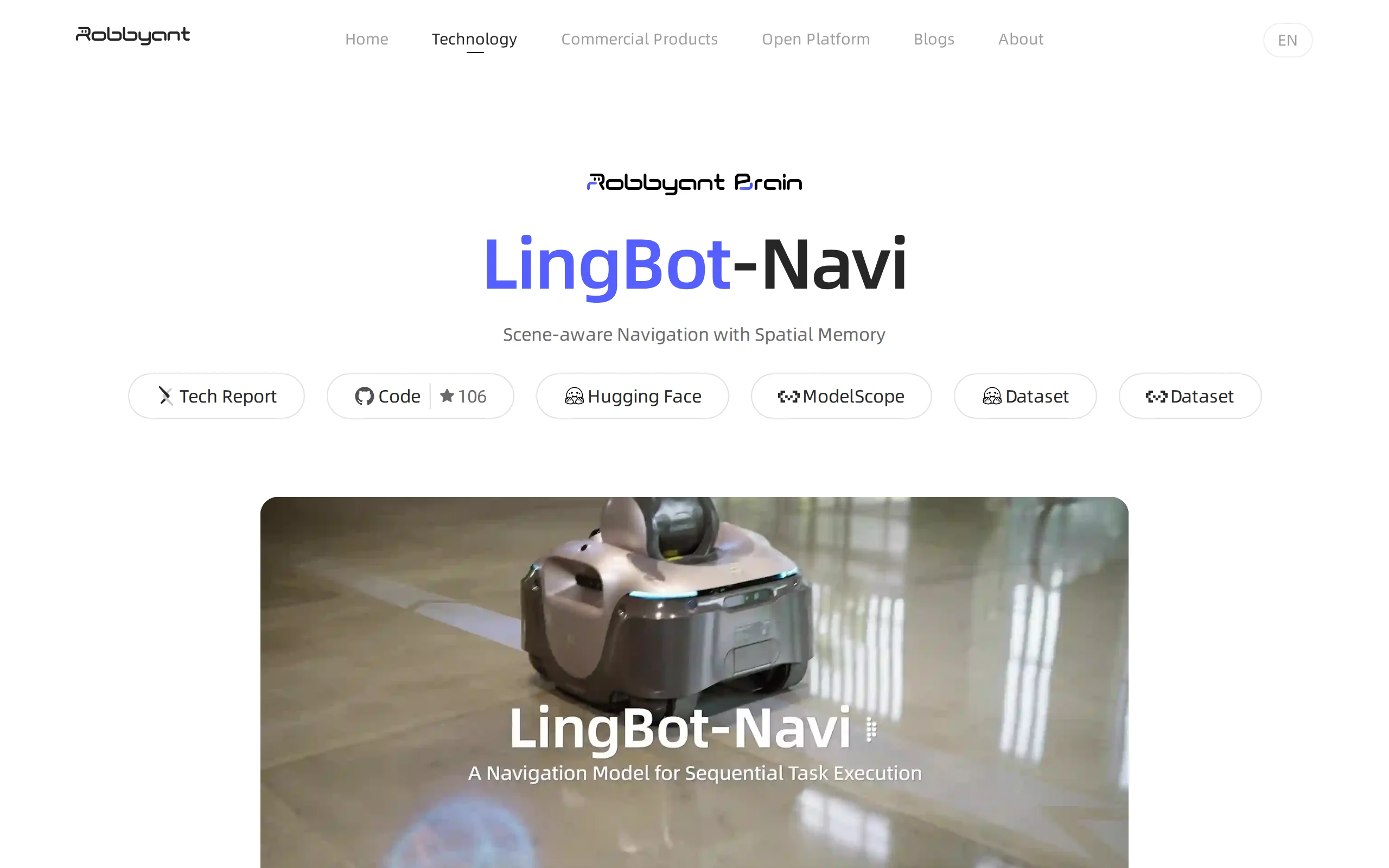
LingBot-Navi is an open-source end-to-end navigation model developed by Robbyant, a team under Ant Group. Its core innovation lies in the introduction of a Cross-Task Spatial Memorymechanism. Based on...
1. What is LingBot-Navi
LingBot-Navi is an open-source end-to-end navigation model developed by Robbyant, a team under Ant Group. Its core innovation lies in the introduction of a Cross-Task Spatial Memorymechanism. Based on the 3D reconstruction capabilities of LingBot-Map 2.0, the model encodes observations made by a robot along its path into point cloud memory blocks enriched with visual-language features. By decoupling scene encoding from task queries, the robot can directly reuse existing memories for target localization and route planning when performing new tasks in the same environment, eliminating the need for re-exploration from scratch. Additionally, the model supports proactive re-evaluation and partial memory updates when environmental changes are detected.
Technical positioning and domain: LingBot-Navi belongs to the field of Embodied AIand is a **Vision-Language Navigation (VLN)**model. It focuses on integrating natural language instructions with 3D spatial memory to achieve end-to-end semantic navigation and target localization. Its technical approach combines multiple cutting-edge technologies, including 3D reconstruction, vision-language pre-training models, and flow-matching trajectory generation.
Development background: This model was developed and open-sourced by the Robbyant team under Ant Group. Previously, the team had released scene understanding models such as LingBot-Map, accumulating technical expertise in 3D reconstruction and spatial intelligence. The motivation behind LingBot-Navi's development was to address the inefficiencies of traditional navigation models in cross-task scenarios, where repeated exploration is required, and to promote navigation capabilities as a fundamental, factory-installed feature of robots.
Core value: The model addresses three key challenges: first, the reuse of spatial memory across different tasks, eliminating the need for re-exploration when switching tasks; second, the precise alignment of natural language instructions with 3D spatial positions, enabling even vague instructions to be translated into specific coordinates; third, data privacy and real-time performance, supporting local execution on edge devices such as Jetson Thor, ensuring that images and instructions remain on-premises.
Technical features: The model employs an explicit 3D point cloud representation combined with per-point visual-language features, stored as independent memory blocks. Architecturally, it decouples scene encoding from task queries, allowing the encoded data to be reused multiple times. It also implements a global-local dual-layer planning mechanism, achieving real-time performance with a global planning latency of 577 milliseconds and a local planning latency of 95 milliseconds per step on edge devices.
2. Key Features
Cross-task Space Memory Reuse: The model saves observations made during task execution as 3D point cloud memory blocks with visual-language features, organizing them as independent blocks within their local coordinate systems. When the robot re-enters the same environment, it can directly retrieve previously built memories to locate targets and plan routes, without needing to re-explore the environment. This mechanism significantly improves operational efficiency in multi-turn task scenarios, with memory becoming increasingly enriched as it is used more frequently, achieving a cumulative effect of "the more you do, the faster you become." Experiments show that with 225 requests where the target had been moved, the success rate with memory review support reached 15.33%, a significant improvement compared to systems without such a review mechanism.
Language Grounding: The model can locate the 3D central position of a target within spatial memory based on natural language descriptions. For example, given a complex instruction like "the green bar stool next to the pink vase," the model aligns textual semantics with point cloud features using a visual-language decoder to output precise coordinates. This feature does not rely on pre-labeled object categories and demonstrates strong generalization capabilities for open-ended and colloquial instructions.
Image Localization: The model supports querying the position and orientation of the camera within spatial memory based on a single image. By comparing the current image's features with existing memory blocks, the model infers the robot's own pose information. This functionality can serve as a supplement to visual odometry in indoor scenarios where GPS is unavailable, providing a reliable starting point for subsequent path planning.
Route Prediction: Using the current position and target coordinates as endpoints, the model reads key-value information from memory and instructions through a trajectory decoder, and generates a sequence of intermediate path points using a flow-matching approach. The generated path naturally avoids known obstacle areas and maintains spatial consistency within the global coordinate system, offering a navigable reference for local planners.
Memory Review and Local Update: When the navigation target may have been moved or the environment has changed significantly, the model can actively return to the old location to review and verify the memory. If the trigger conditions are met, the model updates nearby local memory blocks using new observations and then decides whether to re-query the target location or continue searching. This dynamic correction mechanism ensures that the memory remains consistent with the real-world environment, adapting to changes such as object displacement and temporary obstacles in daily scenarios.
On-device Local Execution: Both global and local planning can be completed on robot-side devices such as Jetson Thor, without the need to connect to a cloud server. With pre-encoded scene data, a global plan based on object descriptions takes approximately 577 milliseconds, and a single step of local planning takes about 95 milliseconds, meeting real-time operational requirements. Image data and user instructions remain entirely on the local device throughout the process, balancing response speed with data privacy and security.
Frontier Exploration: When the target is not present in existing memory, the model can predict the next boundary area worth exploring, guiding the robot to actively expand the coverage of its spatial memory. By incorporating new observations into the memory bank and re-querying, the model gradually expands the navigable area, achieving a closed-loop of autonomous exploration and memory construction in unknown environments.
3. Application Scenarios
Campus and Factory Inspection: In kilometer-level scenarios such as underground parking lots and warehouses, LingBot-Navi's spatial memory correction capability ensures that it doesn't "get lost" on long routes. The model can remain stationed in the same area for a long time, and when performing daily inspections, it can directly reuse the memory built from the previous day, without needing to rescan the environment, significantly reducing preparation time for each inspection and improving operational efficiency.
Warehouse Logistics and Item Retrieval: After the robot memorizes the locations of shelves and items, it can directly query its memory and plan a retrieval route upon receiving an instruction like "find a certain item," without needing to rescan the entire area. When items are moved, the model updates its memory through a verification mechanism to maintain the accuracy of location information. Spatial memory is shared across multiple retrieval tasks, truly achieving "task change, but not the loss of site experience."
Building Delivery and Guidance: In scenarios such as office buildings and shopping malls, when the robot delivers documents, takeout, or packages to a specific workstation or front desk, it can invoke previously accumulated floor layout memory to quickly plan the optimal route. After completing one delivery task, the site experience is directly applied to the next task. In multi-floor environments, the model supports organizing memory blocks by floor, enabling cross-floor navigation.
Hotel and Hospital Service Robots: The robot remembers the locations of hotel rooms, hospital departments, and nurse stations. When items are moved or departments are reorganized, it can actively return to the old location for verification and update its memory accordingly, adapting to the frequent environmental changes in hospitals and hotels. The natural language interface allows patients or medical staff to directly issue spoken commands, such as "go to the medication room on the third floor," reducing the usage barrier.
Autonomous Exploration in Unknown Environments: During the first deployment in a new environment, the model can autonomously explore unknown areas through a cutting-edge exploration mechanism, gradually building a complete spatial memory. This process does not require manual intervention or point-by-point annotation; the robot can independently complete environmental modeling, significantly shortening the preparation time for deployment.
4. How to Use
Environment Requirements and Installation: Requires a Linux x86_64 operating system, Python 3.10 or higher version, and an NVIDIA GPU that supports CUDA 12.8. First, clone the official GitHub repository (
git clone https://github.com/Robbyant/lingbot-navi), then create and activate a Python environment using conda, and finally runpython install.pyin the root directory of the repository to complete dependency installation and project configuration.Download Model Weights: Download the pre-trained weights of LingBot-Navi from the Hugging Face or ModelScope platform. Place the weights in the
ckpts/lingbot-navi/andckpts/lingbot-map/directories according to the directory structure specified in the project documentation, or create symbolic links pointing to the actual storage location. The weight files include both the navigation model itself and the scene reconstruction model. Missing either will prevent normal operation.Prepare Scene Data: Download the
demo.plyfile from the LingBot-Navi-Test dataset. This is a 3D Gaussian Splatting (3DGS) format test scene. Set the scene file path using the environment variableexport LINGBOT_GS_ASSET=/path/to/demo.plyto ensure the model can load the 3D environment data.Build Spatial Memory (Optional Step): When entering a new environment for the first time, run the
examples.build_spatial_memoryscript. This script will render the scene along six pre-stored trajectories, and LingBot-Map 2.0 will reconstruct each memory block. A visual-language model will then extract features, ultimately generating a reusablememory.npzfile for subsequent tasks.Execute Navigation Demo Tasks: The project provides five demo examples, covering different navigation capabilities:
- Object Grounding: Run
examples.demo --task grounding --question "目标描述"(target description). The model outputs the 3D center position of the target in the spatial memory. - Image Localization: Run
examples.demo --task localization --question "Where am I?"to query the camera pose based on the current image input. - Coordinate Navigation: Given a target coordinate, the trajectory decoder plans a path based on the memory.
- Frontier Exploration: When the target is not in the memory, predict the next area for exploration.
- Local Route Execution: Move and navigate around obstacles along the predicted route using a local planner, and save the execution process as a video.
- Object Grounding: Run
Notes and Best Practices: When using the project for the first time, it is recommended to verify the environment configuration with demo data; when building spatial memory, ensure that the trajectories cover the main navigable areas; for natural language instructions, it is advisable to include object names and relative positional relationships, such as color and directional terms; when executing the recheck function, ensure the robot approaches the old location at a safe speed; when deploying in a production environment, it is recommended to evaluate the computational power of the edge device to ensure it meets the performance requirements for global planning with 577-millisecond latency.
5. Pros and Cons Analysis
| Pros |
|---|
| Cross-task Memory Reuse Mechanism: Spatial memory is preserved across tasks using independent scene data, so when re-entering the same location, there's no need to start from scratch. Efficiency in multi-round tasks improves cumulatively with usage frequency, addressing the pain point of traditional VLN systems that require re-mapping for each task. |
| Decoupling of Scene Encoding and Task Query: Scene encoding is built once and can be reused multiple times. Switching instructions or targets doesn't require re-encoding the environment. Even rough spoken instructions can be decoded into specific 3D positions via the visual language decoder, offering strong generalizability. |
| On-device Local Execution Ensures Privacy: Both global and local planning can be completed on the Jetson Thor, keeping images and instructions local. This balances real-time responsiveness with data security, making it suitable for privacy-sensitive deployment scenarios such as home and office environments. |
| Explicit 3D Memory Representation: Memory blocks are organized using 3D visual tokens (3D coordinates + visual language features), preserving richer geometric and semantic information compared to 2D snapshots. This supports direct association of evidence through cross-block attention mechanisms. |
| Open-source Ecosystem Friendly: Model weights, code, and test data are fully open, supporting downloads from both Hugging Face and ModelScope platforms. Academic research and commercial applications can access complete resources. |
6. Comparative Analysis with Similar Tools
| Comparison Dimension | LingBot-Navi | 3D-Mem | SemExp |
|---|---|---|---|
| Core Architecture | Integrated end-to-end architecture combining memory encoder, visual language decoder, and trajectory decoder | Snapshot-based scene memory framework with external VLM for inference and decision-making | Uses semantic maps (Semantic Map) as spatial memory, based on MapNet encoder |
| Memory Form | Explicit 3D point cloud + per-point visual language features (3D visual tokens), organized by local memory blocks | Multi-view image snapshots representing a cluster of co-visual objects | 2D top-down semantic raster map |
| Memory Construction Method | LingBot-Map 2.0 streaming reconstruction generation, natively completed by the model without object detection | Relies on RGB-D input, pose, and YOLO-World object detection for incremental construction through co-visibility clustering | RGB-D input, fused frame-by-frame into a global map via semantic segmentation network |
| Decision-Making Method | Encoding and decoding are completed internally by the model, directly outputting target location and trajectory based on spatial memory | Feeds snapshot images to external large models like GPT-4o, with LLM selecting frontiers or answering | Directly outputs navigation actions via convolutional GRU strategy network |
| Navigation Execution | Built-in flow matching for global path prediction + local planner for obstacle avoidance, full closed-loop | Assumes the existence of a collision-free planner, experimental reliance on Habitat simulator pathfinder | No explicit global path prediction, relies on local strategy network for step-by-step exploration |
| Deployment Method | Can run locally on the edge (Jetson Thor), data remains on-premise | Relies on cloud-based large model APIs, with inference cost and privacy as main constraints | Can run on the edge, with relatively moderate computational requirements |
| Cross-Task Reusability | Native support, scene encoding and instruction are decoupled, allowing direct reuse across tasks | Scene memory snapshots are retained across tasks but require re-inference | Semantic maps are retained across tasks but lack instruction-level reusability mechanisms |
| Open Source Ecosystem | Open-source weights + code + test data, available on Hugging Face/ModelScope dual platforms | Academically open-sourced, relies on community for reproduction | Code is open-sourced, but model weights are not fully disclosed |
| Applicable Scenarios | Real robot deployment, multi-turn tasks, privacy-sensitive scenarios | Cloud inference, academic benchmark research | Indoor semantic navigation research |
Selection Recommendations: For real-world robot product deployment scenarios, LingBot-Navi is a more suitable choice. Its end-to-end architecture avoids the inference latency and privacy risks associated with external models, and its edge-side execution aligns with the real-time and data security requirements of commercial robots. It is particularly suitable for scenarios requiring continuous cross-task operations, such as campus inspections and warehouse logistics. The ability to build a map once and reuse it long-term can significantly reduce operational costs.
For academic research and algorithm validation, 3D-Mem and SemExp provide more mature theoretical frameworks and benchmark experimental data. Among them, 3D-Mem's decision-making mechanism based on large language models is suitable for exploring research directions that combine visual language navigation with common-sense reasoning. However, due to its reliance on cloud APIs, it is difficult to directly migrate to physical robots. CoW excels in its lightweight conceptual graph representation, making it suitable for embedded platforms with limited computational resources. Researchers should weigh factors such as experimental reproducibility and availability of computational resources based on their own conditions and technical preferences.
7. Editor's Summary
LingBot-Navi proposes a memory organization paradigm with practical engineering potential in the field of vision-language navigation. Its core innovation lies in decoupling scene encoding from task queries, using a memory block design that combines explicit 3D point clouds with visual-language features, making spatial memory a truly reusable foundational asset across tasks. This architecture preserves the geometric accuracy of 3D space while leveraging pre-trained vision-language models to endow memory with semantic understanding capabilities, thereby avoiding information loss and error accumulation from global map stitching on the technical path. The model generates a sequence of path points using flow matching, achieving a good balance between trajectory smoothness and planning efficiency.
From a practical value perspective, the greatest contribution of LingBot-Navi is shifting navigation from a "task-bound" model to a "site-bound" mode. Spatial memory accumulated by a robot in one environment can serve all subsequent tasks, significantly reducing deployment and operational costs in multi-task scenarios. The ability to run locally on the device aligns with the dual requirements of real-time response and data privacy in robotic products. A global planning time of 577 milliseconds already meets real-time operation conditions. It should be noted, however, that the success rate of target displacement rechecks (15.33%) indicates that the dynamic memory update mechanism still has considerable room for improvement in complex real-world environments. This aspect may become a key optimization direction in future iterations.
The model primarily targets three user groups: first, robot manufacturers and integrators, who can incorporate cross-task memory navigation capabilities as a core feature of their products; second, researchers in embodied intelligence, who can explore cutting-edge topics such as memory representation and multi-modal alignment based on the open-source baseline; and third, industry users with strict data privacy requirements, such as in home services and healthcare companionship scenarios. The model's open-source strategy is comprehensive, offering full support from code, weights, to test data, significantly lowering the barrier for secondary development.
In future development, cross-task spatial memory, as a foundational capability of embodied intelligence, will be combined with operational skill learning to form a composite task loop of "navigation + operation." The decoupled architecture of scene encoding and task querying also provides room for expansion in continuous learning and memory compression. If LingBot-Navi can further optimize the triggering conditions and update strategies for memory rechecks in subsequent versions, and enhance the robustness of reconstruction quality against environmental factors such as lighting and texture, it has the potential to become a key reference implementation for on-device navigation models, promoting navigation capabilities toward becoming a standard feature in robot manufacturing.
8. FAQ
Q: What is the core difference between LingBot-Navi and traditional Vision-Language Navigation (VLN) models?
A: Traditional VLN models typically perform reasoning for single tasks, requiring re-perception and re-planning each time they enter a scene, and lack knowledge accumulation across tasks. LingBot-Navi introduces a cross-task spatial memory mechanism, encoding observations along the way into reusable 3D point cloud memory blocks. By decoupling scene encoding from task queries, existing memory can be directly reused for target localization and route planning when switching tasks, without the need for re-exploration from scratch.
Q: Is it necessary to rely on LingBot-Map 2.0 to build spatial memory? Can it be replaced with other 3D reconstruction modules?
A: The current version of the spatial memory construction process is tightly integrated with LingBot-Map 2.0, which is responsible for reconstructing short RGB sequences into local memory blocks and extracting visual features. Although the design allows for replacement, compatibility with the memory block storage format and feature extraction interface is required. Any replacement would need adaptation and modification. The official currently recommends using LingBot-Map 2.0 directly for memory construction.
Q: Does the model have special format requirements for natural language instructions? Does it support Chinese instructions?
A: The model extracts features based on a vision-language pre-trained model and has no strict format requirements for instructions, supporting natural spoken descriptions. Since the underlying vision-language model itself has multilingual capabilities, Chinese instructions are also applicable for semantic alignment. It is recommended to include object identification attributes (such as color and material) and relative position relationships (such as "beside" or "opposite") in the instructions, which can help improve localization accuracy.
Q: What is the minimum computational power required for edge deployment? Is Jetson Thor a mandatory requirement?
A: The officially verified edge platform is Jetson Thor, with global planning taking approximately 577 milliseconds and local planning per step approximately 95 milliseconds, assuming pre-existing scene encoding. Other edge GPU platforms with similar computational power (approximately hundreds of TOPS INT8) can also be attempted for deployment, but they have not been officially verified. Custom adaptation of the inference engine and evaluation of real-time performance would be required.
Q: Why is the success rate of the model's recheck mechanism low when the target shifts? What are the current usage limitations?
A: In testing with 225 requests after target shifting, the success rate of the recheck mechanism was 15.33%. This figure reflects performance under specific test conditions (significant target displacement, drastic local scene changes). The recheck mechanism itself is an improvement over the no-recheck approach, but it is limited by the scope of memory block updates and the sensitivity of vision-language features to minor changes. The current version still has notable limitations in complex dynamic scenarios. It is recommended to adopt a more conservative navigation strategy in environments where the target may frequently move.
9. Project Links
- Project Website: https://technology.robbyant.com/lingbot-navi (provides model introduction, technical features, and application scenarios)
- GitHub Repository: https://github.com/Robbyant/lingbot-navi (provides full source code, installation scripts, and demonstration examples)
- Technical Paper: https://github.com/Robbyant/lingbot-navi/blob/main/tech_report/Scene-aware%20Navigation%20with%20Spatial%20Memory.pdf (Technical Report: Scene-aware Navigation with Spatial Memory)
- Hugging Face Model Hub: https://huggingface.co/robbyant/lingbot-navi (provides model weight files and inference code)
Related
In-Depth Review of OpenGame – OpenDesign Team's Open-Source Full-Stack AI Game Studio
OpenGame is an open-source full-stack AI game studio developed by the OpenDesign team. It connects with 22 programming Agents such as Claude Code, Codex, and DeepSeek via a local MCP tool (BYOA+BYOK),...
Ling-3.2-air – In-Depth Review of Ant Group's Bailing Open-Source Native Multimodal Large Model
Ling-3.2-air is the latest flagship open-source native multimodal large model developed by Ant Group's Bailing team. Built on a MoE sparse architecture, it has a total parameter count of 124 billion, ...
3DCodeFactory – Xiaohongshu's Open-Source Fully Automated 3D Data Synthesis Framework
3DCodeFactory is a large-scale fully automated 3D data synthesis framework open-sourced by Xiaohongshu. Its core design philosophy lies in eliminating reliance on existing 3D assets, directly generati...
In-Depth Review of Claude Ship – Anthropic's AI Development Tool
Claude Ship is an AI development tool launched by Anthropic in June 2025, designed to automate the entire post-Pull Request (PR) workflow. This tool covers three critical stages: code review, issue fi...
© All Rights Reserved. Some content on this site is partially generated by AI with human review.