
In-Depth Review of Claude Ship – Anthropic's AI Development Tool
Executive Summary:
Claude Ship is an AI development tool launched by Anthropic in June 2025, designed to automate the entire post-Pull Request (PR) workflow. This tool covers three critical stages: code review, issue fi...
1. What is Claude Ship
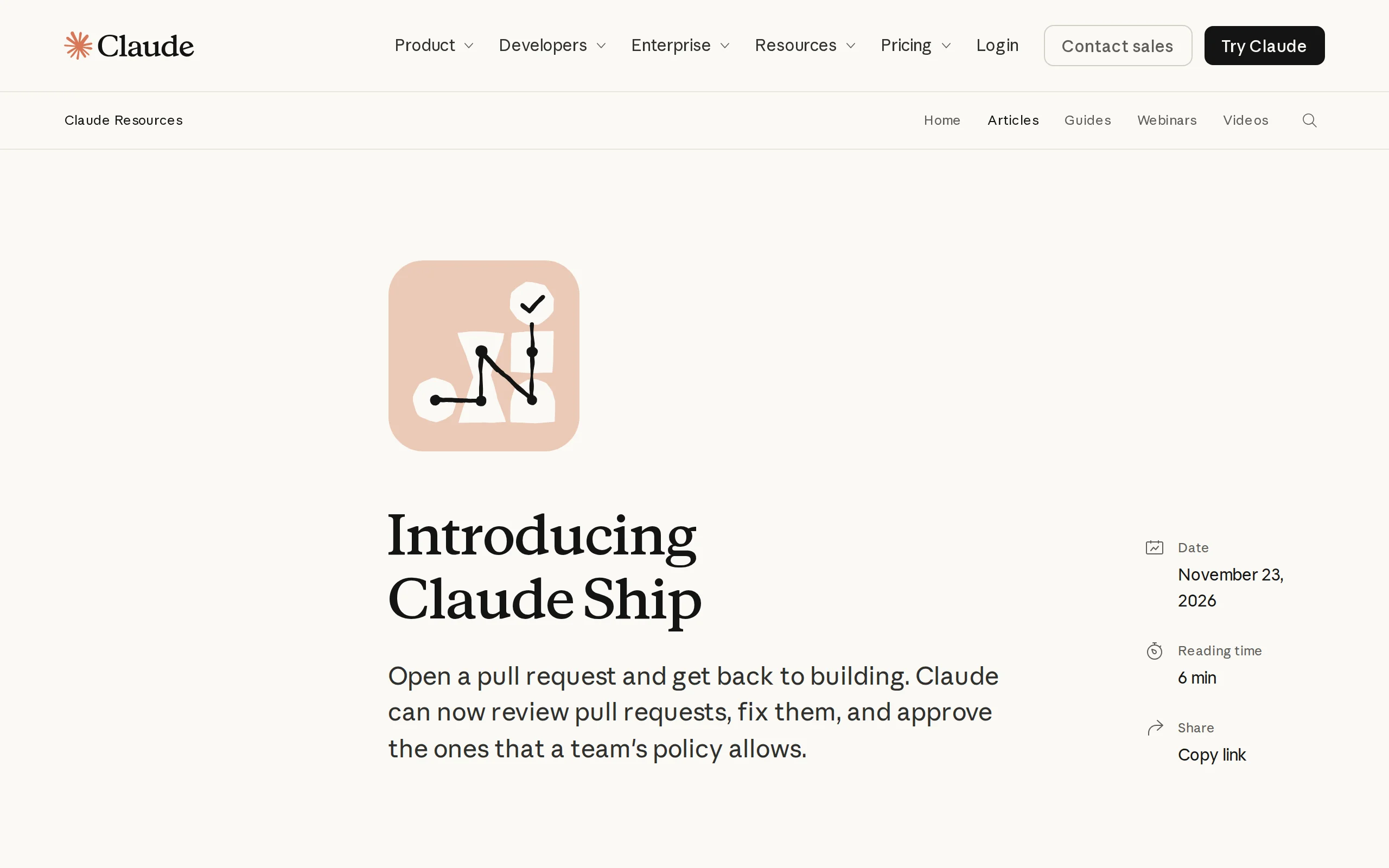
Claude Ship is an AI development tool launched by Anthropic in June 2025, designed to automate the entire post-Pull Request (PR) workflow. This tool covers three critical stages: code review, issue fixing, and approval decisions. It is composed of three integrated components: the official Code Review, PR Steward, and Claude Approvals. Its core design philosophy is to delegate repetitive engineering tasks after PR submission to AI, while retaining the final merge authority with human developers, thus establishing a balance between automation efficiency and human oversight. As an extended capability of the Claude Code ecosystem, Claude Ship is directly integrated into GitHub workflows, enabling fine-grained permission control through repository-level policy files. This marks a key move by Anthropic in the field of software engineering automation.
Technical positioning and domain: Belongs to the AI-assisted Software Engineering domain, focusing on code review, CI failure handling, conflict resolution, and automation of approval processes. It is a representative product that extends from AI programming assistants to the management of the PR lifecycle.
Development background: Built by Anthropic based on the capabilities of its Claude large language model, this tool originated from the observation of the official team regarding bottlenecks in PR processing efficiency. Internal testing data from June to September showed that after enabling Claude Ship, the official team's PR merge count doubled, and the rollback rate decreased by over 40%. These results directly led to the product's official release.
Core value: Addresses three major pain points faced by development teams during the PR process: insufficient depth in code reviews, repeated human resource consumption due to CI failures and merge conflicts, and inflexible approval processes. By implementing multi-tier AI reviews, automatic fix suggestions, and policy-based approvals, Claude Ship significantly increases the throughput of PR handling. It does not replace human decision-making but transforms PR processing from a labor-intensive manual task into an AI-driven high-speed pipeline, with the final merge authority always remaining in the hands of human developers.
Technical features:
- Full lifecycle coverage, forming a complete closed loop from review to fix to approval decision-making
- Governance model where "policy is code," with approval rules stored in the
.claude/approvals.ymlfile within the repository and under version control - Flexible collaboration mode, supporting seamless switching between fully automated operation and human intervention
- Seamless compatibility with existing GitHub toolchains, supporting branch protection and required status checks
2. Key Features
Official Code Review: A multi-dimensional code review engine now fully launched, supporting three levels of review intensity: Quick, Standard, and Deep. Quick is suitable for rapid syntax and basic standard checks, Standard balances depth and speed, and Deep performs in-depth line-by-line analysis. According to Anthropic's official data, during the internal testing period from June to September, the official team's PR merging efficiency doubled, and the rollback rate decreased by over 40%, verifying the practical effectiveness of its review quality.
PR Steward: Automatically handles CI failures, merge conflicts, and various review comments. It can identify the cause of a CI failure and proactively fix it, adjust conflicting code, and automatically push changes after modifying the code based on review feedback. By design, it cannot approve or merge PRs, and every code change is accompanied by a modification note and a way to revert, ensuring that human developers can always fully control the changes.
Claude Approvals: An approval strategy engine based on version control, which automatically determines which PRs can be directly approved by AI and which must be reviewed manually, based on the
.claude/approvals.ymlfile in the repository. Strategy definitions are based on dimensions such as file modification paths, branch rules, and tags, and support defining custom classifiers using natural language, providing a declarative configuration solution for complex approval logic.Personal /ship Command: A simplified entry point for individual developers. By entering
/shipin Claude Code 2.1.330 or higher versions, Claude automatically completes the full cycle of code submission, branch pushing, PR creation, self-review, and fixing. This mode is designed as a fully automated process, but the final merge action remains a manual operation, making it suitable for efficient iteration in personal projects.Administrator Fine-Grained Control: The team version allows administrators to enable features on a repository-by-repository basis, configuring review levels (Quick/Standard/Deep), trigger conditions, and spending limits. An observation mode is provided, allowing administrators to observe AI's review and fixing behavior before officially enabling it, ensuring the rules are reasonable before switching to automatic execution, thereby reducing the risk of introducing AI workflows.
Permissions and Billing Safeguards: Changes to approval rule configurations themselves require approval from two administrators to ensure security. The service bills based on tokens and supports setting limits to prevent resource overuse. It should be noted that Claude Ship does not support enabling Zero Data Retention, HIPAA compliance, or organizations with their own encryption keys, clearly defining its boundaries for data processing.
3. Application Scenarios
Rapid Iteration for Individual Developers: After making code changes, independent developers can input
/shipin Claude Code, and Claude automatically completes the submission, push, creation of a PR, and the self-review and fix loop. Developers only need to return to GitHub and click merge after receiving a notification, making it ideal for personal projects that require frequent small iterations.Non-engineers Submitting Fix Requests: Product managers or customer support can directly provide customer feedback in natural language to Claude, allowing the AI to complete the entire process from opening a PR to self-review. Fixes can be merged the same day, significantly reducing the dependency of non-technical roles on engineering teams.
Handling PR Surges in Large Teams: For teams with a high volume of PRs, let Claude perform the first round of automated review before human inspection. Potential issues are flagged and fixed in advance, allowing human reviewers to focus their energy on high-value logical judgments and architectural evaluations. The CLN team uses this model to achieve human-machine collaborative review.
Daily Operations for CI and Dependency Maintenance: PR Steward automatically handles minor fixes caused by CI failures, merge conflicts, and dependency upgrades, effectively reducing the time developers spend on routine maintenance tasks. Each automated change comes with a rollback method, allowing teams to safely authorize AI to handle repetitive maintenance work.
Standardization of Complex Approval Policies: For enterprise repositories requiring detailed access control, define which paths and branches can be automatically approved and which must be manually reviewed using the
.claude/approvals.ymlfile. This allows approval policies to be treated as code assets and included in version control, ensuring transparency and auditability.
4. How to Use
Verify Account and Plan: Log in to claude.ai as an Owner and confirm that the organization is using the Team or Enterprise plan. Note that the organization must not have Zero Data Retention, HIPAA, or bring-your-own encryption keys enabled, as these will prevent activation. Eligible Team or Enterprise organizations can claim at least $10,000 in Ship credits as startup funds before January 15, 2027.
Access Settings and Management Page: Navigate to Organization settings > Claude Ship management page on claude.ai. This page serves as the configuration entry point for all features. Eligible Team or Enterprise organizations can view their available Ship credits for deductions here.
Connect GitHub and Install the GitHub App: Click Connect to authorize a GitHub account and link the Claude organization to your GitHub account. Then, on the GitHub installation page, select the repositories you want to authorize and grant the necessary permissions. After installation, return to the Claude page and link the GitHub App to your Claude organization.
Add Repositories and Enable Review: In the Add a repository dialog box, select the repositories where you want to enable the feature. You can choose to apply it across all repositories in the GitHub organization. After adding, turn on the Review switch and click Turn on, then select the functional modules you want to enable, such as Code Review, in the pop-up window.
Configure Review Parameters: At the organization level or on a per-repository basis, choose the review level (Quick, Standard, Deep) and trigger timing, and set an expenditure limit. It is recommended to first pilot the Standard level on a single repository with a set limit, confirm the effectiveness, and then expand the scope of application.
Enable PR Steward and Approvals: Teams that have enabled Code Review can directly add the PR Steward component to the repository. Then, create a .claude/approvals.yml policy file on the default branch of the repository, defining the scope of changes that can be automatically approved and the conditions requiring manual approval. Run Approvals in observation mode first to verify the reasonableness of the rules, then switch to automatic execution.
Individual Developer Usage of /ship: Upgrade Claude Code to version 2.1.330 or higher. After making code changes, type
/shipin the session. Claude will automatically perform the commit, push, create a PR, review, and fix issues. Once the fixes are complete, return to GitHub to manually complete the final merge.
5. Pros and Cons Analysis
| Pros |
|---|
| End-to-end automation coverage: From code review after PR submission, issue fixing, to approval decision-making, it forms a complete closed-loop. Developers only need to focus on writing code itself, significantly reducing engineering redundancy in PR processing. Real-world testing has shown that team merging efficiency doubles. |
| Significant real-world effectiveness: Internal testing data from the official team between June and September shows that the number of merged PRs more than doubled, and the rollback rate decreased by over 40%, indicating that the AI review plus automatic fixing model indeed improves code delivery quality. |
Governance model of "policy as code": Approval rules are stored in the repository as a .claude/approvals.yml file and are under version control. Teams can manage AI permission boundaries just like managing code, ensuring that approval logic is transparent, auditable, and traceable. |
Flexible and controllable human-AI collaboration: Supports gradual activation in observation mode. The @claude instruction can be used at any time to guide or halt PR Steward operations. Each automatic change is annotated with the method of modification and how to revert it, ensuring humans always retain the final decision-making authority, which reduces the trust barrier when introducing AI. |
| Compatibility with existing workflows: Seamlessly integrates with GitHub branch protection and required checks. It does not require teams to replace their existing toolchain. The automatic merge operations of PR Steward strictly follow existing branch protection rules, reducing resistance to implementation. |
6. Comparative Analysis with Similar Tools
| Comparison Dimension | Claude Ship | Google Stitch Loop |
|---|---|---|
| Covered Stages | Review + Fix + Approval decision, covering the full PR lifecycle in a closed loop | Detect bugs, modify code, submit PR, with continuous 7×24 operation as the core model |
| Approval Method | Claude can directly approve PRs when rules allow, with policies controlled by the .claude/approvals.yml file |
All changes must be manually approved; AI cannot bypass approval, and full approval authority remains with humans |
| Access Control | Fine-grained control at the repository level with policy files, supports natural language custom classifiers, and administrators can set review levels and spending limits | Manual review is the only checkpoint, with no automated approval mechanism based on policies |
| Operation Mode | Native integration with GitHub, supports triggering via the /ship command or team-level automatic execution, and can be intervened at any time using @claude |
Continuously autonomous operation, similar to an AI engineer on constant duty, does not require human initiation |
| Team Control Capability | Administrators can set review levels (Quick/Standard/Deep), operation timing, spending limits, and support observation mode for preliminary validation | Operates based on human workflow, lacks fine-grained operational parameters and budget control mechanisms |
| Integration Ecosystem | Deeply integrated with Claude Code, compatible with GitHub branch protection and required checks, supports multi-person collaboration | Designed for continuous automated operation scenarios, tightly bound to the Google ecosystem |
Selection Recommendations: For teams that have deeply adopted Claude Code and have a high volume of PRs, Claude Ship is the most natural choice due to its full lifecycle automation and policy-based approval, especially suitable for engineering organizations aiming to balance AI automation with human oversight. Individual developers or small teams can start with the /ship command to lower the usage threshold. For teams with extremely high approval compliance requirements or those deeply tied to non-GitHub platforms, the Google Stitch Loop model or maintaining a traditional manual review process may be more appropriate. It is important to note that Claude Ship retains human decision-making authority for the final merge, while Stitch Loop relies entirely on manual approval. Their differing positions on the automation boundary are key considerations when choosing between them.
7. Editor's Summary
Claude Ship has chosen a niche entry point in the field of AI-assisted software engineering: "PR post-merging full-process automation." This approach complements rather than directly competes with mainstream AI programming assistants on the market. Its core technological innovation lies in shifting AI's automation capabilities from the "code writing" phase to the "code management" phase—the latter often being a bottleneck in team efficiency. According to official beta data, the results of doubling PR merging efficiency and reducing rollback rates by over 40% are quite compelling, indicating that combining AI review with automatic fixes can indeed enhance both PR throughput and code stability.
What makes Claude Ship more noteworthy is its governance design: declarative configuration of approval rules, observation mode, administrator limits, and the principle of retaining final merge authority in human hands. These features reflect Anthropic's cautious approach to the "trust boundary" issue when introducing AI into engineering workflows. It's not about simply letting AI replace humans, but rather enabling teams to define AI's permission boundaries through strategic configuration. This aligns well with the compliance requirements essential for enterprise-level implementation.
For target users, Claude Ship is most appealing to teams already using Claude Code, as it seamlessly extends their automation capabilities. Its heavy reliance on the GitHub ecosystem makes it more suitable for teams that use GitHub as their unified code hosting platform. Individual developers can immediately experience efficiency gains through the /ship command, while large teams will need to invest time in designing approval strategies. Overall, Claude Ship represents a steady evolution of AI in the direction of software engineering automation—seeking a configurable balance between human control and machine efficiency. This philosophy is likely to facilitate its actual adoption within engineering teams.
8. FAQ
Q: What is the relationship between Claude Ship and Claude Code?
A: Claude Ship is an extended capability module of the Claude Code ecosystem, running in the form of a GitHub App and cloud service. Claude Code is a command-line programming assistant provided by Anthropic. Individual developers can invoke Claude Ship's automation capabilities by entering /ship in Claude Code 2.1.330+. Team-level PR automation is achieved through integration with the Claude GitHub App.
Q: Is Claude Ship's automatic approval safe? How do approval rules prevent abuse?
A: Claude Ship features multiple layers of security mechanisms: the policy file itself must be stored in the default branch of the repository and be under version control. Any PR that changes the approval rules must be approved by two administrators. All automatic changes will include notes explaining the modifications and how to revert them. Administrators can also set spending limits and use observation mode to first validate AI behavior before officially enabling it.
Q: Which organizations are not eligible to use Claude Ship?
A: Organizations that have enabled Zero Data Retention, HIPAA compliance mode, or use自带 encryption keys cannot use Claude Ship. In addition, organizations must be on a Team or Enterprise paid plan to enable the team version features. These restrictions are consistent with the data processing boundaries of Claude's enterprise edition.
Q: How is the cost of using Claude Ship calculated? How can I control costs?
A: Claude Ship is billed based on tokens, with costs related to the amount of code reviewed, the depth of review (Quick/Standard/Deep), and the frequency of automatic fixes. Administrators can set spending limits for each repository or for the entire organization. It is recommended to first test with the Standard tier on a single repository to evaluate costs before expanding usage. Eligible organizations can claim at least $10,000 in Ship credits before January 15, 2027.
Q: PR Steward modified my code. Can I track its changes?
A: Yes. Every change made by PR Steward will note which specific files were modified, the reason for the modification, and how to revert it. It cannot approve or merge PRs; the final decision to merge always remains with human developers. Combined with GitHub's commit history, you can fully track all changes made by AI.
9. Project Links
- Product Official Website: https://claude.com/resources/articles/introducing-claude-ship
- Product Experience Entry: https://claude.ai (requires a Team or Enterprise organization account, configure in the Organization settings > Claude Ship management page)
- Claude Code Download and Documentation: https://claude.com/product/claude-code
Related
earshot: Open-Source AI Audio Tool That Adds Auditory Capabilities to Programming Agents
earshot is an open-source AI audio tool developed by independent developer Leonxlnx. Its core objective is to grant programming agents the ability to hear and understand sound. This tool can perform a...

Shotkit: Open-Source AI Pre-Production Tool, a Creation Pipeline Centered on Brand Consistency
Shotkit is an open-source AI pre-production tool developed by the WhyStrohm team, running as a Claude Code plugin and offering a Mac desktop application called Canvas. This tool builds a complete bran...
GLM-5.4 —— Zhipu AI Launches Its First Flagship Model Using Loop Transformer Architecture, Unlocking 2–3T-Level Intelligence with Shared-Weight Cycles
GLM-5.4 is Zhipu AI's first-generation flagship large language model that adopts the Loop Transformer architecture. By enabling a set of layers with shared weights to perform multiple rounds of infere...
Hy4 flash – Tencent HunYuan's High-Cost-Performance Large Model
Hy4 flash is a high-cost-performance large model launched by Tencent HunYuan, which employs a sparse mixture-of-experts (MoE) architecture with a total of 224B parameters and 12B active parameters. It...
© All Rights Reserved. Some content on this site is partially generated by AI with human review.