
HungerG – Qoder's Anonymous Programming Model, Now Available for Free Public Trials
Executive Summary:
HungerG is an anonymous programming model launched by Qoder, currently open to the public for free trials on a time-limited basis. The core positioning of this model is not to attract users through br...
1. What is HungerG
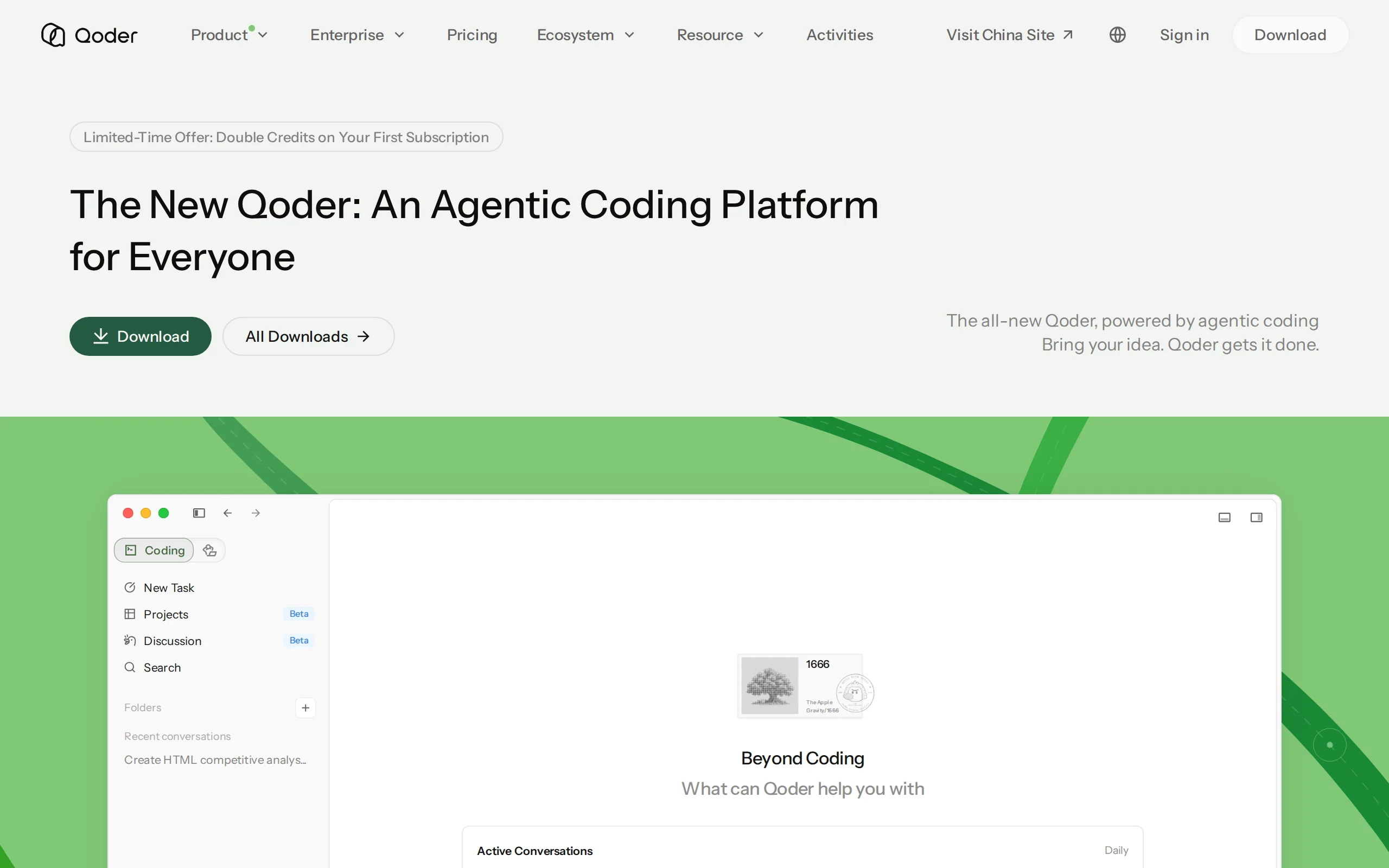
HungerG is an anonymous programming model launched by Qoder, currently open to the public for free trials on a time-limited basis. The core positioning of this model is not to attract users through brand credibility or public parameters, but rather to emphasize verifying its capabilities through real development tasks. The official has not yet disclosed the development team, specific model variants, or formal benchmarks, and explicitly states, "We don't rely on reputation, but on real tasks to validate our capabilities." During the event period from November 23 to November 30, 2026, users of Qoder, Qoder IDE Personal Edition, and free accounts can participate in the trial without any restrictions. Using HungerG does not consume Credits and has no daily usage limit. HungerG covers typical programming scenarios such as code generation, bug detection, project modification, from-scratch development, requirement clarification, and multi-round iteration, aiming to become an auxiliary tool for developers in their daily coding tasks.
Technical Positioning and Domain: HungerG is an AI-assisted programming tool that lies at the intersection of natural language processing and software engineering, focusing on code generation, defect diagnosis, and project-level code modifications. Unlike most programming models, HungerG deliberately conceals its model identity, allowing users to focus on the quality of task completion rather than brand or parameter prestige.
Development Background: This model was launched by Qoder, an AI programming platform aimed at developers, offering products such as Qoder IDE. The official has not yet disclosed the underlying architecture, parameter count, or training details of HungerG, a practice that is relatively rare in the industry. This approach aims to avoid preconceived biases through anonymization design, using only actual task outcomes as the sole evaluation standard.
Core Value: HungerG addresses multiple pain points developers face during the coding process: difficulty in starting when requirements are unclear, time-consuming bug identification, high risk in project modifications, and significant costs in building from scratch. It enables developers to quickly turn vague ideas into executable code through multi-round iteration and project context integration. Additionally, it allows users to complete the closed-loop process of generating, reviewing, and applying patches directly within the IDE, reducing context-switching costs.
2. Key Features
Code Generation: Generates functions, scripts, components, or small interactive pages based on natural language requirements. This feature is ideal for quickly building code snippets or prototype pages. Developers only need to describe their goals in natural language, and HungerG can output directly runnable code, reducing the time cost from idea to implementation.
Bug Localization: Analyzes the root cause of issues and provides verifiable fixes by combining error messages, runtime logs, and reproduction steps. This feature does not simply match error keywords, but instead infers potential failure points along the code path, outputting fix diffs and verification steps to help developers efficiently locate complex bugs.
Project Modification: Executes tasks such as refactoring, migration, adding tests, and adjusting dependencies within an existing codebase. This capability emphasizes a comprehensive understanding of the existing project, enabling it to assess the impact of changes, output incremental patches, and perform compatibility checks, thereby reducing the risk of regression from large-scale modifications.
From Scratch Development: Quickly sets up a runnable application skeleton, including directory structure, interface definitions, page prototypes, and basic deployment configurations. Developers only need to specify the goal, technology stack, and acceptance criteria, and HungerG can generate a starting point for a runnable project, facilitating the rapid validation of product ideas.
Requirement Clarification: Breaks down vague ideas into task lists, boundary cases, and implementation paths. This feature is suitable for stages where product requirements are not yet clear. HungerG helps organize user flows, data models, and MVP scope, aiding in transforming abstract concepts into executable task lists.
Multi-round Iteration: Continuously modifies implementation details based on user feedback, checks for missing constraints, and maintains implementation consistency. During long-term, multi-round interactions, HungerG can track requirement changes and avoid structural disharmony caused by localized modifications.
3. Application Scenarios
New Project Prototype Validation: Starting from an empty repository, define the product goals, technology stack, and acceptance criteria, and let HungerG generate the directory structure, runnable pages/APIs, initial test cases, and startup commands. Developers can use this to quickly validate whether an idea is worth investing resources in for further development, significantly shortening the early research and prototype setup phase.
Legacy Code Maintenance and Refactoring: Import an existing project and provide constraints for refactoring, migration, or dependency upgrades (such as performance requirements, compatibility boundaries), and let HungerG output impact analysis, incremental patches, compatibility checks, and regression testing recommendations. This scenario is suitable for high-risk operations such as technical debt cleanup and framework upgrades, helping to reduce unknown risks introduced by changes.
Troubleshooting Difficult Bugs: Paste the error stack trace, runtime logs, minimal reproduction steps, and expected behavior into HungerG, allowing it to infer the root cause along the code path and provide a fix diff and verification steps. This scenario is especially effective for time-consuming issues that have taken hours to troubleshoot, helping developers quickly narrow down the investigation scope and reduce downtime.
Ambiguous Requirement Clarification: Hand over unclear product ideas to HungerG, asking it to list user flows, boundary cases, data models, API drafts, and MVP scope. This scenario is ideal for product managers, entrepreneurs, or independent developers during the project initiation phase, transforming vague concepts into clear task lists and reducing rework later on.
Frontend Interactive Demo Creation: Describe the page structure, animations, component states, and responsive requirements, and let HungerG generate a previewable demo. Based on review feedback, it can iteratively modify details. This scenario is suitable for internal presentations, requirement reviews, or rapid prototype iteration before user testing, improving communication efficiency.
4. How to Use
Access the Experience Portal: Open the Qoder or Qoder IDE client and log in with your personal account. The HungerG activity is open to all new and existing individual users of the Qoder international and CN versions. Free accounts can also participate without requiring special applications or invitation codes.
Select the Model: Locate the HungerG experience portal in the model selector of the editor or platform, and switch to the HungerG model. During the activity period (from 24:00 on November 23, 2026, to 24:00 on November 30, 2026), calling this model does not consume Credits and has no daily usage limit. Even when the thinking intensity is set to the highest level, it is billed at 0 times.
Prepare the Context: Create a new task or open an existing local project/repository as the analysis context. HungerG performs better when combined with project context. It is recommended to include relevant files, dependency lists, or configuration files in the context to help the model understand the code structure and business logic.
Describe the Requirements: Clearly state the goal in one sentence and add necessary constraints, file paths involved, error logs, or expected output formats. The more specific the requirement description, the closer the generated solution or code will be to the actual needs. It is recommended to use a structured description format of "Goal + Constraints + Example."
Generate and Review: After submitting the requirements, let HungerG generate the solution, code, or patch. All generated results should be reviewed before applying them to the project. Check whether they meet the requirements, identify any missing boundary conditions or potential side effects, and confirm accuracy before merging into the codebase.
Run and Validate: Run test cases or launch the page in a local or CI environment to verify whether the generated results meet the expected requirements. If issues are found, collect failure logs, missing points, or new requirement changes and continue to provide feedback to HungerG for iterative refinement.
Iterative Refinement and Retrospective: Repeat the "feedback—generation—validation" cycle until the results meet the acceptance criteria. After confirming that all modifications are correct, save the changes and record evaluations based on dimensions such as correctness, response speed, and patch quality. These records can serve as reproducible assessment references for comparing the performance of different models in the future.
5. Pros and Cons Analysis
| Pros |
|---|
| Low Barrier Free Trial: During the event period, all personal edition and free users can experience the model. Calls do not consume Credits and have no limit on the number of uses, providing developers with a zero-cost opportunity to evaluate the model. |
| Anonymous Verification of Real Capability: By hiding the model's identity, users can judge based on actual task results rather than brand reputation, making the evaluation more objective and valuable as a reference. |
| Closely Aligned with Real Development Scenarios: It covers the complete workflow from requirement clarification to code generation, bug detection, and project modification, not just a "text-to-code" tool, offering strong practicality. |
| Closed-loop Operation within the IDE: Directly generate, review, and apply patches within the Qoder/Qoder IDE, combined with project context, reducing the cost of switching tools and improving development efficiency. |
6. Comparative Analysis with Similar Tools
| Comparison Dimension | HungerG | GitHub Copilot | DeepSeek Coder |
|---|---|---|---|
| Core Architecture | Officially not disclosed; parameter count and architecture unknown; emphasizes integration with project context. | Based on OpenAI Codex model, using Transformer architecture, with large parameter scale. | Based on DeepSeek's self-developed MoE architecture, offering multiple parameter versions from 1.3B to 33B. |
| Performance Metrics | No official benchmark scores yet; emphasizes real task validation; some users report fast response times. | Stable performance on benchmarks like HumanEval, with low code completion latency. | Outstanding performance on benchmarks like HumanEval and MBPP, ranking among the top in open-source models. |
| Feature Highlights | End-to-end capabilities covering code generation, bug detection, requirement clarification, and project refactoring. | Focuses on code completion and inline suggestions, with supplementary chat-style Q&A. | Specializes in code generation and completion, supports multiple programming languages, and provides open-source weights. |
| Deployment Method | SaaS cloud service, accessible via the Qoder platform and IDE. | SaaS cloud service, supports integration as an IDE plugin. | Supports both SaaS calls and local private deployment, capable of offline operation. |
| Usability | Seamlessly used within the Qoder IDE, no additional installation required; low operational threshold. | Can be used by installing a plugin, with comprehensive support for mainstream IDEs. | Requires API calls or local deployment, with a certain technical threshold. |
| Open Source License | Open source status not disclosed; currently provided as a commercial service. | Closed-source commercial software, charged on a subscription basis. | Open-source model weights, commercial use requires compliance with the corresponding license. |
| Community Ecosystem | Relies on the Qoder ecosystem; the community is still under development, with limited third-party resources. | Large community, with abundant plugin, tutorial, and third-party tool resources. | Active open-source community, high download volume on Hugging Face, and numerous third-party fine-tuned versions. |
Selection Recommendations: If developers require end-to-end programming assistance that deeply integrates with project context and are willing to experience and accumulate real task evaluation data during the trial period, HungerG is worth prioritizing for testing—its zero-cost and unlimited usage features make it ideal for systematic validation. If stable code completion experience and mature IDE integration are priorities, GitHub Copilot remains a reliable choice. If local deployment and data privacy are important, DeepSeek Coder's open-source weights offer greater flexibility. If multi-model switching and project-level refactoring capabilities are needed, Cursor's integrated solution is more appealing.
7. Editor's Summary
HungerG enters the programming model arena under an anonymous identity, a strategy that is relatively rare in the industry and gives it a unique evaluation value. From the perspective of technological innovation, it does not rely on novelty in architecture or parameters, but instead uses a "de-branded" design to guide users to focus on the quality of task completion. This approach holds positive significance in evaluation methodology — it allows the model to be tested on real development tasks rather than relying on benchmark rankings or vendor promotions. In terms of practical value, HungerG covers six key capabilities that fully connect critical development stages such as requirement clarification, zero-to-hero development, code generation, bug localization, and project modification, forming a closed-loop operation within the Qoder IDE, making it especially user-friendly for individual developers and small teams. During the event period, it does not consume Credits and has no limit on the number of uses, significantly reducing evaluation costs and enabling users to compare accuracy, patch quality, latency, and context utilization capabilities across the same set of tasks. In terms of target users, this model is suitable for three categories: first, individual developers who want to verify AI programming assistants at a low cost; second, team engineers who need to handle legacy code refactoring and bug localization; and third, AI researchers interested in model evaluation methods, who can obtain relatively unbiased empirical data through the anonymous mechanism. Regarding future development potential, HungerG's anonymous identity will be revealed on November 30th. At that time, if its technical foundation is made public, it will help users form more rational expectations. Whether the official continues to offer free or low-cost options after the event will directly impact user retention and the accumulation of technical reputation. Overall, HungerG represents a practical attempt focused on real task validation. Its value does not depend on whether its identity is prestigious, but rather on its ability to consistently deliver qualified results in the daily work of developers.
8. FAQ
Q: What exactly is HungerG? Why isn't the official team disclosing its model identity?
A: HungerG is an anonymous coding model launched by Qoder. The official team intentionally withholds information about its development team, underlying architecture, and parameter count, aiming to let users evaluate it solely based on task completion quality and avoid preconceived biases related to brand or specifications. Its identity will be revealed after the event concludes on November 30.
Q: What are the specific rules for the free trial event?
A: From 24:00 on November 23, 2026, to 24:00 on November 30, Qoder International and CN versions will offer a limited-time free trial of HungerG to all individual users, both new and existing. During the event, using this model will not consume Credits, with no daily usage limits. Even when the thinking intensity is set to the highest level, it will remain free.
Q: What is the relationship between HungerG, Qoder, and Qoder IDE?
A: HungerG is a model that runs on the Qoder platform, and Qoder IDE is an integrated development environment product launched by Qoder. Users can switch to HungerG via the model selector in Qoder or Qoder IDE and perform code generation, patch application, and other operations in conjunction with the project context.
Q: Which programming languages does HungerG support?
A: The official team has not yet disclosed the list of programming languages supported by HungerG. Based on its functional description, it appears to be designed for general-purpose programming scenarios, suggesting it likely covers major languages (such as Python, JavaScript, Java, Go, etc.). However, the exact range of supported languages and their respective levels of optimization require further clarification from the official team.
Q: Will HungerG still be available after the event ends? Will it be charged?
A: The official team has not yet announced the pricing policy or billing plan for HungerG after the event concludes on November 30. At that time, the model's identity will be revealed, and the subsequent usage method is expected to be announced simultaneously. It is recommended that users collect evaluation data during the event period to determine whether it is worth paying for.
9. Project Links
- Qoder Official Website: https://qoder.com
- HungerG Free Trial Official Announcement (International Version): http://docs.qoder.com/events/hungerg-free
- HungerG Free Trial Official Announcement (Chinese Version): http://docs.qoder.cn/events/hungerg-free
Related
SpatialScout Evaluation: An Open-Source 3D Spatial Intelligence Benchmark Jointly Developed by Peking University and Tianjin University
SpatialScout is an open-source 3D spatial intelligence evaluation benchmark jointly developed by research teams from Peking University and Tianjin University. It includes 80 physically simulated indoo...
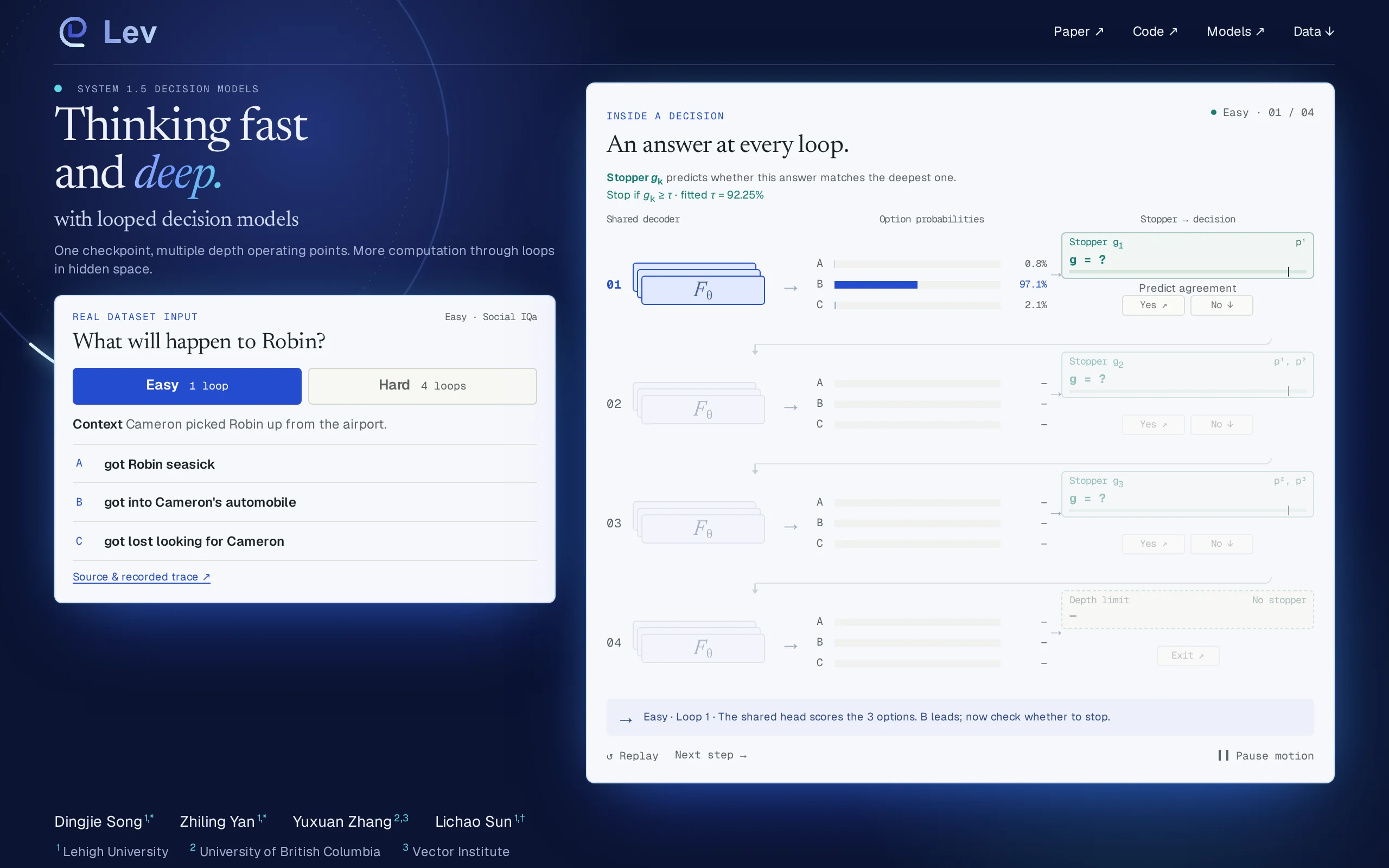
Lev – Open-Source Decision Model Developed by Lehigh University and Others: On-Demand Deep Thinking under Native Cyclic Architecture
Lev is an open-source decision model introduced by academic institutions including Lehigh University. Its core innovation lies in its native cyclic architecture (Ouro/Nanbeige), which enables the same...
GPT-6.2 Astra – OpenAI's Flagship Large Model
GPT-6.2 Astra is OpenAI's flagship cutting-edge model, designed as a specialized solution for complex professional projects. Compared to its predecessor, GPT-6 Astra, this model has achieved significa...
In-Depth Review of Gemini 4 Neon: The Performance Balancer in Google's Flagship Family
Gemini 4 Neon is a key member of Google's Gemini 4 family, precisely positioned between the flagship Carbon and the efficient Hydrogen, specifically designed for high-frequency, complex production-lev...
© All Rights Reserved. Some content on this site is partially generated by AI with human review.