
In-Depth Review of Gemini 4 Neon: The Performance Balancer in Google's Flagship Family
Executive Summary:
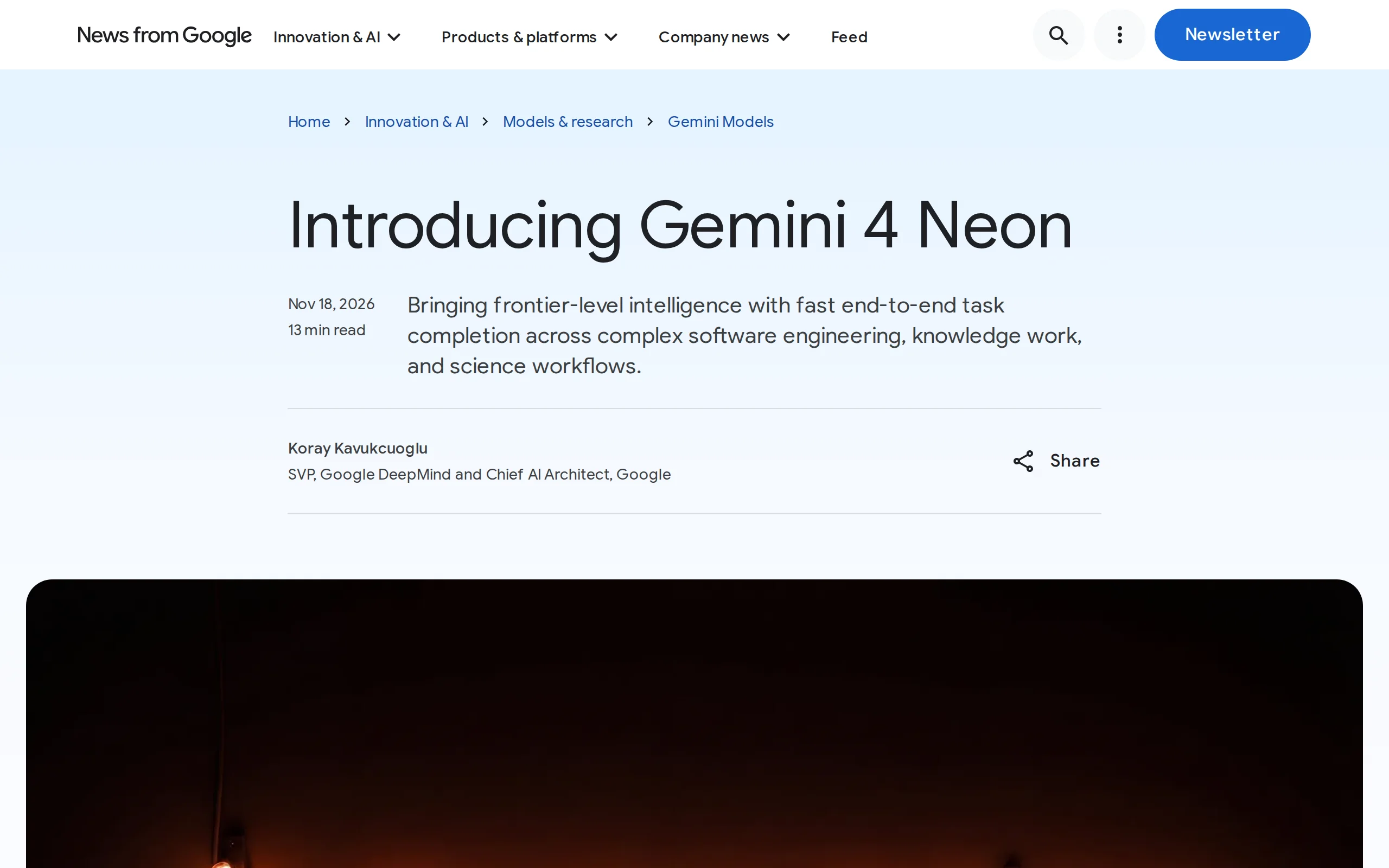
Gemini 4 Neon is a key member of Google's Gemini 4 family, precisely positioned between the flagship Carbon and the efficient Hydrogen, specifically designed for high-frequency, complex production-lev...
1. What is Gemini 4 Neon
Gemini 4 Neon is a key member of Google's Gemini 4 family, precisely positioned between the flagship Carbon and the efficient Hydrogen, specifically designed for high-frequency, complex production-level workloads. Neon achieves a response latency three times faster than Carbon while consuming only 60% of the cost, and supports a context window of up to 1 million tokens with four adjustable thinking depth levels. It ranks among the top in the industry across multiple professional benchmarks, including programming, legal and tax matters, scientific reasoning, and cybersecurity. This differentiated positioning makes Neon a bridge between ultimate performance and practical cost-effectiveness, offering enterprises and developers a pragmatic choice that balances intelligence level with operational cost.
Technical Positioning and Domain: Gemini 4 Neon belongs to the domain of large-scale multimodal language models, developed by Google's DeepMind team. It uses the same model architecture as Carbon but with optimized, streamlined inference pathways. Its core positioning is to serve production-level AI application scenarios that require high-frequency calls, high task complexity, and cost sensitivity, filling the market gap between flagship performance and efficient deployment.
Development Background: Based on the R&D accumulation of the Gemini 4 series, Google DeepMind designed Neon as an intermediate-tier model to address common pain points in enterprise-level AI applications, such as high inference costs and slow response times. Through optimization of inference computation allocation and training strategies, Neon achieves significant improvements in speed and cost reduction while maintaining a comprehensive intelligence level close to the flagship, demonstrating Google's product strategy in multi-model hierarchical deployment.
Core Value: Neon resolves the core contradiction of cutting-edge large models in practical deployment: "too expensive to use and too slow to run." It enables complex programming tasks, long-range agent workflows, and enterprise knowledge processing scenarios to be deployed at scale with controllable costs, providing an economically viable path for AI to transition from technical demonstrations to actual productivity.
2. Key Features
Production-grade code development: Supports multi-file debugging, refactoring, and "surgical editing" operations, enabling precise identification and modification of specific code segments without affecting other functionalities. It ranks first in the Artificial Analysis programming agent index and achieves a 39.0% pass rate on the SWE-sweep benchmark in the Antigravity environment, making it capable of handling full-cycle development for complex engineering tasks.
Multimodal understanding across millions of tokens: Processes content in various formats such as spreadsheets, PDFs, charts, audio, and video within a single window, and integrates them to produce structured deliverables. This capability significantly reduces context-switching costs when handling long documents, making it especially suitable for enterprise knowledge work scenarios requiring comprehensive analysis of multi-source materials.
Adjustable reasoning depth: Offers four levels of reasoning depth—low, medium, high, and highest—allowing developers to flexibly adjust the depth of reasoning and token consumption based on task complexity. By default, the high setting places it on the Pareto frontier of the Vals Index and Agent Arena, while the xhigh setting enables deeper multi-step reasoning to tackle the most challenging engineering and scientific problems.
Agent orchestration and scheduling: Can operate as a high-speed "scheduler" role, using the /swarm command to direct multiple Hydrogen sub-agents to work in parallel on long-range tasks. The design minimizes redundant file reads, enables progress sharing, and ensures reliable context compression, unlocking comprehensive capabilities beyond single-model execution in environments such as Google Antigravity.
Cybersecurity capabilities (Neon for Cyber): Covers the full workflow of secure code generation, vulnerability detection, verification, and patching. Achieves a 0.0% attack success rate on the Gray Swan indirect prompt injection benchmark, helping defenders complete penetration testing and code hardening at half the cost of traditional approaches.
Secure alignment execution: Reduces improper behavior to 0.09% through chained reasoning and behavioral monitoring, with a 99.2% rate of honest evaluation. The training objective explicitly prohibits taking shortcuts, fabricating results, or overstepping authority, while keeping the rejection rate for normal tasks below 2%, achieving a balance between security and usability.
Enhanced consumer experience: Powers writing assistance, document reading, and multi-step Tasks functionality in Gemini applications, and is deeply integrated with Gmail and Docs, enabling ordinary users to access Neon-level intelligent assistance capabilities.
3. Application Scenarios
Enterprise Knowledge Work Automation: Suitable for professional fields such as legal research, tax analysis, financial reporting, and spreadsheet modeling. Neon can integrate materials from multiple sources, including PDFs, charts, audio, and video, to generate structured deliverables. It ranks first in multiple benchmarks across legal, tax, finance, and accounting domains, and also leads in the long-cycle business simulation Vending-Bench 2 test.
Production-Grade Software Engineering: Handles multi-file debugging, code refactoring, and precise code editing tasks, and can act as an orchestrator to schedule multiple sub-agents to work in parallel on long-term development projects. Official demonstrations show that Neon can apply the SWE-sweep method to manage complex repository-level tasks, significantly improving development efficiency and code quality.
Scientific Computing and Mathematical Research: Designed for quantitative analysis, mathematical reasoning, and technical research tasks, Neon achieves state-of-the-art performance in three scientific and mathematical benchmarks: Terminal-Bench Science, RiemannBench, and HLE-Diamond. In an official demonstration, Neon reconstructed Turing's library from archival photos continuously for 12 hours and successfully ran a general Turing machine, showcasing its reliability for long-duration autonomous operations.
Cybersecurity Defense: Through the Neon for Cyber specialized capability, security teams can complete the full cycle of secure code generation, vulnerability detection, verification, and patching. Eligible members of the Fairwind Program can gain dedicated access to achieve continuous penetration testing and code hardening at a lower cost.
Agent Automation Operations: Drives the Tasks feature in Gemini applications and enterprise automation workflows, enabling low-cost handling of complex, multi-step tasks. Neon's high speed and low latency make it an ideal choice for real-time interactive agent services, allowing it to quickly respond to user adjustments.
4. How to Use
The usage of Gemini 4 Neon varies depending on the user type, and Google provides diverse access channels to meet different scenario requirements. Here is the detailed usage guide for each major user group:
Developer Access: Developers can directly call the Neon model through the paid tiers of the Gemini API, quickly test prototypes in Google AI Studio, or integrate it into Android Studio to build AI-enhanced mobile applications. The API offers full model management, parameter configuration, and usage statistics features, supporting the entire workflow from prototype validation to production deployment.
Antigravity Platform Experience: Paid subscribers of Google AI Pro or Ultra can use Neon directly in the Google Antigravity environment. This platform includes intelligent agent orchestration capabilities, allowing users to dispatch multiple Hydrogen sub-agents in parallel using the
/swarmcommand. It is suitable for advanced users requiring complex workflow orchestration.AI Studio Trial: All Pro and Ultra subscribers can log in to Google AI Studio and switch to Neon in the model selector for online trials. This lightweight entry point is ideal for quickly verifying model capabilities and adjusting parameter settings, offering full functionality without the need to configure a local environment.
Enterprise Deployment: Enterprise users can access Neon through the Gemini for Business API or model dropdown menu, or use it in the Antigravity enterprise edition. Enterprise solutions provide dedicated resource quotas, data isolation, and a management console to meet compliance and governance requirements.
Consumer Use: Regular consumers only need to upgrade their Gemini application (web or mobile) to a Pro or Ultra subscription to switch the default model to Neon in the model selector, experiencing enhanced features such as document writing assistance, data reading and analysis, and multi-step Tasks.
Cybersecurity Special Access: Cybersecurity professionals who are members of the Fairwind Program will gain access to Neon for Cyber in the coming days. Alternatively, they can directly contact the cloud account team to request activation. This dedicated access channel will provide specialized toolchains for secure code auditing, vulnerability detection, and remediation.
Notes: The completeness of features varies across different access channels. Some advanced features in the consumer version (such as custom thinking level adjustment and agent orchestration) may be restricted. It is recommended that developers prioritize API integration for deep integration, in order to fully leverage all of Neon's technical capabilities.
5. Pros and Cons Analysis
| Pros |
|---|
| Speed and Cost Efficiency: Offers comparable intelligence levels to Carbon at three times the speed and only 60% of the cost. The cost per task is 36% to 80% lower than most state-of-the-art models, significantly reducing the economic barriers to large-scale deployment. |
| Outstanding Comprehensive Intelligence: The Artificial Analysis intelligence index ranks 3rd, and the Vals Index ranks 2nd. It consistently appears on the performance Pareto frontier and outperforms most peer competitors in standardized benchmarks. |
| Industry-Leading Specialized Capabilities: The programming agent index ranks 1st, and it leads in multiple professional fields including cybersecurity, legal and tax matters, and scientific and mathematical reasoning, demonstrating exceptional vertical domain expertise. |
| Excellent Safety Alignment: Achieved a 0.0% cheating rate in Terminal-Bench 4.0 testing, with indirect prompt injection attack success rates also at 0.0%, maintaining a high level of trustworthiness while ensuring task completion quality. |
6. Comparative Analysis with Similar Tools
| Comparison Dimension | Gemini 4 Neon | GPT-5 Series (OpenAI) | Claude Sonnet 4.5 (Anthropic) |
|---|---|---|---|
| Core Architecture | Multimodal Transformer, with a streamlined inference path derived from Carbon, supporting up to one million tokens of context | Multimodal MoE architecture, supporting cross-modal inputs including text, images, and audio | Text-centric multimodal model, emphasizing long document understanding and analysis |
| Performance Metrics | Speed is 3 times that of Carbon, with a cost of only 60%; ranks 3rd in intelligence index, 1st in programming Agent Index | Strong general-purpose inference capabilities, maintaining top positions in comprehensive benchmarks such as MMLU and GPQA | Outstanding long context handling and code generation capabilities, with leading HumanEval scores |
| Feature Highlights | 4 levels of thinking depth adjustment, /swarm agent orchestration, and Neon for Cyber specialized security capabilities | Built-in deep research mode, strong data analysis and visualization capabilities, and support for real-time internet search | Large context window enables efficient simultaneous processing of multiple documents, with stable tool calling |
| Context Window | 1 million tokens, supporting multi-modal long documents in a single window | Standard version: 128K tokens, Pro version: approximately 200K tokens | 1 million tokens (Beta), supporting ultra-long document analysis and cross-document reasoning |
| Deployment Method | Only available via cloud API, no local deployment option | Primarily cloud API, with enterprise version supporting private deployment | Cloud API, enterprise version supports VPC-isolated deployment |
| Pricing Strategy | Tiered pricing, with task cost 36% to 80% lower than most state-of-the-art models | Token-based billing, with higher prices for high-capacity tiers | API pricing is relatively high, but offers free quotas |
| Safety Alignment | Cheating rate 0.0%, prompt injection attack success rate 0.0%, rejection rate below 2% | Strong safety guardrails, but may exhibit over-rejection | Emphasizes safety, with robust performance in adversarial testing |
Selection Recommendations: For development teams deeply integrated into the Google technology stack, Neon is the optimal choice—it offers highly competitive speed and cost metrics while maintaining high intelligence levels, with leading performance in programming and agent capabilities in industry evaluations. Especially for scenarios involving high-frequency calls, cost-sensitive agent services, and automated workflows, Neon's cost-performance advantage will be fully realized.
For enterprises emphasizing data sovereignty, requiring local deployment, or highly sensitive to vendor lock-in, DeepSeek's open-source solution provides irreplaceable value, particularly for teams needing deep customization of model behavior. Claude Sonnet and GPT-5 have mature advantages within their respective ecosystems and are more suitable for projects already tied to specific cloud service providers or requiring particular feature integrations. Overall, Neon, with its balanced performance and cost, demonstrates strong appeal for production-grade AI deployment scenarios in the current market.
7. Editor's Summary
The launch of Gemini 4 Neon marks a significant leap in the "intelligence-efficiency" curve for cutting-edge AI models. For a long time, the industry has been forced to make trade-offs between intelligence levels and inference costs, but Neon makes this trade-off less acute through architectural-level optimizations—specifically, through the synergy of streamlined inference paths and a tiered thinking control mechanism. Its real-world performance data is compelling: three times the speed, 60% lower cost, while maintaining a comprehensive intelligence level close to that of flagship models. This combination of metrics gives Neon a differentiated competitive edge among its peers.
From a practical value perspective, Neon's most impressive feature is its "specialized yet all-around" nature. It is not simply a scaled-down version of the flagship model, but rather has established independent leadership in areas such as programming, cybersecurity, and scientific reasoning, thanks to Google's domain-specific training and alignment strategies. The release of the Neon for Cyber subset further demonstrates a viable path for vertical AI services, showcasing cost-effectiveness in penetration testing and code hardening tasks, which provides a meaningful reference model for AI applications in the cybersecurity industry.
Neon's positioning makes it more suitable for teams prioritizing practical results: high-frequency tool calling, cost-sensitive structures, and the need for rapid response in production-grade AI deployments are its ideal use cases. Its four-tier thinking depth adjustment mechanism also allows for fine-grained configuration across tasks of varying complexity. Looking ahead, as Neon becomes more deeply integrated into environments like Antigravity for intelligent agent orchestration, and as API costs continue to be optimized, its influence in the enterprise AI market is worth watching. The current generation of Neon has already demonstrated the feasibility of the product philosophy of "sufficient intelligence, outstanding efficiency," which will likely prompt more model developers to reevaluate their own product tiering strategies.
8. FAQ
Q: What is the core difference between Gemini 4 Neon and the flagship Carbon version?
A: Neon and Carbon share the same architectural foundation, but Neon uses a streamlined inference path, achieving 3 times the runtime speed and 60% lower cost with only a slight adjustment in overall intelligence levels. Carbon is designed for the most challenging long-range extreme tasks, while Neon is specifically optimized for high-frequency, cost-sensitive production-level workflows.
Q: How should one choose the four thinking depth levels in Neon?
A: The low level is suitable for quick Q&A and simple reasoning tasks, the medium level handles standard analysis, the high level (default recommendation) can reach the Pareto frontier in Vals Index and Agent Arena, and the highest level is reserved for the most complex engineering and scientific problems. Developers should dynamically adjust based on task complexity and budget requirements to achieve the optimal balance between intelligence level and token cost.
Q: How can regular users experience Gemini 4 Neon?
A: Regular consumers need to subscribe to the Pro or Ultra version of the Gemini app and then switch to Neon in the model selector to use it. Free users cannot access Neon at this time, but they can try other Gemini series models through the free tier of Google AI Studio.
Q: Does Neon support optimization for non-English languages such as Chinese?
A: As a multimodal model, Neon has multilingual understanding capabilities and can process inputs in Chinese, Japanese, and other languages. However, its benchmark tests have primarily been validated in English environments, and performance in Chinese scenarios requires more third-party real-world testing. Users with strict requirements for high-quality Chinese output are advised to conduct thorough language adaptation tests before formal deployment.
Q: Can Gemini 4 Neon be deployed on local or private cloud environments?
A: Currently, Neon is only available via the Google Cloud API and does not provide model weight downloads, making local deployment impossible. For enterprises with strict data compliance requirements, they can evaluate Google Cloud's enterprise-level data isolation options or consider using open-source models like DeepSeek for local deployment as an alternative.
Q: How can one apply for Neon for Cybersecurity?
A: Qualified members of the Fairwind Program will gradually receive access in the coming days. Other security teams can apply by contacting the Google Cloud account team. This specialized version provides full-chain capabilities for secure code generation, vulnerability detection, verification, and patching.
9. Project Links
- Product Official Website: https://blog.google/innovation-and-ai/models-and-research/gemini-models/introducing-gemini-4-neon/
- Official Experience Platform (Google AI Studio): https://aistudio.google.com/
- Gemini Application Entry Point: https://gemini.google.com/
- Developer Technical Community: https://developers.googleblog.com/
- Official API Documentation: https://ai.google.dev/gemini-api/docs
- Technical Papers and Research: https://deepmind.google/research/
Related
Fable 5.2 AI Model Review: Anthropic's Claude Fable 5.2
Anthropic's frontier model (Nov 2026): 1,000 agents ran 8 days to build a bootable OS; Fermat's Last Theorem formalized in 30h. Pricing, tiers and access.
Review of Claude Mythos 5.2: Anthropic's Flagship Model Specializing in Cybersecurity and Life Sciences
Claude Mythos 5.2 is a specialized model in cybersecurity and life sciences introduced by Anthropic, sharing the same underlying architecture as Claude Fable 5.2. It does not include safety or biosecu...
In-Depth Review of GPT-6 Cyber: The Capability Boundaries and Governance Paradigm of OpenAI's Cybersecurity-Specific Model
GPT-6 Cyber is a cybersecurity-specific model launched by OpenAI, trained with reinforcement learning on security tasks based on the GPT-6 Astra base model. It has received the highest Critical rating...
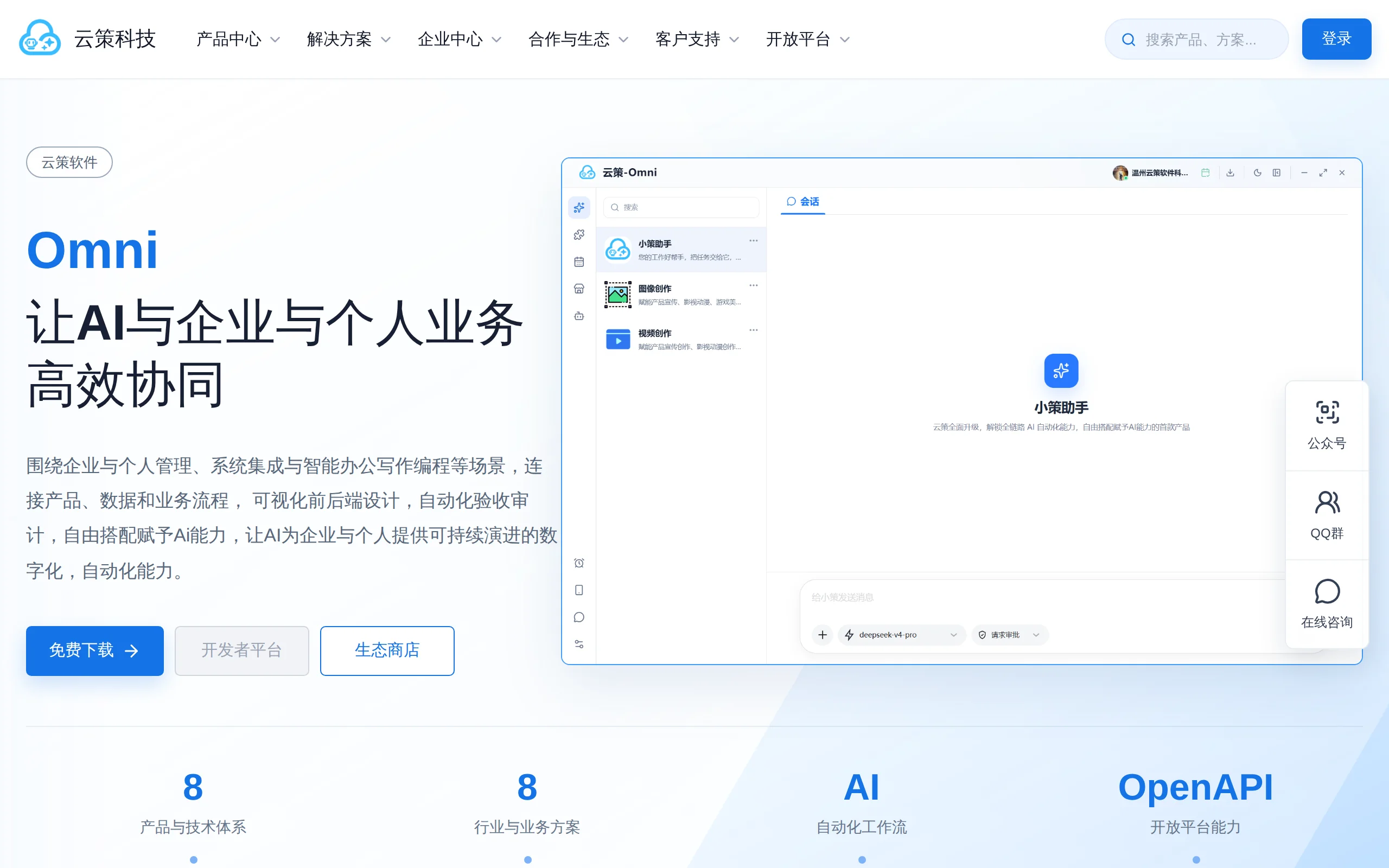
Yuncel Omni – Local AI Work Platform with Customizable AI Capabilities
Yuncel Omni is a cross-platform desktop AI work platform, and the first internet product to emphasize "customizable AI capabilities." Through a loosely coupled architecture combining "models + skills ...
© All Rights Reserved. Some content on this site is partially generated by AI with human review.