
Hindsight – Open-Source Long-Term Memory System for Intelligent Agents, Mimicking Hierarchical Human Memory
Executive Summary:
Hindsight is an open-source long-term memory system for intelligent agents developed by Vectorize.io. Its core design philosophy is to simulate the hierarchical memory processing mechanism of the huma...
1. What is Hindsight
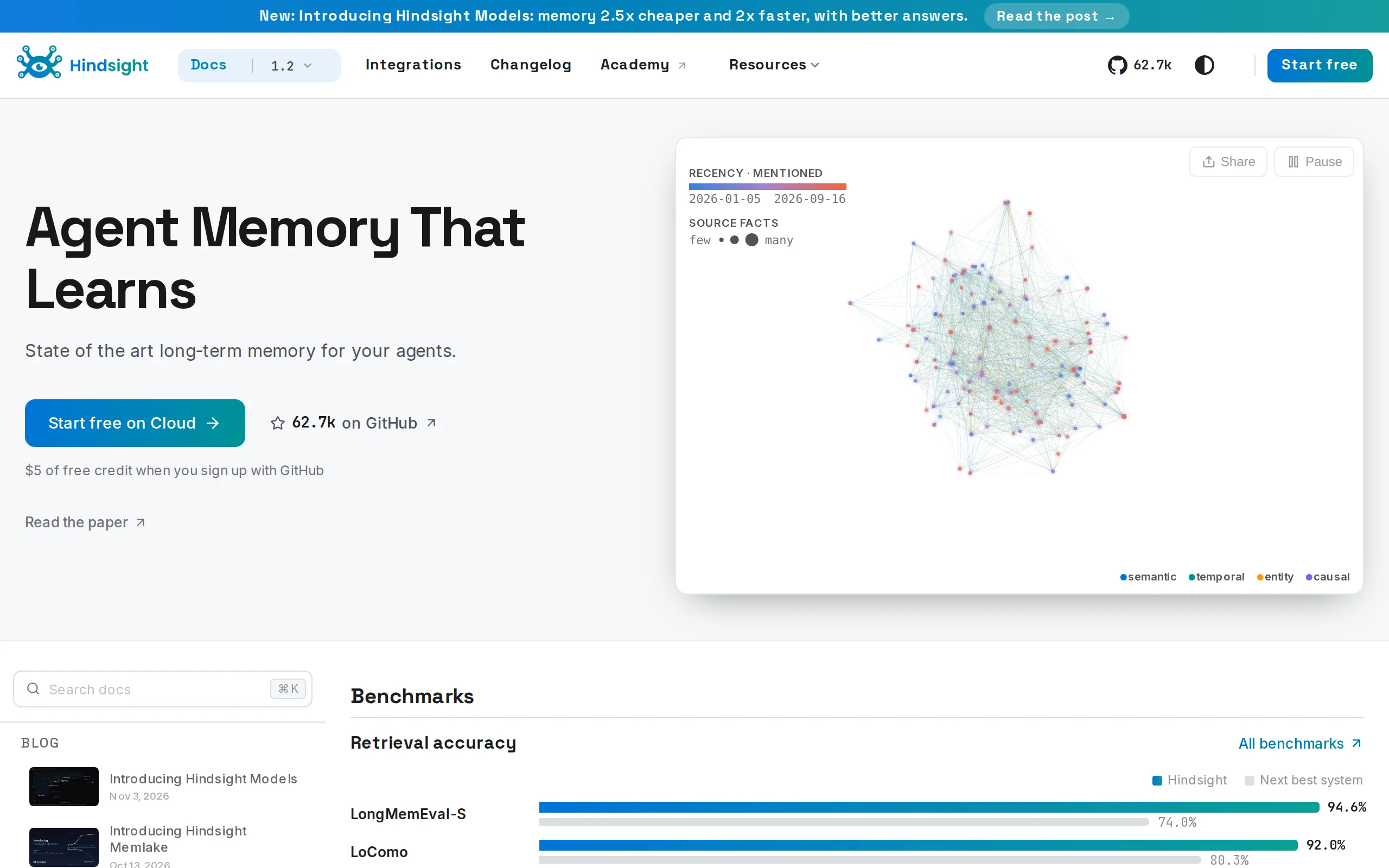
Hindsight is an open-source long-term memory system for intelligent agents developed by Vectorize.io. Its core design philosophy is to simulate the hierarchical memory processing mechanism of the human brain. The system organizes memory into four levels: world facts, experiences, observations, and mental models, each corresponding to different writing pathways. The lower layer is responsible for extracting structured facts from interactions, the middle observation layer automatically deduplicates and merges information through background processes, preserves evidence chains, and incrementally updates with new data. The top-level mental model precomputes answers to common questions, enabling the agent to carry pre-processed cognitive work from the cold start phase. This tool provides three core operations: Retain, Recall, and Reflect, achieving a total score of 94.6% on the LongMemEval benchmark, currently ranking first on the leaderboard.
Technical Positioning and Domain: Hindsight belongs to the memory layer (Memory Layer) infrastructure for intelligent agents, serving as a persistent cognitive component positioned between the large language model (LLM) and business logic in the LLM application architecture. Its unique positioning lies in redefining the data organization of long-term memory using a biomimetic approach, differing from traditional single-vector databases or knowledge graph solutions. By employing a hierarchical memory architecture and an incremental correction mechanism in the observation layer, this tool addresses three core challenges in long-term memory systems: fact updates, memory conflicts, and knowledge accumulation.
Development Background: This project was developed and open-sourced by the Vectorize.io team. The motivation for its development stems from the structural limitations of current LLM applications when handling long conversations, cross-session memory, and continuous learning—existing memory solutions only achieve fact storage and retrieval, lacking the ability to consolidate, abstract, and correct memories. Vectorize.io introduced a cognitive science-based memory processing model into engineering practice, building a complete processing pipeline from raw records to high-level cognition.
Core Value: Hindsight addresses two major pain points in the long-term memory of intelligent agents: "fact updates" and "knowledge accumulation." Its innovative value is reflected in three aspects: mechanistically, it strengthens, weakens, and expands beliefs through evidence chains and proof counting in the observation layer; in terms of cost, it enables high-frequency reads with zero LLM calls by precomputing answers in the mental model; and in terms of effectiveness, it improves the recall completeness and precision of memory retrieval through four parallel retrieval pathways (semantic vectors, BM25 keywords, graph relationships, and time ranges) combined with reciprocal rank fusion and then refined by a cross-encoder ranking model.
Technical Features: The system employs a four-tier hierarchical memory organization architecture, complemented by a probabilistic belief correction mechanism in the observation layer to handle fact updates. During the recall phase, it performs four parallel searches: semantic vectors, BM25 keywords, graph relationships, and time ranges. These results are merged using reciprocal rank fusion and then refined by a cross-encoder ranking model. It includes self-developed lightweight models: a 0.8B decision model, an 114M ranking model, and an 112M embedding model, which take over judgment-based tasks, significantly reducing token consumption.
2. Key Features
Retain (Store): Invoke the LLM to extract key facts, timestamps, entities, and their relationships from raw conversations or text, then normalize and write them into the memory repository. This operation supports native multilingual entity recognition, transforming unstructured conversations into structured memory units and laying the data foundation for subsequent retrieval and reasoning.
Recall (Retrieve): A four-path parallel retrieval pipeline — dense vector semantic search, BM25 keyword matching, entity/temporal/causal graph traversal, and time range filtering — executes simultaneously. Results are merged using the reciprocal rank fusion algorithm and then re-ranked by a cross-encoder model based on relevance. This mechanism balances recall and precision, ensuring stable hits even for time-sensitive queries.
Reflect (Reason): Perform multiple rounds of in-depth reasoning on stored memories to generate new insights or answers to questions requiring comprehensive thinking. When invoking, you can specify personality inclinations such as skeptical, literal, or empathetic, allowing the reasoning results to adapt to different application contexts. This operation is based on evidence chains rather than allowing the model to answer from scratch, effectively suppressing memory-based hallucinations at the mechanism level.
Mind Model and Pages: Maintain resident answers for frequently asked questions, which are automatically rewritten and updated as new memories are stored. Reading a mind model requires only a single database query instead of an LLM invocation, allowing the agent to operate with "pre-established knowledge" right from startup. The Pages feature can project mind models into local Markdown files, facilitating auditing and manual corrections.
Programming Agent Memory: Automatically build a repository-specific memory bank isolated by repository from git history and conversation logs, with support for injecting coding tools such as Claude Code and Cursor. This feature enables programming agents to remember project structure, technical decisions, and historical context across sessions, reducing repetitive troubleshooting.
Memory Banks: Strictly isolate memory spaces for different users or projects at the bank level, preventing data interference. Supports native multilingual entity name storage and includes 45 built-in strategies for sensitive information interception, meeting privacy protection and data compliance requirements.
3. Application Scenarios
Personalized Chat Assistant: Establish an independent memory bank for each user, enabling chatbots to remember user preferences, historical conversations, and personalized context across sessions. For example, if a user mentions "allergic to Southeast Asian cuisine" in a travel planning scenario, the system will automatically filter out relevant dishes in subsequent sessions, without needing the user to restate the information.
Programming Agent Project Memory: Automatically build repository-isolated memory banks from git commit history and historical conversations, and integrate with coding tools such as Claude Code and Cursor. Even after developers switch tasks or restart sessions, the programming agent can still accurately understand project architecture decisions and the evolution of the codebase.
AI Project Manager: Perform multi-round reflective reasoning on project memory via the Reflect operation, automatically identifying risks that need to be avoided in advance. The system can synthesize records of requirement changes, resource allocation data, and historical risk events to generate risk warning reports with evidence chains, supporting decision-making.
Sales Agent: Analyze feedback memories from previous customer outreach efforts to determine which types of scripts and timing are more likely to yield responses, and continuously optimize communication strategies. As more customer interaction data is accumulated, sales script recommendations will be updated with new evidence, ensuring the effectiveness of the strategy.
Customer Service Agent: Record customers' historical tickets, product preferences, and communication habits, while using the Reflect operation to identify high-frequency issues not yet covered in product documentation. These newly discovered insights are then integrated into the mental model, continuously reducing the need for human intervention.
4. How to Use
Environment Requirements: Requires Docker (recommended) or a Python 3.9+ environment. The LLM API Key (any OpenAI-compatible interface is acceptable) is passed in via environment variables. Supports x86_64 and ARM64 architectures; it is recommended that memory be no less than 4GB.
Start the Service: Execute
docker run -p 8888:8888 -e OPENAI_API_KEY=your_key hindsight(or runhindsight-apiafterpip install hindsight-api), and the memory service will start on port 8888. The service includes built-in vector storage and does not require additional configuration of an external database.Install the Client: Choose the corresponding SDK for your language—Python uses
pip install hindsight-client, Node.js usesnpm install hindsight-client, and Go usesgo get hindsight-client—to connect to the service address.Store Memories: Call
retain(bank_id, content)and pass in the original conversation or factual text. The system automatically performs LLM extraction, factual normalization, and storage; developers do not need to manually structure the data.Retrieve Memories: Call
recall(bank_id, query)to retrieve memories from the memory bank in four parallel streams and receive results sorted by relevance. For comprehensive analysis, callreflect(bank_id, query)to obtain reasoning answers with evidence chains.Integrate with Existing Applications: Wrap your existing LLM client using the
wrap_openai()function fromhindsight-litellm. With just two lines of code, every conversation can automatically store and retrieve memories without modifying business logic. This wrapper is compatible with the OpenAI SDK interface, resulting in low migration costs.
Notes: It is recommended to create multiple Banks based on business needs to isolate data for different users or projects; enable PII interception strategies in sensitive scenarios; regularly export Markdown files of Pages for manual audits to ensure the accuracy of the mental model.
5. Pros and Cons Analysis
| Pros |
|---|
| Biomimetic Hierarchical Memory Architecture: The three-tier organization mechanism of facts → observations → mental models is closer to the human brain's "encoding → consolidation → abstraction" processing pipeline than single vector databases or knowledge graphs, providing intelligent agents with a structured knowledge accumulation path. |
| Fact Incremental Correction Mechanism: The background merging process in the observation layer reinforces, weakens, or expands existing beliefs, paired with evidence chains to enable traceable fact changes, addressing the issue of "outdated facts" in long-term memory from a structural perspective. |
| LongMemEval 94.6% Leading Score: In long-term memory benchmark tests, it significantly outperforms Zep (71.2%) and Supermemory (85.92%), and the results have been independently reproduced by a third-party organization, making them highly valuable for reference. |
| Four-Path Recall + Ranking Pipeline: After parallel retrieval via semantic, keyword, graph, and time paths, results are fused using RRF and refined with a cross-encoder, balancing recall and precision with high engineering completeness. |
| Fully Stack MIT Open Source: The project is fully open-sourced from the server to the client SDK, including custom model weights (Apache 2.0 / MIT), with no risk of commercial lock-in, supporting deep customization and secondary development. |
6. Comparative Analysis with Similar Tools
| Dimension | Hindsight | Zep (Graphiti) | Mem0 | Supermemory |
|---|---|---|---|---|
| Core Positioning | Bionic layered memory system | Temporal knowledge graph memory layer | Agent memory layer (API-first) | Long-term memory API platform |
| Data Structure | Three-tier organization: facts → observations → mental models | Dual temporal knowledge graph, facts with validity time windows | Fact + entity + relationship graph structure | Fact cards and context packages |
| Fact Update Mechanism | Incremental correction in the observation layer with evidence chains and proof counts | Facts expire and become invalid + historical versions retained | Conflict detection + time decay | Fact version management |
| Recall Method | Four-path parallel (semantic / keyword / graph / time) + RRF + re-ranking | Three-path hybrid (full-text + vector + graph search) + re-ranking | Hybrid retrieval with vector + graph traversal | Semantic vector + keyword hybrid |
| LongMemEval Performance | 94.6% (third-party independent reproduction) | 71.2% (Hindsight chart data) / Zep official self-reported 90.2% | No official benchmark data published | 85.92% (vendor self-reported) |
| Special Features | Reflect (reflective reasoning), zero LLM read of mental models, Pages (Markdown projection) | P95 retrieval latency <200ms, enterprise-level accumulation | Declarative API, full-language SDK | Free tier supports community-scale usage |
| Deployment Form | Docker single container / pip / embedded library / K8s, with built-in storage | Requires pairing with FalkorDB / Neo4j / Kuzu graph databases | Cloud API + local embedding | Primarily Cloud API |
| Open Source License | Full-stack MIT (model Apache 2.0/MIT) | Graphiti engine open-sourced; community edition no longer maintained | Apache 2.0 | Partial component open-sourced |
Selection Recommendations: For teams requiring local deployment, strict data privacy, and deep customization, Hindsight's full-stack open source nature and built-in storage capabilities offer clear advantages, especially for agent applications requiring long-term cross-session memory. Zep is more suitable for enterprise-level scenarios with existing graph database infrastructure and strict retrieval latency constraints, but note that its community edition is no longer maintained. Mem0 is ideal for teams looking to quickly integrate and build SaaS applications with an API-first philosophy, as its multi-language SDK support reduces integration costs.
7. Editor's Summary
The launch of Hindsight marks a significant evolution in the long-term memory of agents, shifting from a "storage tool" to a "cognitive system." Its core technical contribution lies in mapping the human brain's memory processing chain—raw recording, consolidation, abstraction—into a hierarchically structured data architecture that is engineering-feasible. By incorporating evidence chains and proof-counting mechanisms in the observation layer, it systematically addresses the central challenge in the long-term memory domain: "fact revision." Achieving a 94.6% score on the LongMemEval benchmark and being independently reproduced by third parties confirms its performance has objective reference value.
The practical value of this project is evident on multiple levels: the precomputed mental model mechanism enables high-frequency reads with near-zero LLM costs, the custom-built small model takes over judgment-based tasks to reduce token consumption, and the deployment model, which requires just one Docker command, significantly lowers the barrier to entry. For developers building personalized assistants, programming agents, and vertical domain knowledge systems, Hindsight offers advantages in data privacy and deep customization.
As a relatively new open-source project in this field, its community ecosystem and engineering case accumulation are still in development. However, the full-stack MIT open-source strategy combined with leading benchmark results makes it a promising infrastructure option worth long-term attention. Future directions to watch include: the integration of the hierarchical memory architecture with multi-agent collaboration scenarios, the robustness of the observation layer correction mechanism in complex dynamic environments, and the toolchain ecosystem that the community is building around the Pages feature.
8. FAQ
Q: What is the difference between Hindsight and building a memory system using vector databases (e.g., Pinecone, Milvus)?
A: Vector databases only provide storage and similarity search capabilities, and developers must handle the logic for fact extraction, conflict resolution, deduplication, and knowledge updates themselves. Hindsight implements a complete memory processing pipeline on top of vector storage—fact extraction, observation merging, incremental correction, and precomputed mental models—and includes built-in recall ranking and reflection reasoning capabilities, offering a ready-to-use memory layer solution.
Q: How does the "incremental belief correction" in the observation layer work specifically?
A: A background merging process de-duplicates and integrates related facts into observations, with each observation carrying original evidence citations and proof counts. When new evidence arrives, the system determines its relationship with existing beliefs—if consistent, it strengthens the belief (increasing the proof count); if contradictory, it weakens the belief (decreasing the proof count) and marks the conflict; if it contains new dimensional information, it expands the belief's scope. This mechanism allows beliefs in the memory repository to dynamically evolve as evidence accumulates.
Q: How does Hindsight handle data isolation for multiple users?
A: It is achieved through the "Memory Banks" mechanism. Each bank corresponds to a user or project, with strictly isolated storage space and cross-bank data invisibility. It also supports native multilingual entity name storage and includes 45 built-in PII sensitivity interception strategies, meeting privacy and compliance requirements.
Q: What is the token cost of using Hindsight?
A: The Reta operation requires one LLM call to perform fact extraction, which is the main token cost. However, Recall (recall) and mental model retrieval are purely database operations with zero LLM calls. Reflect operations are called on demand. The self-developed 0.8B decision model and 114M re-ranking model take over judgment tasks, outputting structured results instead of text parsing, resulting in actual token consumption lower than similar solutions.
Q: Can fact extraction and judgment logic be customized in Hindsight?
A: Yes. Hindsight is fully open source across the stack, allowing developers to modify the fact extraction prompt templates on the server side and the inference logic of the self-developed decision model. Additionally, the hindsight-litellm configuration options can be used to adjust extraction frequency, merging strategies, and mental model update triggers, meeting differentiated business needs.
9. Project Links
- Product Official Website: https://hindsight.vectorize.io/
- GitHub Repository: https://github.com/vectorize-io/hindsight
- HuggingFace Model Library: https://huggingface.co/hindsight-ai
Related

Bookworm-S2.1 Flash: In-Depth Review of the Scientific Multimodal Large Model Open-Sourced by the Shanghai AI Lab
Bookworm-S2.1 Flash is a scientific multimodal large model open-sourced by the Shanghai AI Lab, built upon the Bookworm-Yuanzheng unified representation architecture. It is capable of understanding ov...
Nex-N2.6 – A Multimodal Agent Model Open-Sourced by Nex-AGI, Shanghai Chuangzhi Academy
Nex-N2.6 is a multimodal agent model open-sourced by Nex-AGI, Shanghai Chuangzhi Academy. It is post-trained based on Zhipu AI's GLM-5.3-Flash and has a total parameter count of approximately 321B, su...
nanoMuse – An Open-Source Personal Agent from Zhejiang University, the Open-Source Version of Muse
nanoMuse is an open-source personal agent project developed by the Zhejiang University team. Its core concept is to allow users to run a complete AI Agent on their own devices, achieving a cross-devic...
MapFlow – An Open-Source Cross-Model LLM Inference Acceleration System from Peking University
MapFlow is a cross-model LLM inference acceleration system developed by the PKU-DAIR team at Peking University, aimed at addressing the pain points of repeated prefill computation when sharing long co...
© All Rights Reserved. Some content on this site is partially generated by AI with human review.