
WuJie·PhysCapBench – The First Unified Benchmark for Evaluating Cross-Domain Video Physical Description Capabilities Launched by Zhixin
Executive Summary:
WuJie·PhysCapBench is the first cross-domain video physical description evaluation benchmark introduced by Inverse Matrix in collaboration with the Zhixin Institute of Research and Peking University. ...
1. What is WuJie·PhysCapBench
WuJie·PhysCapBench is the first cross-domain video physical description evaluation benchmark introduced by Inverse Matrix in collaboration with the Zhixin Institute of Research and Peking University. It includes 1,500 video clips across three categories: third-person scenarios, first-person operations, and hand-held gripper demonstrations. The benchmark evaluates the coverage and fidelity of captions in capturing physical information such as motion, contact, deformation, and state changes across seven dimensions. It has been validated through video generation and robotic strategy experiments, demonstrating its downstream value and providing a unified metric for optimizing data in physical AI base models. The introduction of this benchmark fills the gap in existing video description evaluations, which lack fine-grained assessment of physical information, enabling objective comparisons of physical description quality across different data sources under a common framework.
Technical Positioning and Domain: WuJie·PhysCapBench belongs to the field of AI data evaluation and benchmarking, specifically focusing on the fine-grained quality assessment of video physical description (Video Captioning). This benchmark supports data-side optimization for physical AI base models, addressing the gap in current evaluations that emphasize model capabilities while neglecting the quality of data annotations. It serves as a crucial evaluation tool that connects data construction with model training performance.
Development Background: Jointly developed by Inverse Matrix, the Zhixin Institute of Research, and Peking University, the motivation behind its creation stems from the observation that current video description models, while capable of summarizing scene actions, generally lose critical physical details such as motion processes, contact relationships, and deformation states, thereby limiting the effectiveness of downstream tasks like video generation and robotic strategy learning. The team leveraged its expertise in embodied intelligence, multimodal learning, and data engineering to build an evaluation framework centered on the completeness of physical information.
Core Value: WuJie·PhysCapBench addresses the core issue of inconsistent measurement of description quality in physical AI data construction, offering a unified metric for assessing the quality of physical information in video data from different sources and perspectives. By validating the benchmark through two downstream tasks—video generation and robotic strategy—it directly links description quality to practical model performance, providing quantifiable decision-making support for optimizing data annotation templates and constructing training supervision signals.
Technical Features: The uniqueness of this benchmark lies in its unified organization of cross-domain data, a seven-dimensional fine-grained evaluation system, and verifiable reference descriptions built upon continuous video evidence. The categorization of the three types of video data is unified under the theme of physical processes, allowing for comparisons between first-person operations and third-person scenarios on the same dimensions. The seven-dimensional scoring mechanism breaks down overall quality into specific types of information, enabling precise identification of shortcomings in description strategies.
2. Key Features
Cross-domain Unified Evaluation Framework: Integrates three video categories—third-person scenarios, first-person operations, and handheld gripper demonstrations—into a single evaluation system, with 500 video clips from each category, totaling 1500 video sequences. This feature addresses the previous issue of evaluation benchmarks being isolated and non-comparable, enabling data from different sources and perspectives to be compared and ranked under a unified standard of physical information quality, thereby providing a foundation for cross-domain data fusion.
Seven-dimensional Physical Information Assessment: The evaluation is decomposed into seven independent dimensions, each examining specific types of physical information such as action processes, contact relationships, state changes, and related temporal sequences. Each dimension is scored individually before being aggregated into a comprehensive score. This design translates the vague concept of "description quality" into actionable, specific information types, allowing for direct comparison of the relative strengths and weaknesses of different description strategies on the leaderboard and providing precise guidance for improving annotation processes.
Reference Description Construction Based on Video Evidence: The annotation process begins with global observation and event localization, progressively identifying involved objects, actions, contact points, and state changes. It then verifies whether each description is supported by continuous video evidence. Mechanisms and causal information are based solely on observable evidence, with complex operations emphasizing consistency between phase divisions and resulting states. Seven professional annotators perform annotation and quality checks, ensuring that the reference descriptions are both informationally complete and faithful to the video content.
Verifiable Annotation Quality Mechanism: Using the reference descriptions built from video evidence as a standard, this feature checks whether candidate annotations are supported by the video, quantifying the coverage and fidelity of the descriptions. This transforms data annotation quality from a subjective judgment into a quantifiable and verifiable objective metric, helping data teams identify "apparently correct but lacking video evidence" false physical descriptions.
Downstream Task Benefit Validation: Through two downstream experiments—video generation and robot strategy—the effectiveness of more complete physical descriptions in enhancing model performance is validated. Experimental data shows that optimized physical descriptions can reduce the LPIPS metric in video generation by as much as 30.88%, and increase the success rate of robot strategies by 7.5 percentage points, directly converting evaluation results into measurable model benefits.
Training Data Optimization Guidance: Based on the distribution of seven-dimensional scores, this feature identifies information gaps in description strategies and guides improvements in annotation templates or auto-generated prompts. When necessary, it refers to the reference description construction process to reorganize annotations. This extends the benchmark from a pure evaluation tool into an optimization engine within the data construction loop, supporting stages such as world model pre-training data filtering, video generation data annotation, and robot imitation learning data quality checks.
3. Application Scenarios
World Model Pre-training Data Optimization: When constructing training datasets for physical world models, use WuJie·PhysCapBenchto filter and rewrite video captions, fully converting physical experiences such as motion, contact, and state changes into training supervision. The data team can score candidate annotations across seven dimensions, prioritizing descriptions with high coverage of physical information and good fidelity, while eliminating low-quality annotations that miss key process information, thereby raising the overall quality ceiling of pre-training data.
Video Generation Data Annotation: Provide high-fidelity physical condition descriptions for video generation models to enhance the consistency of generated content with real-world physical evolution. Annotation teams can design annotation templates based on the seven-dimensional evaluation framework of the benchmark, ensuring that each video description covers motion processes, contact relationships, deformation states, and the temporal sequence of state changes. Video generation models trained with this approach demonstrate more accurate dynamic physical performance, reducing instances where generated content violates physical laws.
Robot Imitation Learning Data Quality Inspection: Evaluate the quality of language annotations for real-world robot or gripper demonstration data, supplementing descriptions of operational processes and resulting states. For robot learning datasets, the benchmark's reference description construction process can be directly applied to the quality inspection phase, verifying whether each demonstration's language annotation includes key stages such as motion before contact, interaction after contact, and execution results. This helps teams identify and fix incomplete operational descriptions.
Embodied Intelligence Training Instruction Enhancement: By employing the Training Instruction Upsamplerapproach, provide more complete process supervision for policy learning to improve task success rates. In this scenario, benchmark evaluation results serve as the basis for instruction enhancement, using descriptions with high physical information coverage as condition inputs for policy training. Experiments have confirmed that this method significantly improves the success rate of robot policy tasks, making it suitable for data pipeline construction in embodied intelligence tasks such as operational skill learning and object manipulation.
4. How to Use
Acquire Resources: Obtain the evaluation code from the GitHub repository (https://github.com/hfwang2001/PhysCapBench) and download the full set of 1500 video clips along with their corresponding reference descriptions from the Hugging Face dataset page (https://huggingface.co/datasets/hfwang01/PhysCapBench). The project website (https://hfwang2001.github.io/physcapbench-site/) provides an overview of the benchmark, instructions on evaluation methods, and leaderboard displays.
Set Up Evaluation Environment: Configure a Python environment, preferably using Python 3.9 or higher. Install necessary deep learning dependencies, including PyTorch and related Hugging Face libraries. While the evaluation code does not strictly require a GPU, the core comparison logic is based on text matching and information coverage statistics. However, optional components such as video feature extraction are recommended to be run on an NVIDIA GPU for faster processing.
Select Evaluation Targets: Determine the source of the captions to be evaluated. This can be human-annotated data, original descriptions from existing datasets, or model-generated descriptions. Organize the candidate descriptions into three categories (third-person scene, first-person operation, handheld gripper demonstration) in a manner consistent with the organization of the reference descriptions to ensure effective scoring comparisons.
Generate or Prepare Candidate Descriptions: Generate candidate captions for the target videos. If using an auto-generated model, it is recommended to design prompts based on the seven-dimensional evaluation framework to guide the model to produce descriptions that cover physical information such as motion, contact, and state changes. If evaluating existing dataset descriptions, simply import the original annotated text without additional processing.
Score by Comparing with Reference Descriptions: Compare each candidate description with the reference descriptions provided by the benchmark, evaluating coverage and fidelity across the seven physical information dimensions individually. The evaluation code will automatically output scores for each dimension and an overall score, and generate a distribution chart of the dimensional scores, making it easier to visually assess performance differences across various physical information aspects.
Analyze Dimensional Scores and Optimize: Review the distribution of overall scores and individual dimensional scores to identify information gaps in the description strategies. Improve the annotation templates or generation prompts based on these gaps, and if necessary, reorganize the annotation workflow following the reference description construction process. Apply the optimized physical descriptions to video generation conditions or strategy training instructions, and confirm the practical benefits using metrics such as LPIPS/PVCS or task success rates.
5. Pros and Cons Analysis
| Pros |
|---|
| Cross-domain unified evaluation: For the first time, it integrates third-person scenarios, first-person operations, and handheld gripper demonstrations into a single evaluation framework, filling the gap in cross-domain video physical description evaluation. This makes the description quality of data from different sources comparable. |
| Fine-grained evaluation dimensions: The seven-dimensional evaluation system breaks down "description quality" into specific information types such as motion, contact, and state changes, enabling precise identification of shortcomings in each description strategy and providing actionable directions for data optimization, avoiding vague quality assessments. |
| Verifiable annotation results: The reference descriptions are built based on continuous video evidence and verified by professionals, ensuring that the descriptions are both information-rich and faithful to the video content, thereby enhancing the credibility and reproducibility of the evaluation results. |
| Quality linked to utility: Through experiments in video generation (LPIPS reduced by up to 30.88%) and robot strategies (success rate increased by 7.5 percentage points), it has been proven that more complete physical descriptions can directly translate into model benefits, giving the evaluation results clear downstream application value. |
6. Comparative Analysis with Similar Tools
| Comparison Dimension | Wujie·PhysCapBench | PhysBench | VideoCaptionBench |
|---|---|---|---|
| Core Focus | Evaluates the coverage and fidelity of video captions to physical information, focusing on data-side quality | Evaluates the understanding and question-answering capabilities of multimodal models regarding physical knowledge, focusing on the model side | General video description generation quality evaluation, focusing on linguistic fluency and content accuracy |
| Evaluation Target | Description text (data-side), can be either manually annotated or automatically generated | The model itself, tested through question-answering formats | Automatically generated description outputs from models |
| Data Domain | Unified across three cross-domain categories: third-person scenarios, first-person actions, and handheld gripper demonstrations | Primarily focused on physical knowledge questions, not specifically designed for actions or robotic data | General video content, covering daily life, natural scenes, etc. |
| Evaluation Method | Seven-dimensional scoring based on physical information types, assessing coverage and fidelity by comparing with reference descriptions | Accuracy of question-answering (objective question format), quantifying the model's grasp of physical knowledge | Multi-metric linguistic quality assessment, with reference description similarity as the core |
| Reference Standard | Reference descriptions built based on continuous video evidence, verified by seven professional annotators | Standard answer options from a physics knowledge question bank designed by experts | Manually written reference descriptions, emphasizing content completeness rather than fine-grained physical information |
| Downstream Validation | Yes, validated through video generation (LPIPS reduced by up to 30.88%) and robotic strategy experiments (success rate increased by 7.5 percentage points) | Primarily evaluates understanding capabilities, without direct validation of generation or strategy benefits | Focuses on the relevance of generation quality, without involvement in robotic or physical AI downstream tasks |
From this comparison, it is evident that Wujie·PhysCapBench has a clear differentiated advantage in the data-side evaluation dimension, making it particularly suitable for scenarios requiring precise physical information annotation, such as robotic learning and video generation. PhysBench is more appropriate for assessing the physical knowledge understanding level of models. These two benchmarks cover evaluation needs on both the data and model sides, and can be used complementarily.
For teams training video generation models that require high-fidelity physical condition descriptions, the seven-dimensional scoring system and reference description construction process provided by Wujie·PhysCapBench can be directly applied to annotation template design and data quality inspection. For researchers in robotic imitation learning, its cross-domain organization and downstream strategy validation mechanisms can effectively guide the enhancement of training instructions and the construction of process supervision signals. For general video understanding evaluation needs, benchmarks like VideoCaptionBench may be more suitable.
7. Editor's Summary
The launch of WuJie·PhysCapBench represents a significant breakthrough in the field of video physical description evaluation. Current video caption benchmarks primarily focus on linguistic fluency and content relevance, whereas physical AI base models demand a higher level of fine-grained processing of information such as motion processes, contact relationships, and deformation states within training data. This creates a clear misalignment in evaluation standards between the two. WuJie·PhysCapBench addresses this by decomposing vague descriptions of quality into specific, operational, and comparable types of physical information through a seven-dimensional evaluation system. It also ensures the objectivity and reproducibility of evaluation criteria by constructing reference descriptions, thereby providing a feasible solution at the methodological level.
The practical value of this benchmark has been preliminarily validated in two downstream tasks. In video generation experiments, the LPIPS metric was reduced by as much as 30.88%, and in robotic strategy tasks, the success rate improved by 7.5 percentage points. These results provide empirical support for the idea that "more complete physical descriptions can directly translate into model performance gains," extending the benchmark from a purely academic evaluation tool to a practical optimization reference in data engineering. For technical teams working on video generation, embodied intelligence, and world models, this benchmark can serve as a reference tool for designing data annotation templates, screening training data, and implementing quality control. Its cross-domain unified framework also enables comparisons of data from different sources under the same physical information standard, reducing the evaluation costs associated with multi-source data integration.
Looking ahead, the evaluation framework of WuJie·PhysCapBench has room for expansion into more video domains and additional physical information dimensions. The current dataset of 1,500 video clips supports initial validation, but the diversity of physical processes necessitates broader data coverage. Future extensions in terms of data scale and domain types are anticipated. Deep integration of evaluation results with automatic annotation tools and data flywheel processes also represents a potential direction for transforming this benchmark into a foundational infrastructure for data construction.
8. FAQ
Q: What is the difference between WuJie·PhysCapBench and PhysBench? Which one is more suitable for my needs?
A: The two benchmarks evaluate different targets. WuJie·PhysCapBench evaluates the coverage and fidelity of video caption text regarding physical information, and it is a data-side benchmark, suitable for teams looking to optimize data annotation quality or build training datasets. PhysBench evaluates the understanding and question-answering capabilities of multimodal models regarding physical knowledge, and it is a model-side benchmark, suitable for assessing and selecting models. If your goal is to improve data quality to enhance downstream model performance, WuJie·PhysCapBench is more appropriate. If your goal is to measure the level of physical knowledge in a model, then PhysBench is the better choice.
Q: What are the seven dimensions of the evaluation system? How should I understand the meaning of the scores?
A: The seven-dimensional evaluation system checks different types of physical information, including action processes, contact relationships, state changes, and their temporal sequences. It specifically covers key physical elements such as motion trajectories, object interactions, deformation evolution, and environmental state transitions. Each dimension is scored independently, reflecting the coverage and fidelity of the candidate description in that particular type of physical information. The overall score aggregates performance across all dimensions. Dimension scores can help identify weaknesses in description strategies—for example, if a strategy scores low on the "contact relationship" dimension, it indicates that the description lacks coverage of the interaction process between objects.
Q: What prerequisites are needed to evaluate my own video description dataset?
A: You need to prepare at least one category of video data and corresponding candidate description text from the three types (third-person scene, first-person operation, handheld gripper demonstration). The core logic of the evaluation does not depend on GPU, but if you need to extract video features for auxiliary analysis, it is recommended to configure an NVIDIA GPU. On the software side, you need to install Python 3.9+ and PyTorch. No additional model training is required—simply use the evaluation scripts provided on GitHub and the reference description data from Hugging Face to run the evaluation.
Q: How are the reference descriptions constructed? Why was this method chosen?
A: The annotation process for reference descriptions starts with global observation and event localization, then systematically identifies involved objects, actions, contact, and state changes. Each description is then verified to ensure it is supported by continuous video evidence. This method was chosen because physical processes often span multiple stages, such as pre-contact motion, post-contact deformation, and final state after action completion. Single-frame information is insufficient for accurate description. Mechanism and causal information are based solely on observable evidence. For complex operations, the consistency of phase division and final states is emphasized. Seven professional annotators perform annotation and quality checks to ensure that the reference descriptions are both informationally complete and faithful to the video content.
Q: How can I verify the downstream benefits of optimized physical descriptions? Which specific metrics should I focus on?
A: The benefits of optimized physical descriptions can be validated through two types of downstream experiments. In the video generation direction, use the improved descriptions as input conditions and observe changes in metrics such as LPIPS and PVCS. Empirical data shows that LPIPS can be reduced by as much as 30.88%. In the robot strategy direction, use the descriptions for instruction augmentation in strategy training and observe changes in task success rates. Empirical data indicates that success rates can increase by 7.5 percentage points. It is recommended to keep other training conditions unchanged during evaluation to isolate the impact of description quality on downstream performance.
Q: Does this benchmark support the evaluation of Chinese video descriptions?
A: Currently, the reference descriptions published with the benchmark are primarily in English. The evaluation scripts are based on text matching and information coverage statistics, and in theory, they can be extended to Chinese descriptions. However, this would require translating or rebuilding the reference descriptions into a Chinese version. For Chinese users, it is recommended to first evaluate the English descriptions to verify the process, and then localize the reference description data according to team needs.
9. Project Links
- Project Website: https://hfwang2001.github.io/physcapbench-site/
- GitHub Repository: https://github.com/hfwang2001/PhysCapBench
- HuggingFace Dataset: https://huggingface.co/datasets/hfwang01/PhysCapBench
- arXiv Technical Paper: https://arxiv.org/pdf/2611.16424
Related
Hy4 flash – Tencent HunYuan's High-Cost-Performance Large Model
Hy4 flash is a high-cost-performance large model launched by Tencent HunYuan, which employs a sparse mixture-of-experts (MoE) architecture with a total of 224B parameters and 12B active parameters. It...

OpenMotion – Open-Source AI Video Recreation Tool, Replicate Videos Using Brand Assets
OpenMotion is an open-source intelligent video production tool. Its core capability lies in deeply analyzing reference videos through AI, extracting the sequence of shots, transition logic, and narrat...

Aure – DeepL's Speech Translation Model
Aure is DeepL's next-generation speech translation model and serves as the core driving force behind all DeepL Voice products. Unlike traditional speech translation systems, Aure can continuously and ...
VoiceStudio – Open-Source Local AI Voice Studio, Generating Voice from Text Descriptions
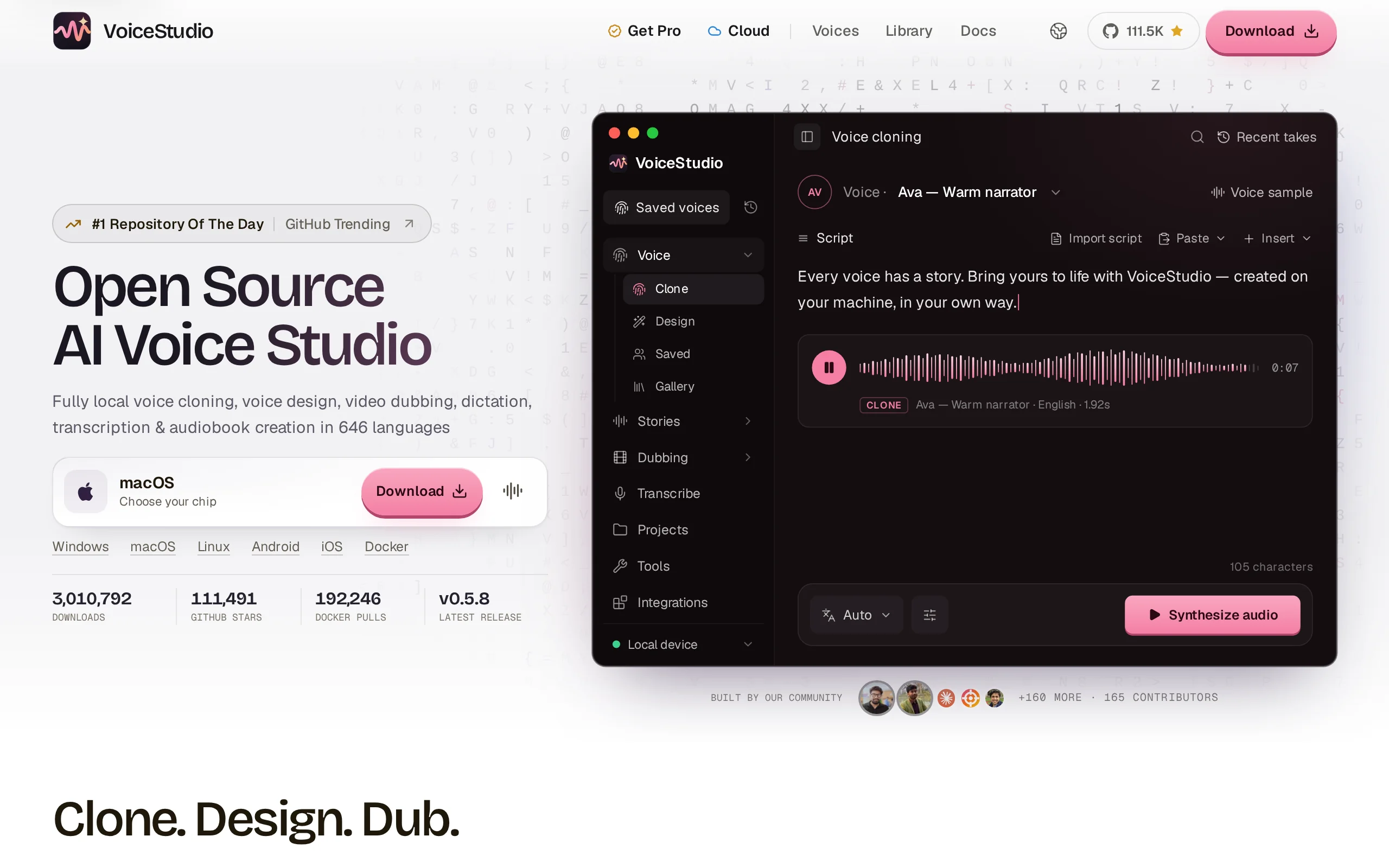
VoiceStudio is an open-source, fully local AI voice studio that integrates multiple capabilities—such as voice cloning, sound design, video dubbing, speech-to-text transcription, and batch generation ...
© All Rights Reserved. Some content on this site is partially generated by AI with human review.