
GPT-6.2 Astra – OpenAI's Flagship Large Model
Executive Summary:
GPT-6.2 Astra is OpenAI's flagship cutting-edge model, designed as a specialized solution for complex professional projects. Compared to its predecessor, GPT-6 Astra, this model has achieved significa...
1. What is GPT-6.2 Astra
GPT-6.2 Astra is OpenAI's flagship cutting-edge model, designed as a specialized solution for complex professional projects. Compared to its predecessor, GPT-6 Astra, this model has achieved significant performance improvements in long-chain tasks such as professional document generation, scientific research assistance, complex programming, CAD simulation, and 3D design. It is particularly renowned for its optimization in output token efficiency—reducing output tokens by approximately 22%, lowering API input/output costs by 20%, and cutting cached input costs by 60%. The model achieved the highest score in the Agents' Last Exam professional evaluation, outperforming GPT-6 Astra by 5.2 points, with task costs less than one-third of the previous model, showcasing a clear advantage in cost-effectiveness.
Technical positioning and domain: Belongs to the field of natural language processing and multimodal reasoning, covering text generation, code writing, visual understanding, and precise computer operations. It is a general-purpose intelligent agent base model designed for professional-level long-range tasks. Within OpenAI's product portfolio, it complements GPT-6.2 Sol—where the latter focuses on efficient mainstream scenarios, while Astra is tailored for complex professional projects.
Development background: Developed by OpenAI, building upon the technical foundation of the previous GPT-6 Astra model, and undergoing domain-specific alignment training to meet the needs of industries such as law, finance, accounting, science, and engineering. The model's development focuses on two key capabilities: one is the reasoning and planning ability for long-chain tasks, and the other is the standardization of outputs in specialized domains. This direction reflects the shift in large model competition from general conversational capabilities to deep industry applications.
Core value: It addresses key pain points in professional scenarios, such as vague model outputs, high hallucination rates, large token consumption, and poor compatibility with enterprise workflows. Through domain-specific training and optimized tool calling, the model generates documents, tables, and code that better align with industry standards, enabling direct use and reducing rework. Additionally, its multi-step Agent workflow capability allows it to autonomously plan long-range tasks, connecting the design and prototyping processes, and delivering practical productivity value in scenarios such as scientific research, legal analysis, and financial modeling.
Technical features: During long-range reasoning, the model can proactively choose between "using plugins or directly operating the computer" based on task complexity, reducing the number of interaction rounds through efficient Bash scripting and tool calling. Enhanced visual understanding enables the model to reconstruct layout, color schemes, and font sizes from template screenshots, supporting part-level operations in CAD and 3D scene construction. In terms of security mechanisms, the model meets the Critical threshold in network security and the High threshold in biochemistry, and is equipped with a Control Room monitoring system.
2. Key Features
- Professional Document Generation: Undergoes domain-specific alignment training for industries such as law, finance, and sales, generating PPTs, tables, and documents that strictly adhere to industry template standards and writing conventions. For example, in legal documents, only outputs that meet all scoring criteria and have no major hallucinations are considered acceptable, effectively reducing vague expressions and formatting rework.
- Scientific Research Assistance: Sets new records in scientific benchmarks such as Terminal-Bench-Science and Vals Science Index. It can interpret real biological data, design experiments, and infer system mechanisms, enabling the execution of complete scientific workflows within the terminal, achieving a closed loop from data processing to conclusion output.
- Complex Programming and Code Modification: Skilled in implementing complex modifications to existing large codebases and can accompany these changes with targeted test cases. The code style is cleaner, and tool calling efficiency is higher; the Basis team reported that long task durations could be reduced by as much as 73%, significantly improving engineering efficiency.
- Computer Precision Operations: Capable of controlling CAD and simulation software for modeling at the individual part level, supporting the simulation of suspension dynamics and generating assembly animations. This achieves a seamless link from design drawings to prototype iteration, and also allows for precise control over tools like Blender.
- Web and 3D Design: Can generate interactive web pages, games, and 3D experience scenarios based solely on text briefs. It ranked first in the AA-3D blind test with a score of 1318 Elo, possessing the ability to reconstruct layouts, color schemes, and even exact font sizes from template screenshots.
- Multi-step Agent Workflow: Capable of planning long-term tasks and autonomously selecting tool paths, achieving the highest score in the Agents' Last Exam professional evaluation. The model decides whether to use plugins or directly operate the computer based on workflow complexity, reducing the number of interactions through more efficient Bash scripting.
- Cybersecurity Attack and Defense: Vulnerability discovery, exploitation, and remediation capabilities have significantly improved compared to previous generations, reaching the Critical level in the OpenAI security framework. It can perform attack and defense simulations and security audits in controlled environments.
- AI Research Acceleration: As the first externally released model to reach the "High" threshold for AI self-improvement, it can assist in AI research work, including training data generation, model evaluation, and experimental design, providing practical value to research teams.
3. Application Scenarios
- Financial Analysis: Analysts can use financial reports and market data to have the model build editable Excel valuation models, automatically completing revenue forecasts, sensitivity analyses, and chart generation. The output adheres to financial industry template standards, and the model can dynamically track data changes, significantly shortening the modeling cycle.
- Legal Practice: Legal teams can extract key facts from massive source documents, and use GPT-6.2 Astra to draft contract review reports, legal memoranda, and other documents. The model meets the passing criteria of the Harvey legal evaluation, and the generated documents can be directly submitted for review, reducing initial drafting time.
- Scientific Research: Researchers can deploy the model on their terminal to execute complete scientific research workflows, including interpreting real biological data, designing experiments to infer system mechanisms, and automatically generating experimental reports. This is particularly practical in data-intensive scenarios such as drug development and genomics.
- Consulting and Knowledge Work: Consultants can leverage the model to complete long-term industry research reports, competitive analyses, and data organization tasks. The model produces fewer tokens and more focused expressions, making it especially suitable for complex knowledge tasks like GDPval that require extended, multi-step reasoning. Its output structure is highly compatible with industry standards.
- Software Engineering: Development teams can use the model to implement complex feature modifications, refactoring, and test writing on large codebases. According to Basis team reports, the time required for long tasks can be reduced by as much as 73%. The model can serve as an auxiliary tool in stages such as continuous integration and code reviews, enhancing iteration efficiency.
- Engineering Design: Engineers can use the model within CAD environments to model components individually, generate assembly animations, and perform stress simulations. The model understands part-level details and assembly relationships, supporting rapid iteration from blueprints to prototypes, and is applicable to mechanical design, product development, and other scenarios.
4. How to Use
Confirm Subscription Tier: GPT-6.2 Astra is available for Plus, Pro, Enterprise, and Edu users in ChatGPT Work and Codex. Different tiers have varying feature permissions; choose the appropriate subscription plan based on your needs.
Configure Ultrafast Mode: Pro 500 users can directly enable the Ultrafast mode in the settings, significantly reducing inference latency. Pro 200 users currently do not support Astra's Ultrafast mode, but they can first try GPT-6.2 Sol to experience the high-speed mode. Enterprise and Edu users must have the model permissions enabled by their workspace administrator in the backend before they can use it.
API Calling Method: Developers can access the
gpt-6.2-astramodel by calling it through the OpenAI API. The model supports Ultrafast mode from the time of its release, making it suitable for latency-sensitive production environment integrations.Optimize Cache and Cost: During usage, keep the prompt prefix consistent and append new instructions to the end of the conversation to improve cache hit rates, thereby reducing latency and API call costs. This strategy is especially important for high-frequency calling scenarios.
Practical Recommendations for Long Tasks: For large-scale codebase modifications or multi-step Agent workflows, it is recommended to break the task into clear phase objectives and use the model's autonomous planning capabilities. Test code should clearly indicate the expected behavior to help the model generate more focused modification plans.
Security Considerations: When dealing with tasks related to network security defense or biochemistry, it is advisable to perform them in a controlled environment. Follow the deployment requirements of the OpenAI security framework and use Control Room to monitor load and appropriately terminate abnormal outputs.
5. Pros and Cons Analysis
| Pros |
|---|
| High Cost Efficiency: Output tokens reduced by approximately 22%, API input/output prices decreased by 20%, and cached input costs reduced by 60%. It scores 5.2 points higher than GPT-6 Astra on Agents' Last Exam, with task costs less than one-third of Astra's, showing a clear cost-performance advantage. |
| Professional Output Standardization: Trained with domain alignment for industries such as law and finance, the generated documents and tables closely align with industry standards. It achieves a legal evaluation pass rate twice that of similar models and can be directly used in workflows, reducing rework. |
| Strong Complex Task Execution Ability: Demonstrates stable performance in long-chain tasks such as scientific research, code modification, and CAD simulation. According to the Basis team report, the time required for long tasks has decreased by up to 73%, and multi-step Agent workflows lead in professional evaluations. |
| Comprehensive Security Mechanisms: Meets the cybersecurity Critical threshold, equipped with the Control Room monitoring and automatic intervention system. Extended monitoring allows for review of model reasoning behaviors and automatic suspension of abnormal sessions, making its security features stand out among similar models. |
6. Comparative Analysis with Similar Tools
| Comparison Dimension | GPT-6.2 Astra | Claude Fable 5.2 |
|---|---|---|
| Core Positioning | Flagship model for complex professional projects, focusing on long-chain reasoning and industry-standard outputs, targeting high-complexity scenarios such as science, law, finance, and engineering design, with a focus on multi-modal Agent workflows. | A comparable leading-edge flagship model with strong general capabilities, competitive in both comprehensive conversations and complex tasks, but with less specific industry customization than Astra. |
| Performance Benchmark | Leads Claude Fable 5.2 by 5.5 points in Agents' Last Exam, with task costs at just 5% of its level; passes the Harvey legal evaluation at twice the rate, with costs about one-sixth. | Agents' Last Exam serves as the benchmark reference; the Harvey legal evaluation pass rate is lower, with a science evaluation score of 74.6% (based on the mini-swe-agent framework). |
| Feature Highlights | Supports fine-grained computer operations (CAD, simulation, Blender), web and 3D design (AA-3D Elo 1318, ranked first), cybersecurity offense and defense, and AI self-improvement assistance. | Strong in general conversation and multiple reasoning tasks, but lacks the fine-grained computer control and 3D design capabilities seen in peer models. |
| Deployment Method | Cloud API calling (gpt-6.2-astra), supports Ultrafast high-speed mode, requires subscription to Plus/Pro/Enterprise/Edu tiers. | Cloud API or product interface integration, similar deployment methods, but no clear corresponding function for high-speed mode. |
| Usability | Simple API calling, session prefix caching strategy optimizes cost, but requires higher structuralization of user instructions and clear task boundaries. | Friendly conversational interface, easy to use, but long-chain tasks require more manual intervention and step-by-step decomposition. |
| Pricing and Commercialization | Output token reduction of 22%, API input/output cost reduction of 20%, cached input cost reduction of 60%, with significant cost advantages for long tasks. | Higher pricing, with task costs approximately 20 times that of Astra, not ideal for cost-sensitive commercial scenarios. |
Selection Recommendations: For long-chain tasks in professional fields such as law, finance, scientific research, and engineering design, GPT-6.2 Astra stands out with its domain-aligned training, multi-step Agent workflows, and cost-efficiency advantages, making it the optimal choice currently. If an enterprise has sufficient budget and tasks focus on in-depth industry document generation, Astra's direct usability can significantly reduce rework costs.
If the team primarily handles high-frequency, medium-complexity general tasks or has limited budget and requires rapid iteration, GPT-6.2 Sol is more suitable for daily operations due to its lower single-call cost and high-speed response. Its Ultrafast mode is accessible at the Pro 200 tier. Claude Fable 5.2 is competitive in general conversation capabilities, but has higher task costs, making it more suitable for teams that are not cost-sensitive and value comprehensive conversation quality.
7. Editor's Summary
GPT-6.2 Astra represents a significant capability release by OpenAI in its cutting-edge model layout, specifically tailored for professional and complex scenarios. Its technological innovation is evident in three aspects: first, the long-range reasoning and planning capability, allowing the model to autonomously select execution paths based on task complexity, reducing the number of rounds through efficient Bash scripting and tool calling—this marks a substantial advancement in the Agent workflow direction. Second, domain-specific alignment training, which applies standardized constraints for industries such as law, finance, and accounting, moving outputs from "usable" to "compliant" and significantly reducing the cost of manual review. Third, an upgraded security system that meets the Critical threshold for network security and the High threshold for biochemistry, complemented by the Control Room monitoring system, offering stronger traceability at the deployment level.
In terms of practical value, GPT-6.2 Astra has already demonstrated quantifiable improvements in work efficiency across scenarios such as scientific research, legal analysis, financial modeling, and software engineering. Testing by the Basis team showed that the time required for long tasks decreased by as much as 73%, and the pass rate in the Harvey legal evaluation exceeded that of similar models by two times. These figures hold real-world significance for professional teams. For independent researchers, consultants, and engineering design teams, this model can be directly embedded into existing workflows as a productivity tool, particularly benefiting those who need to generate standardized documents in alignment with industry regulations.
Its shortcomings lie in its closed-source commercial nature and subscription tier restrictions, making it difficult for individual developers and small teams to experience its full capabilities at a low cost. Industry coverage is also primarily concentrated in a few specialized fields. When OpenAI officially released this model in June 2026, it simultaneously introduced GPT-6.2 Sol as an efficient complementary solution. This product matrix strategy helps to cover a broader range of user scenarios. From the perspective of technological evolution, domain-specific alignment training and cost-efficiency optimization will become key directions in the competition among flagship large models.
8. FAQ
Q: What is the difference between GPT-6.2 Astra and GPT-6.2 Sol?
A: Astra is the flagship model, designed for complex and specialized projects, emphasizing long-chain reasoning, domain-specific outputs, and precise computer control, with superior cost efficiency. Sol is the high-efficiency main model, focused on daily high-frequency tasks, offering fast response times and low single-call costs. The two models complement each other, with Pro 200 users able to use Sol for high-speed mode, while Astra's Ultrafast mode requires Pro 500 or higher tiers.
Q: What hardware requirements does GPT-6.2 Astra have?
A: GPT-6.2 Astra is a cloud-based inference model, and users do not need a local GPU to use it. The main requirement for the user side is the network environment, as the Ultrafast high-speed mode is sensitive to network latency. API developers should confirm their usage quotas and subscription tiers, and Enterprise/Edu users need their administrators to enable model permissions in the backend.
Q: How can I reduce the API call cost for GPT-6.2 Astra?
A: It is recommended to keep the prompt prefix unchanged and append new instructions to the end of the conversation to improve cache hit rates. The model's output token count has decreased by approximately 22% compared to previous generations, and API input/output prices have been reduced by 20%, with cache input prices lowered by 60%. Combined with prefix caching strategies, the cost advantages in long-task scenarios are quite significant.
Q: Can GPT-6.2 Astra be used for cybersecurity attack and defense tasks?
A: Yes, the model has the capability to detect, exploit, and remediate vulnerabilities, and has reached the Critical level in the OpenAI security framework. However, it should be used in a controlled environment, following security deployment requirements. Use the Control Room to monitor load and appropriately terminate abnormal outputs to ensure compliance with operational standards.
Q: What languages does GPT-6.2 Astra support?
A: The model is primarily designed for international mainstream language scenarios, with the most stable performance in English. Tasks such as document generation in Chinese and legal document rewriting can be executed normally. However, domain alignment is mainly based on English industry standards, and the precision of Chinese professional terminology is somewhat lower compared to English scenarios.
Q: How much context can GPT-6.2 Astra handle?
A: The official context window size has not been disclosed, but based on its performance in long-chain tasks, its planning and execution capabilities are suitable for multi-step long tasks. It is recommended to break down ultra-long tasks into phased objectives and use session caching strategies to achieve more stable output quality.
9. Project Links
- Product Official Website: https://openai.com/index/introducing-gpt-6-2-astra-sol/ (Official announcement)
- Official Experience Entry: https://chatgpt.com/ (ChatGPT Work integration)
- Official Documentation: https://platform.openai.com/docs (API reference)
- GitHub Organization: https://github.com/openai (OpenAI official organization)
- Hugging Face: https://huggingface.co/openai (Model weights and evaluations)
Related

Bookworm-S2.1 Flash: In-Depth Review of the Scientific Multimodal Large Model Open-Sourced by the Shanghai AI Lab
Bookworm-S2.1 Flash is a scientific multimodal large model open-sourced by the Shanghai AI Lab, built upon the Bookworm-Yuanzheng unified representation architecture. It is capable of understanding ov...
Nex-N2.6 – A Multimodal Agent Model Open-Sourced by Nex-AGI, Shanghai Chuangzhi Academy
Nex-N2.6 is a multimodal agent model open-sourced by Nex-AGI, Shanghai Chuangzhi Academy. It is post-trained based on Zhipu AI's GLM-5.3-Flash and has a total parameter count of approximately 321B, su...
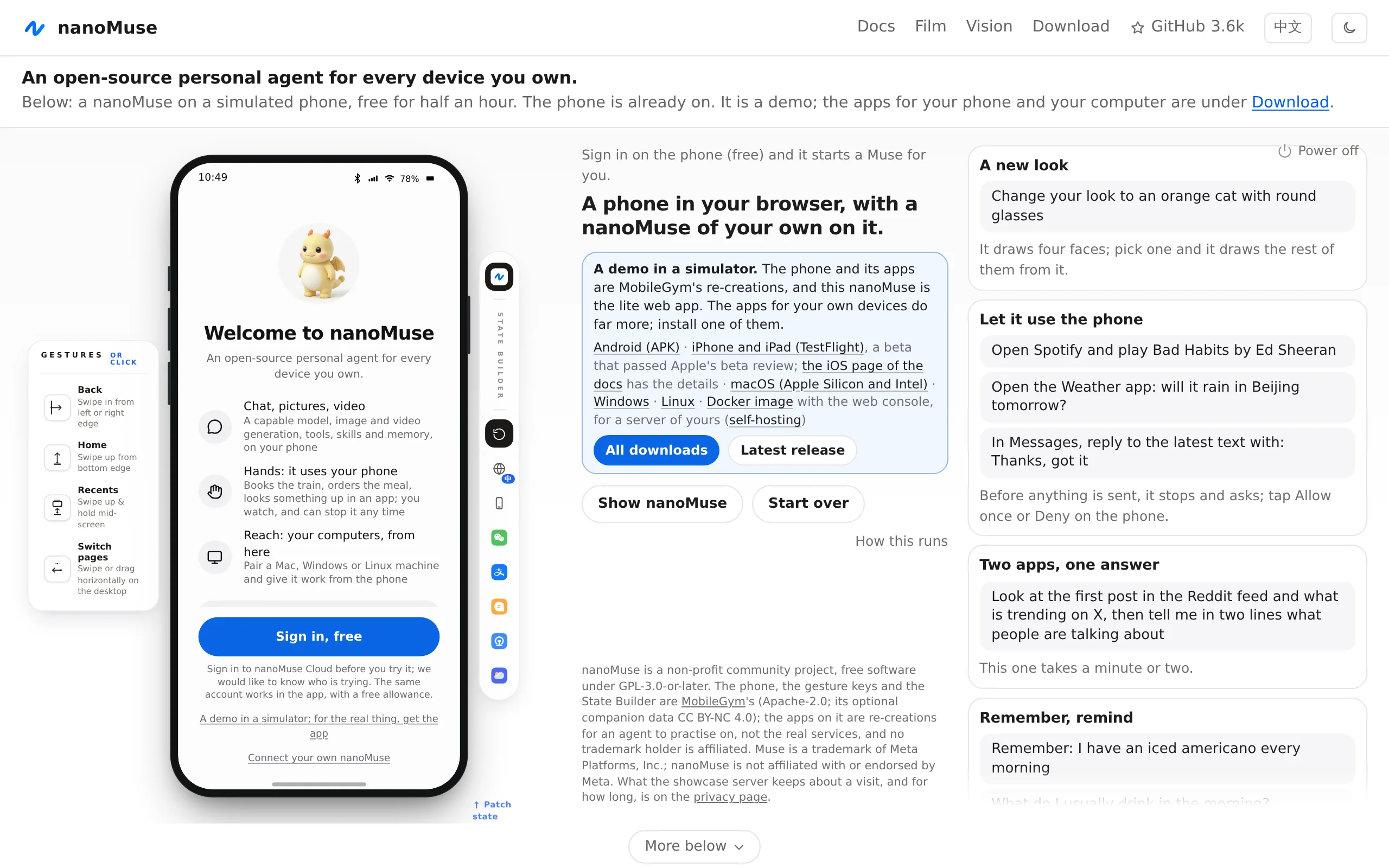
nanoMuse – An Open-Source Personal Agent from Zhejiang University, the Open-Source Version of Muse
nanoMuse is an open-source personal agent project developed by the Zhejiang University team. Its core concept is to allow users to run a complete AI Agent on their own devices, achieving a cross-devic...
MapFlow – An Open-Source Cross-Model LLM Inference Acceleration System from Peking University
MapFlow is a cross-model LLM inference acceleration system developed by the PKU-DAIR team at Peking University, aimed at addressing the pain points of repeated prefill computation when sharing long co...
© All Rights Reserved. Some content on this site is partially generated by AI with human review.