
GLM-5.4 —— Zhipu AI Launches Its First Flagship Model Using Loop Transformer Architecture, Unlocking 2–3T-Level Intelligence with Shared-Weight Cycles
Executive Summary:
GLM-5.4 is Zhipu AI's first-generation flagship large language model that adopts the Loop Transformer architecture. By enabling a set of layers with shared weights to perform multiple rounds of infere...
1. What is GLM-5.4
GLM-5.4 is Zhipu AI's first-generation flagship large language model that adopts the Loop Transformer architecture. By enabling a set of layers with shared weights to perform multiple rounds of inference, the model effectively achieves a deeper network structure without increasing the parameter count, delivering intelligence comparable to models with approximately 2–3T parameters. Based on code extrapolation capabilities, GLM-5.4 can generate videos, build complete games, and complete 3D modeling and mechanical design tasks, extending traditional coding abilities into broader creative domains. In terms of inference performance, the model can reach up to 200 tokens per second during off-peak hours. It is now available on multiple coding platforms including ZCode, Trae, and Qoder, and plans for open-sourcing are underway.
Technical Positioning and Domain: GLM-5.4 belongs to the field of natural language processing and large-scale pre-trained models. Its core technological breakthrough lies in replacing the traditional depth-stacking approach of the Transformer with the Loop Transformer cyclic architecture, significantly enhancing the model's intelligence level while maintaining the same parameter scale. This model is positioned as a flagship-level general-purpose large model, balancing capabilities in deep reasoning, code generation, visual understanding, and multi-modal output.
Development Background: GLM-5.4 was developed by the Zhipu AI team, building upon the technical foundation of previous GLM series models. The research team transformed 28 layers of the pre-trained GLM-5 base model into a two-round loop, achieving an increase in intelligence ceiling with only about 10% additional training computation. They validated the effectiveness of this architecture across multiple parameter scales ranging from 30B to 750B, confirming the scalability of the cyclic architecture from an engineering implementation perspective.
Core Value: GLM-5.4 addresses the trade-off dilemma between parameter scale and intelligence level in traditional Transformer models. Through its cyclic inference mechanism, the model achieves the reasoning capability of an effectively deeper network without increasing the parameter count, enabling near-large-scale model intelligence with a lower deployment cost. Additionally, its optimizations in inference efficiency, deployment cost, and long-context processing provide practical and feasible technical solutions for real-world applications.
Technical Features: The core innovations of GLM-5.4 are reflected in four key areas: the Loop Transformer architecture balances parameter efficiency with intelligence level; the gated progressive update mechanism maintains numerical stability during cyclic inference; the global sharing of KV Cache and independent sliding window design control the deployment cost of long context processing; and sparse attention index reuse reduces computational overhead. These design choices collectively form its differentiated advantages in architectural innovation, inference efficiency, and deployment cost-effectiveness.
2. Key Features
Deep Reasoning Capability: Based on the Loop Transformer architecture, the shared weight layers perform multiple rounds of inference in a loop, with each round continuing to refine the reasoning process from the hidden state of the previous round. Without increasing the parameter count, it effectively achieves the intelligence level of a 2–3T model. It performs exceptionally well on benchmarks such as GPQA and MMLU-Pro, with output length reduced by 10%–14%, and the benefits become more pronounced with longer reasoning chains.
Generalized Coding: Extrapolates code generation capabilities to a wide range of task scenarios. It excels in dimensions such as visual coding, visual replication, and long-range tasks, as demonstrated in 200 real-world scenarios. It evolves from merely "writing code" to "using code to solve all tasks," covering multiple levels from code completion to full engineering implementation.
Video Generation: Draws images in real-time using pure frontend code, without requiring any image assets. It autonomously plans the structure of video chapters and invokes a music generation model to create soundtracks, enabling the complete MV production workflow from scratch. Its video playback smoothness and image quality are highly competitive among similar models.
3D Modeling: Generates high-detail 3D interactive experiences solely through mathematical geometric calculations and custom GLSL shaders. Users can create interactive 3D scenes through natural language descriptions without needing professional graphics knowledge, significantly lowering the technical barrier for 3D content creation.
Engineering Design: Supports engineering modeling of complex devices such as six-axis robotic arms using FreeCAD, and can integrate with Blender for motion design and visualization. This capability enables GLM-5.4 to serve professional engineering scenarios such as mechanical design and industrial simulation.
Long Context Handling: Supports a long context window of up to 1M tokens, capable of handling large-scale software engineering tasks that span multiple files and modules. Inference speed can reach as high as 200 tokens per second during off-peak hours, and remains stable at 70–80 tokens per second during peak times, balancing processing power and response efficiency.
Self-Correction Mechanism: Continuously reflects and self-corrects during extended reasoning processes, making it suitable for complex projects requiring multi-step progression. Combined with long context handling, it maintains stable performance in extremely long reasoning scenarios such as large-scale software engineering, cybersecurity, and 3D modeling.
3. Application Scenarios
Agentic Programming: In coding platforms such as ZCode and Trae, GLM-5.4 can drive the complete development process from requirement analysis, code generation, debugging to submission. Developers describe requirements in natural language, and the model autonomously plans implementation strategies and executes coding tasks.
Large-Scale Software Engineering: With long-chain reasoning and a 1M long context window, GLM-5.4 is capable of handling complex system construction and refactoring across multiple files and modules. In scenarios requiring a global understanding of codebase structure and inter-module dependencies, the model demonstrates strong context integration capabilities.
Long-Horizon Tasks: In projects requiring multi-step progression and prolonged continuous thinking, the model continuously reflects on and corrects its own outputs. It is suitable for task types such as cybersecurity analysis and complex algorithm design that demand long-term focus and iterative optimization.
Visual Coding: Based on design drafts or screenshots, the model can perform visual replication and directly generate usable frontend pages and interactive code. Designers and frontend developers can quickly convert visual designs into functional web applications using this feature, shortening the development cycle.
Video Production: The model uses frontend code for real-time rendering throughout the process, autonomously plans video segments, and calls music generation models for accompaniment. It is applicable to creative content production scenarios such as MV creation and dynamic visual design. Creators can produce complete works without requiring professional video editing skills.
3D Content Creation: The model can generate fully interactive 3D scenes and models from scratch, suitable for application areas such as game development prototyping, product demonstrations, and virtual exhibitions. Through mathematical geometry and shader programming, the model achieves independent 3D content creation without relying on external asset libraries.
4. How to Use
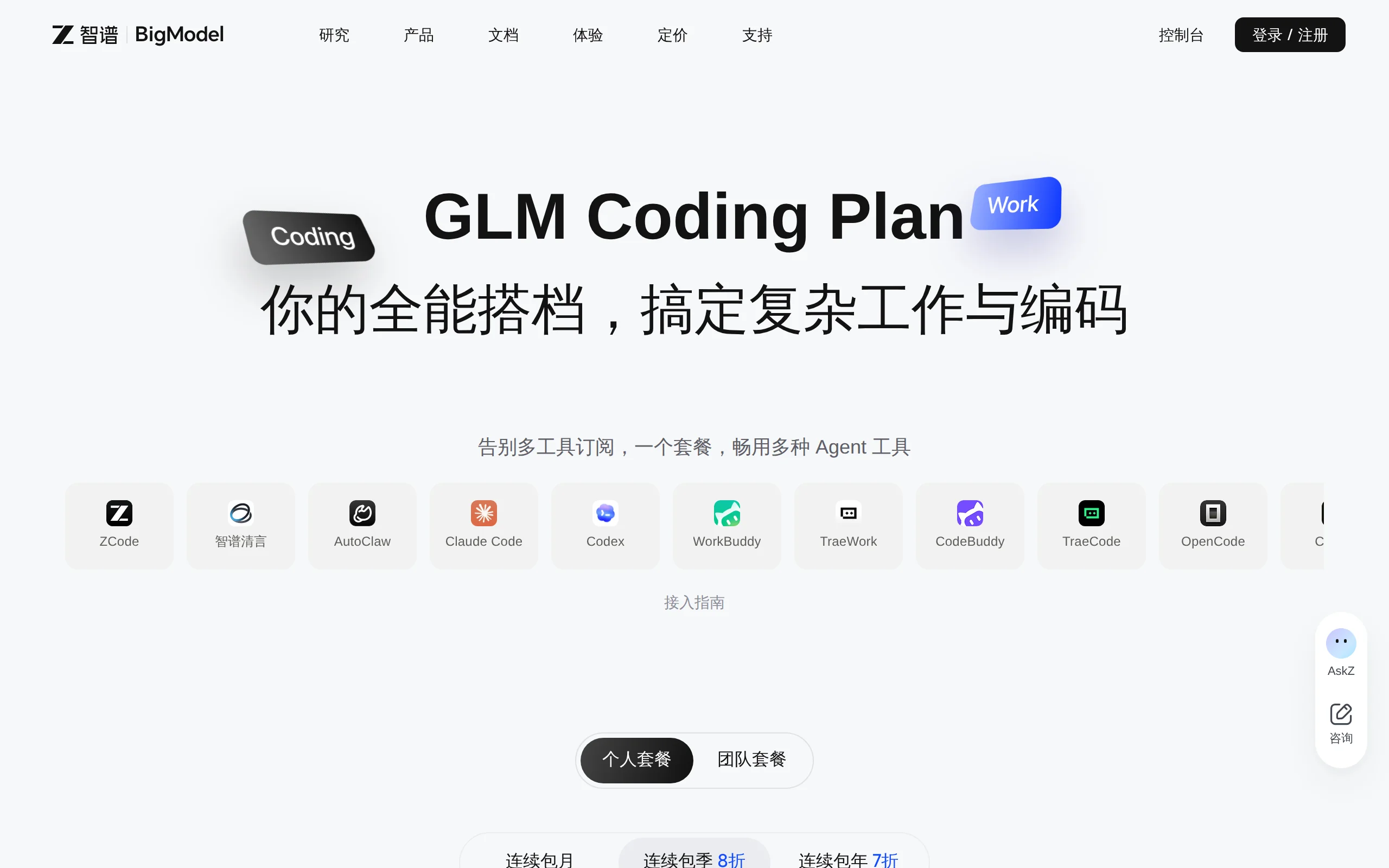
Channel Selection: Choose the access method based on your usage needs. For coding scenarios, consider platforms such as ZCode, Trae, Qoder, and WorkBuddy that have already integrated with GLM-5.4. For general conversation scenarios, you can directly access z.ai, Zhipu Qingyan, or AutoClaw.
Account Registration and Subscription: Visit the official website of the GLM Coding Plan (https://bigmodel.cn/glm-coding) to register or log in to your account. Confirm that your subscription status is V2/V3/Team Edition user, and the GLM-5.4 quota has been automatically increased to 1.5 times.
Platform Binding and Model Selection: Log in and bind the same account on the integrated coding platform. Select GLM-5.4 as the current model in the model selection list within the platform. The specific binding path varies slightly across platforms, and is typically located under the settings or model management module.
Task Initiation and Iterative Optimization: Describe the task requirements in natural language, and the model will automatically plan and execute code generation, reasoning, or creation tasks. For complex tasks, it is recommended to use a step-by-step description and continue interacting based on the output results, in order to fully leverage the model's deep reasoning and self-correction capabilities.
Performance Optimization Recommendations: During off-peak hours (such as nighttime or early morning on workdays), the inference speed can reach as high as 200 tokens per second. For large-scale tasks sensitive to response speed, it is recommended to schedule them during off-peak times. In long context scenarios, it is advised to organize the input structure reasonably and place key information in the appropriate position within the context.
General Coding Terminal Experience: If you wish to experience general coding capabilities such as video generation or 3D modeling, it is recommended to use the full features on the ZCode platform. Support for general coding functions may vary across different platforms. Before formal use, you can review the platform's functional documentation to confirm the scope of capabilities.
5. Pros and Cons Analysis
| Pros |
|---|
| Significant architectural innovation: The Loop Transformer enables shared weight layers to execute in a loop, maintaining the same number of parameters while effectively achieving a deeper network. It trades about 10% additional training computation for an increase in intelligence ceiling, achieving model performance at the 2–3T level, balancing parameter efficiency and intelligence level. |
| Inference efficiency optimization: The depth introduced by looping shifts inference from token flow to the network interior. On benchmarks such as GPQA and MMLU-Pro, output length decreases by 10%–14%, completing the same inference tasks with fewer generated tokens. The longer the inference chain, the more pronounced the benefits. |
| Controllable deployment cost: Global sharing of KV Cache and independent sliding window design result in only an additional memory cost for one window when implementing multiple rounds of looping. Sparse attention index reuse does not increase retrieval cost, and combined with operator fusion, it enables an efficient deployment solution. |
| Outstanding general coding capability: The coding ability extrapolates to multiple fields such as video generation, 3D modeling, and mechanical engineering, all completed through code-driven processes. Its upper limit is significantly higher than traditional coding models, evolving from "writing code" to "using code to solve all tasks." |
6. Comparative Analysis with Similar Tools
| Dimension | GLM-5.4 | Claude Opus 4.5 |
|---|---|---|
| Architecture Approach | Loop Transformer, shared-weight cyclic execution, equivalent to deepening the network | Standard Transformer with depth stacking, focusing on parameter scale |
| Parameters and Intelligence | 750B-level, officially claimed to reach 2–3T-level intelligence | Parameters not disclosed, officially positioned as flagship |
| Inference Method | Internalized iterative reasoning within the loop, output token reduction of 10%–14% | Extended Thinking, reasoning is externalized as long text |
| Context Window | 1M tokens | 200K tokens (1M in beta) |
| Coding Orientation | "General Coding": code-driven video, gaming, 3D, mechanical engineering | Agentic Coding, benchmark for terminal operations |
| Visual Capabilities | Strong in visual coding and replication, with robust multimodal output | Strong visual understanding, with output primarily text/code |
| Speed | Up to 200 tokens/s during non-peak times | Officially claimed to be 3x faster than previous generations, but no guarantees during peak times |
| Availability Channels | Available on multiple platforms including ZCode, Trae, Qoder, WorkBuddy, with plans for open-source | Claude official product + API, third-party support via integration |
Selection Recommendations: In scenarios requiring long context processing and general coding capabilities, GLM-5.4's loop architecture and code extrapolation features offer a differentiated advantage, especially in creative content production areas such as video generation and 3D modeling. Its "code-driven everything" approach leads in functional breadth compared to traditional coding models, making it suitable for development teams with clear multimodal output requirements. In scenarios prioritizing high stability and mature ecosystems, Claude Opus 4.5's agentic coding capabilities and terminal operation experience are more mature, making it ideal for professional developers emphasizing tool calling accuracy and engineering stability. The DeepSeek series, as open-source models, holds unique value in scenarios involving data privacy sensitivity and the need for localized deployment, making it suitable for enterprise users requiring full control over model weights.
7. Editor's Summary
GLM-5.4 has taken a different technical approach from the mainstream Transformer architecture. The Loop Transformer achieves the inference capabilities of an equivalently deeper network with only about 10% additional training computation by repeatedly executing shared-weight layers. This design has been validated step-by-step at model scales ranging from 30B to 750B, demonstrating that the loop architecture is not merely a temporary solution for small models, but a viable path with scalability potential. In terms of practical performance, data showing a 10%–14% reduction in output length on benchmarks such as GPQA and MMLU-Pro indicates that the loop mechanism indeed internalizes part of the reasoning process into network computation, rather than relying on longer generated text — a technical choice that diverges from the current mainstream approach of expanding model capacity.
On the application side, GLM-5.4's "pan-Coding" concept extends coding capabilities to areas such as video generation, 3D modeling, and mechanical design, handling various creative tasks through a unified code-driven paradigm. This method of integrating capabilities offers a new implementation perspective for multimodal generation. In terms of deployment cost, engineering optimizations such as global sharing of KV Cache, independent sliding windows, and reuse of sparse attention indices keep the deployment overhead increase manageable even under 1M long context scenarios. The inference speed of up to 200 tokens/s during non-peak times has also reached a usable level.
Notably, the model is planned to be open-sourced. If the weights are made available as promised, developers can deploy and study the inference behavior of the loop architecture in private environments, providing practical materials for the academic community to deeply understand the internal workings of the loop mechanism. The target users of GLM-5.4 include developers requiring long-chain reasoning capabilities, creative professionals seeking multimodal creation tools, and technical researchers interested in model architecture evolution. Its future ecosystem development and open-source progress will directly impact the application and promotion potential of this technical approach.
8. FAQ
Q: What is the fundamental difference between GLM-5.4's Loop Transformer architecture and traditional Transformers?
A: Traditional Transformers increase network depth by stacking more layers, with each layer having independent weights. Loop Transformer, on the other hand, allows a set of layers with shared weights to execute multiple rounds in a loop, continuing the inference process based on the hidden state from the previous round. GLM-5.4 transforms its base model's 28 layers into two rounds of looping, maintaining the same parameter count while effectively increasing the network depth. This is the core distinction between the two in terms of parameter efficiency and computational pathways.
Q: How does GLM-5.4's "pan-Coding" differ from traditional programming models?
A: Traditional programming models aim to generate code snippets or complete specific programming tasks. GLM-5.4's pan-Coding, however, treats code as a general-purpose problem-solving tool, enabling it to drive tasks such as video rendering, 3D modeling, and mechanical design. The model has been evaluated across 200 real-world scenarios, covering dimensions such as visual replication and long-range tasks, extending its capabilities from code generation to full creative workflows.
Q: How does GLM-5.4's 1M long context perform in practical use? Is the deployment cost controllable?
A: The 1M context can support large-scale software engineering projects involving multiple files and modules. In terms of cost control, the global sharing of KV Cache and the independent sliding window design allow the second round of looping to reuse the sparse KV from the first round, adding only the memory cost of a single window instead of the full context. This keeps the deployment cost increase manageable. Combined with sparse attention index reuse, it avoids redundant computational overhead.
Q: What problem does GLM-5.4's gating progressive update mechanism solve?
A: Directly overwriting the hidden state in the loop can lead to activation norm inflation with the number of loop iterations, affecting training stability. The gating progressive update mechanism introduces per-token gates for each round, writing back candidate changes proportionally. After training, the gates form a division of labor: the first round establishes a global context with a smaller gate value, while the second round reuses the state and fully writes back refined results, dynamically adjusting the step size based on the predicted difficulty of each token.
Q: On which platforms is GLM-5.4 available? Does it support local deployment?
A: GLM-5.4 is currently available on coding platforms such as ZCode, Trae, Qoder, and WorkBuddy, as well as official products like z.ai, Zhishu Qingyan, and AutoClaw. Developers can select GLM-5.4 from the model list after binding their account on the platform. The official team has confirmed plans to open-source the model, with the specific open-source timeline and weight acquisition method to be announced in an official post.
Q: Why does GLM-5.4's inference speed vary significantly across different time periods?
A: Inference speed is affected by server-side load. During off-peak hours, it can reach up to 200 tokens per second, while during peak hours it is approximately 70–80 tokens per second. This variation stems from the dynamic allocation of shared inference resources. For speed-sensitive large-scale tasks, it is recommended to schedule them during off-peak times or confirm the service level via the Coding Plan.
Q: Will GLM-5.4's loop architecture significantly increase inference latency?
A: Although loop execution increases the number of computational steps, the design mitigates some of the overhead through sparse attention index reuse and operator fusion optimization. The number of output tokens actually decreases by 10%–14%, and the total inference time may not necessarily increase. The additional cost of multi-round loops is only for a single sliding window's KV cache, not the full context, making the actual deployment cost relatively controllable.
9. Project Links
- GLM Coding Plan official website: https://bigmodel.cn/glm-coding
- Official product entry 「z.ai」: https://z.ai
- Official product 「ChatGLM」: https://chatglm.cn
- Zhipu AI Open Platform (BigModel): https://open.bigmodel.cn
- Official technical documentation and API reference: https://docs.bigmodel.cn
Related

Shotkit: Open-Source AI Pre-Production Tool, a Creation Pipeline Centered on Brand Consistency
Shotkit is an open-source AI pre-production tool developed by the WhyStrohm team, running as a Claude Code plugin and offering a Mac desktop application called Canvas. This tool builds a complete bran...
Hy4 flash – Tencent HunYuan's High-Cost-Performance Large Model
Hy4 flash is a high-cost-performance large model launched by Tencent HunYuan, which employs a sparse mixture-of-experts (MoE) architecture with a total of 224B parameters and 12B active parameters. It...
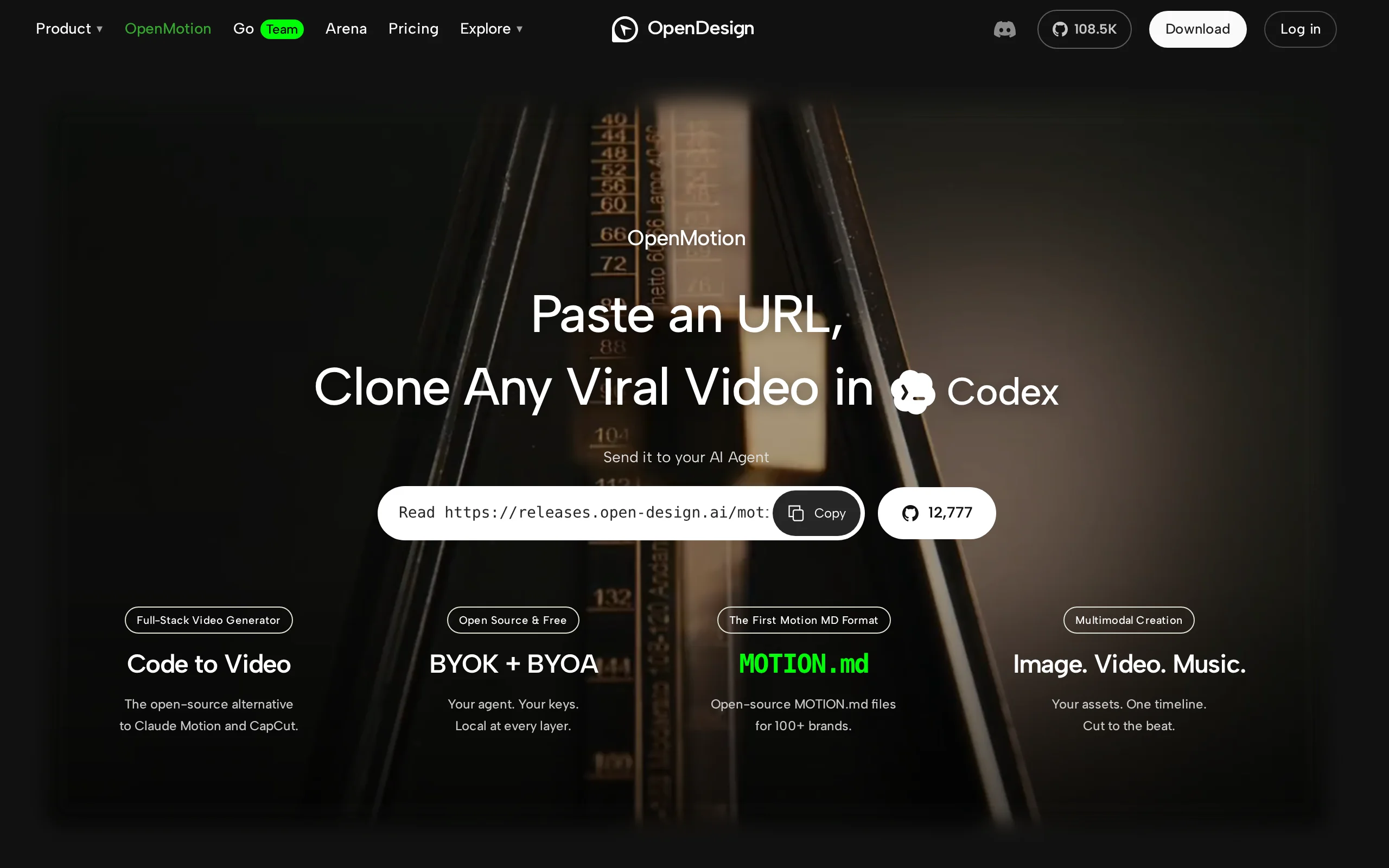
OpenMotion – Open-Source AI Video Recreation Tool, Replicate Videos Using Brand Assets
OpenMotion is an open-source intelligent video production tool. Its core capability lies in deeply analyzing reference videos through AI, extracting the sequence of shots, transition logic, and narrat...
WuJie·PhysCapBench – The First Unified Benchmark for Evaluating Cross-Domain Video Physical Description Capabilities Launched by Zhixin
WuJie·PhysCapBench is the first cross-domain video physical description evaluation benchmark introduced by Inverse Matrix in collaboration with the Zhixin Institute of Research and Peking University. ...
© All Rights Reserved. Some content on this site is partially generated by AI with human review.