
OpenViking – ByteDance's Open-Source AI Agent Context Database
Executive Summary:
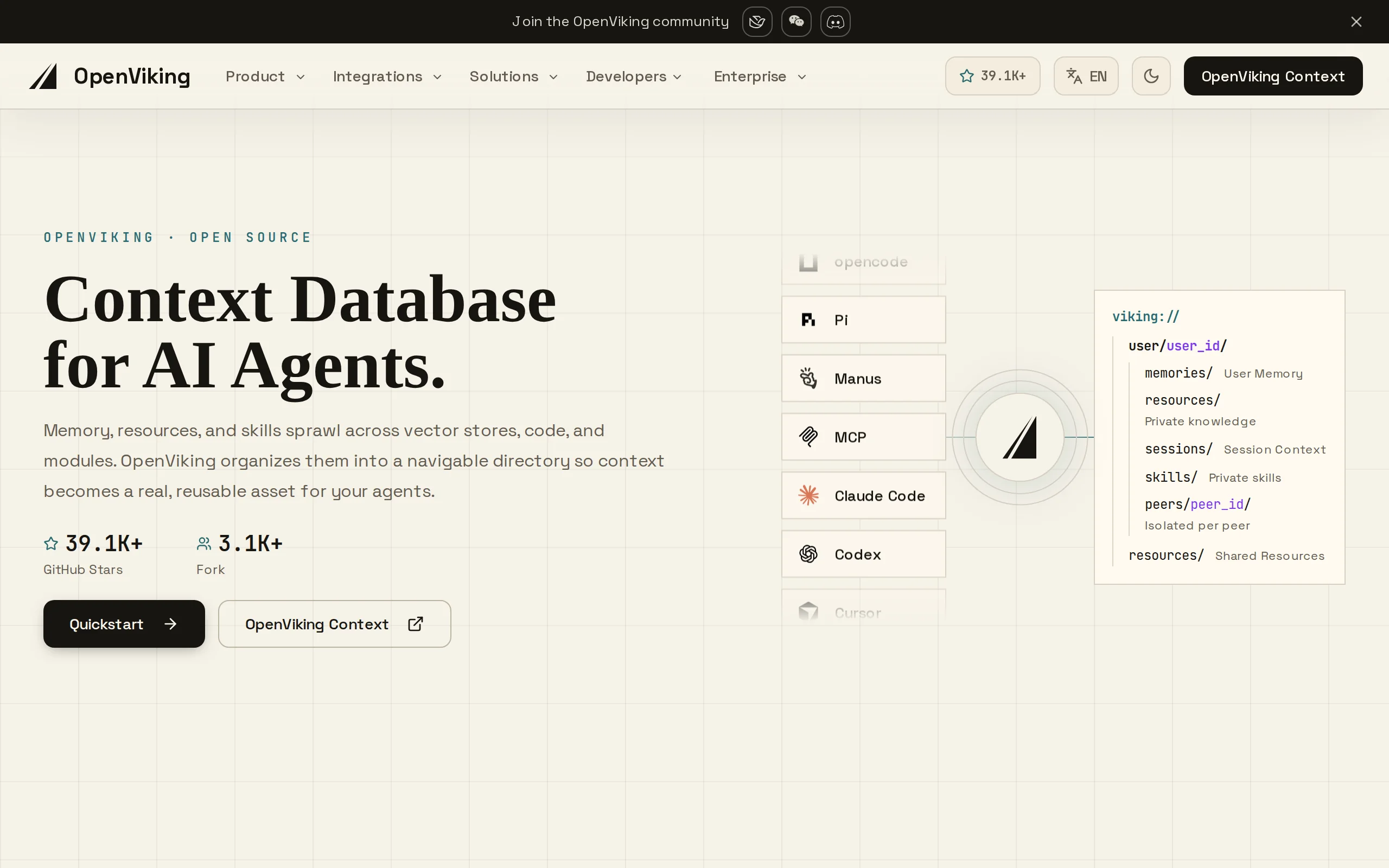
OpenViking is an open-source AI Agent context database developed by ByteDance's Volcano Engine. Its core idea is to unify the Agent's memory, knowledge RAG, and skills within a custom viking:// virt...
1. What is OpenViking
OpenViking is an open-source AI Agent context database developed by ByteDance's Volcano Engine. Its core idea is to unify the Agent's memory, knowledge RAG, and skills within a custom viking:// virtual file system. Agents can browse and retrieve context using commands such as ls, tree, find, and grep, just like operating with files, thus eliminating the traditional "text in, embeddings out" black-box model. Through a three-tier progressive loading mechanism (L0 summary, L1 overview, L2 details), OpenViking supports semantic search at the directory level. In the LoCoMo evaluation, input token consumption was reduced by 34% to 91%, and latency was reduced by 58% to 66%, significantly improving the accuracy of long-term memory and business efficiency.
Technical positioning and domain: OpenViking belongs to the AI Agent infrastructure layer, specifically focusing on the areas of context engineering and long-term memory management. It is not a traditional vector database or key-value store, but rather an agent context management middleware that abstracts the file system and integrates semantic search with hierarchical caching. This tool is designed for intelligent agent applications that require cross-session memory, knowledge scheduling, and skill orchestration, filling a gap in the niche area of white-box management for agent contexts.
Development background: OpenViking was developed and open-sourced by the Volcano Engine team at ByteDance, leveraging the company's engineering experience in cloud-native infrastructure and large model application layers. Volcano Engine has long served enterprise-level AI implementations, with extensive expertise in model services, vector search, and knowledge base construction. The motivation behind OpenViking's development directly addresses three major pain points of AI agents in production environments: invisible context, high token costs, and lack of shared memory for multi-agent collaboration. It aims to systematically solve these issues with a "everything is a file" approach.
Core value: The problem that OpenViking solves is the "black-box" nature of long-term memory and context management in AI agents. Traditional approaches implicitly embed memory and knowledge into vectors, making it impossible for developers to view or correct the agent's cognitive state. OpenViking exposes memory, knowledge, and skills as readable and editable virtual files, combined with three-tier progressive loading and directory-level search, reducing input token consumption by approximately 34% to 91% and latency by 58% to 66%. After integration with main agents such as Claude Code, Hermes, and OpenClaw, the accuracy of long-term memory increased from 24% to 57% to over 80%. Memories can be沉淀ed as Markdown and compiled into wiki or knowledge graphs, achieving observability, reusability, and audibility of memory.
Technical features: The technical core of OpenViking lies in the integration of the custom viking:// file system protocol with the L0/L1/L2 three-tier progressive loading mechanism. It uses the TrieHI index to enable semantic search at the directory level, supporting the limitation of search scope to specific subtrees rather than full-database scans, thus balancing precision and efficiency. At the same time, the framework natively integrates with over a dozen main agents, including Claude Code, Codex, Cursor, and OpenClaw, and provides the MCP protocol, Agent Plugin 1.0 standard, and SDKs for Python, Go, and TypeScript, offering broad ecosystem coverage and low implementation barriers.
2. Key Features
Unified Context File System: Through the custom
viking://protocol, memory, knowledge resources, and skills are uniformly organized as virtual files. Agents can use commands such asls,tree,read, andgrepto directly browse and edit the context, achieving transparent and white-box management of the context. This design transforms the non-explainable nature of traditional vector databases into the intuitive operability of a file system, making it the most distinctive feature of OpenViking compared to similar products.Three-tier Progressive Loading Mechanism: Each directory automatically generates three levels of context representation: L0 summary, L1 overview, and L2 full content. When retrieving, the Agent first reads the L0 summary to determine relevance, and then loads L1 or L2 levels as needed, avoiding the influx of the entire context into the prompt. According to LoCoMo evaluation data, this mechanism reduces input token consumption by 34% to 91%, and lowers latency by 58% to 66%, showing excellent performance in long-context scenarios.
Directory-level Semantic Search: Supports
findandsearchcommands, allowing the search scope to be strictly limited to a project or memory subtree, rather than scanning the entire database. The underlying implementation relies on the TrieHI index structure, a technology that has been validated by an ICDE paper. Compared to full-database vector search, directory-level semantic search significantly reduces search noise while improving hit accuracy, making it especially suitable for large code repositories and multi-project parallel scenarios.Session沉淀为Files: After a conversation is completed, it can be automatically archived and extracted into checkable and editable Markdown files. VikingBot can also compile the materials into wiki, knowledge graphs, or structured reports using the
ov compilecommand. This feature connects the transformation chain from "conversation - memory - knowledge," enabling the results of each interaction to be continuously accumulated as reusable knowledge assets for the team.Multi-Agent Ecosystem Integration: Natively integrates over a dozen mainstream Agents, including Claude Code, Codex, Cursor, OpenClaw, and Hermes. It also provides the MCP protocol, the Agent Plugin 1.0 standard plugin, and SDKs in three languages: Python, Go, and TypeScript. Developers and the Agent ecosystem can quickly integrate with OpenViking without needing to adapt from scratch, reducing migration costs and integration barriers.
Studio Visualization Panel: Offers both a browser-based OpenViking Studio and a self-hosted Web version. Developers can visually browse the
viking://directory structure and test semantic search features online. For teams requiring intuitive management of Agent context, the visual interface lowers the usage threshold and makes context status checks and debugging more efficient.Multi-user and Access Control: The server supports multiple account systems and provides user-level isolation along with optional resource ACL access control. This mechanism is suitable for team deployment scenarios, allowing multiple developers or Agents to share a single context infrastructure while ensuring clear and controllable boundaries for data access permissions.
3. How to Use
Install the main package: Execute
pip install openviking --upgradein the terminal to install the OpenViking main package and its dependencies. This command will update to the latest version, and it is recommended to run it periodically to ensure full functionality. If you need to use the built-in Agent features, you can additionally runpip install "openviking[bot]"to install the bot extension.Initialize the server: Run the
openviking-server initcommand and configure the model provider information according to the interactive prompts, including parameters such as API Key, model name, and Base URL. The initialization process will generate a default configuration file, and users can adjust the model parameters and retrieval strategies based on their actual deployment environment.Environment self-check: Execute the
openviking-server doctorcommand. The system will automatically verify the correctness of the configuration file, the connectivity to the model provider, and the completeness of the local environment. This step can identify configuration errors or network unavailability issues in advance, and it is recommended to run it before any in-depth usage.Start the service: Run
openviking-serverto start the local server. By default, the service listens on a local port. If remote access or team collaboration is required, adjust the listening address and port number in the configuration file, and refer to the official documentation to enable ACL access control.Import knowledge resources: Use the
ov add-resource <url or path>command to import GitHub repositories, local document directories, or web links as knowledge resources. After importing, check the indexing task progress withov task statusand wait for the system to complete vectorization and directory structure building.Browse and retrieve: Use
ov lsandov treeto browse the directory structure and locate the required context based on the directory. Useov find "question"to perform semantic search, and useov grepfor exact text matching. During retrieval, you can limit the scope to a specific directory or subtree to control noise recall.Experience the Agent conversation: If the bot extension is installed, run
openviking-server --with-botto start the server with the built-in Agent. Then useov chatto initiate a conversation session. The Agent will perform memory read/write and tool calling operations on theviking://file system, allowing it to continuously track project progress across sessions.
Notes and Best Practices: It is recommended to divide directory hierarchies before importing large repositories to facilitate subsequent directory-level retrieval; regularly use ov compile to organize session content and avoid fragmented memory; when deploying in a team environment, make sure to enable ACL to ensure that context data from different business lines is isolated.
4. Pros and Cons Analysis
| Pros |
|---|
Context White-box Management: Memory, knowledge, and skills are uniformly exposed as viking:// virtual files, allowing developers to browse and edit the Agent's context state at any time. This addresses the pain points of traditional vector databases, which are "uninterpretable and uncorrectable," significantly improving troubleshooting and debugging efficiency. |
| Significant Token Efficiency Optimization: The L0/L1/L2 three-tier progressive loading mechanism reduced input token consumption by 34% to 91% and latency by 58% to 66% in the LoCoMo evaluation. This provides practical benefits for cost control in scenarios involving long contexts and high-frequency retrieval. |
| Accurate Directory-level Semantic Retrieval: It supports limiting the search scope to specific projects or memory subtrees. Leveraging the TrieHI index structure (backed by an ICDE paper) reduces retrieval noise and avoids irrelevant recalls caused by full-database scans. |
| Broad Ecosystem Integration: Natively integrates with over a dozen mainstream Agents such as Claude Code, Codex, Cursor, and OpenClaw, and supports the MCP and Agent Plugin 1.0 standards, along with Python/Go/TS SDKs, resulting in low adaptation costs. |
Session沉淀 and Knowledge Reuse: Conversations can be archived as Markdown and memories can be automatically extracted. ov compile can generate wiki, knowledge graphs, or reports, enabling continuous accumulation from conversations to knowledge. |
| Multi-user and Permission Isolation: The server supports multi-account, user-level isolation, and optional ACL access control, making it suitable for team deployment and enterprise scenarios with high data security requirements. |
5. Comparative Analysis with Similar Tools
| Comparison Dimension | OpenViking (ByteDance Volcano Engine) | MemOS | Mem0 |
|---|---|---|---|
| Core Positioning | Context Database: Unified Memory, Knowledge RAG, Skills | Agent Memory System (2.0+ extended knowledge base, multi-modal) | Open-source memory layer for long-term memory management of Agents |
| Data Organization Method | viking:// virtual file system, directory tree structure |
Structured memory graph + Memory Cube spatial isolation | Vector database priority, fragmented memory blocks |
| Core Abstraction | Everything is a file: resources/memories/skills/sessions/peers | Memory Cube: isolates memory space by project/user/Agent | Memory fragments (memories) stored by metadata classification |
| Context Loading | Three-tier progressive loading: L0 summary / L1 overview / L2 details | Memory nodes + asynchronous recombination for relationships and hierarchy | Instant recall based on relevance, no tiered progressive loading |
| Retrieval Mechanism | Directory-level vector retrieval + find/search semantic retrieval + grep text matching + Rerank | Graph retrieval + vector retrieval + BM25 keyword parallel recall + Rerank | Vector similarity + metadata filtering, supports Rerank |
| Retrieval Scope Control | Can limit to directories/subtrees (TrieHI index, supported by ICDE paper) | Cube isolation + TaskGoalParser task parsing | Metadata tag filtering, can limit to user/Agent |
| Conflict Resolution | Session submission for archiving, editable and merged memory | LLM determines conflicts/redundancies, merges while preserving lineage tracing | Merges similar memory blocks, retains update timestamps |
| Visualization | OpenViking Studio browser-based demo + desktop application (Beta) | WebUI cloud service | Web panel for managing memory library |
| Agent Integration | Native integration with Claude Code/Codex/Cursor/OpenClaw/Hermes/pi and more than 10 agents + MCP + Agent Plugin 1.0 | Plugin support for OpenClaw/Hermes/DSH + REST API | Plugin support for LangChain/CrewAI/OpenClaw + REST API |
| API/SDK | Python/Go/TypeScript SDK + HTTP API | Unified REST API | Python/JS SDK + REST API |
| Open Source License | Open source (Apache-2.0, official repository as reference) | Partially open source, cloud service closed source | Apache-2.0 |
Selection Recommendations: For developers using mainstream agents such as Claude Code, Codex, Cursor, and prioritizing context visualization and token cost control, OpenViking is a natural choice. Its three-tier progressive loading mechanism provides significant advantages in cost-sensitive scenarios. If your team needs to share knowledge across different agents and emphasizes retrieval diversity (semantic + graph + keywords), the parallel recall mechanism and Memory Cube isolation approach of MemOS are worth considering.
Additional Recommendations: For teams building agent applications using frameworks such as LangChain or CrewAI, Mem0 offers a lower integration cost with its plugin system, making it ideal for quickly adding long-term memory capabilities. Meanwhile, developers seeking autonomous memory management and requiring function-level control over memory lifecycle will find Letta's "operating system-style" memory management paradigm to provide a more fundamental and flexible interface, although it comes with increased engineering complexity.
6. Editor's Summary
OpenViking demonstrates clear differentiated value in its technical approach. By abstracting the Agent context through a virtual file system and unifying memory, knowledge, and skills into readable and writable files, this design transforms context management from a "black-box vector" into a "white-box directory," providing a new technical pathway for the debuggability and interpretability of Agents. The L0/L1/L2 three-tier progressive loading mechanism directly addresses the pain point of token costs, with empirical data showing a 34% to 91% reduction in input tokens, proving the effectiveness of the engineering solution. The introduction of the TrieHI index provides academic validation for directory-level semantic retrieval, establishing a quantifiable balance between retrieval accuracy and efficiency. These technical choices indicate that OpenViking is not merely a collection of concepts, but a systematic engineering solution tailored to real-world issues in Agent production environments.
In terms of practical value, OpenViking is supported by empirical data across three dimensions: multi-Agent collaboration, improvement in long-term memory accuracy, and context cost optimization. After integrating three foundational systems, memory accuracy has increased from 24% to 57% to over 80%. Its ecosystem supports mainstream tools such as Claude Code, Codex, and Cursor, and with the combination of general standards like MCP and Agent Plugin 1.0, it reduces integration barriers. For AI application developers, Agent framework maintainers, and vertical scenario teams requiring long-term memory support, OpenViking offers one of the few available context management infrastructures today that provide white-box observability and cost control capabilities.
In terms of growth potential, as Agents take on more complex tasks in production environments, context management will gradually evolve from a supporting feature to a core infrastructure. OpenViking's technical strategy—using a file system as an interaction metaphor, hierarchical loading for performance optimization, and open protocols for ecosystem expansion—has the potential to evolve into an enterprise-level knowledge management platform. The team's deployment requirements, including ACL-based access control and multi-account support, have already reserved space for commercialization and enterprise adoption.
7. Application Scenarios
Intelligent Coding Assistant: Import code repositories and technical documentation into the
viking://resources/directory. The coding Agent can search for code context within the directory and remember the developer's coding habits and project conventions. During cross-session development, the Agent does not need to rescan the entire codebase, but can directly useov findto locate relevant implementations, continuously track project progress, and reduce redundant questions and ineffective searches.Multi-Agent Collaboration System: Isolate the context of different interaction entities using the
peersdirectory, while sharing theresourcesdirectory to accumulate team knowledge. Multiple Agents can collaborate on the sameviking://file system, each with its own independent memory subtree, while sharing common knowledge resources. This structure naturally supports a "multiple Agents per team" collaboration model, preventing memory silos among Agents.Sales and Customer Service: Accumulate customer preferences, historical communication records, and order status in the user memory directory. The sales Agent can invoke
ov recallacross sessions to obtain a complete customer profile, maintaining long-term customer relationships. The customer service Agent can quickly search for similar cases based on the historical ticket directory, reducing time to identify issues and improving the success rate and customer satisfaction of multi-turn business tasks.Video and Content Creation: Organize storyboards, asset libraries, and brand guidelines into subdirectories under
viking://resources/. The creation Agent can search for assets by project, and remember the creator's writing style and visual preferences during conversations, supporting long-form content creation across cycles and chapters, and avoiding the need to re-describe style requirements for each creation session.Recommendation System Diagnosis: Import policy documents, bad case records, and experimental logs. The diagnosis Agent can search for evidence chains within the directory scope, identifying root causes with fewer token consumptions.
ov compilecan automatically generate analysis reports, turning the multi-round diagnostic process into reusable wiki documents or knowledge graphs for the team, improving the standardization level of issue diagnosis.
8. FAQ
Q: What differentiates OpenViking from vector databases (such as Milvus, Pinecone)?
A: OpenViking also uses vector indexing at the lower level to support semantic retrieval, but it does not merely provide storage and retrieval capabilities. Its core difference lies in organizing memory, knowledge, and skills into a readable and editable virtual file system, and offering a three-tiered progressive loading mechanism (L0/L1/L2) along with directory-level retrieval control. While vector databases address "how to find relevant content," OpenViking addresses "how to organize, browse, and control an Agent's context," effectively building a context management layer for Agents on top of vector capabilities.
Q: How does the L0/L1/L2 three-tiered progressive loading reduce token consumption?
A: Each directory automatically generates three levels of content representation: L0 is a directory summary, L1 is an overview, and L2 is the full details. When an Agent receives a task, it first reads the L0 summary to quickly determine if the directory is relevant to the current question. If it is, the Agent loads L1 or L2 as needed. Since most irrelevant directories remain at the L0 summary level and do not enter the prompt, token consumption is significantly reduced. In the LoCoMo evaluation, this mechanism reduced input tokens by 34% to 91%, and latency by 58% to 66%.
Q: How can I integrate my own developed Agent into OpenViking?
A: OpenViking provides three integration paths: first, through the MCP protocol, suitable for Agents that support MCP; second, using the Agent Plugin 1.0 standard plugin, suitable for Agent runtimes compatible with this framework; third, directly calling APIs via Python/Go/TS SDKs for deep customization. It is recommended that new projects start with MCP, as it has the lowest integration cost.
Q: Can OpenViking be deployed internally within a team? How is data isolated?
A: Yes. The OpenViking server supports a multi-account system, providing user-level isolation and optional resource-level ACL access control. When deploying within a team, you can configure access permissions for different members and Agents, ensuring that business data is not accessed beyond authorized limits. It is recommended to refer to the official documentation when adjusting listening addresses and ACL policies during deployment to align with enterprise security standards.
Q: Will retrieval speed decrease after importing a large code repository?
A: There will be resource consumption during the indexing phase, but once the import is complete, query performance is largely unaffected by the overall size of the repository. OpenViking's TrieHI index supports directory-level retrieval, allowing semantic searches to be limited to specific subtrees and avoiding full-database scans. As a result, even with large total data volumes, the recall scope for each query remains controllable, and speed does not degrade linearly.
9. Project Links
- Project Website: https://openviking.ai/
- GitHub Repository: https://github.com/volcengine/OpenViking
Related AI Model Articles
Claude Haiku 5.5 – Anthropic's Most Lightweight Model
Claude Haiku 5.5 is the latest small language model officially released by Anthropic on October 7, 2026. It is positioned as a high-value product with the tagline "cheapest, fastest, and most capable....
Ling-3.1-flash – A New Generation Large Model Launched by the Bailing Team at Ant Group
Ling-3.1-flash is a new generation large language model launched by the Bailing team at Ant Group. It employs a hybrid linear Attention architecture and MoE sparse activation technology, with a total ...
IQuest-Q1 Review: A 320B Sparse MoE Open-Source Agent Foundation Model Specializing in Code and Long-Horizon Agent Tasks
IQuest-Q1 is an open-source Agent foundation model developed by IQuestLab, with a core focus on code generation and Agent task execution. The model employs a sparse MoE architecture, featuring a total...
GPT-6.1 Sol – OpenAI's New Generation Mainstream Model
GPT-6.1 Sol is a new generation mainstream model launched by OpenAI in 2026, serving as an upgraded version of GPT-6 Sol. It achieves nearly the same level of intelligence as the latter at just one-fi...
© All Rights Reserved. Some content on this site is partially generated by AI with human review.