
VitaBench 2.0 – Meituan LongCat’s Long-Horizon Dynamic Agent Benchmark
Executive Summary:
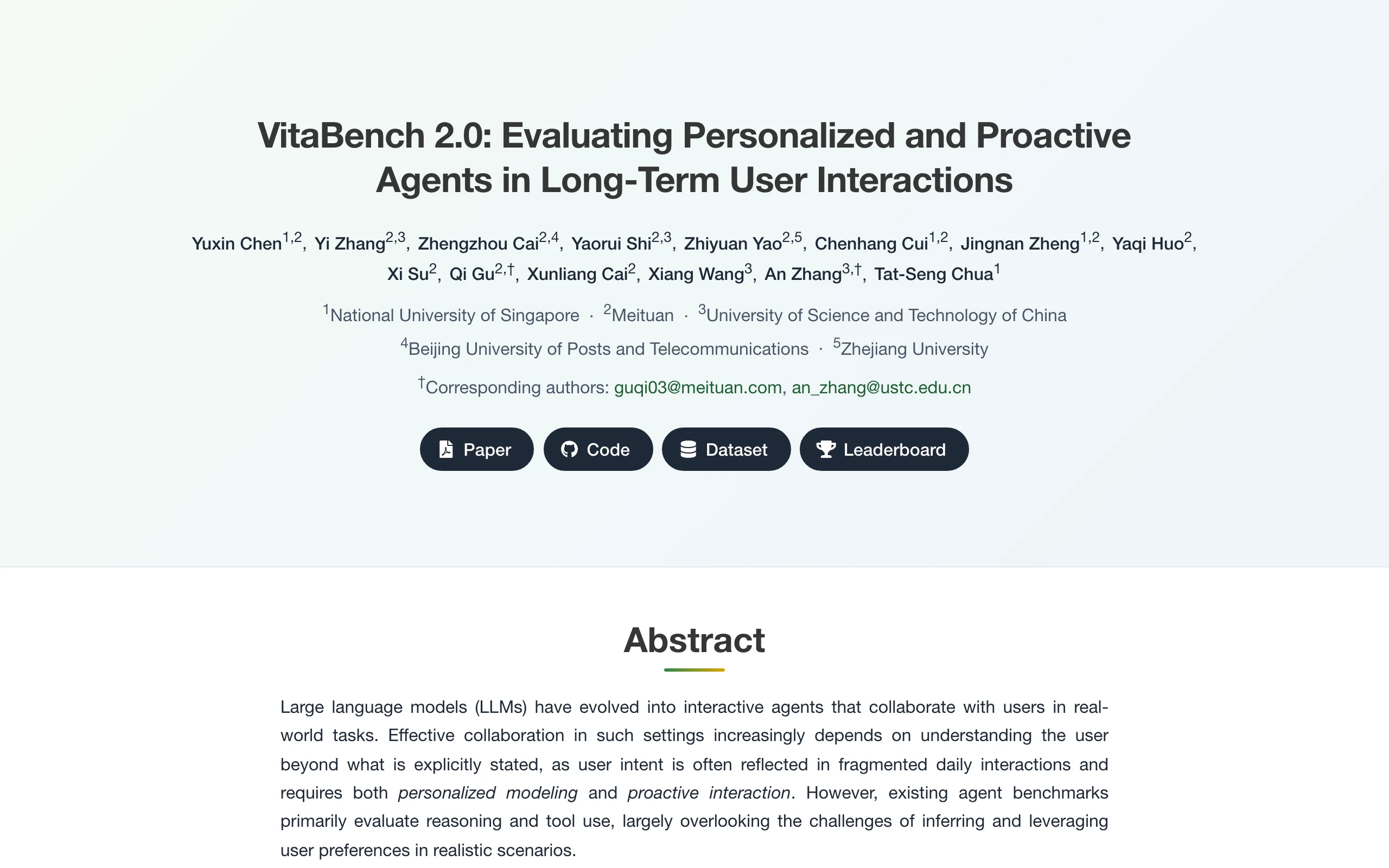
VitaBench 2.0 from Meituan’s LongCat team is the first benchmark for long-horizon dynamic user modeling in real-life agent scenarios. It ships 56 statistically grounded synthetic users, 819 lifecycle-...
1. What Is VitaBench 2.0
VitaBench 2.0 from Meituan’s LongCat team is the first benchmark for long-horizon dynamic user modeling in real-life agent scenarios. It ships 56 statistically grounded synthetic users, 819 lifecycle-spanning tasks, 2,000+ evolving preferences, and 66 executable tools—average interaction span 1,580 days (max 2,974)—to measure personalization, proactive service, and adaptation over years—not single-shot accuracy.
Technical positioning and domain: AI evaluation for longitudinal user modeling. Unlike SWE-bench or AgentBench one-offs, time is a first-class axis: models must track drifting tastes across multi-year event streams.
Development background: LongCat’s lifestyle-AI experience exposed a gap—no standard way to score “ remembers you five years later.” VitaBench 2.0 fills that for assistants, concierge bots, and local services.
Core value: Quantifies long-term personalization—memory, preference inference, proactive clarification—pushing models from Q&A to companionship.
Technical characteristics: 3D decomposition (profile, prefs, history, tasks) on a strict timeline; memory arena pitting Agentic Memory vs RAG Memory on identical trajectories for fair architecture comparisons.
2. Key Features
Realistic user trajectories: 56 users across delivery, in-store, travel, etc., with demographics mirroring real-world stats.
Dynamic preference evolution: 2,000+ preference shifts (~48+ per user)—taste, spend, life-stage changes models must track.
Complex task battery: 819 executable tasks tied to long-term prefs—decisions, retrieval, recommendations.
Dual memory showdown: Agentic vs RAG vs full-context baselines on the same data/tasks with standardized hooks.
Proactive tasks: Scenarios requiring clarifying questions when info is incomplete—mirrors real service dialogs.
Noise injection: ~20% irrelevant/exploratory interactions—tests signal extraction under realistic clutter.
3. How to Use
Environment: Python 3.8+, ~5 GB dataset, 16 GB RAM recommended; Linux/macOS preferred.
Clone framework:
git clone https://github.com/meituan-longcat/vitabench-2.0.gitDownload data:
from datasets import load_dataset
dataset = load_dataset("meituan-longcat/VitaBench-2.0")
Install deps:
cd vitabench-2.0
pip install -r requirements.txt
Pick memory mode: Full context, Agentic Memory, or RAG Memory baseline.
Plug in your agent/model:
python run_benchmark.py --model your_model_name --memory_mode agenticAnalyze reports: Review Avg@4, Pass@4, temporal decay curves for long-horizon weakness.
4. Pros and Cons
| Pros |
|---|
| First long-horizon lifestyle agent bench: Fills a major evaluation void. |
| Multi-year spans: Avg 1,580 days exposes drift invisible to short benchmarks. |
| Statistically grounded personas: 56 diverse synthetic users aid generalization claims. |
| Unified memory comparison: Arena design guides memory module R&D. |
5. Comparison with Similar Tools
| Dimension | VitaBench 2.0 | SWE-bench | AgentBench |
|---|---|---|---|
| Goal | Long-term user modeling & proactive service | Real GitHub SWE fixes | Multi-scenario general tasks |
| Tasks | Lifestyle decisions (food, travel, local) | Code patches | Web, games, code, chat |
| Time span | Avg 1,580 days | Single shot | Single/short dialog |
| User dimension | 56 personas + preference drift | None (repo/issue only) | None |
| Memory focus | Core metric (3 modes) | Current code context only | Dialog context only |
| Proactivity | Designed-in | N/A | Partial exploration |
| Noise | ~20% distractor events | Low | Low |
| Top scores | ~0.50 full-history (Claude Opus 4.6 class) | 40–60%+ pass rates | 60–80% task success |
Selection guidance: Long-term personalization research → VitaBench 2.0. Code automation → SWE-bench. Broad agent scenarios → AgentBench. Tool-use depth → ToolBench.
6. Editor's Take
Introducing time and preference drift to agent eval is a milestone—SWE/AgentBench can’t tell if your assistant still knows you after a lifestyle change.
Directly actionable for personal AI, concierge, and recommendation teams; the memory arena is especially valuable for architecture choices.
Audience: Researchers, LLM vendors, agent engineers, lifestyle platform algo teams.
Future: More industries, multimodal traces, richer social graphs.
— Foundational bench despite hardware/learning curve costs.
7. Use Cases
Personal assistant eval: Measure memory, habit tracking, proactive help.
Customer support tuning: Test preference recall under evolving users.
Recommendation QA: Realistic long-run behavior for food/travel/hotel stacks.
Memory R&D: Compare Agentic vs RAG head-to-head.
Long-context stress tests: Years of noisy events probe context limits.
8. FAQ
Q: vs VitaBench 1.0?
A: 2.0 scales users/tasks/time, adds dynamic prefs and noise separation vs smaller 1.0 scope.
Q: Integrate my model?
A: Implement the documented Agent API—ingest timed events, maintain memory, call tools, emit responses; samples in repo.
Q: Avg@4 and Pass@4?
A: Average success over 4 attempts vs at-least-once success in 4 tries—stability vs peak capability.
Q: Chinese models?
A: Dataset is Chinese lifestyle-centric; any model handling Chinese works; English-only models need adaptation.
Q: Runtime/hardware?
A: Hours in full-context mode; 16 GB+ RAM; GPU (A100/V100 class) recommended for local LLM inference.
Q: Privacy?
A: Fully synthetic users—no real PII; compliance-reviewed release.
Q: Can I run a subset of users or tasks for faster iteration?
A: Yes—the harness supports filtering by user ID, task category, or date range so you can smoke-test a new memory module on a handful of trajectories before launching the full 819-task sweep. Check run_benchmark.py flags and the README for --user_subset and --max_tasks options; partial runs still emit comparable Avg@4 metrics on the selected slice.
9. Project Links
- Site: https://vitabench2.github.io/
- GitHub: https://github.com/meituan-longcat/vitabench-2.0
- Hugging Face dataset: https://huggingface.co/datasets/meituan-longcat/VitaBench-2.0
- Paper: https://arxiv.org/pdf/2605.27141
Related AI Model Articles
QwenGyre – The Online Reinforcement Learning Framework for Long-Horizon Agents Launched by Alibaba Qwen
QwenGyre is an online reinforcement learning framework introduced by the Alibaba Qwen team, specifically designed for long-horizon agent tasks that involve executing approximately 700,000 tokens in a ...
REA: Open-Source Reverse Analysis Tool That Enables AI Agents to Analyze Software Without Source Code
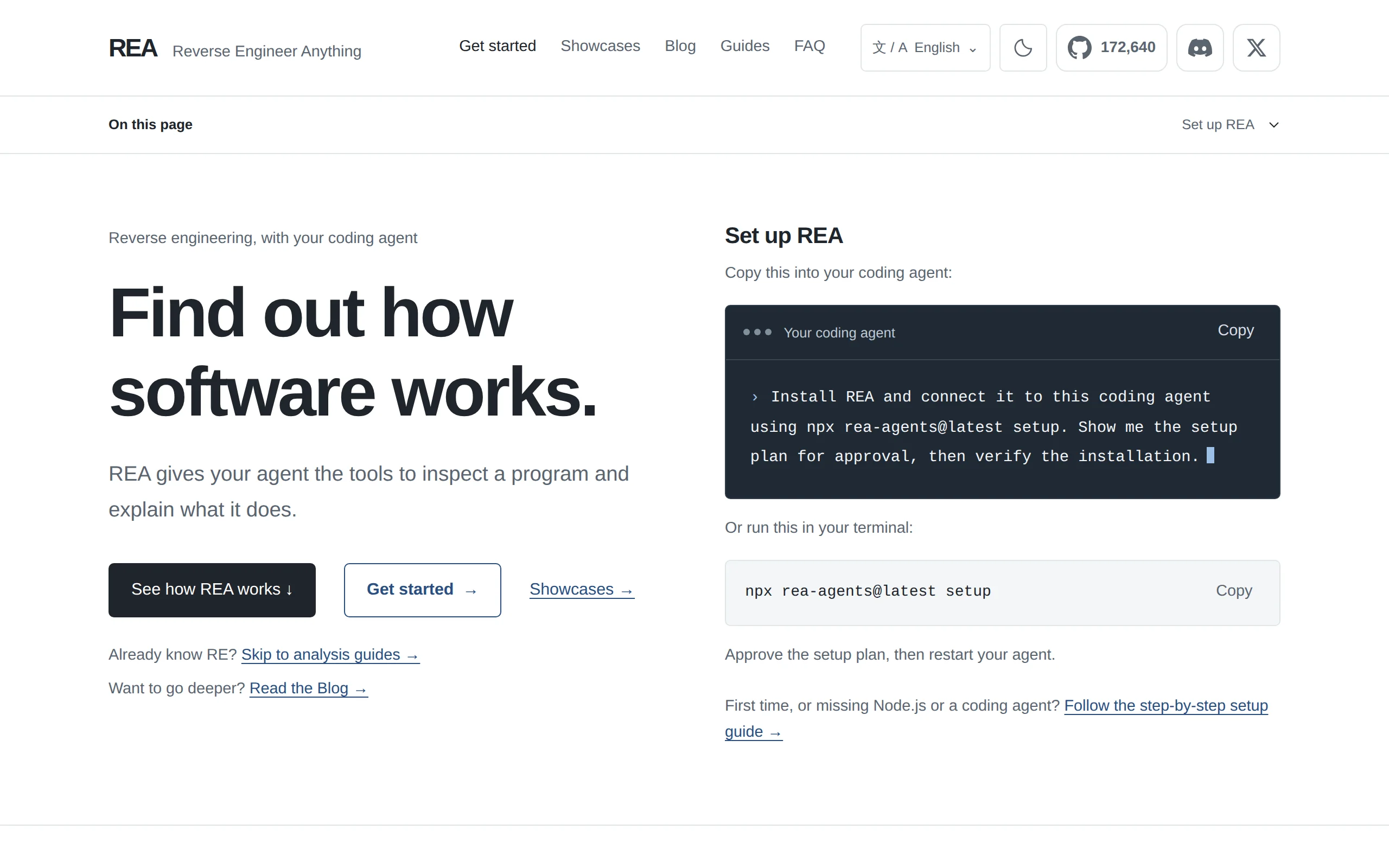
REA (Reverse Engineer Anything) is an open-source general-purpose reverse analysis tool that connects AI programming agents such as Claude Code, Codex, and Cursor with professional reverse engineering...
Poppy – A Joint Open Protocol Draft by Sierra and Meta
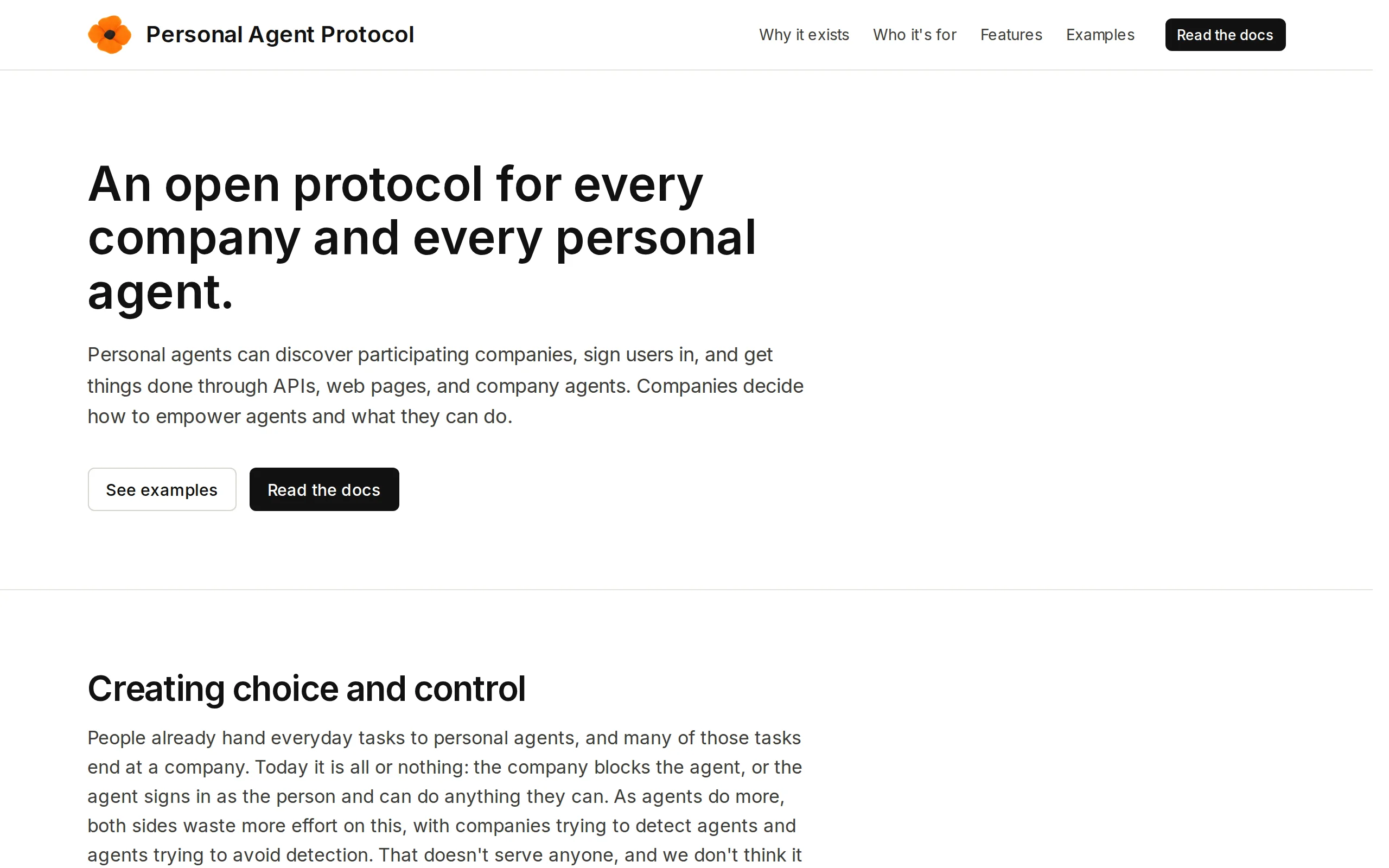
Poppy (Personal Agent Protocol) is an open protocol draft jointly launched by Sierra along with Meta and multiple enterprises, aiming to address the identity verification and authorization issues when...
In-Depth Review of Clef – Cloudflare's Open-Source Decision Model Family
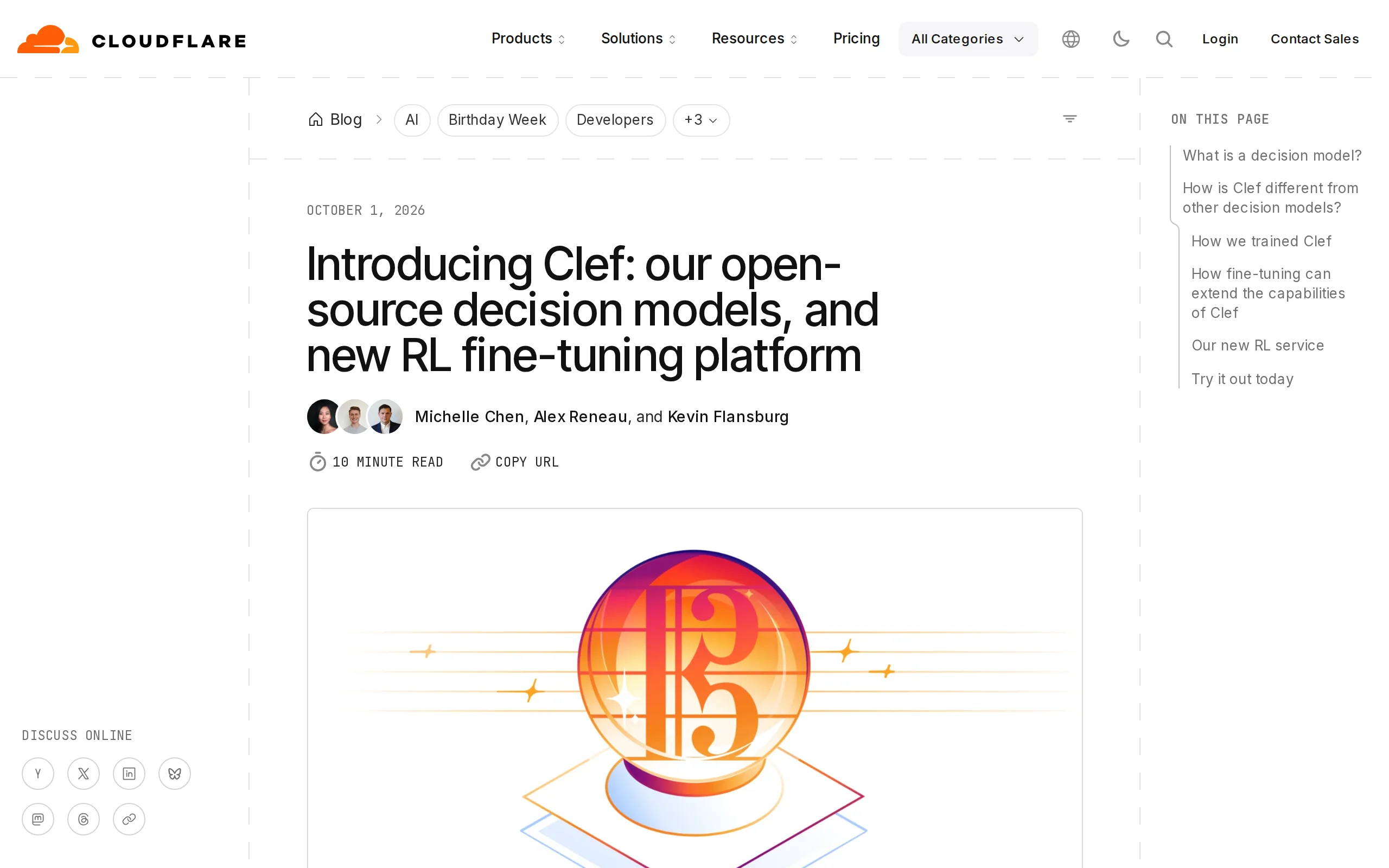
Clef is a family of decision models open-sourced by Cloudflare. Its core purpose is not to generate open-ended text, but to temporarily define problems within requests and output probabilistic scores ...
© All Rights Reserved. Some content on this site is partially generated by AI with human review.