
Sage-A1.5 – A Scientific Agent from the Shanghai AI Lab with General and Specialized Capabilities
Executive Summary:
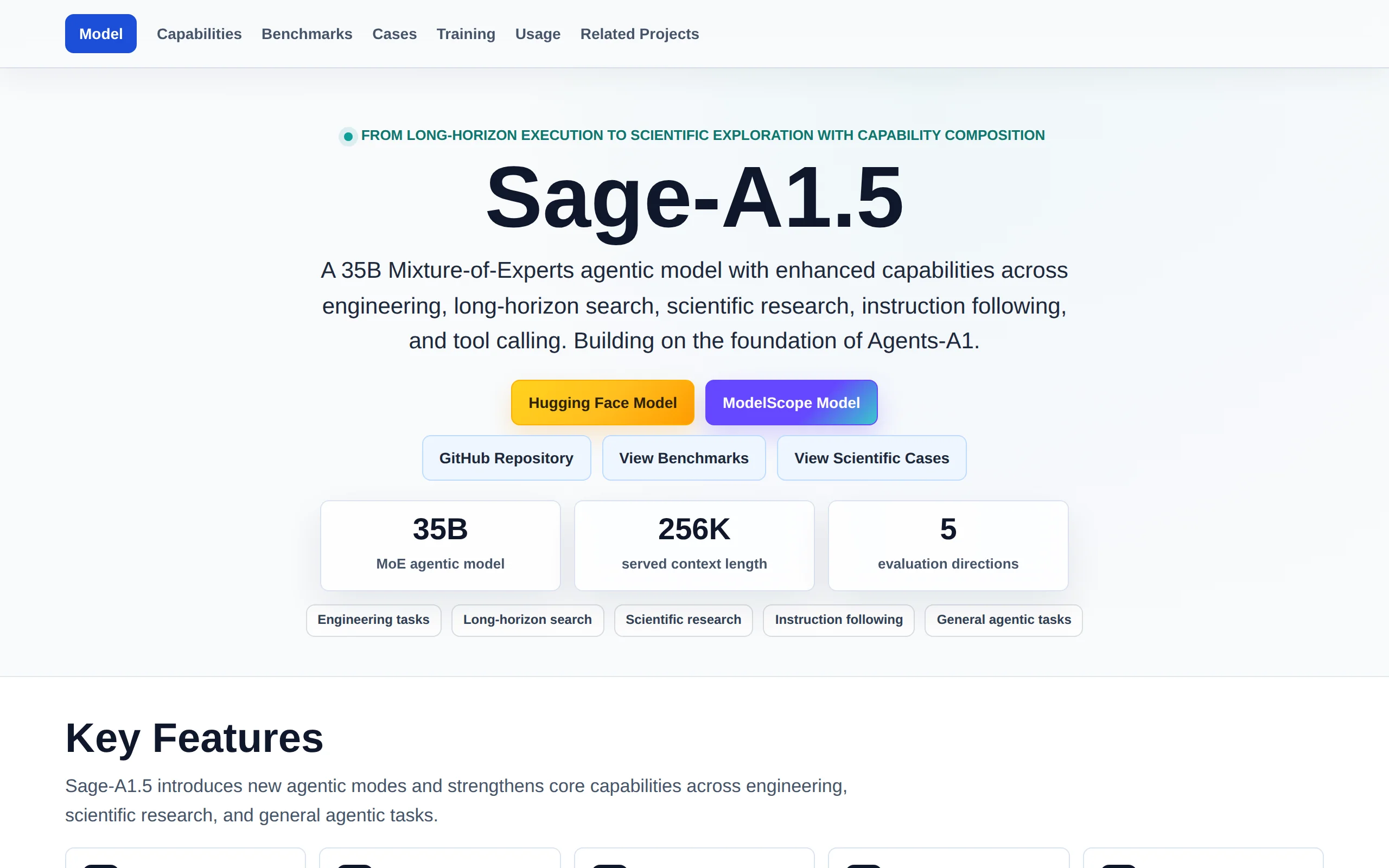
Sage-A1.5 is a 35B-scale scientific agent with general and specialized capabilities, developed by the Shanghai Artificial Intelligence Laboratory. It is built upon the long-range task capabilities of ...

1. What is Sage-A1.5
Sage-A1.5 is a 35B-scale scientific agent with general and specialized capabilities, developed by the Shanghai Artificial Intelligence Laboratory. It is built upon the long-range task capabilities of Agents-A1 and the Sage·Duanyan scientific discovery platform, aiming to validate the RSI (Researcher-Scientist-Investigator) closed-loop in real scientific research scenarios. This model can autonomously decompose complex scientific tasks, orchestrate multiple sub-agents for parallel investigation, and activate verification mechanisms to identify evidence gaps and refine research hypotheses. Sage-A1.5 has been applied to multiple scientific research cases, including neuroscience, electrochemistry, and space science reviews. It continues to evolve through the MVSP scientific evaluation system and SFT/RL feedback training, supporting quantized deployment on heterogeneous hardware such as Ascend, Muxi, and AMD. The model emphasizes traceable and verifiable long-range autonomous research capabilities.
Technical Positioning and Domain: Sage-A1.5 belongs to the scientific agent domain, with the core objective of integrating the long-range reasoning and tool calling capabilities of large language models with the rigorous requirements of scientific research. Unlike general-purpose conversational assistants, this model focuses on autonomous execution across the entire scientific task workflow, including literature review, hypothesis generation, experimental validation, and result analysis, addressing the capability gap of general large models in specialized scientific processes.
Development Background: This model was developed by the Shanghai AI Lab, whose team has accumulated substantial technical expertise in the open-source large model domain through the Sage series (InternLM/InternScience). The motivation for development stems from the significant human resource consumption caused by repetitive literature review and experimental design tasks in current scientific discovery processes, as well as the tendency of general large models to accumulate errors during long-range scientific tasks. The team leveraged the Sage·Duanyan platform to incorporate the organization, execution, and adjustment of scientific research processes into the training objectives, enabling the model to continuously evolve within real scientific tasks.
Core Value: Sage-A1.5 addresses the lack of closed-loop verification capabilities in AI-assisted tools for scientific research scenarios. Its innovation lies in proposing the RSI closed-loop concept of "Environment as Data," where scientific evaluation serves as the driving force and environment synthesis provides feedback, forming a continuous evolution mechanism that mutually reinforces capability diagnosis, task environment setup, and model training. Additionally, by aligning the model iteration direction with the real needs of scientists through the Minimum Verifiable Scientific Proposal (MVSP) and the co-construction of evaluation benchmarks across more than a dozen major scientific scenarios, it ensures practical relevance.
Technical Features: The model employs a two-phase cross-domain heterogeneous training paradigm combining "multi-domain supervised fine-tuning" with "unified post-training," supported by fully asynchronous pipelines and adaptive sampling mechanisms. This approach simultaneously enhances the model's capabilities in scientific exploration and engineering coding. On the inference side, it supports collaborative work between agent orchestration and autonomous verification, capable of distinguishing between confirmed facts and unverified hypotheses. It dynamically adjusts strategies during long-range execution, reducing the risk of error accumulation.
2. Key Features
Agent Orchestration: Capable of autonomously decomposing complex scientific research tasks into multiple subtasks and coordinating multiple sub-agents to perform parallel literature retrieval, evidence comparison, and conclusion summarization. This feature supports parallel exploration with multiple clues and evidence, significantly improving the efficiency of investigating complex scientific issues, and is well-suited for large-scale literature reviews requiring cross-verification.
Agent Verification: Automatically determines the timing and target of verification, distinguishing between confirmed facts and unverified hypotheses, and promptly adjusts the retrieval direction or research strategy. This mechanism effectively reduces error accumulation in long-range tasks, ensuring that research conclusions are based on verifiable evidence, and represents a key differentiating capability from traditional large models.
Long-Range Scientific Execution: Integrates retrieval, hypothesis generation, code writing, and result validation into a complete closed-loop, delivering traceable and verifiable code, data, charts, and research reports. The entire execution process maintains a full operational log, enabling researchers to conduct end-to-end verification after the fact, meeting the strict requirements of reproducibility in academic research.
Scientific Scenario Empowerment: Tailored for specific scientific tasks such as literature reviews in neuroscience, electrochemistry, and space science, it provides structured outputs like evidence matrices, verification checklists, and revision logs. These deliverables align with the working habits of researchers and can be directly integrated into the daily workflow of research teams, reducing the deployment cost of AI-assisted research.
Scientific Code Support: Designed for algorithm optimization and scientific code development scenarios, it covers code evaluation benchmarks such as SWE-Bench Pro, Multilingual, and MLE-Bench-Lite. The model is not only capable of writing scientific code but also debugging and optimizing it, assisting researchers in completing engineering tasks such as data analysis, model training, and visualization.
Multi-Hardware Deployment: Offers multiple quantized versions, supporting platforms such as Huawei Ascend NPU, Muxi, and AMD GPUs, and is compatible with mainstream inference frameworks. This feature allows research institutions to flexibly deploy based on their existing computational infrastructure, reducing dependency on specific hardware vendors and facilitating trial use and secondary development by research and industry partners.
3. How to Use
Access the Experience Portal: Visit the Sage-A1.5 platform experience page (https://discovery.intern-ai.org.cn/token-plan/home?tabIndex=0), log in, and apply for or use inference credits as prompted on the page. This platform provides online inference services, allowing you to experience core features without local deployment.
Select Model Variant: Choose an appropriate model version based on your current computational resources. For online scenarios, you can directly use the cloud-based Sage-A1.5 service; for private deployment scenarios, you can select the quantized deployment package corresponding to Huawei Ascend NPU, Muxi, or AMD. Each version differs in inference speed and memory usage.
Create a Research Task: In the platform's workspace, create a new project and fill in the research question description, constraints (such as time/resource limitations), and the expected output format (report/code/chart), and specify whether a traceable evidence chain is required. A clear task description directly affects the decomposition quality and execution efficiency of the agent.
Integrate Materials and Environment: Upload relevant literature, experimental data, code, or historical experiment records, and configure the scientific computing toolchain, sandbox environment, and necessary external databases or API tools. This step provides the agent with sufficient context and execution resources, which is a prerequisite for ensuring research quality.
Start Orchestration and Execution: Allow Sage-A1.5 to autonomously decompose the task, schedule sub-agents for parallel investigation, and activate the agent verification feature to automatically identify gaps in evidence. During execution, the system will record the search paths, hypothesis changes, and verification logs, forming a complete audit trail.
Review and Export Deliverables: Verify the generated code, data, charts, reports, and checklists/evidence matrices/revisions. If necessary, request the model to rerun experiments or add control experiments; after confirming everything is correct, export reproducible code and full reports. Conduct expert-level reviews within the research team before using them for paper writing or experimental decision-making.
4. Pros and Cons Analysis
| Pros |
|---|
| RSI Closed-loop Evolution Mechanism: Centered on the core path of "environment as data," it continuously accumulates domain knowledge and corrects reasoning biases in real scientific tasks. The model iteration direction is highly aligned with actual research needs, forming a sustainable self-enhancing cycle. |
| Generalist-Specialist Integrated Architecture: While inheriting the long-range task capabilities of Agents-A1, it enhances professional reasoning, evidence handling, and tool calling for scientific scenarios, achieving a good balance between general intelligence and specialized abilities. |
| Agent Orchestration and Verification Collaboration: It can autonomously decompose tasks and parallelly schedule multiple sub-agents, combined with self-verification to identify evidence gaps, forming a closed-loop of "execution—check—correction," effectively reducing error accumulation in long-range tasks. |
| Traceable and Verifiable Design Philosophy: It records the entire execution trace, including retrieval paths, hypothesis changes, and verification logs. The deliverables include an evidence matrix, a verification checklist, and revision records, meeting the requirements of scientific research for reproducibility and auditability. |
5. Comparative Analysis with Similar Tools
| Comparison Dimension | Sage-A1.5 (Shusheng-A1.5) | Kimi-K3 | GLM-5.3 |
|---|---|---|---|
| Product Positioning | A science intelligent agent integrating general and specialized capabilities from the Shanghai AI Lab, verifying a model self-evolution path driven by real scientific scenarios | A larger parameter-scale general-purpose large model, used as a benchmark for comparison | A larger parameter-scale general-purpose large model, used as a benchmark for comparison |
| Parameter Scale | 35B | Larger parameter scale | Larger parameter scale |
| Core Technical Approach | Agents-A1 long-range task capability + Shusheng·Duanyan platform, implementing the "environment as data" RSI flywheel | Focuses on general instruction-following and multi-task capabilities | Focuses on general instruction-following and multi-task capabilities |
| Key Capabilities | Agent orchestration + agent verification, parallel scheduling of sub-agents, autonomous judgment of verification timing and correction | General instruction-following and long-text processing | General instruction-following and long-text processing |
| Scientific Evaluation Performance | Outperforms benchmark models in comprehensive performance across scenarios such as condensed matter physics (CMT), doctoral-level research (FS-R), science Olympiad (FS-O), IFBench, and PinchBench | Benchmark model that is outperformed | Benchmark model that is outperformed |
| Deployment Method | Supports quantized deployment on multiple domestic hardware platforms including Ascend, Muxi, and AMD, and provides online experience | Relies on cloud API or specific hardware | Relies on cloud API or specific hardware |
| Open Source License | Open source, providing model weights and deployment solutions | Closed source | Partially open source |
In different application scenarios, selection strategies should vary: for academic laboratories and research institutions that require deployment in local or private environments and have limited computational resources, the 35B model of Sage-A1.5 provides more complete scientific intelligent agent capabilities under a relatively lightweight parameter scale, and supports multiple domestic hardware platforms, offering greater deployment flexibility compared to larger-scale closed-source or partially open-source models like Kimi-K3, GLM-5.3, and GPT-5.6-Sol.
For enterprise users with sufficient computational power and mature IT infrastructure who prioritize ultimate general-purpose capabilities, Kimi-K3, GLM-5.3, and GPT-5.6-Sol still hold advantages in general tasks. However, from the perspective of scientific research, Sage-A1.5's approach of aligning evaluations with real scientific needs ensures that the model's iteration direction better matches the actual usage habits of researchers, providing clear differentiated value in scientific scenarios requiring long-range reasoning, evidence chain tracking, and reproducible deliverables.
6. Editor's Summary
The technological innovation of Bookworm-A1.5 lies in its implementation of the RSI closed-loop concept of "environment as data" into a functional research intelligent agent system. Unlike traditional large models that are merely passive tools called upon by users, this model incorporates the organization, execution, and adjustment of research processes into its training objectives. As a result, the model is capable of actively decomposing tasks, autonomously determining validation timing, and dynamically refining research strategies. This design approach holds exploratory value in the current field of scientific AI—it attempts to address the core question of "how to enable models to continuously evolve within real scientific tasks," rather than simply stacking parameter scale.
In terms of practical value, Bookworm-A1.5 provides a complete workflow for research assistance, covering task decomposition, parallel investigation, evidence verification, and report generation. Each step includes audit trail records, transforming AI-assisted research from a "black box" output into a transparent, interpretable, and verifiable process. The model's support for quantized deployment on domestic hardware from companies such as Ascend, Muxi, and AMD also reduces vendor lock-in risks for research institutions when purchasing computing power, making it highly relevant to the practical construction of self-reliant and controllable AI infrastructure.
The target audience for Bookworm-A1.5 includes graduate students and young researchers who require extensive literature reviews and cross-validation, frontline scientists who wish to accelerate experimental design with AI assistance, and IT departments in universities and research institutions that focus on AI for Science infrastructure development. For scientific projects that involve handling evidence from multiple sources, long-range reasoning chains, and strict reproducibility requirements, this model offers relatively comprehensive functional coverage within the current open-source ecosystem.
Looking ahead, as the MVSP evaluation benchmark expands to cover more academic disciplines and as more real-world research scenarios and training data return, Bookworm-A1.5 has ongoing potential to broaden its adaptability across subjects and enhance its stability in long-term tasks. Its position within the open-source ecosystem also lays the groundwork for future community-driven development of research intelligent agent toolchains.
7. Application Scenarios
Neuroscience Data Analysis: Conduct brain region decoding metric analysis based on whole-brain data from mice, supporting PCA dimensionality reduction, permutation testing, and visual output. Researchers can describe their analytical needs in natural language, and the model automatically generates analysis code, executes computations, and interprets statistical results, assisting in uncovering the distribution patterns of task/movement information across brain regions, significantly shortening the data analysis iteration cycle.
Electrochemical Synthesis Optimization: Integrate literature and historical experimental records to iteratively refine reaction conditions and mechanism hypotheses, aiding in the innovative design of organic synthesis pathways such as Friedel-Crafts alkylation. The model can compare multiple sets of experimental parameters and yield data, propose improvement strategies, and flag critical steps requiring experimental validation, providing decision support for optimizing electrochemical synthesis routes.
Space Science Review Verification: Coordinate multiple sub-agents to parallelly verify key technical assertions in space science missions, distinguishing the strength of evidence at different levels, and ultimately outputting verification tables, evidence matrices, and revision logs. This scenario fully leverages the model's agent verification capabilities, ensuring that every assertion in review-based research is grounded in verifiable information.
Error Correction in Photochemistry/Mechanism Research: When retrieval results conflict with existing research hypotheses, the model can automatically converge on the research direction, check the validity of reaction principles, and flag critical steps requiring experimental validation. This application effectively prevents directional drift caused by information overload in traditional literature reviews, reducing the cost of scientific trial and error.
Interdisciplinary Scientific Evaluation System Construction: Collaborate with major scientific scenarios such as high-energy physics, material design, drug development, chemical intelligence, and disease diagnosis using the MVSP framework to co-build a verifiable evaluation environment. This aligns the model's iteration direction with real scientific needs. This scenario is suitable for infrastructure development in large scientific research platforms and interdisciplinary centers, providing a standardized evaluation and training environment for AI-assisted research across various fields.
8. FAQ
Q: What is the fundamental difference between Bookworm-A1.5 and general-purpose large models in research scenarios?
A: The core difference lies in the closed-loop verification capability. General-purpose large models provide information retrieval and text generation, but cannot independently assess the reliability of information or identify evidence gaps. Bookworm-A1.5 distinguishes between verified facts and unverified hypotheses through an intelligent agent verification mechanism and continuously adjusts research strategies during execution, ensuring the traceability and re-examinability of research outputs.
Q: Can the model completely replace researchers' literature review work?
A: It cannot fully replace, but it can significantly reduce the burden of repetitive research tasks. The model can perform initial screening of literature, evidence comparison, and structured organization, but professional judgment from researchers is still required for determining research directions, confirming key hypotheses, and making decisions on experimental designs. The design philosophy is "human-machine collaboration" rather than "fully automated replacement."
Q: Is a 35B parameter scale sufficient to support complex scientific reasoning tasks?
A: Evaluation data shows that Sage-A1.5 with a 35B parameter scale performs better than some larger-scale comparison models on benchmarks such as CMT in condensed matter physics, FS-R for doctoral-level research, FS-O for science competitions, IFBench, and PinchBench. This indicates that targeted training strategies and task architectures are more effective than simply increasing parameter scale in scientific reasoning scenarios.
Q: What hardware configuration is required to deploy Bookworm-A1.5?
A: The model supports multiple hardware platforms, including Huawei昇腾 NPU, Murix, and AMD, and provides various quantization versions to adapt to different computational power conditions. Specific memory requirements depend on the selected quantization precision and inference framework. It is recommended to refer to the hardware configuration suggestions in the official deployment documentation before deployment, or first experience the model online on the Bookworm·Duanyan platform to evaluate practical performance.
Q: How is the reliability of the model's research results ensured?
A: The system records audit information such as retrieval paths, hypothesis changes, and verification logs throughout the task execution. The final deliverables include an evidence matrix, verification checklist, and revision history. Researchers can review the model's research process item by item, and if necessary, request the model to rerun experiments or add control validations, thereby ensuring that conclusions are based on an auditable chain of evidence.
Q: What is the open-source status of Bookworm-A1.5? Are there any restrictions on commercial use?
A: The project provides open-source model weights and deployment solutions, with the model card and related resources already published on HuggingFace. For specific open-source license terms, please check the License file in the model repository to confirm the boundaries of commercial use. For private deployment scenarios, you can contact the Shanghai AI Laboratory for more detailed authorization and technical support information.
9. Project Links
- Project Website: https://alpha-innovator.github.io/Sage-A1.5/
- Online Demo Experience: https://discovery.intern-ai.org.cn/token-plan/home?tabIndex=0
- Hugging Face Model Repository: https://huggingface.co/collections/InternScience/sage-a15
- Technical Paper: https://arxiv.org/pdf/2610.28578
Related
WorkForge – In-Depth Review of the Smart Agent Training Environment Construction Framework Jointly Launched by Tencent and Fudan University
WorkForge is a framework for constructing training environments for intelligent agents, jointly developed by Tencent HunYuan and Fudan University. It aims to address the core bottleneck of scarce high...
BaoCut – Open-Source AI Video Agent Tool with Multilingual Dubbing Support
BaoCut is an open-source AI video Agent tool developed by JimLiu. Its core positioning is to use an "editable timeline" as an intermediate state, enabling human creators and AI Agents to collaborate w...
Agensh – A Multi-Agent Collaboration Framework Introduced by Microsoft Research
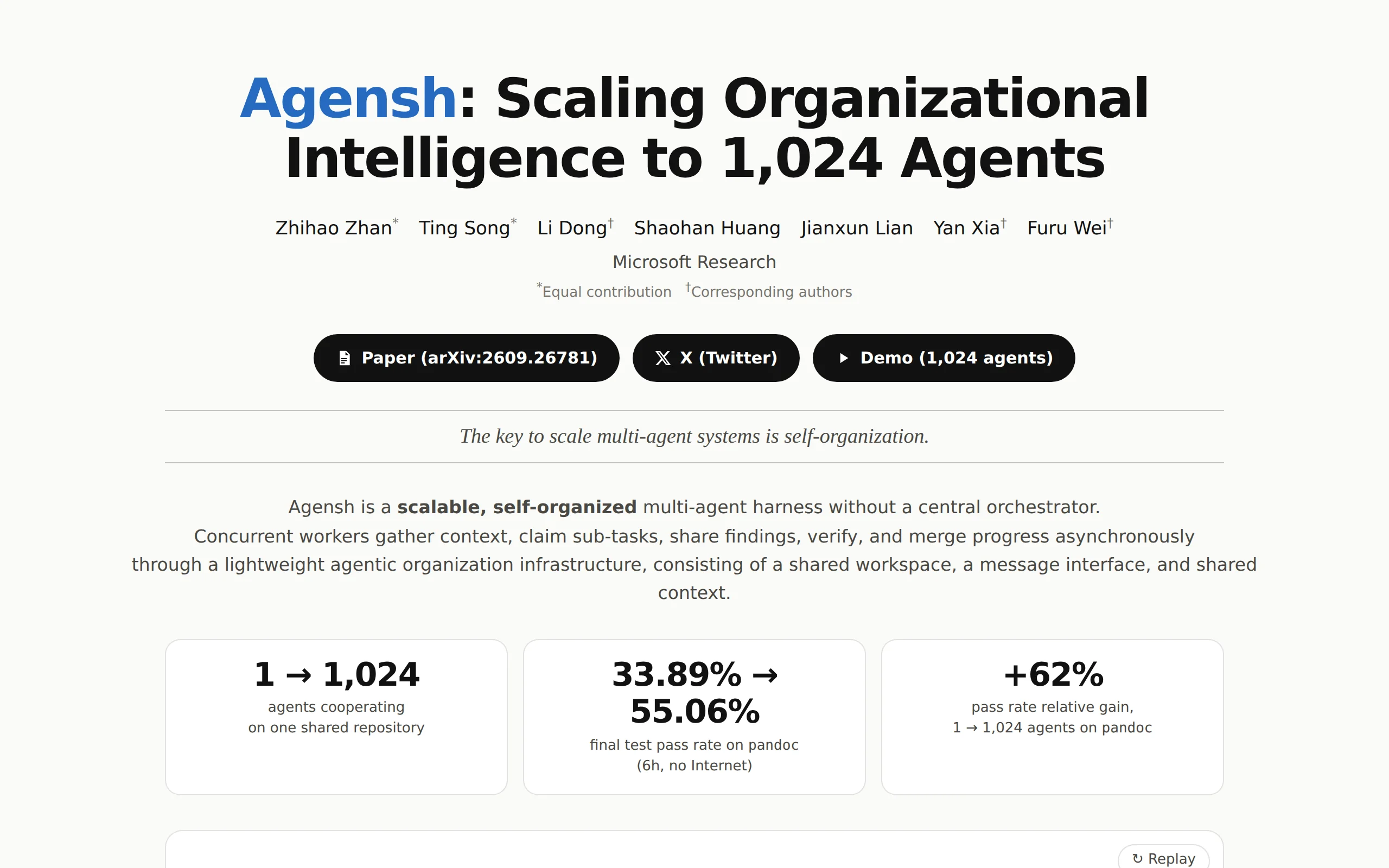
Agensh is a multi-agent collaboration framework introduced by Microsoft Research. Its core innovation lies in a fully decentralized organizational structure—where all agents follow a unified five-step...
Eleven Realtime: ElevenLabs' Architectural Breakthrough and Engineering Practices in Unified Voice Agent Models
Eleven Realtime is a unified voice agent model series introduced by ElevenLabs, featuring two versions: v1 Mini and v1 Max. Its core design philosophy is to integrate speech recognition (ASR), languag...
© All Rights Reserved. Some content on this site is partially generated by AI with human review.