
Beam – Reflection AI's First Open-Source Large Language Model: A Masterpiece of Engineering with a 501B Sparse MoE Architecture

Executive Summary:
Beam is Reflection AI's first open-source large language model, built using a sparse MoE architecture with 501B parameters. Only 23B parameters are activated per token, supporting a context window of ...
1. What is Beam
Beam is Reflection AI's first open-source large language model, built using a sparse MoE architecture with 501B parameters. Only 23B parameters are activated per token, supporting a context window of up to 1 million tokens, and trained on 23.8T tokens. The model achieves performance comparable to GLM-5.2 on software engineering tasks. Its training process is a testament to heavy-duty computational power: pre-training was completed in less than four weeks using 6,144 GB300 GPUs, followed by a four-week large-scale reinforcement learning phase involving 10,500 GB300 GPUs and over 100 million rollouts. Beam's core design philosophy focuses on achieving high performance through extreme sparsity activation and engineered training methods, while significantly reducing inference costs.
Technical positioning and domain: Beam belongs to the large language model direction within the natural language processing field, targeting enterprise-level coding workloads and automated Agent execution scenarios. Its unique feature is achieving comparable inference performance with only a 4.6% activation ratio, creating a differentiated competitive advantage in intelligent density. Compared to similar models, Beam prioritizes inference efficiency as its primary design goal, achieving nearly uniform expert utilization through fine-grained expert routing and auxiliary loss-agnostic load balancing mechanisms within the sparse MoE architecture.
Development background: Beam was developed by the Reflection AI team, founded by former OpenAI members, who specialize in building AI systems with autonomous execution capabilities. The team has accumulated extensive experience in reinforcement learning and large-scale distributed training, providing the technical foundation for Beam's use of ultra-large-scale RL training strategies. Its development was driven by the industry's pressing issues of high inference costs and high deployment barriers for large models.
Core value: Beam addresses the balance challenge between training stability and inference efficiency in sparse MoE models. By leveraging an asynchronous policy gradients system and a length-controllable inference learning mechanism, the model maintains high performance while reducing inference computational requirements to one-third to one-fourth of those of comparable models. Its engineered training solution (with a goodput of 92.3% and only 9 semi-automated rollbacks) provides a reference paradigm for stability in large-scale training within the industry.
Technical features: Beam employs a fine-grained MoE architecture with 52 residual layers that remain stable throughout the process. It is supported by a topology-aware scheduler and silent data corruption detection to ensure efficient training. Its fully asynchronous RL system enables parallel rollouts and training, with new weights distributed to the inference cluster via RoCE in a median of just 12 seconds. The inference length can be flexibly adjusted using the reasoning effort parameter.
2. Key Features
Programming Development Capabilities: Beam achieves performance comparable to GLM-5.2 on software engineering tasks, capable of handling complex development tasks such as code generation, debugging, and refactoring. Designed for enterprise coding workloads, it excels in code comprehension, function completion, and cross-file dependency analysis, supporting the daily development workflow of large-scale projects.
Agent Autonomy: The model is equipped with capabilities such as tool calling, terminal operations, and web searches, enabling it to autonomously complete multi-step tasks. Trained with over 100 million rollouts using reinforcement learning, Beam has learned to invoke other large models and OCR APIs, demonstrating strong tool composition and task decomposition abilities, suitable for automated workflow scenarios.
Long Text Processing: Supports a 1 million token context window, allowing the entire contents of a medium-sized codebase or lengthy document to be loaded in one go. The model can locate and associate key information from ultra-long contexts, enabling understanding of cross-file dependencies and global analysis, significantly improving the efficiency and accuracy of code auditing and document processing.
Adjustable Reasoning Intensity: Users can flexibly switch between short responses and extensive reasoning using the
reasoning effortparameter, matching different task complexities and computational budgets. This mechanism allows the model to dynamically balance between rapid responses and deep thinking, ensuring both interactive experience and reasoning quality, and providing enterprises with a direct method to control reasoning costs as needed.Efficient Reasoning Engine: Based on fine-grained MoE routing and a load balancing design that is independent of auxiliary loss, the busiest expert load is only 1.04×, achieving nearly uniform expert utilization. This hardware-level foundation enables Beam to reach the same level of reasoning performance as GLM-5.2 with 3 to 4 times less inference compute power, significantly reducing deployment and operational costs.
Controllable Reasoning Length: By incorporating a length penalty term into RL training, the model first learns to solve problems using fewer tokens, and then naturally extends its reasoning length after enhancing its agentic capabilities. This progressive training strategy achieves the optimal trade-off between capability and token consumption, ensuring efficiency across tasks of varying complexity.
3. How to Use
Apply for Early Access: Beam's weights are not yet publicly available and are currently only accessible in preview form to a select group of users. Visit https://platform.reflection.ai/ to fill out an application form, providing details about your use case and requirements. Once approved by the official team, you will gain API access.
Obtain API Credentials: After approval, create an API key in the Reflection AI platform console. It is recommended to store the key in environment variables or secure configuration files, avoiding hardcoding it into your code repository to ensure security during API calls.
Call the Inference Interface: Use standard HTTP requests or the official SDK to call the Beam API. The API supports setting the
reasoning effortparameter to control the depth of inference. For programming tasks, it is recommended to set a medium reasoning intensity; for complex Agent tasks, increase the reasoning intensity to achieve a more thorough thought process.Configure the Context Window: Set the input length based on your task requirements. Beam supports a maximum context of 1 million tokens. When processing large codebases, you can upload the entire project files at once; for short tasks, appropriately reduce the context to lower latency and cost.
Performance Optimization Practices: Adjust sampling parameters (such as
temperature,top_p) based on different task types. For code generation tasks, use a lower temperature (0.2–0.4) to ensure determinism. For creative writing or open-ended tasks, use a higher temperature (0.7–0.9) to increase diversity. Monitor API call latency and token consumption to optimize inference costs.Production Environment Deployment: After the weights are officially released, enterprises can deploy Beam via self-hosting. It is recommended to configure it with 8×H100 or GB300 nodes, using inference frameworks such as vLLM or TensorRT-LLM for service deployment, and combining with load balancing to handle high concurrency.
4. Pros and Cons Analysis
| Pros |
|---|
| Outstanding Inference Efficiency: Achieves comparable inference performance with 3 to 4 times less inference computational power than GLM-5.2, with only 23B activated parameters, significantly reducing deployment and inference costs, and demonstrating superior intelligence density among models of the same level. |
| Rarely Large RL Training Scale: 10.5K GB300 instances continuously trained for four weeks, with over 100 million rollouts, making it one of the largest RL training efforts in open-source labs to date. The model has undergone extensive reinforcement learning for Agent tasks. |
| High Training Engineering Maturity: The entire pre-training process involved only 9 semi-automated rollbacks, with a goodput of 92.3%, stable training curves, and a fully asynchronous RL system that supports efficient parallel processing of rollouts and training. |
| Generous Context Window: Supports a context window of up to 1 million tokens, capable of handling large codebases and long documents, reducing the complexity of multi-round retrieval and segmented processing. |
5. Comparative Analysis with Similar Tools
| Dimension | Beam (Reflection AI) | GLM-5.2 (Z.ai / Zhipu AI) |
|---|---|---|
| Total Parameters / Activated Parameters | 501B / 23B | 744B / 40B |
| Activated Parameter Ratio | Approximately 4.6% (more sparse) | Approximately 5.4% |
| Context Window | 1M tokens | 1M tokens |
| Pre-training Data Volume | 23.8T tokens | 28.5T tokens |
| Architecture Features | Fine-grained MoE + auxiliary loss for irrelevant load balancing, 52-layer residual flow with full stability | MoE + MLA + sparse attention (DSA/IndexShare), 78 layers (first 3 dense) |
| Post-training Strategy | 10.5K GB300 machines for 4 weeks of RL, over 100 million rollouts, asynchronous policy gradients | Slime asynchronous RL infrastructure, long-range agentic training |
| Capability Positioning | Competes with GLM-5.2, with advantages in inference efficiency | Open-source model with strongest inference and programming capabilities, GPQA Diamond 89%, SWE-bench Pro 62.1% |
| Inference Efficiency | Achieves the same inference level as GLM-5.2 using only about 1/3 to 1/4 of the computational resources | Benchmark reference, 40B activated parameters already considered efficient |
| License Agreement | Apache 2.0 | MIT open-source weights (already downloadable) |
| Current Availability | Waitlist for API preview, weights not released | Weights already published, supports self-hosting or using Z.ai API |
Selection Recommendations: For enterprises prioritizing inference efficiency and cost control in deployment, Beam's sparse activation design offers a significant advantage. With an activation ratio of approximately 4.6%, it implies lower computational resource consumption and faster response times, making it ideal for large-scale production environments for code assistants and Agent services. If immediate self-hosted deployment is required, GLM-5.2 is currently a more mature option, as its MIT open-source weights are already downloadable and its Z.ai API is available for use, with a relatively complete community ecosystem. For scenarios requiring ultra-large parameter capabilities, Qwen 3.8-Max offers a 2T+ parameter option, but its inference costs should be closely monitored. Overall, Beam is suitable for teams with extreme requirements for inference efficiency, while GLM-5.2 is better suited for users needing rapid deployment and self-hosting.
6. Editor's Summary
As Reflection AI's first open-source project, Beam demonstrates solid technical capabilities in the areas of sparse MoE architecture and large-scale reinforcement learning engineering. Its core innovation lies in combining fine-grained routing of experts with a load balancing mechanism that is independent of auxiliary loss, achieving an almost ideal distribution where the busiest expert's load is only 1.04× the average. This provides hardware-level guarantees for inference efficiency. From a training engineering perspective, Beam's 92.3% goodput during the pre-training phase and its record of only 9 semi-automated rollbacks reflect the team's mature methodology in controlling the stability of distributed training. The fully asynchronous RL system supports up to 110,000 concurrent rollouts and 170,000 concurrent sandboxes, a scale that is rare in open-source laboratories.
In terms of practical value, Beam achieves comparable inference performance with 3 to 4 times less computational power than GLM-5.2. This characteristic has direct implications for deployment in production environments—enterprises can obtain high-performance coding and Agent capabilities at significantly lower computational costs. A 1 million token context window further expands its application boundaries, enabling analysis of large codebases and processing of long documents. The design of the "reasoning effort" parameter reflects a deep consideration of real-world deployment scenarios, giving users flexibility to adjust between performance and cost.
The primary target users for Beam include: enterprise development teams sensitive to inference costs, government and enterprise organizations requiring self-hosted or private deployment, and engineers working on Agent workflow development. The current lack of weight release is a major limitation, but the Apache 2.0 license provides a positive outlook for future practical applications. As weights become available and the community ecosystem gradually develops, Beam's advantages in inference efficiency are expected to be fully validated in real business scenarios, and its training engineering experience will also offer valuable references to the industry.
7. Application Scenarios
Enterprise Private Coding Assistant: Enterprises can fully self-host an AI coding assistant based on Beam, enabling features such as code generation, completion, explanation, and debugging. Since the model supports localized deployment, data does not need to leave the internal network environment, meeting the compliance requirements of industries with strict data security standards such as finance and healthcare, while supporting team daily development with low inference costs.
Codebase-Level Refactoring and Auditing: With a 1 million token context window, Beam can load an entire medium-sized codebase at once, understand dependencies across files, and perform large-scale refactoring or security audits. Developers can ask the model to analyze coupling between modules, identify potential security vulnerabilities, or generate refactoring plans, significantly improving the maintenance efficiency of large codebases.
Automated Agent Workflow: Beam has been trained with over 100 million rollout steps in reinforcement learning, enabling it to perform tool calling, terminal operations, and web searches. It can drive long-chain, multi-step tasks such as data analysis and operations inspections. For example, it can automatically execute data cleaning in a data pipeline, call analysis scripts, and generate reports, or perform scheduled server inspections and automatically handle anomalies.
Government and Enterprise Sovereign AI Deployment: As an open-weight model developed by a U.S.-based team, Beam is auditable and supports isolated deployment, aligning with compliance procurement needs for non-China supply chain models in sectors such as government, energy, and defense. Its Apache 2.0 license allows for deep customization and secondary development, supporting behavior adjustments as needed to meet specific industry regulations.
8. FAQ
Q: When will Beam's weights be available for download?
A: Beam is currently in preview mode and only provides API access to a limited number of users. The official has not yet announced a specific timeline for weight availability. It is recommended to follow the Reflection AI official website and blog for the latest updates. To apply for early access, visit https://platform.reflection.ai/ and fill in the relevant information.
Q: How much can Beam reduce inference costs compared to similar models?
A: According to official data, Beam achieves inference performance comparable to GLM-5.2 while requiring only about 1/3 to 1/4 of the inference computational power. This is due to its sparse MoE design, which activates only 4.6% of the parameters (23B per token out of a total of 501B), significantly reducing resource consumption during deployment and inference.
Q: Which programming languages and frameworks does Beam support?
A: Beam achieves performance comparable to GLM-5.2 in software engineering tasks, supporting code generation, completion, and debugging for mainstream programming languages, including Python, JavaScript, Java, Go, Rust, etc. Specific capabilities can be tested via API calls. It is recommended to verify based on your own technology stack.
Q: How can you adjust Beam's inference intensity?
A: You can control the depth of inference by setting the reasoning effort parameter. Low parameter values are suitable for simple Q&A and short response scenarios, while high parameter values are appropriate for complex reasoning and multi-step planning tasks. Users can flexibly adjust based on task complexity and computational budget to achieve a balance between performance and cost.
Q: How effective is Beam's 1 million token context window in practice?
A: Beam's 1 million token context window allows it to process large codebases or long documents in a single pass. The model can locate and associate key information from ultra-long contexts, enabling dependency analysis across files. Practical effectiveness is limited by task complexity and GPU memory configuration, and it is recommended to test within the scope of medium-sized codebases (approximately 100,000 lines of code).
9. Project Links
- Project Website: https://reflection.ai/blog/introducing-beam
- Experience Platform: https://platform.reflection.ai/ (waitlist preview application)
Related AI Model Articles
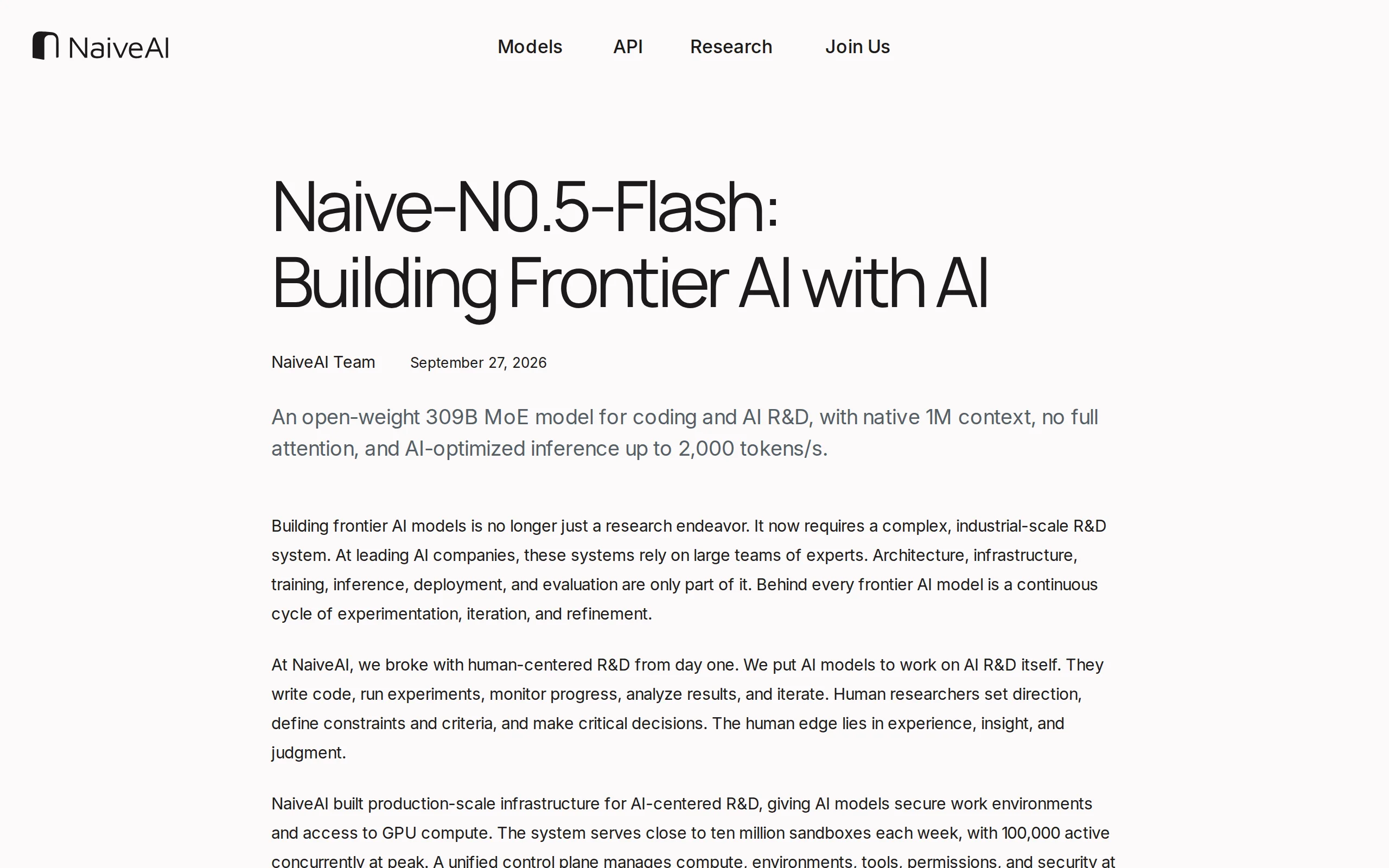
Naive-N0.5-Flash: NaiveAI's First Open-Source 309B MoE Large Model, Designed for AI Research and Development
Naive-N0.5-Flash is NaiveAI's first open-source MoE large model, specifically designed for programming and AI research and development scenarios. This model is based on the MiMo-V2.5 base model from X...
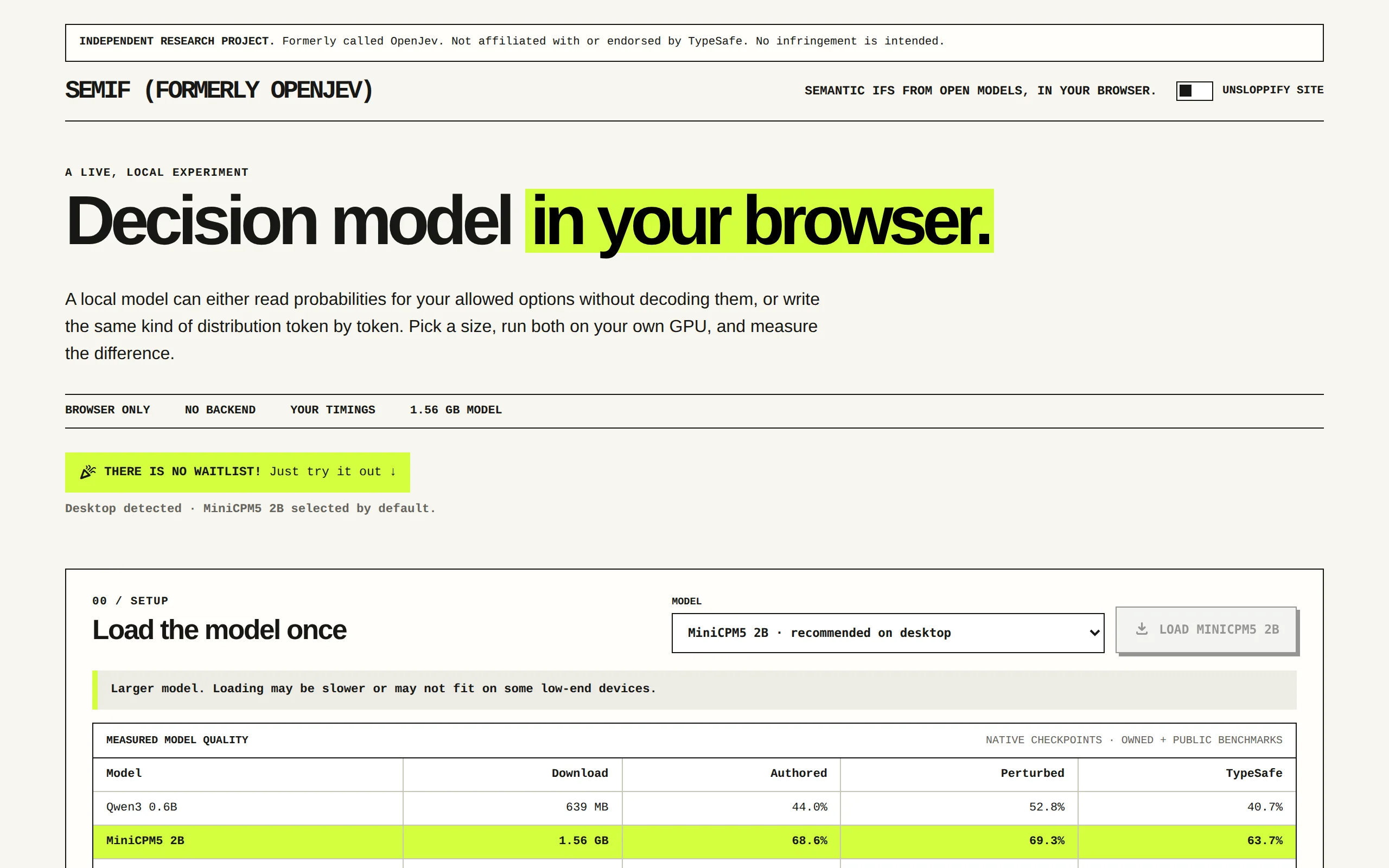
SemIf: Technical Analysis of the Open-Source Semantic Decision Model Replicating the Jev Pattern
SemIf (formerly OpenJev) is an open-source AI decision model designed to replicate the semantic decision interface pattern of TypeSafe's closed-source service, Jev, using open-source methods. This mod...
Ling-3.1-flash – A New Generation Large Model Launched by the Bailing Team at Ant Group
Ling-3.1-flash is a new generation large language model launched by the Bailing team at Ant Group. It employs a hybrid linear Attention architecture and MoE sparse activation technology, with a total ...

Index-Translate – Bilibili's Open-Source Multilingual Translation Model Family
Index-Translate is an open-source multilingual translation model family developed by Bilibili's Index LLM team. It is built upon the Qwen3.5 foundation and opens its weights under the Apache-2.0 licen...
© All Rights Reserved. Some content on this site is partially generated by AI with human review.