
Claude Haiku 5.5 – Anthropic's Most Lightweight Model
Executive Summary:
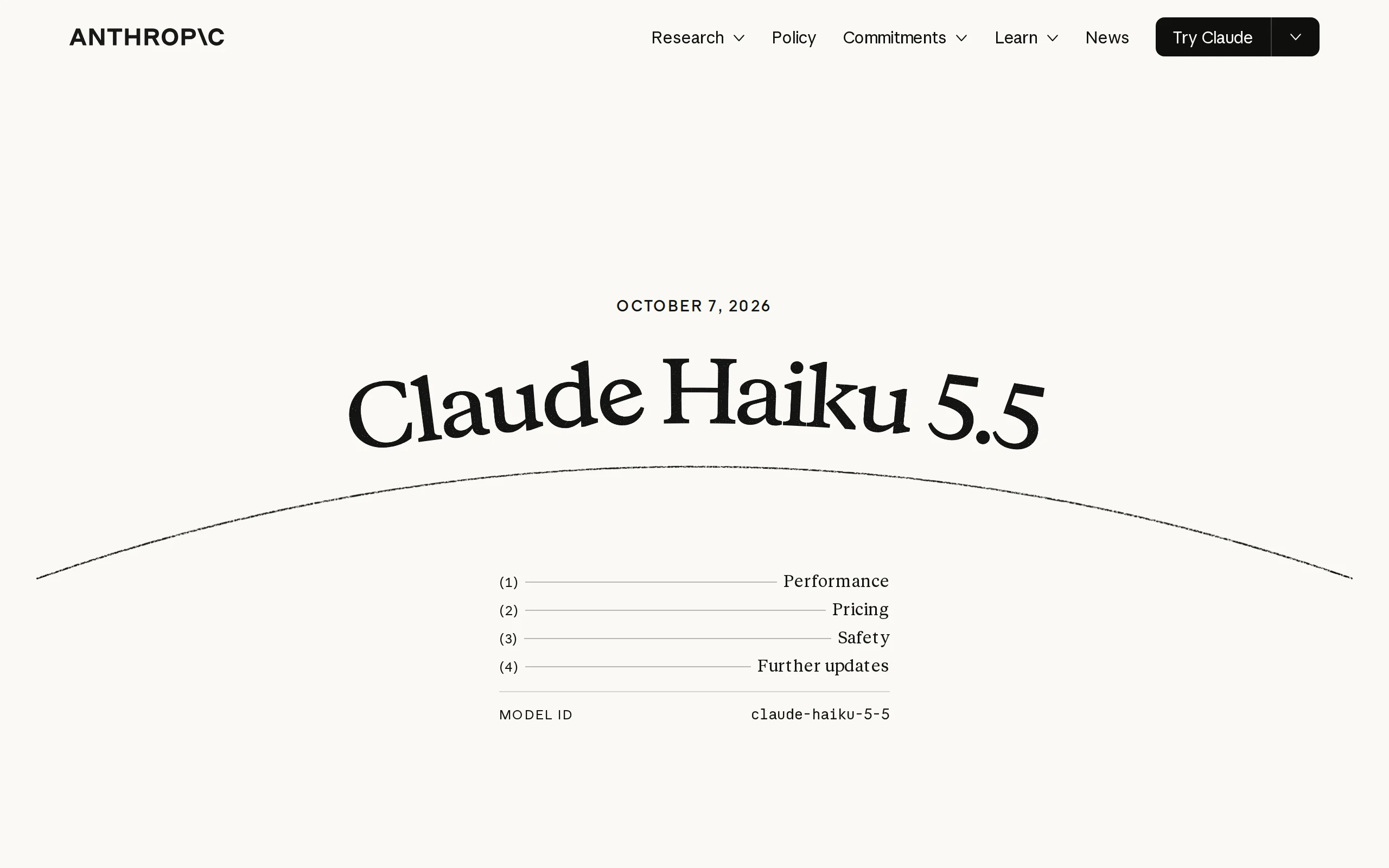
Claude Haiku 5.5 is the latest small language model officially released by Anthropic on October 7, 2026. It is positioned as a high-value product with the tagline "cheapest, fastest, and most capable....
1. What is Claude Haiku 5.5
Claude Haiku 5.5 is the latest small language model officially released by Anthropic on October 7, 2026. It is positioned as a high-value product with the tagline "cheapest, fastest, and most capable." This model reduces input costs to $0.10 per million tokens, cutting overall costs by approximately 75%, while significantly improving computer operation capabilities from 15.7% to 72.4%. It supports a 1 million token context window and a five-level adjustable thinking mechanism, making it suitable for high-frequency use cases such as intelligent summarization, data classification, real-time customer service, and sub-agent execution in multi-agent systems.
Technical positioning and domain: A lightweight language model in the field of natural language processing, expanding the boundaries of agent capabilities while maintaining low inference costs. The model shifts its performance focus from pure language generation to practical task execution scenarios such as computer operations, terminal programming, and browser automation, establishing a clear technical positioning centered on "task completion capability" among models of similar scale.
Development background: Iterated from the technical foundation of the Claude 4.5 series by the Anthropic team. The development motivation stems from two dimensions of market demand: one is the cost sensitivity of enterprise users for large-scale, high-frequency API calls, and the other is the performance requirements of agent architectures for high-concurrency sub-agent execution layers. It forms a complete product matrix with Opus 5.5 and Sonnet 5.5, covering different performance tiers.
Core value: Resolves the contradiction between the "limited capabilities" of small models and their "price advantage." Through architectural upgrades and a five-level thinking mechanism, it increases the OSWorld score from 15.7% to 72.4% while maintaining low prices, enabling developers to build complex agent systems at a lower cost. It serves as the execution layer in multi-agent architectures, combining the decision-making power of large models with the parallel efficiency of small models, providing a feasible path for the deployment of large-scale AI applications.
Technical features: Introduces for the first time in the Haiku series a configurable thinking level, allowing the model to adaptively allocate inference computational resources across five levels: low, medium, high, ultra-high, and maximum. It maintains token consistency with Opus 5.5 through a unified tokenizer architecture. Its 1 million token context window and 128,000 token maximum output size rank among the top in its class.
2. Key Features
Computer and Browser Operations: Achieves 72.4% computer operation capability based on the OSWorld benchmark, enabling GUI automation tasks such as clicking, form filling, and cross-application operations. In browser scenarios, it supports web navigation, data extraction, and content interaction, realized through the dedicated
computer_toolset_20260801toolset. This feature makes the small model the first to offer a viable alternative to traditional RPA solutions.Terminal Programming Ability: Scores 39.2% on the Terminal-Bench benchmark, capable of independently completing coding and debugging tasks in a command-line environment. It provides a complete workflow including code writing, execution, error detection, and resolution, offering practical value for automated development and operations scenarios. This is a rare "hands-on" programming capability among lightweight models.
Multi-Agent Collaboration (Sub-Agents): Acts as the execution layer in an Agent architecture combining "large model decision-making + small model execution." Task decomposition is handled by Opus/Sonnet, while multiple Haiku 5.5 instances execute subtasks in parallel. In the official demo, 10 Haiku sub-agents tested 86 different approaches within 58 seconds, reducing the cost from $0.47 to $0.14, demonstrating the principle of parallel processing that trades breadth for depth.
Intelligent Summarization and Context Compression: Provides low-cost summarization and context compression services for long documents and extended conversations. Leveraging the advantage of a 1 million token context window, it can fully read ultra-long documents and output highly condensed core information, making it suitable for high-throughput scenarios such as news aggregation, meeting minutes, and research reports.
Data Querying and Classification: Supports data-intensive tasks such as large-scale database queries, content tagging, and text classification. It significantly reduces the processing cost per data item while maintaining classification accuracy, making it applicable for enterprise-level data processing pipelines such as user-generated content moderation, sentiment analysis, and ticket auto-classification.
Chart and Multimodal Understanding: Chartography chart-reading capability has increased from 6.4% to 46.4%, enabling the model to parse charts, images, and multimodal information. It can identify chart trends, extract key data points, and generate structured interpretations, taking on an auxiliary analytical role in data visualization and report analysis scenarios.
3. How to Use
Confirm Integration Channel: Access the Claude Platform (console.claude.com) or integrate via Claude Code. The model supports multiple cloud channels, including Amazon Bedrock, Google Cloud Vertex AI, and Microsoft Foundry. Enterprise users can choose their integration method based on their existing cloud service provider.
Obtain API Key: Create an API key on the API Keys page of the Claude Platform, or enable model access through the AWS/GCP/Azure console. Ensure your account has the necessary qualifications for model usage and confirm the availability of the service in your region.
Specify Model ID: Use
claude-haiku-5-5as the model name when making calls, replacing historical version IDs such asclaude-haiku-4-5-20251001. In Claude Code, you can use the command/claude-api migrate this project to claude-haiku-5-5for project-level automatic migration.Configure Thinking Gears: Set the
effortparameter according to the task complexity, with options oflow,medium,high,xhigh, andmax, defaulting tomedium. Higher gears result in higher scores on tests such as OSWorld, GDPval-AA, and HLE, but the cost increases logarithmically. A balance must be struck between performance and cost.Adjust Sampling and Output: Remove the old sampling parameters
temperature,top_p, andtop_kused in previous versions, and instead use the structured output constraint format for generation control. Re-evaluate themax_tokensoutput limit. This change represents a key difference in the model version upgrade; directly using old parameters may lead to abnormal behavior.Upgrade Toolset: For computer operation scenarios, switch the toolset to
computer_toolset_20260801. For browser operations, use the new beta tool interface added to the SDK. The old toolset cannot trigger full GUI operation capabilities.Cost Optimization (Optional): Enable prompt caching to reduce token consumption for repeated inputs. For offline, non-real-time tasks, using the Batch API can provide an additional 50% discount, making it suitable for large-scale processing scenarios where timing is not critical.
Validation and Stress Testing: Before switching to the full production environment, first conduct small-scale gray testing using the official "score-cost" gear curve. Select an appropriate number of samples to verify whether the output quality and cost align with expectations. Once confirmed, proceed with the full switch.
4. Pros and Cons Analysis
| Pros |
|---|
| Outstanding Cost Efficiency: Input pricing drops to $0.10 per million tokens (≤100,000 tokens), a 90% reduction compared to the previous generation, with overall costs decreasing by approximately 75%. This aligns precisely with the pricing of GPT-6 Luna, significantly lowering the economic barrier for large-scale usage. |
| Excellent Inference Speed: It becomes the fastest model in the Claude series (excluding Opus's fast mode), significantly reducing response latency in real-time interaction scenarios, making it suitable for latency-sensitive applications such as high-concurrency customer service and real-time content processing. |
| Significant Ability Improvement: OSWorld increases from 15.7% to 72.4%, and Terminal-Bench increases from 0 to 39.2%. For the first time, a small model possesses usable computer operation and terminal programming capabilities, expanding the application boundaries of small models. |
| Five-Level Reasoning Adjustability: The Haiku series now first supports configurable reasoning intensity, allowing developers to precisely balance performance and cost as needed. The same model covers everything from simple classification to complex reasoning, reducing the complexity of multi-model integration. |
5. Comparative Analysis with Similar Tools
| Comparison Dimension | Claude Haiku 5.5 | GPT-6 Luna |
|---|---|---|
| Product Positioning | The most affordable, fastest, and capable small model, with both computer operation and terminal programming capabilities | A cost-effective model focused on high-concurrency tasks (summarization, extraction) |
| Input Cost (Short Context) | $0.10/million (≤100,000 tokens) | $0.10/million (≤272,000 tokens) |
| Input Cost (Long Context) | $0.50/million (>100,000 tokens) | $0.20/million (>272,000 tokens) |
| Output Cost | $0.50 (short) / $2.50 (long) | $0.50 (short) / $0.75 (long) |
| Context Window | 1 million tokens | 1.05 million tokens (single input limit 922,000) |
| Maximum Output | 128,000 tokens | 128,000 tokens |
| Thinking Modes | 5 modes: Low/Med/High/Xhigh/Max (default: Med) | 6 modes: none/low/medium (default)/high/xhigh/max |
| Computer Operation Capability | OSWorld 72.4% (previous generation: 15.7%) | No publicly available OSWorld results |
| Deployment Method | API + Claude Code + Multi-cloud (AWS/GCP/Azure) | API service |
Recommendation One: For lightweight tasks with high concurrency and cost sensitivity (information extraction, content classification, real-time customer service), Claude Haiku 5.5 and GPT-6 Luna have similar pricing, but Claude Haiku 5.5 clearly outperforms in computer operation capabilities. If browser automation or GUI operation tasks are required, Haiku 5.5 is the direct choice among the three. If the task is limited to text extraction and a lower cost for long-text processing is desired, GPT-6 Luna's $0.20/million token long input cost is more economical.
Recommendation Two: When serving as a sub-agent in an Agent architecture, Claude Haiku 5.5 has the advantage of unified tokenization and native integration with its family models (Opus/Sonnet), resulting in simpler task distribution and result collection logic. Gemini 2.5 Flash is more suitable for teams that have already built applications within the Google Cloud ecosystem and require deep integration with Google services.
6. Editor's Summary
The release of Claude Haiku 5.5 marks Anthropic's redefinition of its lightweight model product line. From a technological innovation perspective, the five-tier adjustable thinking mechanism breaks the limitations of small models with "fixed inference budgets," allowing developers to allocate matching computational resources for tasks of varying complexity. This mechanism expands the upper limits of capabilities while ensuring a baseline level of fundamental performance. The 15.7% to 72.4% improvement in OSWorld demonstrates that small models have already achieved practical value in core agent capabilities such as tool calling and computer operations. The breakthrough from 0 to 39.2% in Terminal-Bench further moves "small models writing code" from demonstration to real-world application.
In terms of practical value, the input price of $0.10 per million tokens and Claude's fastest response speed make it a strong choice for high-concurrency business scenarios. Its 1 million token context and 12.8 thousand token output specifications remain leading among small models. The sub-agent execution capability addresses the cost bottleneck in large-scale agent systems — in the official demonstration, 10 parallel sub-agents only required $0.14 in cost, providing economic support for the commercial deployment of multi-agent architectures.
In terms of target users, this model is suitable for three types of users: first, developers of large-scale applications who are sensitive to API call costs; second, architects who need a low-cost execution layer within agent architectures; and third, startup teams that require real-time interactive capabilities but have limited budgets. It is important to note that the unified tokenizer brings a 30% increase in token consumption, and changes to sampling parameters may require code migration, which constitute the actual costs of adopting this model. Development teams should conduct thorough gray-scale validation before switching.
Looking at its potential for growth, the launch of Haiku 5.5 has clearly defined Anthropic's model matrix as "flagship models for decision-making, lightweight models for execution." As multi-agent architectures become the standard design for complex AI applications, the demand for high-cost-performance execution models will continue to rise. The ecological value of the Haiku series within this framework will become even more pronounced.
7. Application Scenarios
Real-time Customer Service and Chatbots: The fastest response speed of the Claude series, combined with extremely low per-turn cost, makes this model suitable for real-time interaction scenarios such as high-concurrency online customer service, pre-sales consultation, and after-sales support. During conversations, it can call tools like knowledge base queries and order status tracking in real time, ensuring smooth interaction while controlling per-user service costs.
Large-scale Document Processing Pipeline: Perform tasks such as summary generation, automatic classification, label annotation, and information extraction on massive volumes of reports, emails, web pages, and PDF documents. The 1 million token context window allows the model to process ultra-long documents in full, making it ideal for enterprise-level content platforms, contract review pipelines, and sentiment monitoring systems, significantly reducing the cost per document.
Sub-agents in Agent Systems (Core Scenario): In the "large model for decision-making + small model for execution" architecture, Opus/Sonnet is responsible for task decomposition and strategy planning, while multiple Haiku 5.5 models execute subtasks in parallel, such as retrieval, form filling, code modification, and data processing. This scenario fully leverages its parallel efficiency and cost-effectiveness, serving as an effective alternative to labor-intensive manual operations.
Computer/Browser Automation: With 72.4% of computer operation capabilities, OSWorld can perform tasks such as automatic web form filling, cross-application data transfer, and GUI workflow automation. When paired with the dedicated
computer_toolset_20260801toolset, it can replace traditional RPA solutions to complete repetitive operational processes within business systems.
8. FAQ
Q: What are the main differences between Claude Haiku 5.5 and the previous generation Haiku 4.5?
A: The core differences are reflected in three aspects: first, a significant price reduction, with input costs dropping from $1.00 per million tokens to $0.10 per million tokens; second, a notable performance leap, with OSWorld increasing from 15.7% to 72.4%; third, the addition of five adjustable thinking levels, allowing developers to flexibly configure reasoning intensity based on task complexity—a capability that the Haiku series previously lacked.
Q: How should one choose the thinking level (effort parameter)?
A: Choosing the right level involves balancing effectiveness and cost. The default Med level is suitable for most routine tasks; Low level can be used for simple classification and summarization to reduce costs; High or Xhigh levels are recommended for complex reasoning, programming, and computer operation tasks; Max level is appropriate for the most challenging tasks, but it also incurs the highest cost per use. It is advised to first run with the Med level to observe results, then gradually adjust based on the outcomes.
Q: Why have sampling parameters like temperature and top_p been removed in the new version?
A: The new version replaces the old sampling parameters with a structured output constraint format, which is an interface change resulting from the model architecture upgrade. Developers must remove these parameters when making calls and instead use the structured output format to constrain generated content. Additionally, they should re-estimate max_tokens. Continuing to use the old parameters may lead to abnormal behavior or errors.
Q: After unifying the tokenizer, token consumption has increased by 30%. Will the actual cost rise?
A: Although the same text consumes approximately 30% more tokens in the new version, the price per token has dropped from $1.00 to $0.10 (a 90% decrease), resulting in an overall cost reduction of about 75%. It is recommended to enable prompt caching to further optimize scenarios with frequent repeated inputs. For offline tasks, using the Batch API can provide an additional 50% discount.
Q: Can Claude Haiku 5.5 be deployed locally?
A: Local deployment is not currently supported. The model can be accessed via the official API, with available channels including Claude Platform, Amazon Bedrock, Google Cloud Vertex AI, and Microsoft Foundry. API calls must be made over the network, and inference and maintenance updates are centrally managed by Anthropic.
Q: How can the computer operation feature (OSWorld 72.4%) be enabled?
A: You need to switch to the computer_toolset_20260801 toolset when making calls. For browser operations, the newly added beta tool interface in the SDK must be used. To achieve optimal operational performance, it is recommended to use the High or higher thinking levels. Operation success rates may decrease when using lower levels.
9. Project Links
- Claude Haiku 5.5 Product Page: https://www.anthropic.com/claude-haiku-5-5
- Claude Product Homepage: https://claude.com/
- Claude Platform Console: https://console.claude.com
- Official Model Documentation: https://platform.claude.com/docs/en/models/haiku-5-5/overview
- Anthropic Official GitHub Organization: https://github.com/anthropics/
- Claude Code Repository: https://github.com/anthropics/claude-code
Related AI Model Articles
Ling-3.1-flash – A New Generation Large Model Launched by the Bailing Team at Ant Group
Ling-3.1-flash is a new generation large language model launched by the Bailing team at Ant Group. It employs a hybrid linear Attention architecture and MoE sparse activation technology, with a total ...
IQuest-Q1 Review: A 320B Sparse MoE Open-Source Agent Foundation Model Specializing in Code and Long-Horizon Agent Tasks
IQuest-Q1 is an open-source Agent foundation model developed by IQuestLab, with a core focus on code generation and Agent task execution. The model employs a sparse MoE architecture, featuring a total...
OpenViking – ByteDance's Open-Source AI Agent Context Database
OpenViking is an open-source AI Agent context database developed by ByteDance's Volcano Engine. Its core idea is to unify the Agent's memory, knowledge RAG, and skills within a custom `viking://` virt...
GPT-6.1 Sol – OpenAI's New Generation Mainstream Model
GPT-6.1 Sol is a new generation mainstream model launched by OpenAI in 2026, serving as an upgraded version of GPT-6 Sol. It achieves nearly the same level of intelligence as the latter at just one-fi...
© All Rights Reserved. Some content on this site is partially generated by AI with human review.