
Gemini 4 Argon Review: Engineering Practices of Google DeepMind's Million-Token Long-Range Reasoning Large Model
Executive Summary:
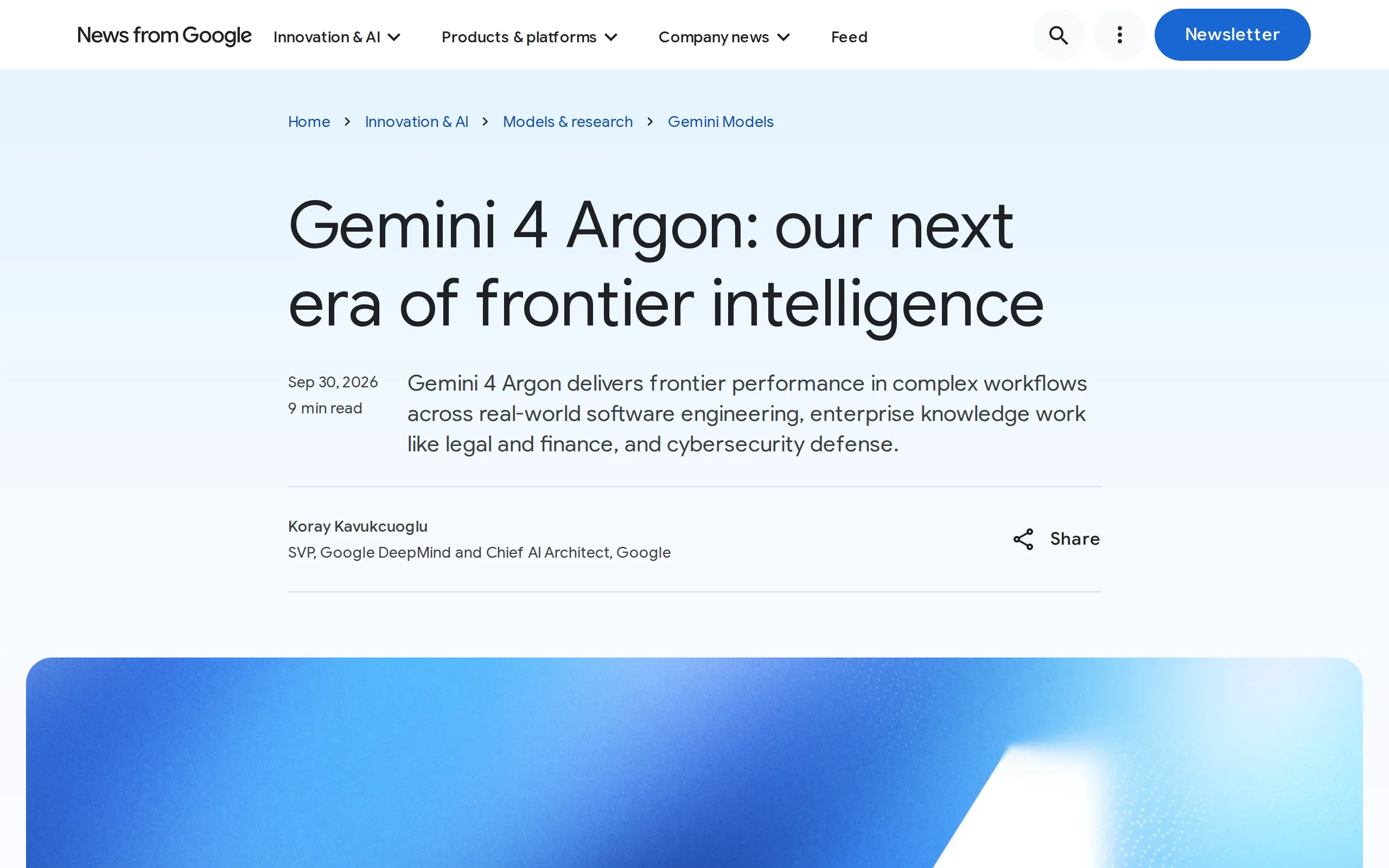
Gemini 4 Argon is a new generation of frontier large model launched by Google DeepMind, with a core positioning as an enterprise-level AI system capable of handling complex, long-term workflows. It is...
1. What is Gemini 4 Argon
Gemini 4 Argon is a new generation of frontier large model launched by Google DeepMind, with a core positioning as an enterprise-level AI system capable of handling complex, long-term workflows. It is applicable to knowledge-intensive tasks such as software engineering and financial law, as well as cybersecurity defense scenarios. This model significantly increases the single-output limit from 64,000 tokens to 1,000,000 tokens, enabling it to complete multi-step complex tasks—such as large-scale code migration and in-depth research—in one go within a single task trajectory. In the DeepSWE v1.1 software engineering benchmark, Argon achieved a score of 77.9%, and ranked first in the Vals Index enterprise knowledge work benchmark weighted by U.S. GDP. The model is being released in phases through the Fairwind initiative, with the initial phase targeting trusted cybersecurity defenders.
Technical positioning and domain: Gemini 4 Argon falls under the category of general-purpose large language models, but differs from traditional conversational models in that its design focuses on the agent-based long-range task execution capability. The model is aimed at enterprise production environments, emphasizing the ability to complete end-to-end complex workflows in specialized fields such as software engineering, financial analysis, legal documentation, and cybersecurity, rather than simple text generation and question-answering.
Development background: This model was developed by the Google DeepMind team, leveraging Google's technical expertise in Transformer architecture, reinforcement learning, and multimodal understanding. The release of Argon continues the technical trajectory of the Gemini series, but shifts the optimization focus from multimodal dialogue to long-range reasoning and autonomous execution, reflecting the industry trend of frontier models evolving from "chat tools" to "digital labor forces."
Core value: Argon addresses the core pain point of existing large models, which frequently interrupt long-term tasks and fail to maintain reasoning continuity due to output length limitations. The 1,000,000-token single-output limit allows the model to complete complex tasks such as large-scale codebase migration and full-cluster performance optimization without interruption—tasks that previously required manual segmentation or multiple calls—thus significantly enhancing the degree of autonomy of AI in real-world production environments.
Technical features: The model employs a multi-agent collaboration mode, enabling it to autonomously analyze telemetry data, implement memory optimization, and rewrite code. At the same time, it has constructed a four-tier security protection system, including anti-abuse measures, resistance to indirect prompt injection, chain-of-thought mismatch monitoring, and sandbox reinforcement, ensuring controllability and auditability of operations while maintaining high autonomy.
2. Key Features
Extended Output Capability: The maximum single output limit has been increased from 64,000 Tokens to 1,000,000 Tokens, nearly 8 times that of most state-of-the-art models (approximately 128,000 Tokens). This capability enables the model to generate lengthy code, in-depth research reports, or multi-step operation sequences of tens of thousands of Tokens in one go, without interrupting the reasoning trajectory, providing a technical foundation for long-term complex tasks.
Software Engineering Automation: Achieved a score of 77.9% in the DeepSWE v1.1 real-world long-term engineering evaluation, supporting code debugging, algorithm design, and large-scale codebase migration. The model has already supported internal Google projects involving the migration of hundreds of thousands of lines of C/C++ code to Rust. All large-scale code migrations must undergo automated auditing, simulation testing, and manual review before deployment.
Enterprise Knowledge Work Processing: Demonstrates outstanding performance in specialized fields such as finance, law, and taxation, ranking first on the Vals Index weighted by U.S. GDP. The model can understand professional charts, analyze multiple documents, and take actions based on document content, making it suitable for knowledge-intensive scenarios such as financial report analysis, legal document review, and tax compliance checks.
Multimodal Understanding and Reasoning: Achieved 91.7% on the long-video understanding benchmark LVBench, capable of analyzing professional charts, understanding long-video content, and performing cross-modal reasoning and decision-making based on multiple documents. This ability allows the model to handle complex tasks involving multiple information formats, including images, videos, and text.
Cybersecurity Defense: Can autonomously detect, verify, and fix critical vulnerabilities, achieving a tied first with a score of 68% on the CWE-bench v1 benchmark. The model can identify attack surfaces in black-box penetration testing without access to source code, having previously discovered high-risk vulnerabilities affecting medical software used globally. It possesses a closed-loop capability from vulnerability detection to remediation.
Business Process Automation Execution: Ranked first on the Zapier AutomationBench end-to-end business execution benchmark with a score of 51.3%. The model can understand the business process context, autonomously call various tools and application interfaces, and complete the full business loop from task decomposition to execution verification.
Four-Layer Security Protection System: Based on the Frontier Safety Framework, it rejects network attacks and CBRN abuse requests while preserving legitimate dual-use research. Robustness is enhanced through internal activation monitoring and red team testing, and it resists indirect prompt injection via automated red teaming and adversarial training. The entire thought process and actions are monitored, and execution is automatically halted when deviations from user intent are detected.
3. How to Use
Confirm Early Access Eligibility: Gemini 4 Argon is not yet fully available and users must first confirm whether they belong to one of the three early access categories. These include trusted cybersecurity defenders, paid API customers, and Google AI Ultra subscribers. Regular developers must wait for the official gradual rollout.
Defender Application Channel: Cybersecurity professionals can apply through the Google Fairwind Program website (https://deepmind.google/fairwind-program/). Upon approval, they will receive the full defensive version without network safeguards. This version is intended for defensive security research, and applicants must provide relevant qualification documents.
API Integration Process: After obtaining eligibility, log in to the Google AI Developer Platform, create a project, and enable the Gemini 4 Argon interface. The API calling method is consistent with other models in the Gemini series, supporting RESTful API calls. Pricing for input and output is $2 per million tokens and $10 per million tokens respectively, with a 50% discount on input when using the caching feature.
Subscriber Priority Access: Google AI Ultra subscribers will receive priority access and can directly access the Argon model through the subscription interface. Developers and enterprise users must wait for the official gradual rollout, with early access available through paid API integration.
Environmental Requirements and Best Practices: Argon is a cloud-hosted model and does not require local deployment; it can be accessed via API calls. It is recommended to clearly define task boundaries before making calls, and to utilize its ultra-long output capability to handle complete long-term tasks. When performing production-level operations such as code migration, follow the process standards of automated auditing, simulation testing, and manual review.
4. Pros and Cons Analysis
| Pros |
|---|
| Outstanding long-output capability: Supports up to 1 million Tokens per output, nearly 8 times that of most state-of-the-art models. It can complete large-scale code migration and in-depth research tasks in one go, avoiding context loss caused by interrupted reasoning. |
| Leading software engineering capabilities: Achieved a 77.9% score on DeepSWE v1.1. It supports the migration of hundreds of thousands of lines of C/C++ code to Rust within Google's internal systems and has demonstrated a 2.7x performance improvement in code rewriting cases, showcasing production-grade engineering capabilities. |
| Comprehensive security protection system: Features four layers of protection, including anti-abuse measures, resistance to indirect prompt injection, chain-of-thought mismatch monitoring, and sandbox reinforcement. It maintains auditable and interruptible operations even in high-autonomy scenarios, making it suitable for security-sensitive enterprise environments. |
| Solid multimodal understanding: Achieved a 91.7% score on the LVBench long-video understanding benchmark. It can analyze professional charts and take actions based on multiple documents, demonstrating comprehensive performance in knowledge-intensive scenarios such as finance and law. |
5. Comparative Analysis with Similar Tools
| Comparison Dimension | Gemini 4 Argon (Google) |
|---|---|
| Output Limit | 1 million Tokens (previously 64K) |
| Context Window | Not explicitly disclosed |
| Input Pricing | $2 per million Tokens |
| Output Pricing | $10 per million Tokens |
| Cached Input | 50% discount (-95%) |
| Long Context Pricing | No disclosure |
| Software Engineering Capability | DeepSWE v1.1: 77.9% (officially claimed as SOTA) |
| Enterprise Knowledge Work | First in Vals Index (finance/law/taxation/programming) |
Selection Recommendations: For teams handling long-term tasks such as large-scale code migration or in-depth research reports, Gemini 4 Argon's 1 million Token output limit provides a clear advantage, helping to avoid efficiency losses caused by task interruptions. Its pricing strategy also offers greater cost-effectiveness in output-intensive scenarios, making it suitable for tasks like codebase migration and large-scale refactoring that involve high output volumes.
For applications requiring a massive input context, such as processing extensive document collections or analyzing large codebases, GPT-6 Astra's 1.05 million Token input window is more appealing. If the task primarily involves input understanding with relatively limited output, Astra's input capabilities can reduce the cost of splitting documents. Enterprises should make their selection based on the input-output ratio, frequency of long context usage, and budget constraints in their specific tasks.
6. Editor's Summary
Gemini 4 Argon represents a significant direction in the evolution of cutting-edge large models from conversational interaction toward autonomous execution. Its 1 million Token single-output limit is not merely a result of parameter stacking, but rather a substantial reengineering of long-range reasoning architecture—when a model can generate tens of thousands of Tokens within a single task trajectory, it can perform deeper reasoning without interruption, providing technical feasibility for previously difficult-to-fully-automate tasks such as large-scale code migration and in-depth research. The 77.9% score achieved by DeepSWE v1.1 and the practical case of rewriting 32,000 lines of SIMD code in libgav1, achieving a 2.7x speedup, both demonstrate that its engineering capabilities have reached production-grade usability.
In terms of practical value, Argon transforms AI from a "advisor" to an "executor" through a multi-agent collaboration model: autonomously analyzing telemetry data, implementing memory optimizations, and rewriting performance-critical code. These capabilities directly translate into quantifiable business benefits—such as the release of over 300TiB of resources through data center memory optimization. The establishment of a four-tier security protection system addresses the compliance and controllability needs of high-autonomy AI in enterprise production environments.
In terms of target users, Argon is currently primarily aimed at three categories: software engineering teams dealing with large-scale code migration, financial and legal professionals relying on long-document analysis, and cybersecurity defenders requiring autonomous vulnerability detection and remediation capabilities. For general developers, access will be available gradually through the API after the official rollout.
Looking at its potential for development, Argon's phased release strategy (Fairwind plan) reflects the balance being explored between security and usability in cutting-edge models. As the openness expands and the context window is enriched with additional information, its application potential in enterprise knowledge work and software engineering fields is worth continuous attention.
7. Application Scenarios
Codebase Migration and Refactoring: Automatically migrate over 800,000 lines of C/C++ code from core libraries such as Google re2 and libgav1, as well as the Fuchsia Zircon kernel, into memory-safe Rust. After automated auditing, the code is deployed. The model can complete the entire process—from code analysis, transformation to verification—within a single task flow, significantly reducing the cost of manual migration.
Performance-Critical Code Rewriting: In the open-source video decoder libgav1, automatically rewrite 32,000 lines of SIMD code into safe Rust that can be automatically vectorized by the compiler, producing identical video output while achieving a 2.7x speedup. Suitable for optimizing performance-sensitive low-level libraries, the model can autonomously complete the full cycle of rewriting, testing, and verification.
Data Center Resource Optimization: Analyze performance telemetry data across the entire cluster, autonomously identify and apply memory optimization strategies. After deployment, it released over 300TiB of memory, with an estimated total savings of 500TiB to 1PiB. The model can understand cluster-level runtime data and execute optimization operations, making it ideal for large-scale infrastructure cost reduction and efficiency improvement.
Network Security Vulnerability Management: Automatically detect, verify, and fix critical vulnerabilities, identifying attack surfaces in black-box penetration testing without source code access. It previously discovered a high-risk vulnerability affecting medical software used globally in hospitals, making it suitable for enterprise security teams conducting vulnerability discovery, penetration testing, and verification of fixes.
Financial and Legal Document Analysis: Process complex professional documents in fields such as finance, law, and taxation, analyzing multiple documents and taking appropriate actions. The model can understand professional charts and perform cross-document reasoning, making it applicable to knowledge-intensive tasks such as financial report reviews, legal due diligence, and tax compliance checks.
8. FAQ
Q: When will Gemini 4 Argon be fully open to the public?
A: The official has not yet announced a full release timeline. The initial batch of users includes trusted cybersecurity defenders, paid API customers, and Google AI Ultra subscribers. Developers and enterprise users should follow Google's official channels for updates on future availability.
Q: How can I apply for early access to the Fairwind program?
A: Cybersecurity professionals can apply via the official Google Fairwind Program website (https://deepmind.google/fairwind-program/). Upon approval, they will receive the full defensive version without network restrictions, intended for defensive security research purposes.
Q: What is the significance of the 1 million Token output limit in practical use?
A: This capability allows the model to generate hundreds of thousands of Tokens in a single task flow without interruption, making it suitable for long-term tasks such as large-scale code migration and in-depth research reports. Compared to the previous 64K limit, it prevents context loss and the need to restart tasks due to output truncation.
Q: How does Argon differ from GPT-6 Astra in pricing?
A: Argon's input pricing is $2 per million Tokens, and output pricing is $10, with cached input enjoying a 50% discount. Astra's input pricing is $10 per million Tokens, and output pricing is $50, with cached input enjoying a 10% discount. Argon shows a clear cost advantage in output-intensive scenarios.
Q: How does the model's safety protection mechanism work?
A: Argon has a four-tier safety framework: it rejects abusive requests based on the Frontier Safety Framework, enhances robustness through internal activation monitoring and red team testing, defends against indirect prompt injection using automated red teams and adversarial training, and monitors the entire chain of thought and actions, halting them when they deviate from user intent. Before high-risk training and evaluation, the sandbox environment is isolated and sealed.
Q: What languages and multimodal inputs does Argon support?
A: As a Gemini series model, Argon supports multimodal understanding, including the analysis of professional charts and comprehension of long video content. For precise details on the supported languages and input formats, please refer to the official Google technical documentation.
9. Project Links
- Project Website: https://blog.google/innovation-and-ai/models-and-research/gemini-models/gemini-4-argon/
- Fairwind Program Application: https://deepmind.google/fairwind-program/
Related AI Model Articles
Mistral Large 4 – Mistral AI's Most Flagship Open-Source Large Model
Mistral Large 4 is the latest flagship open-source large model launched by Mistral AI, a French artificial intelligence company, and is nicknamed "Le Chonk" (the chubby cat). This model employs a fine...
Ling-3.1-flash – A New Generation Large Model Launched by the Bailing Team at Ant Group
Ling-3.1-flash is a new generation large language model launched by the Bailing team at Ant Group. It employs a hybrid linear Attention architecture and MoE sparse activation technology, with a total ...
IQuest-Q1 Review: A 320B Sparse MoE Open-Source Agent Foundation Model Specializing in Code and Long-Horizon Agent Tasks
IQuest-Q1 is an open-source Agent foundation model developed by IQuestLab, with a core focus on code generation and Agent task execution. The model employs a sparse MoE architecture, featuring a total...
GPT-6.1 Sol – OpenAI's New Generation Mainstream Model
GPT-6.1 Sol is a new generation mainstream model launched by OpenAI in 2026, serving as an upgraded version of GPT-6 Sol. It achieves nearly the same level of intelligence as the latter at just one-fi...
© All Rights Reserved. Some content on this site is partially generated by AI with human review.