
SandBase – AI Agent Infrastructure Platform, One-Stop Agent Runtime Foundation
Executive Summary:
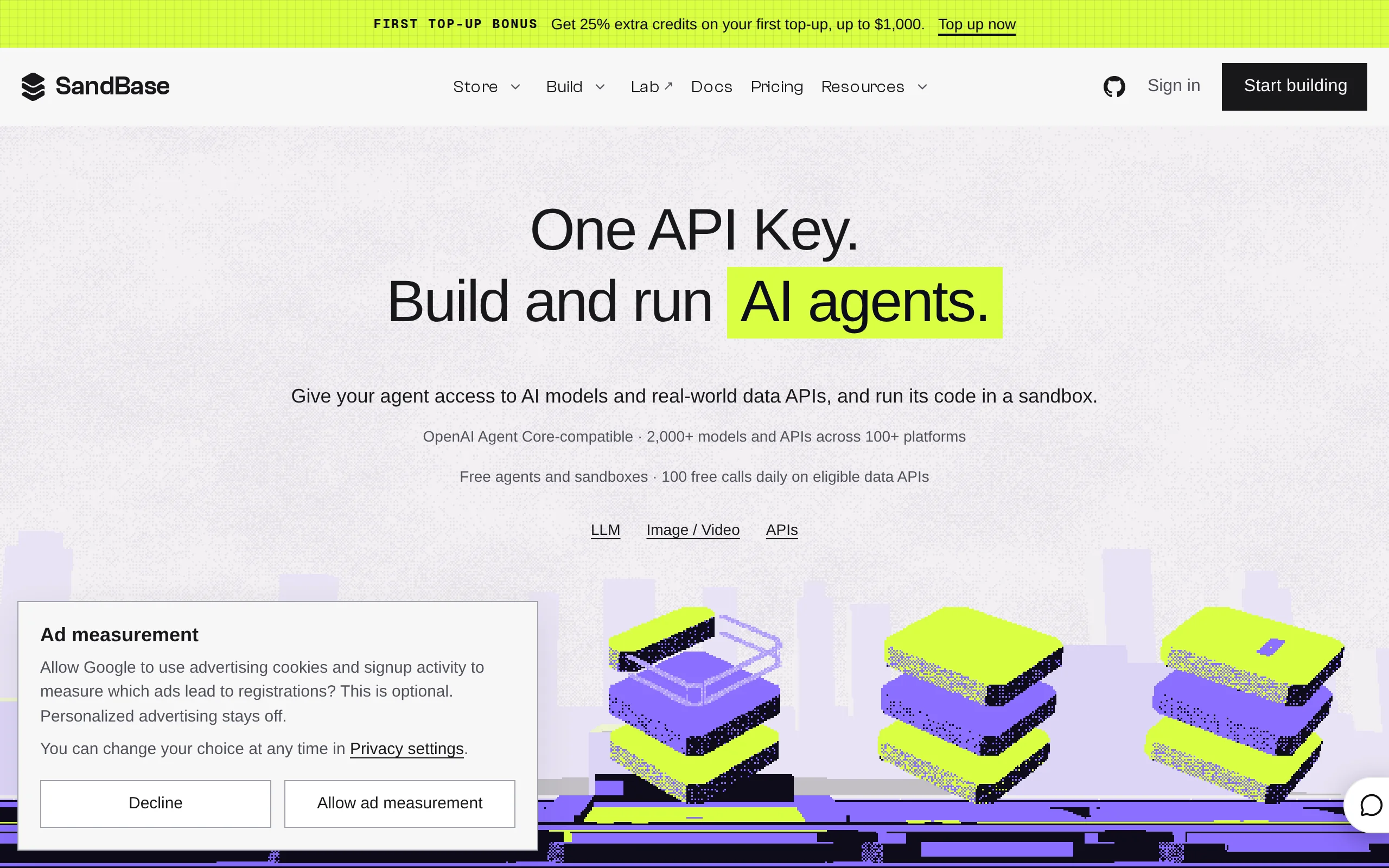
SandBase is an AI Agent infrastructure platform designed for developers, positioned as a one-stop runtime foundation for agents. The platform enables unified access to over 2000 model and data APIs vi...
1. What is SandBase
SandBase is an AI Agent infrastructure platform designed for developers, positioned as a one-stop runtime foundation for agents. The platform enables unified access to over 2000 model and data APIs via a single API Key, provides an E2B-compatible sandbox runtime environment, and is compatible with the OpenAI Agents API standard. Developers can leverage this platform to allow agents to access real-world data, execute code, and process files. They can encapsulate familiar workflows into Personal Agents, embedding them into their own products or CLI, MCP tools, and pay based on usage volume.
Technical positioning and domain: SandBase belongs to the AI Agent infrastructure layer, spanning four major modules: model gateway, data services, sandbox computing, and agent runtime. Compared to single-model API service providers or pure sandbox providers, SandBase integrates model calling, real-time data acquisition, and code execution into a unified platform, assuming the role of a "runtime foundation" in the agent development pipeline. Its target users include independent developers, AI Builders, and agent startup teams.
Development background: SandBase was launched by the SandBase team, whose design philosophy stems from the pain points of multi-platform integration in agent development—developers often need to separately connect model APIs, data sources, and sandbox environments, resulting in fragmented authentication systems and high migration costs. The team chose to be compatible with two mature technical standards: OpenAI Agents API and E2B SDK, to reduce the onboarding barriers for developers. At the same time, it provides integration through SKILL.md, CLI, and local MCP bridges, forming an ecosystem linkage with mainstream AI tools such as Claude Code, Codex, and Cursor. This product strategy of "first compatibility, then integration" allows the platform to rapidly build its own service loop on top of the existing technical ecosystem.
Core value: SandBase addresses the practical issue of "dispersed management of models, data, and execution environments" in agent development. A single API Key is sufficient to complete model calling, data API access, and sandbox resource requests, eliminating the redundant work of managing multiple platform authentications and accounts. The platform integrates real-world data APIs such as X, YouTube, and web search, enabling agents to perform information collection, content analysis, and other productive tasks, rather than being limited to pure text-based conversations.
Technical features: At the protocol layer, the platform adopts a dual-compatibility strategy, supporting both OpenAI Agents API and E2B SDK. Developers can continue using their existing code habits for integration. At the integration layer, it provides three methods: SKILL.md, CLI, and local MCP bridges, allowing direct embedding into mainstream AI tools. At the resource layer, it uses a sandbox as the code execution carrier, enabling agents to run code, process files, and return results in an isolated environment.
2. Key Features
Unified Model Access: Compatible with the OpenAI Agents API standard, developers can directly use the OpenAI SDK to create Agents, establish sessions, and run tasks. The endpoint is
api.sandbase.ai/v1, and switching between different models can be done by specifying model parameters, without the need to modify business code. The platform officially supports access to over 2000 models and APIs, covering more than 100 platforms, meeting diverse selection requirements.Real-World Data API: Covers real-world data sources such as X (Twitter), YouTube, web search, and company information, enabling Agents to obtain real-time information and complete tasks with tangible outputs. Some APIs offer 100 free calls per day, allowing developers to first verify data quality before deciding whether to pay for expanded usage.
E2B-Compatible Sandbox Execution: Provides an E2B-compatible runtime environment, allowing Agents to execute code, process files, and return results within the sandbox. Projects with existing E2B code can be migrated to SandBase at a low cost, reducing the workload of code refactoring.
Tool Ecosystem Integration: Supports three integration methods: SKILL.md, CLI, and local MCP bridging. It can directly integrate with existing AI tools such as Claude Code, Codex, and Cursor. By pasting a single instruction, environment configuration can be completed, allowing AI assistants to automatically handle the rest of the integration process.
Reusable Skill Templates: Built-in reusable Skills such as Twitter intelligence, YouTube transcription, SEO analysis, and company research help Agents quickly complete practical tasks. These templates encapsulate data API calls, result organization, and output formatting into standardized workflows, which developers can use directly or customize based on them.
Unified Authentication Management: A single API Key can access the model, data API, and sandbox modules simultaneously, eliminating the need for repeated registration and management of multiple keys across different platforms. For Agent applications that require calling multiple services, this significantly reduces the maintenance cost of account systems.
Pay-Per-Use Pricing Model: The platform uses a pay-per-use billing model, with the resale margin between models and data APIs forming the main commercialization path. First-time recharge grants a 25% credit, suitable for different stages from prototype validation to small-scale deployment.
3. Application Scenarios
Expert-Level Training Data Production: Organize industry experts to generate high-threshold SFT data in bulk for cutting-edge model companies, covering knowledge-intensive fields such as finance, law, healthcare, and STEM. Through SandBase's sandbox environment and data API, experts can complete data collection, organization, and annotation within a unified workflow, improving the efficiency of training data production.
RL Environment and Anti-Pattern Data Construction: Build reinforcement learning environments and "anti-pattern" training datasets for models, enabling them to enhance their reasoning and error-correction capabilities through multiple rounds of trial and error. SandBase has open-sourced datasets and training outputs such as Dynasor and ProRL, providing a practical foundation for reinforcement learning research.
Benchmark Evaluation and Exam Simulation: Offer expert-level benchmark evaluation services, simulating real exam environments to test the model's performance on complex professional tasks. Evaluation results can be referenced by model laboratories to identify capability gaps and guide iteration directions.
Vertical Industry Model Capability Enhancement: For Agent scenarios beyond programming, generate training tasks that replicate real-world workflows, ensuring the model remains stable and reliable during long-chain professional tasks. This scenario is suitable for fields such as financial analysis, legal documentation, and medical consultation, where professionalism and workflow integrity are critical.
Personal Agent Workflow Packaging: Developers can package their familiar workflows into Personal Agents, embedding them into their own products or CLI, MCP tools for use. For example, the process of "collecting competitor information → generating analysis reports → outputting to a specified format" can be solidified as an Agent task, enabling the automation of daily work.
Real-World Data Collection and Analysis: Using data APIs such as X, YouTube, and web search, Agents can perform data-intensive tasks like sentiment monitoring, content tracking, and research data collection. Combined with the code execution capabilities of the sandbox environment, collected data can be cleaned, analyzed, and results generated within the same platform.
4. How to Use
Environment Requirements: Using SandBase requires no local GPU or complex dependencies—only a development environment with internet access. It supports tool calling via AI tools such as OpenAI SDK, Claude Code, Codex, Cursor, and more. The operating system is unrestricted.
Register an Account: Visit the SandBase official website (https://www.sandbase.ai/) to register an account and access the Console to obtain your SandBase API Key. This key serves as a unified credential for accessing models, data APIs, and sandboxes.
Quick Integration with Existing AI Tools: Paste the command
set up https://www.sandbase.ai/SKILL.mdinto AI tools like Claude Code, Codex, or Cursor. The AI assistant will automatically complete the environment setup. This method is ideal for developers who want to quickly experience the platform's capabilities.Configure Model Endpoints: Use the OpenAI-compatible endpoint
api.sandbase.ai/v1and specify the desired model using the OpenAI SDK to create an Agent and configure task instructions. Due to protocol compatibility, existing OpenAI SDK code only needs to modify the base_url and API Key to migrate.Access Data APIs: Use the same API Key to call data APIs such as X, YouTube, and web search. It is recommended to first review the capabilities and pricing of each interface before performing actual calls to help manage costs.
Run and Verify: After creating an Agent session and issuing a task, the Agent will execute the code, gather information, and generate result files within the sandbox. Manually verify the validity of the original links and whether the output meets the filtering rules. Only after confirming the process is reliable should you integrate it into your own product.
Notes: The free quota for data APIs is calculated on a daily basis; frequent calls require attention to quota usage. It is advisable to set timeout controls for tasks running in the sandbox to prevent long-running tasks from consuming resources. Before integrating into a production environment, thoroughly test the stability of data sources and the consistency of output formats.
5. Pros and Cons Analysis
| Pros |
|---|
| Unified Entry Simplifies Integration: A single API Key connects the model, data API, and sandbox modules, eliminating redundant work for multi-platform authentication and account management, significantly reducing the integration complexity for Agent development. |
| Protocol Compatibility Reduces Migration Costs: Compatible with both OpenAI Agents API and E2B SDK, developers can seamlessly integrate using their existing code habits, and existing E2B code can be migrated to SandBase at low cost. |
| Access to Real-World Data: Data APIs from over 100 platforms, including X, YouTube, web search, and company data, allow Agents to perform practical tasks such as information collection and content analysis. |
| Strong Ecosystem Integration: Through SKILL.md, CLI, and MCP bridge, it directly integrates with mainstream AI tools such as Claude Code, Codex, and Cursor, enabling Agents to reach developers effectively with a clear customer acquisition path. |
| Broad Coverage at Scale: Officially claims to support integration with over 2000 models and APIs, covering more than 100 platforms, providing developers with a rich selection of options. |
6. Comparative Analysis with Similar Tools
| Dimension | SandBase | E2B | OpenRouter |
|---|---|---|---|
| Positioning | "One-stop" Agent infrastructure: model + data API + sandbox + Agent runtime | AI Agent Cloud, focusing on the sandbox execution layer | Unified LLM API gateway, aggregating multiple model providers |
| Core Product | Four-layer package, one Key to access all | Firecracker microVM sandbox: run code, install packages, manipulate files, desktop version includes browser | Unified API access to hundreds of models, billed by token |
| Protocol Compatibility | Dual compatibility with OpenAI Agents API and E2B SDK | The standard itself, being the compatible party | OpenAI-compatible API format |
| Data Layer | Key differentiator: real-time data APIs from over 100+ platforms including X/YouTube/web search | No data API provided | No data API provided, focuses on model routing |
| Usage Scale | Official site shows 108 listed offers, in early stages | Over 1 billion sandbox launches, millions of SDK downloads monthly, clients include Perplexity, Manus, Hugging Face, etc. | Widely used in the developer community, one of the mainstream model aggregation services |
| Commercialization | Resale margin on model/data APIs + pay-as-you-go, 25% discount on first charge | Billed by second (approx. $0.0504/vCPU·hour), Hobby free tier provides $100 credit, Pro tier is $150/month | Billed by token, platform charges a small channel fee |
| Open Source Strategy | SDK/CLI open source (sandbase-harness) | Runtime code open source (Apache 2.0), supports BYOC self-hosting | SDK open source, core network closed source |
Selection Recommendations: If the core requirement of the project is sandbox code execution, and there is a high demand for the stability and scale of the execution environment, E2B is a well-validated choice, with its over 1 billion sandbox launches and Fortune 100 customer base providing a reference for reliability. If the project needs to address three issues simultaneously: model integration, real data acquisition, and code execution, and aims to complete all integrations with a single API key, SandBase's one-stop solution can reduce the engineering costs of multi-platform integration.
For teams that already have OpenAI SDK code and wish to quickly switch model providers, OpenRouter offers a lightweight model routing solution. However, teams requiring deep integration with OpenAI ecosystem capabilities (such as Handoffs for multi-Agent collaboration) should prioritize the OpenAI Agents API. SandBase's differentiated value lies in its bundled integration of "model + data + sandbox," making it suitable for Agent applications with strong dependencies on real-time data and a desire to control integration complexity.
7. Editor's Summary
SandBase has chosen an integrated approach in the AI Agent infrastructure domain. Unlike E2B, which focuses on the sandbox execution layer, and OpenRouter, which specializes in model routing, SandBase packages model gateways, data APIs, sandbox computing, and Agent runtime into a unified platform. It reduces migration costs through protocol compatibility strategies and integrates with mainstream AI tool ecosystems via SKILL.md and MCP bridging. This "one-stop" design directly addresses the real pain points of multi-platform integration in Agent development, especially for Agent applications that heavily rely on real-time data. The closed-loop integration of data APIs and sandbox execution within the same platform can significantly reduce engineering overhead.
In terms of practical value, SandBase is well-suited for independent developers, AI Builders, and Agent startup teams. Its pay-as-you-go model and initial credit offer lower the barrier to entry, while its compatibility with the OpenAI SDK allows existing code to be quickly migrated. Additionally, the platform's layout in areas such as training data generation, RL environment construction, and benchmark evaluation extends its reach to model development teams, creating dual value for both application development and model training.
Objectively speaking, SandBase is still in its early stages. The scale of its 108 listed offers is far behind E2B's over 1 billion sandbox launches. Its ecosystem maturity and accumulation of benchmark cases still require time. Its reliance on E2B's compatibility standards for the sandbox layer also limits its potential for innovation at the foundational level. However, the direction of integrating models, data, and execution into a single platform offers tangible appeal for Agent teams focused on development efficiency. Its future growth will depend on the platform's ability to continuously expand data source coverage, improve its documentation system, and accumulate trustworthy customer cases.
8. FAQ
Q: What is the difference between SandBase and E2B?
A: E2B focuses on the sandbox execution layer, providing a Firecracker microVM environment, and does not involve data APIs or model gateways. SandBase, on the other hand, offers model access, data APIs, and an E2B-compatible sandbox, positioning itself as a "one-stop" Agent infrastructure. If your project only requires a code execution environment, E2B is more specialized. If you need a solution that simultaneously addresses data retrieval and model calling, SandBase's integrated approach is more efficient.
Q: How to migrate existing OpenAI SDK code to SandBase?
A: SandBase provides an OpenAI-compatible endpoint api.sandbase.ai/v1. To migrate, simply change the base_url in the OpenAI SDK to this endpoint and replace the API Key with a SandBase Key. You can then use the OpenAI SDK to create Agents, establish sessions, and run tasks, with minimal changes required to your business code.
Q: How is the free quota for the data API calculated?
A: Some data APIs offer 100 free calls per day, calculated on a natural day basis. Developers can view the quota consumption for each API in the Console. High-frequency calling needs require payment. It is recommended to check the capability descriptions and pricing of each API before making calls, and plan your usage accordingly.
Q: What is SKILL.md and how is it used?
A: SKILL.md is a fast configuration mechanism provided by SandBase. In AI tools such as Claude Code, Codex, and Cursor, paste the instruction set up https://www.sandbase.ai/SKILL.md, and the AI assistant will automatically complete the environment setup, including API Key configuration, model endpoint setup, and skill template loading.
Q: Which models does SandBase support?
A: According to official information, SandBase integrates over 2000 models and APIs across more than 100 platforms. Developers can specify the required model when creating an Agent via the OpenAI-compatible endpoint. The specific list of models can be viewed in the Console.
Q: Is the sandbox environment secure?
A: SandBase provides an E2B-compatible sandbox runtime environment. Code is executed in an isolated virtual machine, separated from the host machine and other tenants. Developers should follow the principle of least privilege, not storing sensitive credentials in the sandbox, and promptly clean up runtime resources after task completion.
Q: How to integrate SandBase into your own product?
A: Developers can encapsulate familiar workflows into Personal Agents, using the OpenAI SDK to call SandBase's model, data API, and sandbox capabilities, thereby embedding the Agent into their own product. It also supports CLI and local MCP bridging methods, enabling integration into existing toolchains.
9. Project Links
- Product Website: https://www.sandbase.ai/
- GitHub Repository: https://github.com/sandbaseai/
Related
LoopForge – Tencent's Open-Source Cloud-Based AI R&D Collaboration Platform
LoopForge is an open-source, team-level cloud-based AI R&D collaboration platform developed by Tencent, designed to address engineering breakpoints that occur during multi-Agent handover processes. Un...
Muse Ember Review: Meta Redefines the Efficiency Boundaries of Lightweight Models
Muse Ember is Meta's smallest parameter-scale AI model introduced in mid-2026, specifically designed for high-frequency, repetitive tasks in agents. According to official benchmark data, this model ac...
Claude Fable 5.2 – Anthropic's Flagship AI Model
Claude Fable 5.2 is Anthropic's flagship AI model, sharing a common origin with the security-focused Claude Mythos 5.2. This model is renowned for its capability of autonomous collaboration among thou...
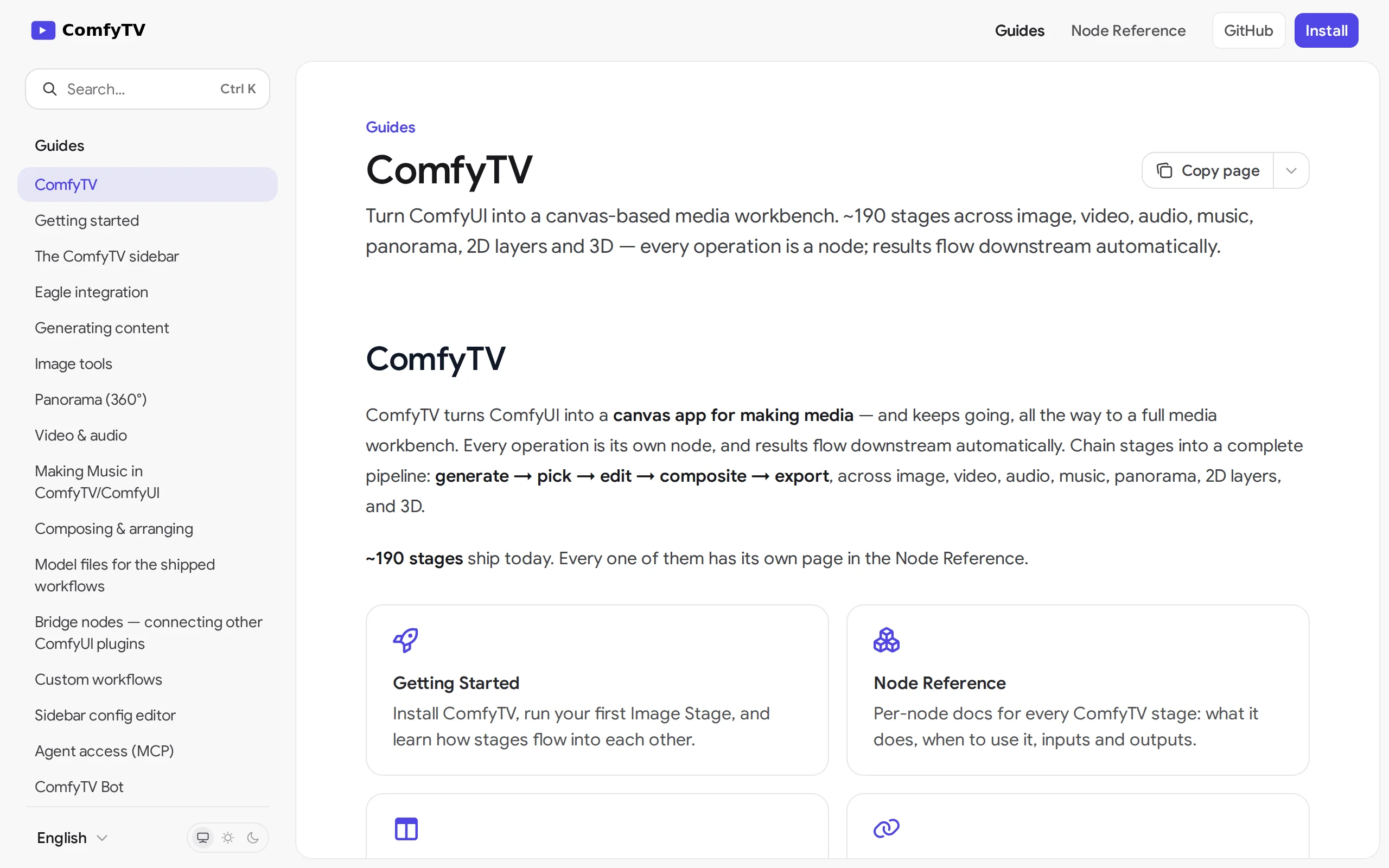
ComfyTV – Open-Source ComfyUI Plugin, Local Infinite Canvas Media Workbench
ComfyTV is an open-source ComfyUI plugin that operates entirely locally, transforming ComfyUI into an infinite canvas-style media workbench similar to TapNow and LibTV. Each operation on the canvas is...
© All Rights Reserved. Some content on this site is partially generated by AI with human review.