
Muse Ember Review: Meta Redefines the Efficiency Boundaries of Lightweight Models
Executive Summary:
Muse Ember is Meta's smallest parameter-scale AI model introduced in mid-2026, specifically designed for high-frequency, repetitive tasks in agents. According to official benchmark data, this model ac...
1. What is Muse Ember
Muse Ember is Meta's smallest parameter-scale AI model introduced in mid-2026, specifically designed for high-frequency, repetitive tasks in agents. According to official benchmark data, this model achieves a performance score comparable to Claude Haiku 5.5 at approximately one-third of the single-task cost. It also significantly outperforms others in the agent workflow benchmark (AutomationBench-AA) with a score of 37.8, placing it at the forefront of efficiency in Artificial Analysis. Its core configuration includes a 1 million Token context window, a maximum output capacity of 512,000 Tokens, and native support for four modalities: text, image, audio, and video. It is also Meta's first specialized model distilled from the flagship model, Muse Wonder Full.
Technical Positioning and Domain: Muse Ember belongs to the intersection of natural language processing and multimodal understanding, positioning itself as a lightweight, high-cost-performance agent execution engine. Unlike the flagship general-purpose model, it deliberately avoids direct competition in complex reasoning scenarios and instead focuses on optimizing the "small tasks" that are frequently consumed in daily agent operations—tool calling, code subtasks, information routing, data extraction, and long document parsing. This differentiated positioning gives it a unique ecological niche in the efficiency frontier of Artificial Analysis: on the complete leaderboard, no other model can achieve the same score at a lower single-task cost.
Development Background: Muse Ember was developed by Meta's core AI research team and is a crucial component of Meta's model portfolio strategy. Its development was driven by the cost bottleneck encountered when deploying agents—while flagship models are highly capable, they are too costly for handling massive volumes of repetitive tasks. To address this, Meta has constructed a clearly differentiated model matrix: Muse Wonder handles the most difficult problems, Muse Spark is responsible for programming and agent workflows, and Muse Ember takes on repetitive tasks in a scalable and low-cost manner. Notably, Ember is the first specialized model trained through knowledge distillation from the flagship model, Muse Wonder Full, inheriting its reasoning and multimodal capabilities, and then being pruned and specialized for efficient execution scenarios.
Core Value: Muse Ember addresses the core issue of cost-efficiency in the large-scale deployment of agents. Real-world test data shows that it scores 37.8 on AutomationBench-AA, nearly 2.7 times that of Claude Haiku 5.5 (13.9 points), and 1.9 times that of GPT-6 Luna. It also scores 61.6 on Agents' Last Exam, surpassing Claude Haiku 5.5's 57.0. The single-task cost is approximately $0.14, about one-third of the cost required to achieve the same score with Claude Haiku 5.5 (~$0.411). This cost structure enables AI capabilities to be embedded into a wide range of products and business processes, pushing agents from proof-of-concept to mass production.
2. Key Features
Agent Workflow Execution: Muse Ember is capable of executing complete business processes end-to-end, sequentially calling tools and updating system states across applications. It scores 37.8 on the AutomationBench-AA benchmark, nearly 2.7 times that of Claude Haiku 5.5, covering routine agent tasks such as record retrieval, information routing, and data extraction, significantly reducing latency and failure rates in multi-step task orchestration.
Large-Scale Programming Subtask Handling: Optimized for handling hundreds of frequent small tasks within agent conversations, including reading files, running tests, and targeted code defect fixes. It scores 40.9 on the Terminal-Bench 4.0 terminal programming benchmark, surpassing Claude Haiku 5.5's 39.2; on the FrontierCode 2.0-AA real-world engineering tasks benchmark, it scores 27.2, capable of efficiently handling mechanical coding tasks in large-scale development processes at low cost.
Ultra-Long Context Handling: Provides a context window of up to 1 million Tokens, with a maximum output of 512,000 Tokens per single call. This configuration allows the model to process entire code repositories, full technical documentation, or large-scale contract texts in a single inference, eliminating the engineering complexity of concatenating context across multiple rounds of conversation and ensuring information consistency in long-sequence tasks.
Native Multimodal Unified Understanding: Muse Ember can process four modalities—text, image, audio, and video—simultaneously without relying on external auxiliary models. It can analyze screenshots, charts, and scanned documents, handle voice memos, meeting recordings, and video content, and even perform direct computer operations based on screen captures. It scores 69.5 on the OSWorld 2.1 computer operation benchmark, slightly higher than Claude Haiku 5.5's 68.9, effectively reducing the system orchestration complexity of multimodal agents.
High-Cost-Effectiveness Inference: Input cost is $0.10 per million Tokens, output cost is $0.50 per million Tokens, and cached input is only $0.004 per million Tokens. For long-text inputs exceeding 200,000 Tokens, the cost increases to $0.30 per million Tokens, and output increases to $1.50 per million Tokens. It ranks at the forefront of the Artificial Analysis efficiency frontier, with a single task cost of approximately $0.136–$0.14, about one-third of Claude Haiku 5.5's ($0.411), making it suitable for large-scale concurrent calls.
Enterprise-Level Security Evaluation: Despite its smaller model size, Muse Ember undergoes a comprehensive evaluation using the Meta Super Intelligence Expansion Framework before release, covering chemical/biological threats, cybersecurity, loss-of-control risks, and the safety of proxy actions when acting on behalf of users. All risk levels are below high-risk thresholds. The security training standards align with those of the core model, providing assurance for enterprise deployment in sensitive business processes.
3. Application Scenarios
Enterprise Document Intelligence Review: Enterprises can use Muse Ember for contract review and resume screening. For example, Box has implemented it to compare contract content clause by clause with the company's negotiation guidelines, generating an overall risk rating. The HR department can apply detailed resume criteria to filter candidates and flag borderline cases, enabling high-speed, high-Token-efficiency enterprise content processing. Compared to manual reviews, the cost of approximately $0.14 per task makes large-scale document reviews financially feasible.
Handling Large-Scale Programming Subtasks: Development teams can delegate hundreds of high-frequency small tasks to Muse Ember within intelligent agent conversations—such as reading code files, running unit tests, identifying and fixing bugs—while reserving the most complex architectural design tasks for the flagship model, Muse Wonder. This "heavy model planning, light model execution" collaboration model significantly reduces API usage across the entire coding process. With a score of 40.9 on Terminal-Bench 4.0, it is nearly on par with Claude Haiku's 5.5.
End-to-End Business Process Automation: Enterprises can use Muse Ember to complete full business workflows across multiple applications, including retrieving customer records, sequentially calling multiple tools, and synchronizing data updates between CRM and ERP systems. Its 1 million Token context capacity allows it to retain all business states in a single conversation. A score of 37.8 on AutomationBench-AA indicates its reliable task completion rate in multi-step tool calling scenarios.
Multimodal Content Processing and Parsing: For unstructured data such as voice memos, meeting recordings, video materials, screenshots, and scanned documents, Muse Ember can directly extract information and perform subsequent operations without needing to connect to other models. Its OSWorld 2.1 computer operation score of 69.5 demonstrates its ability to perform GUI operations based on screenshots, making it suitable for practical applications such as automated desktop workflows and data entry.
4. How to Use
Muse Ember does not provide locally deployable weights. It is primarily accessed through cloud-based APIs and integrated with third-party platforms, making it overall easy to use.
Via Meta Model API: Register an account on the developer platform dev.meta.ai and create an API Key. After obtaining the key, send requests to the endpoint
https://api.meta.ai/v1/responseswith the model IDmuse-ember-1.0. This interface is compatible with the Responses API format and supports advanced features such as streaming output and tool calling, making it suitable for production environments with existing backend services.Using OpenAI SDK: Muse Ember is compatible with mainstream OpenAI SDKs. Developers simply need to point the base URL to
(link to be updated after official release)and input their own API Key, allowing them to seamlessly replace the model in their existing code without modifying business logic. This design significantly reduces migration costs and is ideal for teams that have already built applications within the OpenAI ecosystem.
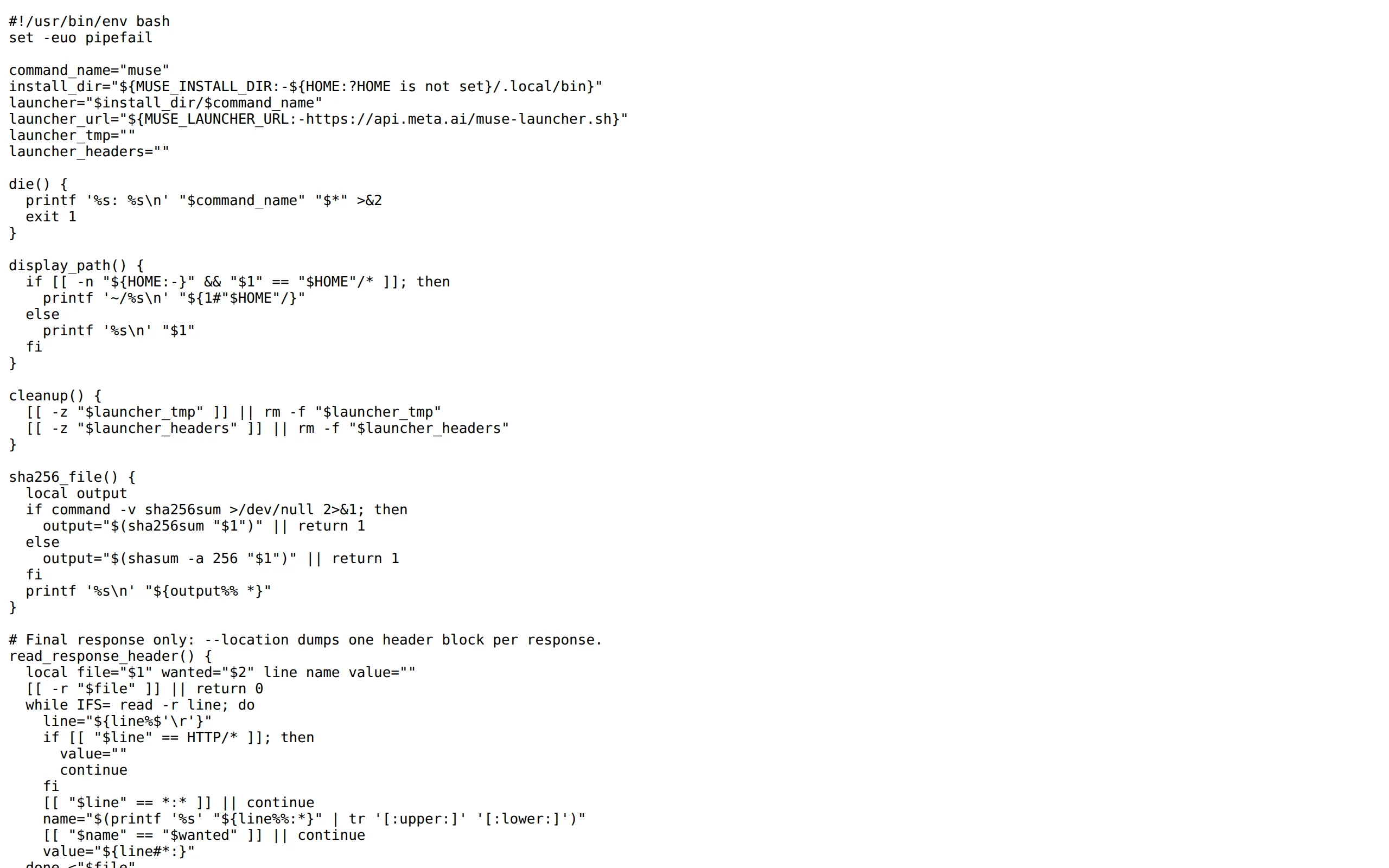
| Using Muse Code terminal for programming: Run the installation command `curl -fsSL https://dev.meta.ai/install.sh |
Through cloud platforms: Select the
muse-ember-1.0model in Google Cloud's Model Garden or Oracle Cloud, and activate and bill it according to the standard procedures of each platform. This channel is suitable for enterprise users who already have cloud accounts, wish to manage billing uniformly, or need to coordinate with existing cloud services.Via third-party gateways: Choose
meta/muse-emberon the OpenRouter platform, or purchase usage quotas through the Vercel / Netlify AI Gateway. A single account can manage multiple models uniformly, facilitating multi-model comparisons and business switching. This is suitable for developers who need flexible allocation of model resources.
Notes and Best Practices: When the number of input tokens exceeds 200,000, the input cost increases from $0.10 to $0.30 per million tokens, and the output cost increases from $0.50 to $1.50 per million tokens. For long-text scenarios, it is recommended to enable input caching (at $0.004 per million tokens) to reduce costs. For complex architectural design tasks, it is advised to use Muse Wonder or Muse Spark in conjunction, positioning Ember as a high-frequency execution component.
5. Pros and Cons Analysis
| Pros |
|---|
| Exceptional Cost-Effectiveness: The cost per task is approximately $0.136–$0.14, only about one-third of Claude Haiku 5.5's cost ($0.411) when achieving the same benchmark score. The input price is $0.10 per million Tokens, making it ideal for large-scale, high-frequency usage scenarios. |
| Outstanding Performance in Agent Tasks: Scores 37.8 on AutomationBench-AA, nearly 2.7 times that of Claude Haiku 5.5. Its terminal programming and computer operation capabilities reach or exceed those of comparable products, with dedicated optimizations for high-frequency agent scenarios. |
| Ultra-Long Context Window: With an input capacity of 1 million Tokens and an output capacity of 512,000 Tokens, a single call can process an entire codebase, significantly reducing the complexity of multi-round concatenation for long-sequence tasks. |
| Native Multimodal Understanding: It can uniformly process text, images, audio, and video without relying on external visual or speech-specific models. It scores 69.5 on OSWorld 2.1, reducing the architectural complexity of multimodal agent systems. |
| Flagship Capabilities Democratized: As the first specialized model distilled from Muse Wonder Full, it inherits some of the flagship model's reasoning and multimodal capabilities, achieving high intelligence density in a minimal form factor. |
6. Comparative Analysis with Similar Tools
| Comparison Dimension | Muse Ember | Claude Haiku 5.5 |
|---|---|---|
| Core Positioning | The smallest and most efficient agent execution model, focused on high-frequency repetitive tasks | Lightweight general-purpose inference model, balanced performance and speed |
| Input Cost | $0.10 per million Tokens (>200,000 tokens increase to $0.30) | Several times that of Ember, with specific pricing based on tiers |
| Output Cost | $0.50 per million Tokens (>200,000 tokens increase to $1.50) | Higher, approximately several times that of Ember |
| Single Task Cost (AA Test) | Approximately $0.136–$0.14 | Approximately $0.411 (max tier, same score) |
| Comprehensive Benchmark Score (AA Index, max) | 36 | 36 (tied, cost approximately 3 times higher) |
| Agent Workflow (AutomationBench-AA) | 37.8 | 13.9 |
| Agent Tasks (Agents' Last Exam) | 61.6 | 57.0 |
| Terminal Programming (Terminal-Bench 4.0) | 40.9 | 39.2 |
| Real-World Engineering Tasks (FrontierCode 2.0-AA) | 27.2 | 34.9 (Haiku's only clearly leading item) |
| Computer Operation (OSWorld 2.1) | 69.5 | 68.9 |
| Context Window | 1 million Tokens | 200,000 level |
| Maximum Output | 512,000 Tokens | Smaller |
| Multimodal Support | Native text + image + audio + video | Text + image as primary |
| Training Sources | The first specialized model distilled from Muse Wonder Full | Anthropic's self-developed model |
| Access Channels | Meta Model API, Muse Code, Google Cloud, Oracle Cloud, OpenRouter | Anthropic API, Claude ecosystem |
| Consumer Apps | Not listed on Meta AI App | Integrated into the Claude product ecosystem |
Selection Recommendations: If the core of your business involves high-frequency agent tasks—tool calling, information routing, data extraction, and code subtasks—and you are highly cost-sensitive, Muse Ember is currently the preferred choice at the efficiency frontier. Its significant advantage on AutomationBench-AA means it can support a much higher volume of concurrent agent operations under the same budget; however, note that its score on real-world engineering tasks (FrontierCode 2.0-AA) is notably lower than that of Claude Haiku 5.5 (27.2 vs. 34.9). If your workflow involves extensive modifications to complex codebases, it is recommended to use Haiku 5.5 for such subtasks while retaining Ember for simpler, repetitive operations.
If an enterprise has deeply integrated the Anthropic or OpenAI ecosystem, migrating to Ember would require additional engineering efforts. Meta has reduced the switching barrier by ensuring compatibility with the OpenAI SDK and offering multi-platform access channels. However, the absence of consumer-grade product coverage means non-technical users cannot directly experience it. Overall, Muse Ember is most suitable for teams sensitive to per-task costs and aiming to embed AI into large-scale business processes, while flagship models remain a necessary complement for complex architectural design.
7. Editor's Summary
Muse Ember's technological innovation lies in its clear "efficiency-driven" design philosophy. While the industry generally pursues larger parameter scales and broader capability coverage, Meta takes a different approach by launching the smallest model to date, yet achieves remarkable intelligence density through knowledge distillation and task specialization. Its distillation training path based on Muse Wonder Full holds methodological significance—it is not simply about shrinking the model, but rather purposefully trimming and enhancing capabilities for high-frequency tasks of the agent, enabling the model to achieve a score of 37.8 on AutomationBench-AA, nearly 2.7 times that of Claude Haiku 5.5, while reducing the cost per task to approximately one-third. This "thinking big with small" approach provides a reusable technical paradigm for lightweight model development.
In terms of practical value, Muse Ember's most direct contribution is moving agents from concept validation to large-scale production. With a 1 million Token context window, 51.2 thousand Token output, and a unified architecture supporting native multimodality, it can process entire codebases or document sets in a single call, significantly reducing system orchestration complexity. Meanwhile, the cost of approximately $0.14 per task allows AI capabilities to be embedded into high-frequency business scenarios such as contract review, resume screening, and cross-application process automation. Combined with multi-channel access through Meta Model API, cloud platforms, and third-party gateways, developers can quickly integrate it into their existing technology stack.
In terms of target users, Muse Ember is more suitable for developer teams with clear task scenarios, SaaS product managers, and enterprises undergoing intelligent transformation. For users requiring complex reasoning or creative work, the flagship model remains a necessary complement. For technical teams aiming to build low-cost, high-throughput agent services, Muse Ember holds a leading position at the current efficiency frontier. Its future iteration directions will continue to track updates to automation benchmarks and the improvement of the ecosystem toolchain. Meta's model matrix division strategy also provides a clear evolutionary path for Ember—it will continue to serve as the execution layer for large-scale, cost-sensitive agent services.
8. FAQ
Q: What are the differences between Muse Ember, Muse Wonder, and Muse Spark?
A: The three are specialized components within Meta's model matrix. Muse Wonder is the flagship model, responsible for the most challenging questions and deep reasoning. Muse Spark focuses on programming and agent workflows. Muse Ember is the smallest and most efficient model, designed to handle repetitive tasks at scale and with low cost. Ember is the first dedicated model distilled from the full Muse Wonder, inheriting some of the flagship model's reasoning and multimodal capabilities.
Q: What are the main ways to access Muse Ember?
| A: There are five channels to access it: Meta Model API (register at dev.meta.ai to obtain a key, request (link to be updated after official release)/responses); OpenAI SDK (set the base URL to (link to be updated after official release)); Muse Code terminal programming (install by executing `curl -fsSL https://dev.meta.ai/install.sh |
Q: What is the cost of a single call?
A: Input price is $0.10 per million Tokens, output price is $0.50 per million Tokens, and cached input is only $0.004 per million Tokens. When input exceeds 200,000 Tokens, the input price increases to $0.30 and the output price to $1.50 per million Tokens. In testing by Artificial Analysis, the average cost per task is approximately $0.136–$0.14, about one-third of Claude Haiku 5.5's cost.
Q: What is the context window and maximum output size?
A: Muse Ember supports an input context window of up to 1 million Tokens and can output a maximum of 512,000 Tokens in a single call. This configuration allows the model to process entire code repositories or full sets of documents in one inference, maintaining information consistency in long-sequence tasks and reducing engineering overhead from multi-round concatenation.
Q: Which modalities does Muse Ember support?
A: Muse Ember natively supports four modalities: text, image, audio, and video. It can read screenshots, charts, scanned documents, voice memos, meeting recordings, and video content without relying on external specialized models. It can also perform direct computer operations based on screen captures. This feature reduces the system complexity and latency of multimodal agents.
Q: Can Muse Ember be deployed locally?
A: Currently, Muse Ember does not provide local deployment weights and only supports access through cloud APIs and third-party platforms. Developers must register at dev.meta.ai or on platforms such as Google Cloud, Oracle Cloud, and OpenRouter to obtain an API key and be billed based on usage.
Q: How does it perform on real engineering tasks?
A: It scored 27.2 on the FrontierCode 2.0-AA benchmark, which is lower than Claude Haiku 5.5's 34.9—the only evaluation item where Haiku 5.5 shows a clear advantage. For multi-step tasks involving complex codebase modifications, there is still room for improvement in Muse Ember's performance. Its strengths are mainly in high-frequency, repetitive programming subtasks (reading files, running tests, targeted fixes), where it slightly outperformed with a score of 40.9 on Terminal-Bench 4.0.
9. Project Links
- Meta Developer Platform (API Registration and Console): https://dev.meta.ai
- Muse Ember Official Release Information: https://research.meta.ai/blog/muse-ember
- Muse Code Terminal Installation Script: https://dev.meta.ai/install.sh
- Meta Model API Endpoint: https://api.meta.ai/v1/responses
Related
LoopForge – Tencent's Open-Source Cloud-Based AI R&D Collaboration Platform
LoopForge is an open-source, team-level cloud-based AI R&D collaboration platform developed by Tencent, designed to address engineering breakpoints that occur during multi-Agent handover processes. Un...
Claude Fable 5.2 – Anthropic's Flagship AI Model
Claude Fable 5.2 is Anthropic's flagship AI model, sharing a common origin with the security-focused Claude Mythos 5.2. This model is renowned for its capability of autonomous collaboration among thou...
ComfyTV – Open-Source ComfyUI Plugin, Local Infinite Canvas Media Workbench
ComfyTV is an open-source ComfyUI plugin that operates entirely locally, transforming ComfyUI into an infinite canvas-style media workbench similar to TapNow and LibTV. Each operation on the canvas is...

Apollo World – Baidu Apollo's Multimodal World Model, Empowering Autonomous Driving Closed-loop Simulation and Data Flywheel
Apollo World is a multimodal world model driven by intelligent agents, introduced by Baidu Apollo for physical AI. Unlike traditional simulation tools, this system constructs virtual cities based on r...
© All Rights Reserved. Some content on this site is partially generated by AI with human review.