
GLM-Legal – Zhipu AI's Legal-Specific Large Model
Executive Summary:
GLM-Legal is a legal-specific large model launched by Zhipu AI, built upon the lightweight base model GLM-5.3-Flash and further trained through intermediate training and reinforcement learning in the ...
1. What is GLM-Legal
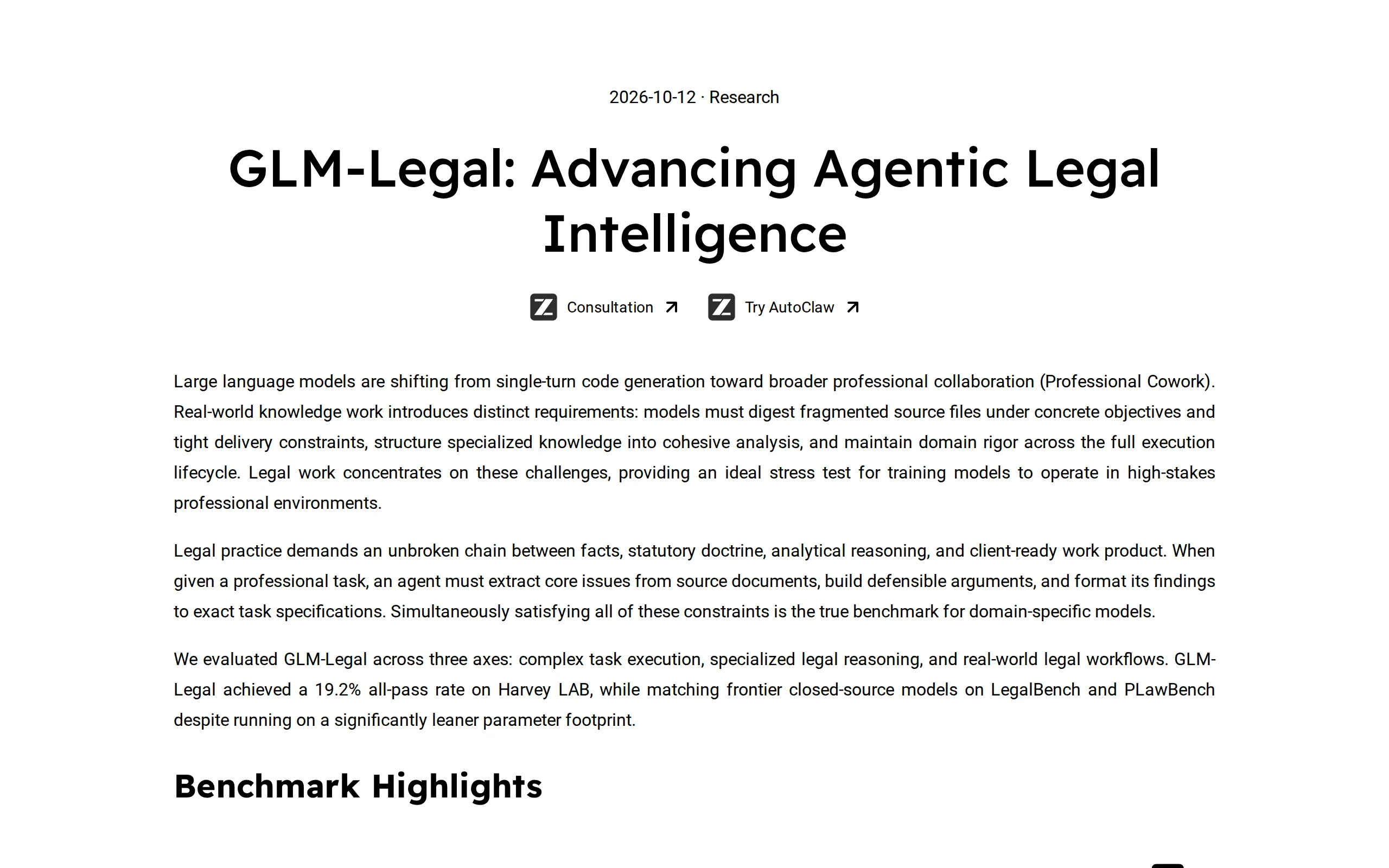
GLM-Legal is a legal-specific large model launched by Zhipu AI, built upon the lightweight base model GLM-5.3-Flash and further trained through intermediate training and reinforcement learning in the legal domain. This model covers the complete workflow from reading materials, extracting facts, analyzing legal relationships, formulating recommendations, to generating professional documents. It supports tasks such as contract review, evidence analysis, legal research, and compliance planning. In official evaluations, it achieved a full-item pass rate of 19.2% on the Harvey LAB, and its performance on LegalBench and PLawBench is on par with state-of-the-art closed-source models, showcasing strong domain adaptability despite its smaller parameter size.
Technical positioning and domain: GLM-Legal is a large language model specialized in the legal vertical within the field of natural language processing. It focuses on legal text understanding, logical reasoning, and professional document generation. Its positioning is not as a general-purpose conversational assistant, but rather as a dedicated workflow engine for lawyers, legal professionals, and legal tech companies, emphasizing end-to-end task execution capabilities and delivery quality.
Development background: This model was developed by Zhipu AI, leveraging the technical accumulation of the GLM series and its self-developed inference engine. Zhipu's layout in the legal AI domain is based on observations of industry pain points—legal texts are structurally complex, argumentation requires strict rigor, and outputs must conform to professional standards, which are difficult for general-purpose models to meet in practice.
Core value: GLM-Legal addresses the high cost of repetitive document processing and preliminary analysis in the legal industry. In traditional models, contract review and evidence analysis heavily rely on senior lawyers investing significant hours of work. This model can process materials in bulk, automatically generate annotated analysis results with citations, and ensure professional quality through a manual review phase, effectively improving the basic operational efficiency of law firms and legal teams.
Technical features: The model follows a "lightweight base + domain scaling" approach, achieving near-state-of-the-art domain capabilities with a relatively small parameter size. During the post-training phase, it integrates reinforcement learning with the Harness runtime orchestration framework for co-evolution, supported by a production feedback loop from practicing lawyers, enabling continuous optimization and iteration in the cycle of "practical needs—training—validation."
2. Key Features
Contract Review: The model can analyze potential risk points in contract clauses item by item and provide specific, actionable modification suggestions from the client's perspective. The output results are organized according to legal work standards, clearly marking risk levels and modification reasons for direct reference by lawyers during negotiations.
Evidence Analysis and Contradiction Identification: The system can batch-read dozens of case documents and automatically construct a map of contradictions between pieces of evidence, such as identifying inconsistencies between external progress reports and internal actual records. The analysis results cite specific source file numbers, strictly distinguishing factual statements from inferential conclusions, providing a traceable chain of reasoning for the formation of case theories.
Legal Research and Applicability Analysis: The model retrieves and applies relevant legal rules based on the specific facts of the case, producing analysis conclusions supported by legal references. The generated content includes citations of legal provisions and reasoning logic, which can be directly used as a preliminary draft of professional legal opinions for lawyers, significantly reducing the workload of basic legal research.
Compliance Obligations Organization: For cross-border business scenarios such as e-commerce and data transfer across borders, the system can organize compliance obligations required in each jurisdiction, outputting a prioritized implementation checklist. Each obligation is accompanied by specific legal citations, helping legal teams advance compliance rectification work in order.
Professional Document Generation: The model organizes analysis, opinions, or modification proposals according to legal document standards and strictly follows the delivery format requirements set in the task brief. The output can directly enter the review process, eliminating the need for downstream teams to perform large-scale rework and achieving an "ready-to-use upon delivery" effect.
AutoClaw Desktop Integration: After integration with the AutoClaw desktop Agent platform, the model can directly present contract modification content in revision mode and as comments within Word documents. Lawyers can intuitively view each change and its rationale, seamlessly incorporating it into their existing document workflow.
3. How to Use
Submit a Beta Application: Visit the official Zhipu Beta application page at https://z.ai/consultation/legal and fill in the relevant information to submit an application for GLM-Legal's Beta testing. This model is currently in a targeted invitation phase and requires approval before API access is granted. There is no publicly available self-registration portal yet.
Review and Access Authorization: Zhipu will review the application, and upon approval, issue an API key to the developer. Applicants must confirm their organization or team's legal business background. The review cycle will be determined by official notifications. If the application is not approved, applicants can consult official channels to learn the specific reasons.
Choose a Usage Method: After obtaining API access, developers can call the GLM-Legal interface and integrate it into their own legal workflow systems. Regular legal professionals can download the AutoClaw desktop application (available on the z.ai official website) and interact with it through a graphical interface, without needing to write any code.
Set Tasks and Provide Materials: Provide the model with a clear task brief, specifying the review or analysis objectives, and upload relevant source materials such as contract texts and evidence files. Also, clearly define the delivery format requirements (e.g., whether Word revision mode is needed, report structure, etc.).
Receive Results and Manual Review: The model will automatically complete the entire process, including reading the materials, extracting facts, conducting legal analysis, generating reasoning suggestions, and producing documents. The generated results must be reviewed by a practicing attorney to ensure the accuracy of the arguments and compliance with formatting standards before being delivered to clients or used in negotiation scenarios.
4. Pros and Cons Analysis
| Pros |
|---|
| End-to-end task execution capability: Covers the complete workflow from reading materials, extracting facts, analyzing legal relationships, formulating recommendations, and generating documents, with smooth integration across stages and reduced efficiency loss from manual interventions. |
| Solid evaluation performance: Harvey LAB achieved a 19.2% pass rate across all tests, an improvement of 12.5 percentage points over the base model. It performs on par with leading closed-source legal models on LegalBench and PLawBench, with the latter offering valuable validation of the model's capabilities in Chinese legal practice. |
| Cost advantage from lightweight base model: Built upon GLM-5.3-Flash, the model has significantly fewer parameters than comparable closed-source legal models, offering higher inference efficiency. Its deployment cost and per-call expenses are competitive, making it suitable for medium-sized law firms and early-stage legal tech companies. |
| Evidence-level rigor design: Analysis results cite source document numbers, distinguish between facts and inferences, and allow for traceable verification of reasoning chains, meeting the accountability requirements of the legal profession and reducing the risk of uninterpretable AI outputs. |
| Production feedback loop mechanism: Practicing lawyers review actual outputs based on the criteria of "complete coverage of issues, evidence-based reasoning, format compliance, and zero rework," converting subjective quality assessments into engineering loss signals that are fed back into model training and Harness design, creating a continuous optimization cycle. |
5. Comparative Analysis with Similar Tools
| Comparison Dimension | GLM-Legal | Harvey | Thomson Reuters CoCounsel |
|---|---|---|---|
| Core Architecture | Self-developed lightweight base model GLM-5.3-Flash + domain post-training, equipped with the Harness runtime orchestration framework | Built on third-party state-of-the-art large models such as GPT to create a legal Agent suite | Based on general-purpose large models like GPT-4, paired with a legal retrieval-enhanced module |
| Evaluation Performance | 19.2% overall pass rate on Harvey LAB (12.5pp higher than the base model), performance on LegalBench/PLawBench matches leading closed-source models, independently assessed by Vals | The test creator of Harvey LAB, specific scores of its own product on this benchmark are not publicly disclosed | Public performance on benchmarks such as the MBE bar exam, but limited LegalBench-specific data |
| Core Capabilities | Contract review, evidence analysis, legal research, compliance planning, and professional document generation, covering the full workflow | End-to-end legal workflow (research, drafting, review), covering large law firm scenarios | Legal research, document review, timeline analysis, memory search, and contract analysis |
| Delivery Form | API + AutoClaw desktop Agent, capable of outputting revision mode and annotations directly in Word | Independent SaaS platform, deeply integrated with Microsoft Word and law firm management systems | Cloud SaaS platform, integrated with the Westlaw legal database |
| Language and Market | Balanced Chinese and English capabilities, verified legal practical skills in China through PLawBench | Primarily targets the English common law market, with ongoing expansion into Europe | Primarily English market, covering U.S. federal and state legal systems |
| Deployment and Cost | Lightweight base model with high inference efficiency, competitive API calling costs, supports desktop deployment | Customized solutions for large law firms, high subscription fees, long implementation cycle | Medium to high subscription fees, billed per seat |
| Open Source License and Ecosystem | Model is not open source, provides API access and desktop applications, ecosystem is in Beta expansion phase | Closed-source commercial product, ecosystem primarily composed of law firm partners | Closed-source commercial product, ecosystem relies on Thomson Reuters legal resources |
Selection Recommendations: For Chinese law firms, corporate legal departments, and legal tech companies targeting Chinese legal scenarios, GLM-Legal demonstrates strong competitiveness in industry evaluation data, bilingual capabilities, and cost structure. If the core business involves contract review and evidence analysis, and API integration flexibility is important, GLM-Legal is a key candidate to evaluate during the Beta phase. For large law firms with cross-border English common law business needs, Harvey and CoCounsel still hold advantages in maturity and local ecosystem, though their subscription costs are high, making them suitable for well-funded institutions with high levels of business standardization. For small and medium-sized teams focusing on Chinese contract review, domestic products like MeBox offer more mature localized solutions and can serve as supplementary comparative options.
6. Editor's Summary
The release of GLM-Legal demonstrates a clear industry focus: achieving domain-specific capabilities of cutting-edge models with a lightweight base. Its 19.2% full-item pass rate in the Harvey LAB evaluation, an improvement of 12.5 percentage points over the base model, validates the effectiveness of the "mid-training + post-training reinforcement" approach. The legal domain requires not only knowledge retention but also the ability to organize multi-step reasoning chains, from fact extraction to argument generation. This result is significant for the industry, indicating that parameter scale is not the sole determinant of vertical domain capabilities, and targeted training strategies and data quality are equally crucial.
In terms of practical value, GLM-Legal addresses two core needs in the legal sector: delivering ready-to-use results and ensuring evidential rigor. By citing source numbers, distinguishing between facts and inferences, and generating document formats that align with legal professionals' review habits, the model is designed with accountability and traceability in mind. The integration of AutoClaw into the desktop environment further reduces the barrier to entry, allowing practicing lawyers unfamiliar with APIs to directly experience AI-assisted review workflows.
In terms of target users, GLM-Legal's intended audience is clear: junior lawyers and assistants in law firms, basic operational tasks within corporate legal teams, and legal SaaS vendors seeking to quickly acquire AI capabilities without building their own models. The cost advantages brought by its lightweight base make it particularly appealing to small teams.
In terms of growth potential, the Harness collaborative evolution mechanism and the production feedback loop of GLM-Legal are worth noting. Reinforcement learning in tens of thousands of real legal task environments, combined with feedback signals from practicing lawyers, creates an iterative quality improvement pathway. In the future, if evaluation datasets become more publicly available and the AutoClaw ecosystem continues to mature, GLM-Legal's position in the Chinese legal AI market will become even more solid. The current limitations in the Beta phase mean that some capabilities still require time to be fully validated, but its technical approach represents a pragmatic development direction for vertical domain models.
7. Application Scenarios
Contract Review and Negotiation Support: Lawyers can submit documents such as software service contracts and procurement agreements to GLM-Legal for analysis. The model identifies risky clauses from the client's perspective and provides specific modification suggestions, directly displaying them in Word in revision mode. Before negotiations, lawyers can quickly obtain a clearly annotated risk report for clauses, shortening the review cycle and improving negotiation efficiency.
Litigation Evidence Analysis and Case Preparation: Litigation teams can upload dozens of case documents in bulk, and GLM-Legal constructs an evidence contradiction map. For example, it can identify discrepancies between external progress reports and internal actual records, and assist in forming case theories through source numbering. Contradictions among pieces of evidence and key facts become immediately apparent, providing a reference for courtroom strategy.
Cross-border Compliance Planning: For companies planning to launch products in markets such as Singapore, Malaysia, and Indonesia, legal teams use GLM-Legal to organize privacy and data compliance obligations across different regions. They receive a prioritized implementation checklist, with each obligation accompanied by specific legal references, enabling compliance rectification efforts to proceed in order.
Legal Research and Legal Opinion Drafting: Lawyers can provide the model with case facts and research questions, and GLM-Legal will search for and apply relevant legal rules, generating a preliminary draft of a legal analysis opinion or memo that is well-supported by evidence and formatted properly. Lawyers can then add their personal judgment and practical experience to the draft, significantly reducing the basic workload.
Legal Tech Product Capability Foundation: Legal SaaS vendors can integrate GLM-Legal's contract review and document generation capabilities into their own product ecosystems via API calls. Without the need to build their own models or training teams, they can offer clients intelligent features with legal expertise, accelerating product iteration speed.
8. FAQ
Q: Is GLM-Legal currently available for public use?
A: GLM-Legal is currently in a Beta phase with定向 invitations for testing. Users must submit an access request via the official Zhipu application page (https://z.ai/consultation/legal) to obtain API permissions after approval. There is no public self-registration portal available yet, and the application results will be subject to official notifications.
Q: What is the core difference between GLM-Legal and general-purpose large models in legal scenarios?
A: GLM-Legal has undergone intermediate training and reinforcement learning in the legal domain, establishing a systematic knowledge foundation for legal concepts, regulations, and interpretive frameworks. It also comes equipped with the Harness runtime orchestration framework to manage task context and tool calling, enabling it to complete the entire workflow—from reading materials to generating professional documents—in an end-to-end manner. The output format adheres to legal industry delivery standards, and the sources of references are traceable, which is difficult for general-purpose conversational models to achieve.
Q: How should we interpret GLM-Legal's evaluation results? What does a 19.2% full-task pass rate on Harvey LAB signify?
A: Harvey LAB is a multi-step task benchmark that covers the full legal workflow. A 19.2% full-task pass rate indicates that the model can independently complete all steps in nearly 20% of tasks without human intervention. This represents a 12.5 percentage point improvement over the base model. GLM-Legal performs on par with leading closed-source models on LegalBench and PLawBench, with PLawBench specifically validating capabilities in Chinese legal practice. This performance was independently assessed by Vals.
Q: Can the model's output be used directly for client delivery or submission to court?
A: It is not recommended for direct use. Although GLM-Legal's output follows professional document formats and includes traceable references, the official process explicitly requires a practicing lawyer to manually review the output, confirming the accuracy of the arguments and compliance with formatting standards before delivering it to clients or using it in negotiations. GLM-Legal is designed as an auxiliary tool to enhance lawyer efficiency, not to replace professional legal judgment.
Q: What languages does GLM-Legal support? Can it handle cross-border legal matters?
A: GLM-Legal has balanced bilingual capabilities in Chinese and English. PLawBench validates its ability in Chinese legal practice, and official scenario examples include cross-border compliance planning (e.g., Singapore, Malaysia, Indonesia, etc.). However, its coverage for in-depth case analysis under the common law system is relatively limited in public evaluations and case data. It is recommended to test it in specific scenarios first.
Q: What is AutoClaw? How can users view changes in Word using it?
A: AutoClaw is a desktop Agent platform launched by Zhipu. After integrating GLM-Legal, users can view contract modifications directly in Word using revision mode and comments. Users can download the AutoClaw desktop application from the z.ai website, import the task brief and contract documents, and the model will analyze them, generating traceable annotations within the document.
9. Project Links
- Product Official Website/Blog: https://z.ai/blog/glm-legal
- Beta Application Entry: https://z.ai/consultation/legal
Related AI Model Articles
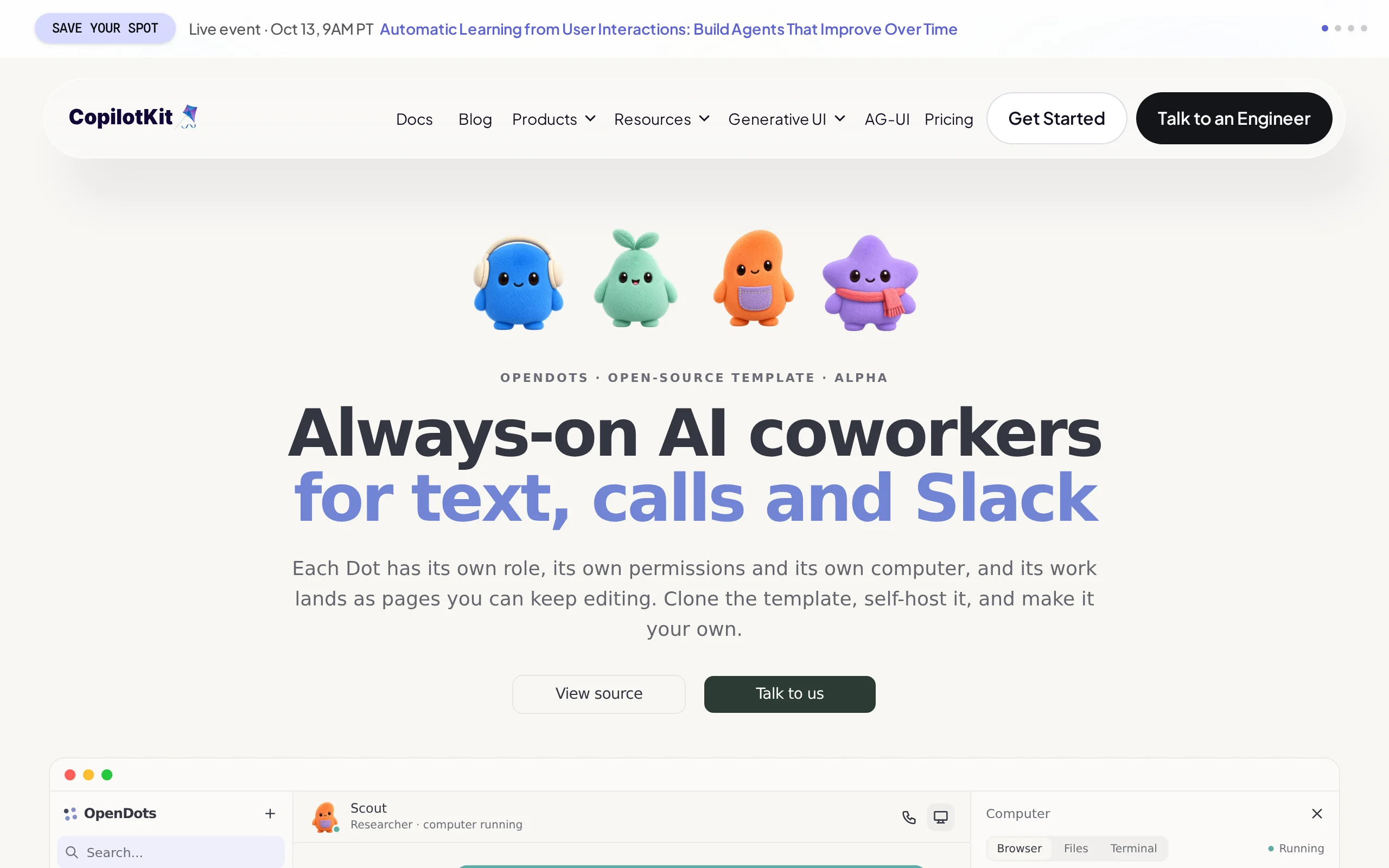
In-Depth Review of OpenDots: Can the Open-Source AI Colleague Workspace from CopilotKit Replace OpenAI Dots?
OpenDots is an open-source AI colleague workspace template launched by CopilotKit, supporting fully self-hosted deployment by users. This tool allows users to create AI employees (referred to as Dots)...
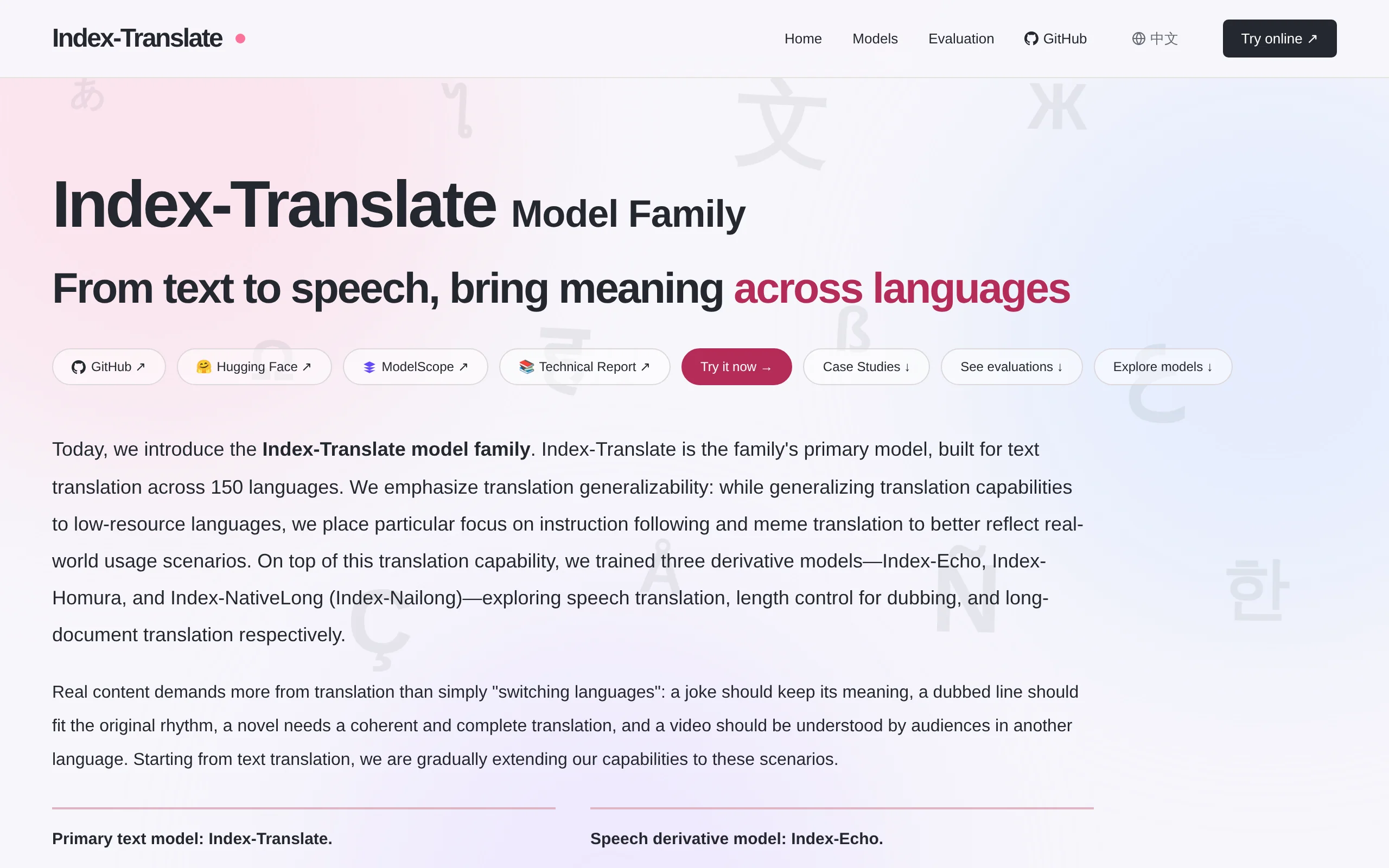
Index-Translate – Bilibili's Open-Source Multilingual Translation Model Family
Index-Translate is an open-source multilingual translation model family developed by Bilibili's Index LLM team. It is built upon the Qwen3.5 foundation and opens its weights under the Apache-2.0 licen...

Claude Sonnet 5.5 – Anthropic's Latest AI Model
Claude Sonnet 5.5 is the second model in Anthropic's Claude 5.5 series, released just six days after the flagship Claude Opus 5.5. It is a comprehensive upgrade from Claude Sonnet 5. This model is pos...

Kimu: In-Depth Review of the Open-Source AI Video Editor from the trykimu Team
Kimu (officially named Kimu Studio) is an open-source AI video editor developed by the trykimu team. Its core concept lies in describing requirements through natural language, allowing AI to automatic...
© All Rights Reserved. Some content on this site is partially generated by AI with human review.