
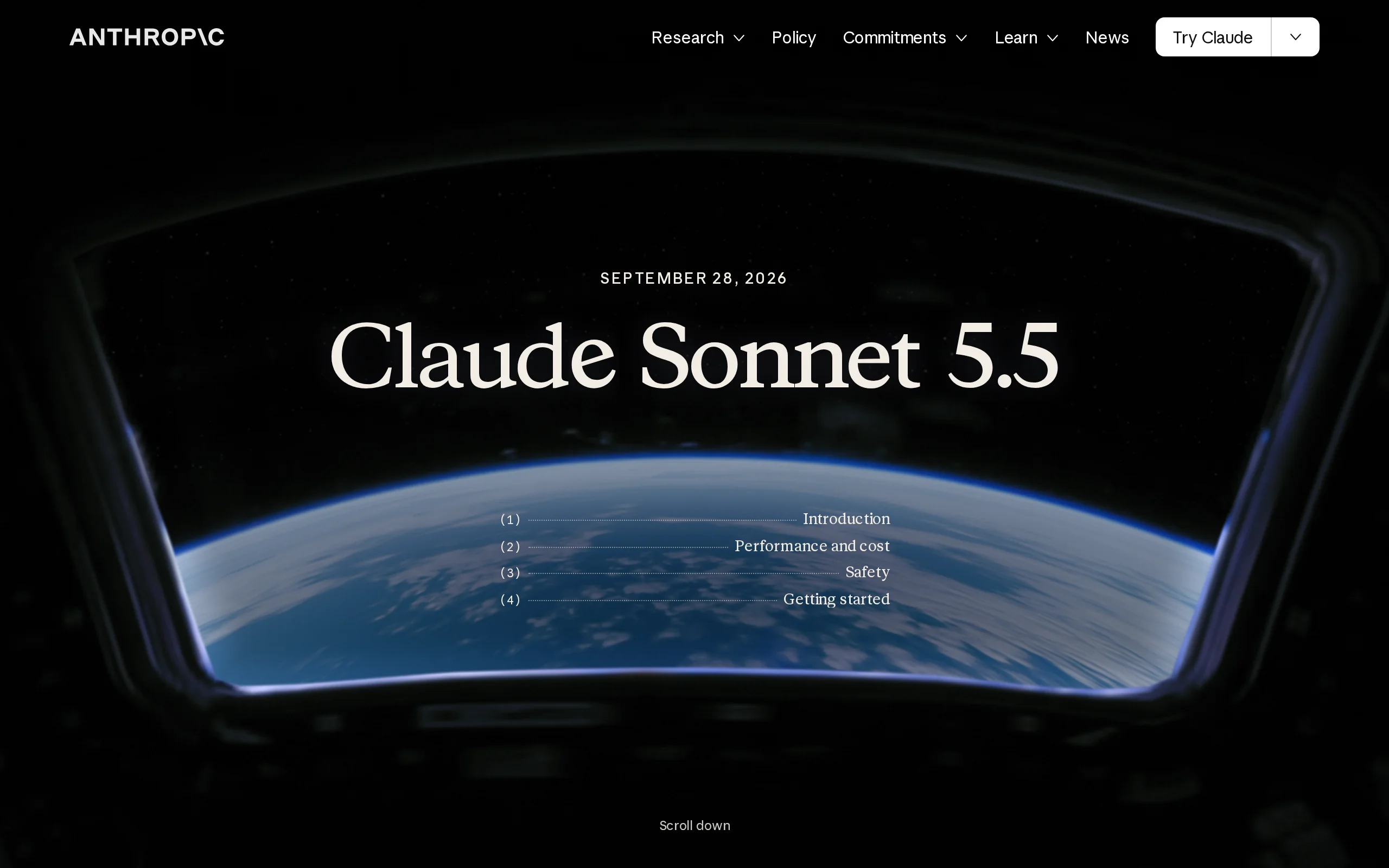
Claude Sonnet 5.5 – Anthropic's Latest AI Model
Executive Summary:
Claude Sonnet 5.5 is the second model in Anthropic's Claude 5.5 series, released just six days after the flagship Claude Opus 5.5. It is a comprehensive upgrade from Claude Sonnet 5. This model is pos...
1. What is Claude Sonnet 5.5
Claude Sonnet 5.5 is the second model in Anthropic's Claude 5.5 series, released just six days after the flagship Claude Opus 5.5. It is a comprehensive upgrade from Claude Sonnet 5. This model is positioned as a complementary and cost-effective alternative to the flagship Opus 5.5, focusing on handling well-defined daily tasks. It achieved a score of 70.6% on Terminal-Bench 4.0, with most benchmarks approaching the performance of the flagship model. It excels in everyday programming, bug fixing, and knowledge-based tasks such as document processing, PowerPoint creation, and table manipulation, while providing near-flagship capabilities at a significantly lower cost.
Technical Positioning and Domain: Belongs to the large language model (LLM) domain, it is the "medium-sized" model in the Anthropic Claude series, emphasizing the optimal balance between quality and cost. It is targeted at scenarios such as software development, enterprise knowledge work, and customer service automation. Through an adjustable thinking intensity (Effort) mechanism, it covers a wide range of needs—from high-frequency lightweight tasks to complex long-chain decision-making—on the same model, filling the performance gap between the flagship model and entry-level models.
Development Background: Developed by Anthropic, as a key member of the Claude 5.5 series, this model inherits multiple technical achievements from Opus 5.5 and is specifically optimized in terms of cost efficiency, tool calling, and security protection. Its rapid release schedule, just six days after Opus 5.5, reflects Anthropic's strategy of fast iteration and layered market coverage.
Core Value: Addresses the industry pain point of "flagship model overkill and high cost." Sonnet 5.5 achieves most benchmark performances close to the flagship model at half the per-unit cost, with single-task costs reduced to as low as one-tenth of the previous generation. This cost-performance advantage enables enterprises to embed high-quality AI capabilities into high-frequency scenarios such as daily development, document processing, and customer service automation, while keeping budgets under control, significantly lowering the marginal cost of AI implementation.
Technical Features: It employs a multi-level thinking intensity (Effort) adjustment mechanism, supporting five levels of inference depth control from Low to Max; introduces parallel tool calling and batch processing architecture, reducing tool calling by about one-third and shell execution counts by nearly half; and includes built-in network security safeguards, automatically reverting high-risk tasks to Sonnet 5 for processing, thereby isolating abuse risks while maintaining development capabilities.
2. Key Features
High-performance programming capabilities: Achieves a score of 70.6% on the Terminal-Bench 4.0 benchmark, surpassing the flagship Opus 5.5's 66.4%. It supports multi-step professional command-line tasks, can handle coding tasks with clear boundaries, and allows code modifications to be directly merged. It requires fewer steps, has a lower error rate, and is suitable as a primary model in programming tools such as Claude Code and Cursor.
Daily knowledge work processing: Skilled in handling well-defined knowledge-based tasks such as document writing, PowerPoint creation, and table processing, with output quality approaching that of Opus. The model possesses design aesthetics, capable of generating nearly ready-to-use business review templates according to specified formats, significantly reducing the repetitive workload for knowledge workers.
Understanding of large codebases: Can quickly comprehend complex codebases with tens of thousands of lines of code and stably process large-scale project code, such as game architectures. This capability makes Sonnet 5.5 suitable for code analysis tasks requiring a global perspective, such as system architecture design audits and data flow reviews.
High cost-effectiveness in operation: The price per unit is on par with Sonnet 5, with input at $2/M token and output at $10/M token. It can outperform the best results of the previous generation model even at low/medium thinking levels, with a single task cost approximately one-tenth of the previous version. Combined with the official optimization announcement that "most task costs will decrease by up to 30%", this creates an efficiency curve where more tasks can be completed under the same budget.
Enterprise-level intelligent agent applications: Can be embedded in enterprise scenarios such as Rovo Agent, Slackbot, and customer service systems. Real-world testing shows a 20% increase in ticket processing speed, effectively reducing decision-making errors. It has the lowest tool calling failure rate among similar models and maintains stable responses for long-running tasks, making it suitable for large-scale deployment in production environments.
Visual and gaming comprehension: Multimodal capabilities have significantly improved, making it the first Sonnet model to complete通关《Pokémon Red》 solely based on screenshots. This breakthrough indicates the model has strong comprehensive capabilities in visual information understanding, game state judgment, and long-sequence decision-making.
Secure network protection: The first Sonnet model to be equipped with network security guardrails. It includes an in-built network security judgment layer that automatically routes requests back to Sonnet 5 when high-risk network security tasks are detected, effectively isolating abuse risks while maintaining daily development capabilities.
3. How to Use
Select an Entry Point: Users can directly experience it on the Claude official website or within the app, or they can invoke it through Claude Code or Claude Platform. The API has been simultaneously launched on the three major cloud platforms: AWS, Google Cloud, and Microsoft Azure. Developers can choose the connection method based on their own infrastructure.
Switch Models: In the chat interface or model selector, switch the model from Sonnet 5 to Sonnet 5.5. When calling via API, the model name is
claude-sonnet-5-5, and developers must specify this model identifier in the request parameters.Set Thinking Level: Choose from five levels of thinking intensity—Low, Medium, High, Xhigh, and Max—based on the complexity of the task. For daily tasks, the default Medium level provides a good balance between cost and quality. For complex reviews and long-chain decision-making, it is recommended to use High or higher levels. For high-frequency, lightweight tasks, using the Low level can further reduce costs and improve response speed.
Integration into Programming Environments: Directly invoke Sonnet 5.5 in programming tools such as Claude Code or Cursor. The model automatically processes tool calls in parallel batches, reducing serial waiting time. In practical tests, tool calls were reduced by approximately one-third, and the number of shell executions was cut nearly in half, significantly improving coding efficiency.
API Calls: Developers call the interface using
claude-sonnet-5-5, with pricing at $2 per million input tokens, $10 per million output tokens, and $0.2 per million tokens for cache reads. It supports a zero-data retention option, meeting enterprise compliance requirements for data privacy. It is recommended to enable the sub-Agent task splitting feature when using high thinking levels, allowing review tasks to be processed in parallel to improve efficiency.
4. Pros and Cons Analysis
| Pros |
|---|
| Performance Close to Flagship Models: Terminal-Bench 4.0 achieves 70.6%, surpassing Opus 5.5's 66.4%, and approaches flagship-level performance on most benchmarks. The "medium-tier" model now rivals the "large-tier" in capabilities, breaking the previous trend where mid-range models significantly lagged behind. |
| Exceptional Cost-Effectiveness: Its unit price is only half that of Opus 5.5, and the cost per task can be reduced to as low as one-tenth of the previous generation. Combined with a token optimization that can further reduce costs by up to 30% for most tasks, it allows users to accomplish more tasks within the same budget. |
| Improved Speed and Efficiency: It is over 30% faster than Sonnet 5, consuming fewer tokens to complete the same tasks. The parallel tool calling architecture reduces tool calls by about one-third and cuts the number of shell executions by nearly half, resulting in fewer steps and less likelihood of getting stuck. |
| Enterprise-Grade Stability: It has the lowest tool calling failure rate among similar models and maintains fast and stable responses even during long-running tasks, making it suitable for large-scale deployment in production environments. It is already integrated into enterprise-level scenarios such as Rovo Agent, Slackbot, and customer service systems. |
5. Comparative Analysis with Similar Tools
| Comparison Dimension | Claude Sonnet 5.5 | GPT-6 Sol |
|---|---|---|
| Product Positioning | The "medium-sized" model in the Claude 5.5 series, focusing on quality-to-cost ratio, handling routine tasks that are scaled down from flagship models | The "mid-to-high-end" layer of GPT-6 Astra capabilities, emphasizing the lowest "unit intelligence cost" |
| API Pricing | Input $2/M, Output $10/M, Cache Read $0.2 | Input $2/M, Output $10/M (50% reduction from previous generation), 90% discount on cache reads |
| Programming Integration (FrontierCode) | High tier performance is comparable to GPT-6 Sol, with cost about 1/5 of that model | Achieves performance on par with Claude Fable 5.1 xhigh tier at a significantly lower cost |
| Computer Operation (OSWorld) | 80.1% (OSWorld 2.1) | 60.5% (OSWorld 2.0; different versions make direct comparison invalid) |
| Reasoning Intensity Adjustment | Multiple Effort tiers (Low–Max), low tier can exceed the best performance of the previous generation, with cost about 1/10 | Multiple tiers (low–xhigh), cache can be controlled with mid-tier switching |
| Cache Mechanism | Standard cache pricing | Explicit breakpoint control for cache prefix + 90% read discount, offering more obvious cost advantages for long tasks |
| Usage Entry Points | Claude App / Claude Code / API (claude-sonnet-5-5) / AWS, GCP, Azure | ChatGPT Work (Plus/Pro/Business/Edu) / Codex / API (gpt-6-sol) |
| Security Mechanism | First Sonnet model with built-in network security guardrails, automatically falling back to Sonnet 5 for high-risk tasks | Inheriting Astra alignment technology, with metrics such as code deception and bypassing reviews superior to the GPT-5.6 series |
Selection Recommendations: For teams with limited budgets but requiring high-quality AI capabilities, Claude Sonnet 5.5 is currently a standout choice in terms of cost-effectiveness. Its performance in programming integration and routine knowledge work is close to that of the flagship model, while its cost is only half that of Opus 5.5, making it especially suitable for development teams and knowledge workers with high-frequency API calls and clearly defined task boundaries. If tasks primarily involve long context, complex multi-step reasoning, and require high cache efficiency, GPT-6 Sol's explicit breakpoint cache control and 90% read discount provide greater cost advantages in long-running task scenarios.
Flagship Scenario Selection: For scenarios requiring the handling of the most complex reasoning, long-chain decision-making, or with extremely high output quality requirements, Claude Opus 5.5 remains the more appropriate choice. Its top-tier reasoning capabilities and comprehensive security mechanisms are irreplaceable in critical tasks, though teams must accept the higher per-task cost. Teams can establish a "tiered calling" strategy based on task type: use Sonnet 5.5 for daily tasks and upgrade to Opus 5.5 for complex tasks, thereby achieving optimal overall cost coverage of capabilities.
6. Editor's Summary
The release of Claude Sonnet 5.5 marks a significant step forward for Anthropic in its model tiering strategy. From a technological innovation perspective, this model achieves broad coverage—from high-frequency lightweight tasks to complex, long-chain decision-making—through a multi-level thinking intensity (Effort) adjustment mechanism on a single model. This design effectively reduces the friction cost for users switching between multiple models. The introduction of parallel tool calling and batch processing architecture has reduced tool calls by approximately one-third and decreased shell execution counts by nearly half, directly improving execution efficiency and stability in agent-based scenarios. The optimization path of "actual cost reduction"—achieved by minimizing the number of tokens required to complete a task rather than simply lowering prices—represents a new direction for LLM cost optimization.
In terms of practical value, Sonnet 5.5 achieves most flagship benchmark performances at half the per-token cost of Opus 5.5, with the cost per task potentially reduced to as low as one-tenth of the previous generation. This cost-performance advantage offers real appeal to small and medium-sized teams and enterprises. Its tested performance in scenarios such as code merging, daily knowledge work, and customer service automation already demonstrates readiness for production deployment. Features such as the lowest tool calling failure rate and stable long-duration task responses make it a viable foundation for enterprise-level agent applications.
In terms of target users, Sonnet 5.5 is suitable for developers requiring frequent AI capability calls, knowledge workers, and enterprise teams looking to deploy AI agents within a controlled budget. For complex reasoning scenarios where peak performance is essential, Opus 5.5 remains the more appropriate choice.
Looking ahead, the "quality-to-cost ratio" optimization path demonstrated by Sonnet 5.5 may become a crucial competitive dimension in the LLM industry. Its enhanced capabilities in safety guardrails and visual understanding also indicate that the functional boundaries of mid-tier models are continuously expanding. With the full launch of its API on cloud platforms such as AWS, GCP, and Azure, Sonnet 5.5 is expected to gain widespread adoption in the enterprise market, further driving AI capabilities into more everyday scenarios.
7. Application Scenarios
Daily Programming and Bug Fixing: When handling well-defined coding tasks in tools like Claude Code and Cursor, the model can quickly identify issues and generate fix code, with changes directly mergeable into the codebase. Its parallel tool calling mechanism makes multi-step operations more efficient, with fewer steps and lower cost, making it ideal for high-frequency development workflows.
Large Codebase Auditing: Leveraging its strong codebase understanding capabilities, it can quickly parse tens of thousands of lines of code, performing system architecture design audits, data flow reviews, and dependency analysis. Its ability to stably process large project code over extended periods makes it an effective tool for architects and technical leads to ensure code quality.
Enterprise Knowledge Work: Generate and iterate through documents, slides, and tables in bulk. The model possesses design aesthetics and can output nearly ready-to-use business review materials according to templates. Knowledge workers can delegate repetitive content creation tasks to Sonnet 5.5, allowing them to focus on creative decision-making.
Customer Service and Business Process Automation: Integrated into enterprise systems such as Zendesk, Slack, and Atlassian Rovo, it enables automatic ticket classification, response generation, and workflow transitions. Real-world testing has shown a 20% increase in ticket processing speed, effectively reducing erroneous decisions. Additionally, built-in cybersecurity safeguards ensure safe isolation for high-risk tasks.
8. FAQ
Q: What are the differences between Claude Sonnet 5.5 and Claude Sonnet 5?
A: Sonnet 5.5 is a comprehensive upgrade over Sonnet 5, achieving a score of 70.6% on the Terminal-Bench 4.0 benchmark (Sonnet 5's performance on the same benchmark is not disclosed), with a speed increase of over 30%. It introduces a multi-level thinking intensity (Effort) adjustment mechanism, a parallel tool calling architecture, and a network security guardrail. The cost for single tasks can be reduced to as low as one-tenth of the previous generation, with most tasks seeing a maximum cost reduction of 30%.
Q: How should I choose the appropriate thinking level (Effort)?
A: For everyday high-frequency tasks, it is recommended to use the Low or default Medium level to save costs and ensure response speed; for complex reviews and long-chain decision-making, High or higher levels are advised. Xhigh and Max levels are suitable for the most complex reasoning tasks. Even at lower levels, Sonnet 5.5 can surpass the best performance of the previous generation model. Users can dynamically adjust based on the complexity of the task.
Q: What is the API pricing for Claude Sonnet 5.5?
A: Input pricing is $2 per million tokens, output pricing is $10 per million tokens, and cache read pricing is $0.2 per million tokens. This pricing is the same as Sonnet 5 and only half of Opus 5.5. The API model name is claude-sonnet-5-5, and it is now available on the three major cloud platforms: AWS, Google Cloud, and Microsoft Azure.
Q: How does the network security guardrail in Sonnet 5.5 work?
A: The model includes an embedded network security judgment layer. When it detects high-risk network security tasks, it automatically routes the request back to Sonnet 5 for processing. This mechanism isolates the risk of the model being used for malicious security attacks while maintaining its daily development capabilities. It is the first Sonnet model to be equipped with a network security guardrail.
Q: Can Sonnet 5.5 be used for large-scale deployment in production environments?
A: Yes. Sonnet 5.5 has the lowest tool calling failure rate among similar models and maintains fast and stable responses for long-running tasks, making it suitable for large-scale deployment in production environments. It has already been integrated into enterprise-level scenarios such as Rovo Agent, Slackbot, and customer service systems, with real-world testing showing a 20% improvement in ticket processing speed.
Q: How should I choose between Sonnet 5.5 and Opus 5.5?
A: For well-defined daily tasks, Sonnet 5.5 is a more cost-effective choice, as its performance on most benchmarks is close to the flagship model, with costs only half of Opus 5.5. For scenarios requiring handling of the most complex reasoning, long-chain decision-making, or extremely high output quality, Opus 5.5 is still the more suitable option. Teams can establish a tiered calling strategy to achieve optimal overall cost while covering all required capabilities.
9. Project Links
- Product Official Website: https://www.anthropic.com/claude-sonnet-5-5
- Product Experience Entry: https://claude.ai
- Developer Platform: https://console.anthropic.com
- Official API Documentation: https://docs.anthropic.com
Related AI Model Articles
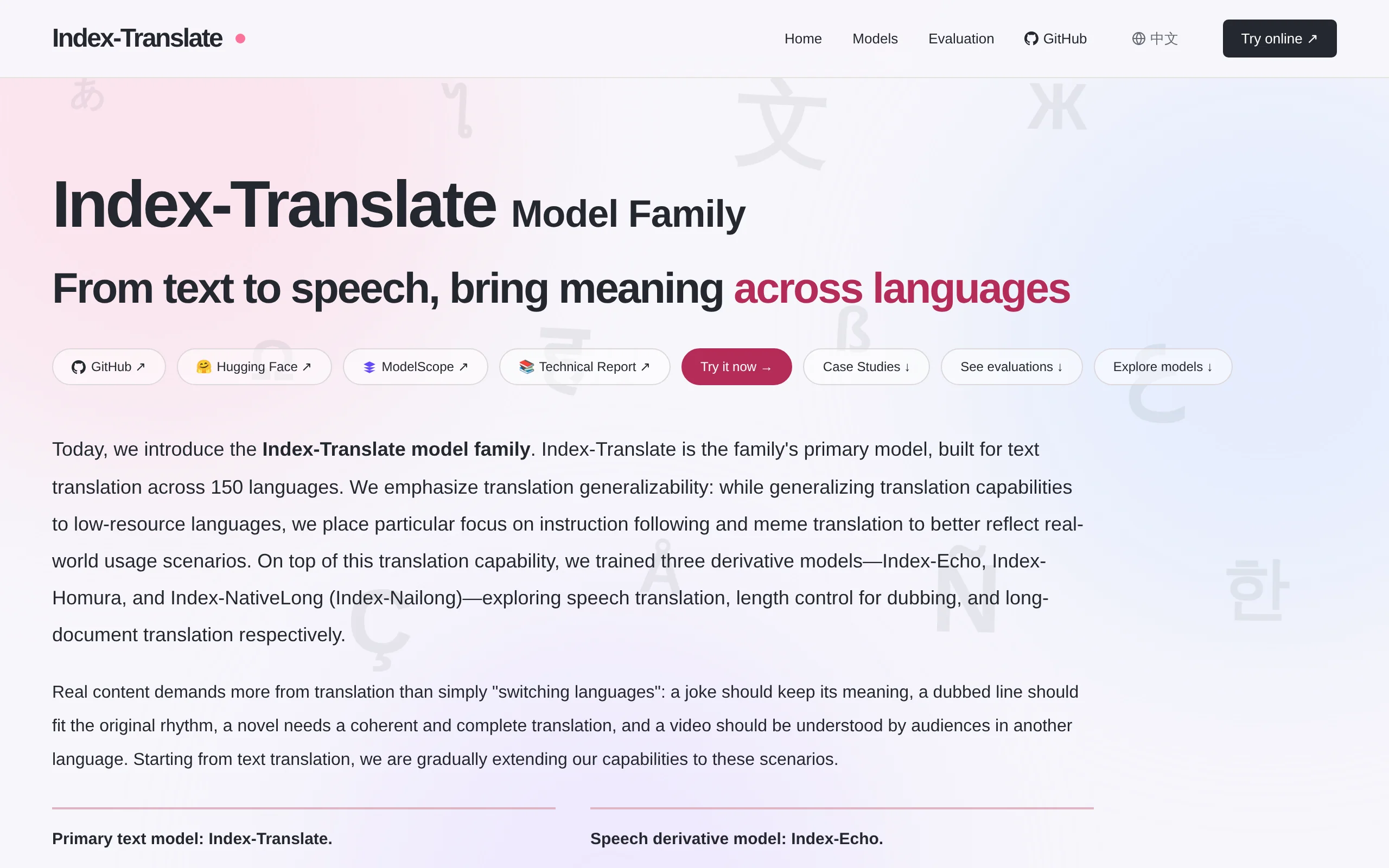
Index-Translate – Bilibili's Open-Source Multilingual Translation Model Family
Index-Translate is an open-source multilingual translation model family developed by Bilibili's Index LLM team. It is built upon the Qwen3.5 foundation and opens its weights under the Apache-2.0 licen...
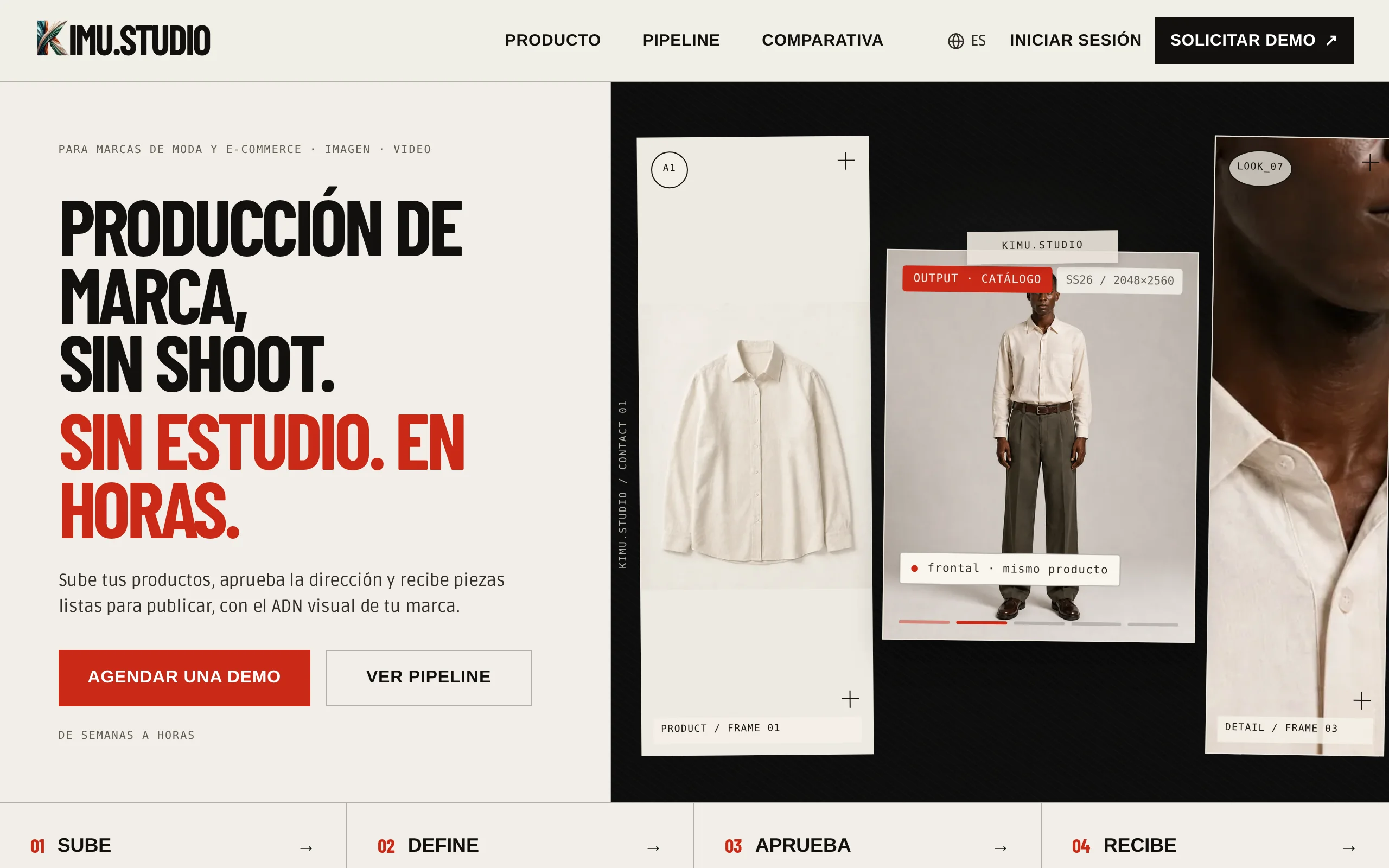
Kimu: In-Depth Review of the Open-Source AI Video Editor from the trykimu Team
Kimu (officially named Kimu Studio) is an open-source AI video editor developed by the trykimu team. Its core concept lies in describing requirements through natural language, allowing AI to automatic...

Ok Work – Baidu's AI On-the-Go Office Tool
Ok Work is Baidu's lightweight AI on-the-go office tool, running in the form of a WeChat Mini Program, targeting students and new professionals, and focusing on fragmented office scenarios. The produc...
In-Depth Evaluation of TeleOCR – The Open-Sourced Document Parsing Model by China Telecom's XingChen Lab
TeleOCR is an open-sourced document parsing model developed by China Telecom's XingChen Lab. It employs a lightweight vision-language architecture with approximately 1.2B parameters, unifying the proc...
© All Rights Reserved. Some content on this site is partially generated by AI with human review.