
Hy MT3 – Tencent HunYuan's Third-Generation Open-Source Translation Model
Executive Summary:
Hy MT3 is the third-generation open-source translation model developed by the Tencent HunYuan team, representing a full iteration of both architecture and capabilities over its predecessor, MT2. This ...
1. What is Hy MT3
Hy MT3 is the third-generation open-source translation model developed by the Tencent HunYuan team, representing a full iteration of both architecture and capabilities over its predecessor, MT2. This model supports mutual translation among 102 languages and offers three parameter scale versions: 1.8B, 7B, and 30B-A3B. The 30B-A3B version employs a MoE sparse activation architecture, with a total of 30B parameters but only activating 3B parameters during each inference, achieving near-top-tier closed-source model translation performance with minimal computational resources. The model has been specifically optimized for game localization and image translation scenarios, and comes with an open-source automatic evaluation framework called TransRubric and a translation toolchain for the game Honor of Kings. In internal Tencent evaluations, the number of mistranslated samples in Hy MT3 decreased by 43% compared to the previous generation, the ratio of omissions and additions dropped by 74%, and instruction-following errors were reduced by 40%, placing it among the top open-source translation models in overall performance.
Technical Positioning and Domains: Hy MT3 belongs to the machine translation models in the natural language processing domain, covering multiple application directions such as general text translation, game localization, image translation, and on-device offline translation. Its core positioning is to establish a quality benchmark among open-source translation models, while also supporting deployment in both cloud and on-device scenarios, including PCs and mobile phones, achieving a balance between translation quality, computational efficiency, and deployment flexibility.
Development Background: This model was developed by the Tencent HunYuan team, building upon the technical roadmap and user feedback accumulated after the open-source release of Hy MT2. The development team defined four core issues based on error samples collected from real-world scenarios: mistranslation, omissions/additions, instruction-following, and terminology consistency. They then conducted targeted training optimization based on these issues. Collaboration with the Honor of Kings team further enriched the model with specialized game data and evaluation systems, significantly improving key indicators for game localization such as rich text processing, OCR noise handling, and terminology consistency.
Core Value: Hy MT3 addresses long-standing shortcomings in open-source translation models regarding long-text quality, instruction-following, and scenario adaptability. By leveraging the MoE sparse activation architecture, it achieves performance comparable to ultra-large closed-source models with a computational cost equivalent to only activating 3B parameters. Through scenario-specific data training, its game localization capabilities surpass those of Gemini 3.1 Pro. With the 1.8B and 7B smaller versions, offline translation becomes feasible on mobile phones and PCs. These breakthroughs bring high-quality translation capabilities from the cloud to on-device environments and from general-purpose to industry-specific applications.
2. Key Features
Multilingual General Translation: Supports mutual translation among 102 languages, covering major languages and minority languages. Compared to the previous generation, which supported only 38 languages, this version has nearly tripled the language coverage, enabling the model to serve a broader range of cross-language communication scenarios, including learning, office work, and cross-border business needs.
High-Quality Translation Output: The proportion of mistranslated samples has decreased by 43% compared to the previous generation, while instances of omissions and additions have dropped by 74%. The translation quality has significantly improved in terms of both accuracy and completeness. Through targeted training driven by real-world errors, the model's understanding of error-prone contexts has been enhanced, and its handling of long sentences and complex structures is now more stable.
Instruction-Following Translation: Supports user control of output format via natural language instructions, including outputting only the translation, preserving original line breaks, retaining proper nouns, and preserving HTML tags. This feature enables Hy MT3 to adapt to scenarios with strict formatting requirements, such as web translation, document translation, and code comment translation.
Game Localization: Strictly preserves placeholders and rich text tags, ensuring consistency in terminology translation, and can be directly integrated into the game development workflow. Trained on data from the game Honor of Kings, the model demonstrates high industry adaptability in translating in-game dialogues, task descriptions, and item names. Its localization quality has surpassed that of Gemini 3.1 Pro in evaluations.
On-Device Offline Deployment: Provides lightweight versions with 1.8B and 7B parameter sizes, supporting local execution on PCs and mobile phones, with data remaining on the device. The browser plugin has been jointly developed with AMD, leveraging FastFlowLM on the XDNA2 NPU to accelerate local translation. It automatically adapts to NPU/GPU/CPU computing power, balancing privacy protection with usability in offline scenarios.
3. Application Scenarios
Daily General Translation: Supports text translation across 102 languages, suitable for learning, office work, and cross-border communication scenarios. Users can directly input text into the Tencent Hy Translation App or Mini Program to obtain translation results, or use browser extensions for immersive translation of web pages and documents without switching applications.
Game Localization Publishing: Game developers can integrate the open-source toolchain TiMiHOKGameTranslator, embedding Hy MT3 into their development process for localization. The model strictly preserves placeholders and rich text tags, ensures consistent terminology translation, and reduces the workload of manual proofreading, making it ideal for creating multilingual versions during game internationalization and publishing.
Image Text Translation: Combines OCR error correction mechanisms to translate text within images such as screenshots, posters, and menus. The model uses contextual information to correct recognition errors and improve translation accuracy, meeting the needs for unstructured text translation in scenarios like travel, shopping, and document organization.
On-device Offline Translation: Runs a compact model locally on mobile phones or PCs, enabling translation without internet connectivity and keeping data within the device. This meets the needs of privacy-sensitive scenarios and environments with no network access. Browser extensions support one-click installation of the local model, and once activated, offline translation can be performed, suitable for international conferences, overseas travel, and confidential work scenarios.
Real-time Interpretation and Subtitle Translation: The 30B-A3B version activates only 3B parameters per token, and its low computational demand makes it suitable for scenarios requiring low-latency processing, such as live chat, online meetings, and video subtitles. Through browser extensions or API integration, continuous translation of real-time audio or text streams can be achieved, facilitating cross-language real-time communication.
4. How to Use
Environment Requirements: The 1.8B and 7B versions can run on consumer-grade PCs, smartphones, and other edge devices, with a recommended minimum of 8GB of RAM. The 30B-A3B version is recommended for deployment with high-performance GPUs (such as NVIDIA A100 or Tencent Cloud computing power), as the MoE architecture has certain memory requirements. The operating system supports Windows, Linux, and mainstream mobile platforms.
General User Usage: Open the Tencent Hy translation App or mini-program, and input or paste text directly to get translation results. You can also install the Chrome/Edge browser extension, which allows one-click translation of web pages, documents, and images via a sidebar, with support for intelligent text selection translation.
Local Model Deployment: Enable the one-click local model installation feature in the browser extension settings. The model will automatically download and be configured on your local machine. Once enabled, you can perform offline translations with data remaining on the device. On the PC end, you can also directly download the ONNX Runtime version of the model file and invoke it via the command line or scripts.
Developer Integration: Download the model weights and code from GitHub or Hugging Face, and choose the 1.8B, 7B, or 30B-A3B size based on your use case. You can use the API via platforms such as OpenRouter or SiliconFlow, or integrate with mainstream inference and fine-tuning frameworks like ONNX Runtime, NVIDIA NeMo, MNN, and LLaMA-Factory.
Game Localization Integration: Game developers can introduce the open-source toolchain TiMiHOKGameTranslator, embedding it into their development process. The toolchain samples content in layers based on text length, rich text complexity, and the number of placeholders, and works in conjunction with a terminology database to complete translations and consistency checks. It can directly output multilingual text resources usable in games.
Quality Evaluation and Fine-tuning: Use the open-source TransRubric automatic evaluation framework to assess translation quality according to scoring criteria, identifying error types and distributions. Based on the evaluation results, developers can use frameworks like LLaMA-Factory to fine-tune the model, further optimizing it for specific domains or languages.
5. Pros and Cons Analysis
| Pros |
|---|
| Significantly improved translation quality: The number of mistranslation samples has decreased by 43% compared to previous generations, with reductions of 74% in omissions and additions, and 40% in instruction-following errors. The accuracy and completeness of the translations stand out among open-source models. |
| Outstanding computational efficiency: The MoE architecture enables the 30B-A3B version to activate only 3B parameters per token, achieving performance comparable to models with 30 times more computational power. It demonstrates good latency and cost control during inference. |
| Deeply optimized for specific scenarios: The game localization performance surpasses that of Gemini 3.1 Pro, and image translation reaches the strongest performance for the same size. The mechanisms for handling OCR noise and rich text tags provide differentiated advantages in vertical scenarios. |
| Complete open-source ecosystem: The model weights, evaluation framework (TransRubric), and game translation toolchain (TiMiHOKGameTranslator) are fully open-sourced. It has been adapted to mainstream frameworks such as ONNX, NeMo, and MNN, resulting in a low barrier for secondary development. |
6. Comparative Analysis with Similar Tools
| Comparison Dimension | Hy MT3-30B-A3B | Gemini-4-Argon |
|---|---|---|
| Model Type | Open-source, weights and code downloadable for deployment | Closed-source, only API calls available |
| Operation Mode | Fast thinking mode, directly generates translations | Thinking model, supports inference mode |
| Overall Translation Performance | Best in fast thinking mode, close to the strongest closed-source thinking models | Strongest closed-source level at the same time, slightly better than Hy MT3 |
| Computational Efficiency | Only activates 3B parameters per token, low inference cost | Inference computational load is over 30 times that of Hy MT3 |
| Language Support | 102 languages | Broad coverage claimed, specific languages not disclosed |
| On-Device Deployment | Supports offline operation on PC, mobile, and NPU | Does not support local deployment |
| Scenario Optimization | Deeply optimized for game localization and image translation, outperforming the strongest models of the same size | Strong general capabilities, no publicly disclosed specialized optimization for game localization |
| Usage Cost | Can be freely deployed locally, API cost is low | Closed-source API, relatively higher cost |
Selection Recommendations: For enterprise users requiring deep customization or data privacy protection, the open-source nature of Hy MT3 provides flexibility in deployment and secondary development, especially game localization teams can directly integrate TiMiHOKGameTranslator into their development process. The 30B-A3B version of Hy MT3 achieves a good balance between computational efficiency and translation quality, making it suitable for scenarios with cost sensitivity but high quality requirements.
For users who prioritize top-tier translation performance and are not budget-constrained, closed-source models like Gemini-4-Argon still have certain advantages, but they come with API call costs and cannot be deployed offline. For individual developers or edge applications with limited hardware resources, the 1.8B/7B versions of Hy MT3 offer practical local translation capabilities, making them competitive in terms of privacy protection and offline usage. Overall, the choice between open-source and closed-source models depends on a comprehensive trade-off between quality, cost, controllability, and scenario adaptability.
7. Editor's Summary
Hy MT3 represents a significant advancement in the engineering capabilities of open-source translation models. Its application of the MoE sparse activation architecture directly addresses the high deployment costs of large models, achieving performance close to that of ultra-large closed-source models with only 3B activated parameters. This provides a valuable reference for the architectural selection of efficient translation models. According to data disclosed by the Tencent Hun Yuan team, the improvements in translation accuracy—reducing mistranslations by 43% and omissions/additions by 74%—demonstrate the effectiveness of an iteration strategy based on real-world error feedback, rather than simply stacking model size.
In terms of practical value, the scenario-specific optimization approach of Hy MT3 is worth noting. The game translation toolchain co-developed with Honor of Kings and the image translation mechanism adapted for OCR noise illustrate the methodology of mapping general-purpose model capabilities to industry-specific needs. The full open-source ecosystem—including model weights, the TransRubric evaluation framework, and the game translation toolchain—lowers the integration threshold for developers, enabling the model to be rapidly deployed in real business scenarios.
Hy MT3 is suitable for a wide range of users: development teams seeking high-quality translation capabilities at a low cost, government and enterprise users with data security and compliance requirements, game localization and publishing teams, and application developers requiring on-device translation capabilities. Each of these user groups can find an appropriate deployment solution in the three available model sizes.
In terms of growth potential, translation models are shifting from competition based on single quality metrics to a broader contest of comprehensive capabilities. Hy MT3 demonstrates the potential of the open-source route in deepening scenario-specific applications and optimizing efficiency, providing support for user feedback and evaluation loops in future iterations. If continuous investment is made in areas such as translation quality for low-resource languages and multimodal integration, its ecosystem value and application scope will expand further.
8. FAQ
Q: What are the core improvements of Hy MT3 compared to Hy MT2?
A: Hy MT3 achieves significant upgrades in three aspects: language support expands from 38 to 102 languages; based on user feedback after the open-sourcing of Hy MT2, the model undergoes targeted training optimization to reduce four types of errors: mistranslation, omission/insertion, instruction-following issues, and terminology inconsistency; it introduces the MoE architecture, improving quality while reducing inference computational costs.
Q: The 30B-A3B version only activates 3B parameters—how is translation quality ensured?
A: The 30B-A3B version uses a MoE (Mixture of Experts) sparse activation architecture, with a total of 30B parameters but only activating 3B relevant parameters per inference. Through an expert routing mechanism, the model calls only the most relevant expert subnetwork for the current translation task, reducing computational overhead while maintaining the capacity of a large model. Empirical results show that its performance exceeds models with 30 times more computational power and is close to the level of the strongest closed-source thinking models.
Q: Can Hy MT3 run offline on a mobile phone or PC?
A: Yes. The 1.8B and 7B versions are specifically designed for edge deployment and support local operation on devices such as PCs and mobile phones, ensuring data remains on the device. The browser plugin, developed in collaboration with AMD, leverages FastFlowLM on the XDNA2 NPU to enable local translation acceleration, automatically adapting to NPU/GPU/CPU computing power. Once installed, offline translation can be used without an internet connection.
Q: How does the TransRubric evaluation scheme help optimize translation quality?
A: TransRubric is an automatic evaluation scheme open-sourced by Tencent Hun Yuan. It quantitatively measures translation quality using a series of scoring criteria. It can automatically identify issues such as mistranslation, omission, insertion, and instruction-following deviations, with evaluation stability higher than manual evaluation. Developers can use the evaluation results as feedback signals to guide model fine-tuning and iteration directions, and it can also be used to compare the translation quality of different versions or models.
Q: How can game developers integrate Hy MT3 into their localization workflows?
A: Game developers can integrate the open-sourced TiMiHOKGameTranslator toolchain by Tencent. This toolchain was co-built with the Honor of Kings team and trains in layers based on text length, rich text complexity, and the number of placeholders. After integration, the model can strictly preserve placeholders and rich text tags, maintain terminology translation consistency, and directly output multilingual text resources usable in games, reducing the workload of manual proofreading.
Q: What advantages does Hy MT3 have over commercial translation APIs?
A: As an open-source model, Hy MT3 has three main advantages: it can be locally deployed to protect data privacy; it can be used for free or only incur infrastructure costs; and it can be fine-tuned and customized for specific domains. Compared to commercial APIs, its game localization capabilities outperform Gemini 3.1 Pro in evaluations, and it provides a complete toolchain and evaluation scheme, making it easier to integrate into enterprise R&D processes.
9. Project Links
- GitHub Repository: https://github.com/Tencent-Hunyuan/Hy-MT3 (official open-source release site)
- Hugging Face Model Library: https://huggingface.co/collections/tencent/hy-mt3 (official model weights, including three sizes: 1.8B, 7B, and 30B-A3B)
- arXiv Technical Paper: https://arxiv.org/pdf/2611.27673 (official technical report)
Related
DFly2 – Tencent HunYuan's Open-Source Draft Model
DFly2 is a new-generation draft model open-sourced by Tencent HunYuan, specifically designed for DSA (Dense-Sparse-Attention) sparse attention large models and long-context reasoning scenarios. As an ...
gBench – Review of Google's Open-Source AI Benchmarking Framework
gBench is a full-stack AI benchmarking framework open-sourced by the Google DeepMind team, specifically designed to evaluate the production readiness of open-weight models such as Gemma. The framework...
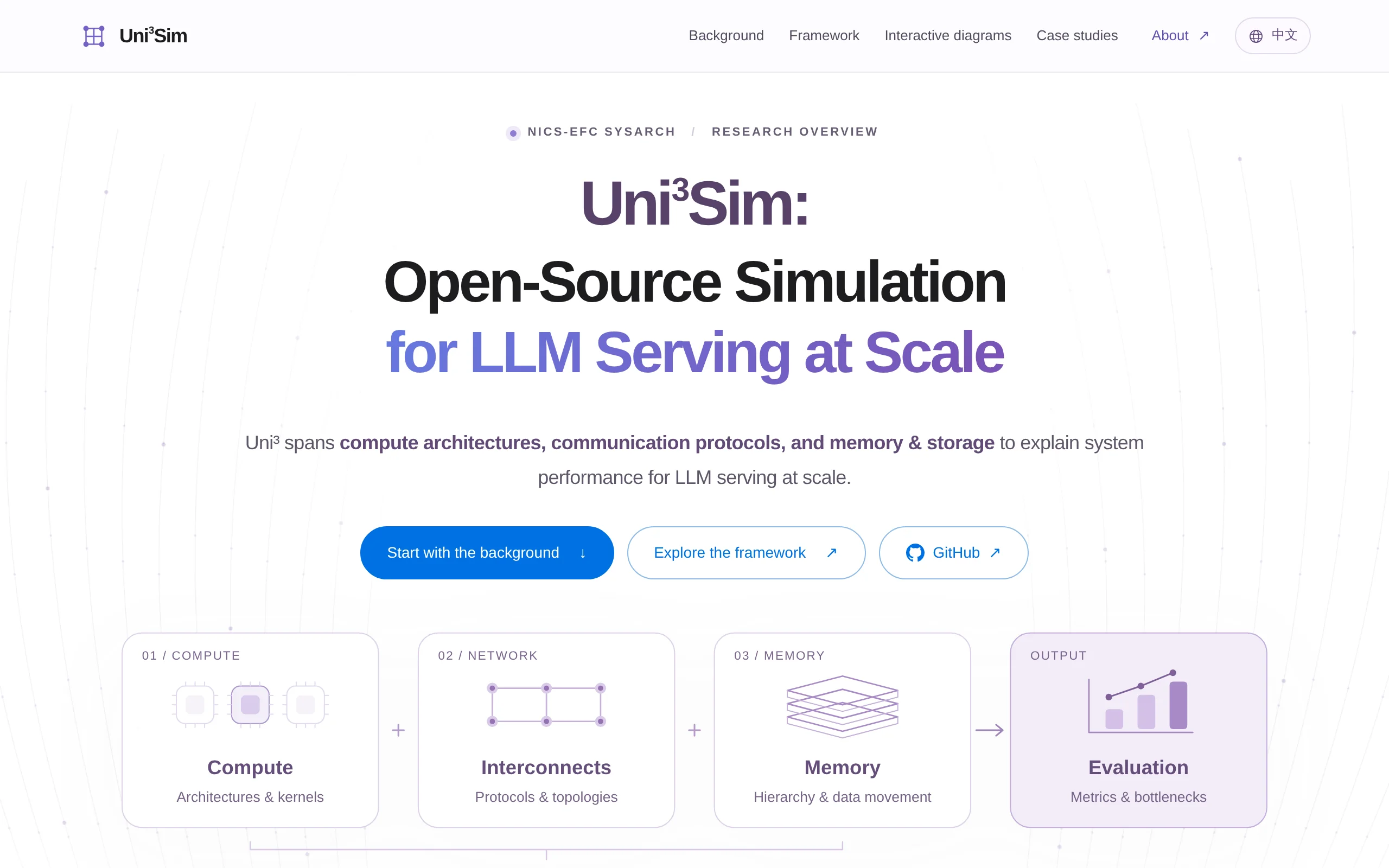
Uni3Sim – A System-Level Simulation Platform Open-Sourced by Zhipu AI and Tsinghua University
Uni3Sim is a system-level simulation platform jointly open-sourced by Zhipu AI and Tsinghua University, focusing on performance pre-simulation and design validation for large-scale LLM inference clust...

Linger – Open-Source Personal AI Agent by Former DeepSeek-VL Lead
Linger is an open-source personal AI agent created by Zhang Bo, the former lead of DeepSeek-VL. It can run entirely on the user's own computer. The core value of this tool lies in addressing the indus...
© All Rights Reserved. Some content on this site is partially generated by AI with human review.