
Uni3Sim – A System-Level Simulation Platform Open-Sourced by Zhipu AI and Tsinghua University
Executive Summary:
Uni3Sim is a system-level simulation platform jointly open-sourced by Zhipu AI and Tsinghua University, focusing on performance pre-simulation and design validation for large-scale LLM inference clust...
1. What is Uni3Sim
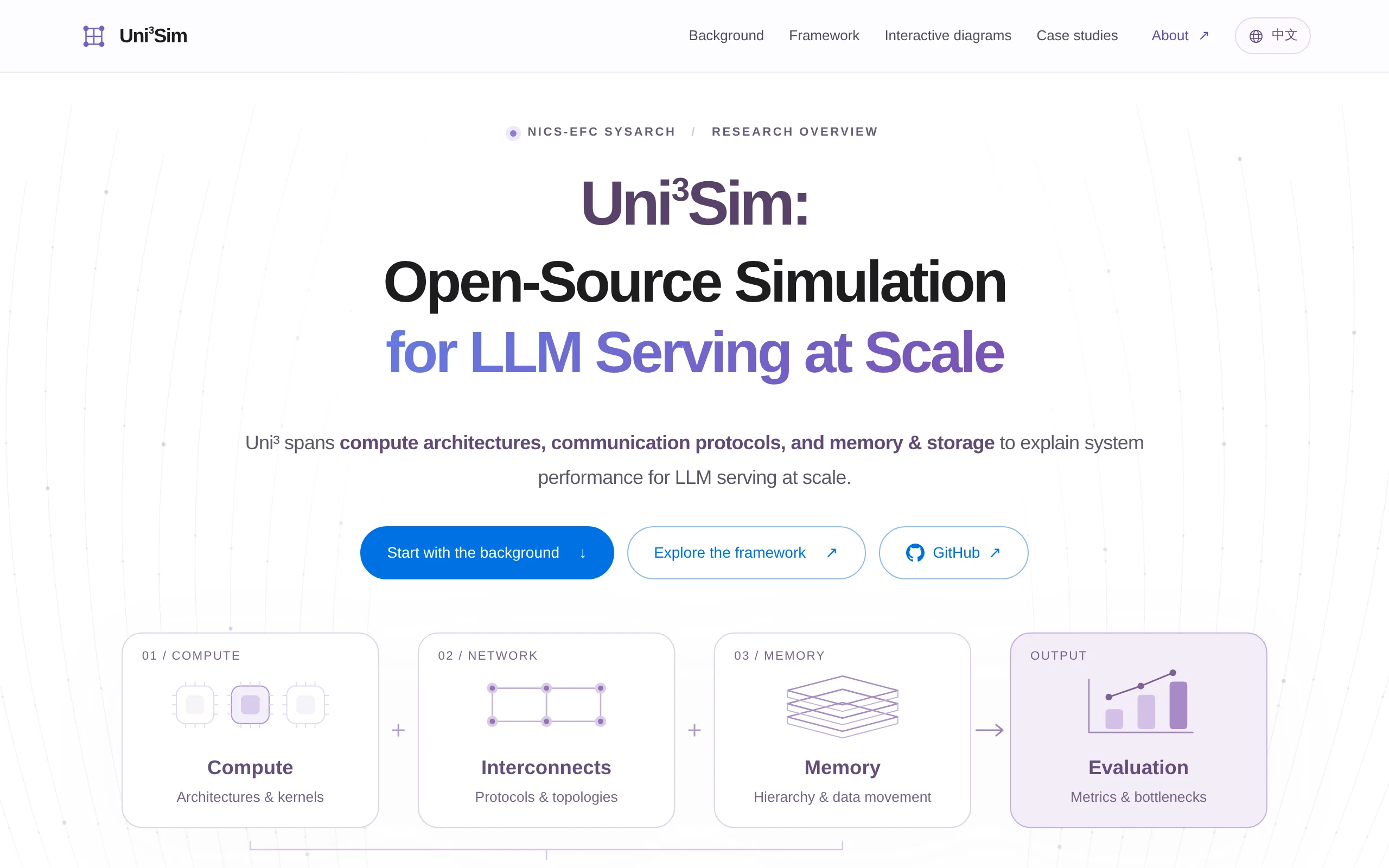
Uni3Sim is a system-level simulation platform jointly open-sourced by Zhipu AI and Tsinghua University, focusing on performance pre-simulation and design validation for large-scale LLM inference clusters. By integrating native schedulers such as vLLM and SGLang, the platform replays workloads according to real business request trajectories and uniformly models the three hardware layers: computing (ArchPrism), storage (HBFrame), and interconnect (ProtoBridge). This allows developers to evaluate service performance under different chip configurations, storage architectures, network topologies, and parallel strategies before deployment. This technology transforms costly physical trial-and-error into low-cost, repeatable digital trial-and-error, and its accuracy has been validated on platforms such as A800, MXC500, and Ascend 910B.
Technical positioning and domain: Uni3Sim belongs to the field of system-level simulation and performance modeling, targeting the pre-deployment evaluation and architectural optimization of large language model inference clusters. In the context of increasingly complex AI infrastructure and diverse hardware options, Uni3Sim fills the gap between single-card performance testing and cluster-level service simulation, providing quantitative support for cluster design and operational decisions. It is not a traditional benchmarking tool, but rather an end-to-end simulation environment that integrates scheduling behavior, operator execution, storage access, and network interconnect on a unified timeline.
Development background: This platform was jointly developed by Zhipu AI and Tsinghua University, stemming from a deep observation of the pain point in LLM inference cluster design: the high cost of physical trial-and-error. The team has long-term expertise in heterogeneous computing, storage systems, and interconnect protocols, which they have transformed into three unified modeling components: ArchPrism, HBFrame, and ProtoBridge. The purpose of open-sourcing this platform is to promote a shift in the industry from experience-driven to data-driven cluster design paradigms.
Core value: The core problem that Uni3Sim addresses is the uncertainty in cluster construction—how different chip combinations, storage hierarchies, and network topologies perform under actual workloads. Previously, this could only be verified by setting up real environments. Uni3Sim replays workloads using real business traces, integrating scheduling, kernel execution, and runtime overhead into a unified timeline, and outputs key metrics such as TTFT, TPOT, throughput, and tail latency. This enables quantitative validation of hardware selection, resource allocation, and storage design before deployment, significantly reducing trial-and-error costs.
Technical features: The core technical advantage of Uni3Sim lies in its three-layer unified modeling—ArchPrism predicts operator performance across heterogeneous chips, HBFrame covers storage layers such as HBM, HBF, Host DRAM, and storage pooling, and ProtoBridge models Scale-Up/Scale-Out protocols and topologies. Additionally, it directly integrates with the native schedulers of vLLM and SGLang, preserving real system behaviors such as batch processing and prefix cache reuse, rather than simplifying the simulation. This makes its results more reliable.
2. Key Features
End-to-end Inference Service Simulation: Uni3Sim replays workloads according to real business request trajectories, simulating the complete execution process from request arrival to completion. Unlike single-point performance testing, this feature captures request arrival patterns, concurrent contention, and queuing effects, making the prediction results closely align with actual production environment performance. Users can leverage this to evaluate service performance under different workload characteristics and identify potential bottlenecks.
Framework-Aware Scheduling Simulation: The platform directly integrates with native schedulers from vLLM and SGLang, fully preserving real system behaviors such as continuous batching and prefix cache reuse. This deep integration avoids biases introduced by abstract scheduling models, allowing simulation results to reflect optimization effects at the framework level. Users do not need to rewrite or adapt scheduling logic, significantly lowering the learning curve.
Unified Compute Modeling (ArchPrism): ArchPrism predicts operator execution time across heterogeneous chip architectures, supporting platforms such as NVIDIA A800, Mux C500, and Ascend 910B. Its underlying modeling method is not a simple lookup table, but rather a matching analysis between operator computational characteristics and hardware microarchitecture, enabling reasonable estimation of execution time under various tensor shapes and parallel strategies. This is the core technological support that allows Uni3Sim to migrate predictions across multiple platforms.
Unified Storage Modeling (HBFrame): HBFrame incorporates HBM, HBF (Host Buffer), Host DRAM, and storage pooling into a unified model, evaluating data access and migration costs. It supports quantitative analysis of the storage location, capacity expansion, and remote read cost of KV Cache. In storage architecture exploration scenarios, users can compare performance differences among various cache reuse strategies and storage hierarchy configurations, providing a basis for cost optimization.
Unified Interconnect Modeling (ProtoBridge): ProtoBridge explicitly models Scale-Up/Scale-Out protocols, network topology, link bandwidth, and resource contention, analyzing the impact of interconnect solutions on end-to-end performance. In multi-card or multi-node deployment scenarios, interconnect is often the bottleneck. This feature allows engineers to preview the effects of different network topologies and protocol configurations in a virtual environment, avoiding the discovery of interconnect performance issues only after actual deployment.
End-to-end Metric Prediction and Decomposition: The platform outputs TTFT (First Token Latency), TPOT (Per Token Output Latency), system throughput, and tail latency, while decomposing the time spent in each stage and hardware utilization. This fine-grained metric decomposition helps identify the source of performance loss—whether it is scheduling overhead, operator execution, or storage waiting. For performance tuning, the data provided by this feature is more diagnostic than a single throughput metric.
Hardware Solution Comparative Evaluation: Users can compare different combinations of chips, storage, links, and deployment strategies under a fixed budget. Uni3Sim supports defining experimental variables by modifying the configuration manifest and allows horizontal comparison of multiple hardware configurations under the same workload. This provides a systematic method for evaluating cluster design options, saving time and resources that would otherwise be spent setting up physical environments one by one.
Cost-Benefit Quantitative Analysis: The platform quantifies the impact of optimization strategies such as cache reuse and resource allocation on throughput and economic returns. For example, it can assess whether the throughput improvement from increasing KV Cache capacity justifies the added storage costs. This feature links technical performance metrics with business returns, supporting more economically rational decision-making.
3. Application Scenarios
Cluster Capacity Planning: Before data center construction or expansion, use real business traces to simulate the TTFT/TPOT performance under different computational scale configurations in a virtual environment. With Uni3Sim, planning teams can quickly compare multiple candidate configurations and determine the minimal cluster scale that meets SLOs (Service Level Objectives). This approach effectively avoids resource waste caused by over-provisioning or service quality issues resulting from under-provisioning.
Prefill/Decode Resource Allocation Optimization: Based on the bursty nature of request arrivals and tail latency requirements, evaluate the resource allocation ratio between the Prefill and Decode phases in inference instances. A common issue in real production environments is low Prefill resource utilization (e.g., only 26%), while the Decode phase becomes a bottleneck due to insufficient resources. Uni3Sim can simulate performance under different allocation ratios, helping operations teams find the optimal balance in resource distribution.
Domestic Chip Selection and Validation: Compare the service performance of deploying the same model across heterogeneous chips such as A800, Muxi C500, and Ascend 910B. Uni3Sim provides quantitative evidence for domestic replacement options through its ArchPrism component, which can predict performance without setting up actual hardware environments, thereby reducing the initial investment in domestic chip evaluation. This scenario is particularly useful for trusted innovation projects and the formulation of mixed-chip deployment strategies.
Storage Architecture and Pooling Design: Simulate and evaluate various storage solutions, including HBM, HBF, Host DRAM, and storage pooling. Users can jointly adjust deployment strategies and interconnect topologies to assess whether the benefits of capacity expansion outweigh the additional overhead introduced by remote reads. This scenario is suitable for inference system designs that handle long contexts or large-scale concurrent requests, helping to identify the balance between cache capacity and access latency.
4. How to Use
Environment Preparation: Ensure that the Linux system is ready, with Python version 3.10 or higher installed. Additionally, install Git LFS and a C compiler (recommended as GCC). The simulation kernel of Uni3Sim requires local compilation, and the C compilation environment is a mandatory prerequisite. Its absence will result in kernel build failure.
Clone the Repository: Execute
git clone --recurse-submodules https://github.com/thu-nics/uni3sim.gitto pull the code and all submodules. The--recurse-submodulesparameter is very critical, as Uni3Sim relies on multiple submodules to provide full functionality. Omitting this will cause subsequent steps to fail.Fetch the Dataset: After entering the project directory, run
git lfs install --local && git lfs pullto obtain the dataset required for micro-benchmarking. This dataset contains input samples used for operator performance evaluation and is a necessary input for running the kernel evaluation step.Install Dependencies: Create a Python virtual environment and execute
pip install -r requirements-reports.txtto install the dependency packages required for report generation. It is recommended to use a virtual environment to isolate project dependencies and avoid conflicts with the system Python environment.Compile the Simulation Kernel: Run
cc -O3 -shared -fPIC -o build/lru_sim.so src/kernel/csrc/lru_sim.cto compile the LRU simulation kernel. This step generates a shared library file used for simulating cache behavior in subsequent service simulations. The compilation option-O3ensures optimal kernel performance.Run Kernel Evaluation: Execute
run_kernel_evaluation.py --hardware-id nvidia_a800to predict operator performance on the target hardware. Supported hardware identifiers includenvidia_a800,muxi_c500, andascend_910b. The output is a detailed HTML report containing latency prediction results for each operator.Configure Simulation Experiments: Choose or create an experiment manifest file in the
configs/directory, specifying the model type, load trace path, and software/hardware configuration parameters. The manifest uses a structured format, allowing users to flexibly define variables such as chip model, memory hierarchy, interconnect topology, and parallel strategies.Run Service Simulation: Execute
run_serving_experiments.py --manifest <config> --run-dir <output directory>to launch the end-to-end service simulation. This step is a CPU-intensive task and can be completed without a GPU, making it convenient for quick validation in a development environment.Analyze the Result Report: After the simulation is complete, open
result.htmlin the output directory to view key metrics such as TTFT, TPOT, throughput, and timeline breakdown. The report includes visualizations of the time spent in each component and hardware utilization, helping to identify performance bottlenecks.Compare and Validate Schemes: Adjust the manifest configuration and rerun the simulation to compare performance differences under various hardware and deployment strategies. It is recommended to modify configurations one variable at a time to ensure that differences can be attributed to specific design decisions.
5. Pros and Cons Analysis
| Pros |
|---|
| Three-tier unified modeling architecture: ArchPrism, HBFrame, and ProtoBridge respectively cover the computing, storage, and interconnect layers, abstracting heterogeneous hardware differences into a unified interface. This significantly expands the applicability of the simulation and supports cross-architecture solution comparisons. |
| Deep integration with real frameworks: Directly connects to the native schedulers of vLLM and SGLang, allowing the simulation of real scheduling behavior without rewriting code. The simulation results reflect the actual effects of framework-level optimizations, ensuring high credibility. |
| Proven cross-platform capability: Verified on three different GPU architectures: NVIDIA A800, Mux C500, and Ascend 910B. The throughput error is controlled within 5.2%, demonstrating compatibility with domestic chips and strong modeling generalization. |
| End-to-end revenue simulation: Goes beyond pure performance metrics by linking throughput, cache reuse efficiency, and business revenue, providing a more comprehensive reference dimension for cluster investment decisions. |
| Open source and community-driven: Released as open source, allowing users and research institutions to extend hardware support and optimize model accuracy. With the technical background of Tsinghua University and Wuwenxinqiong, the project has strong potential for continuous development. |
6. Comparative Analysis with Similar Tools
| Comparison Dimension | Uni3Sim | rLLM | NVIDIA DGX Sim |
|---|---|---|---|
| Core Focus | Cluster-level system simulation platform for large-scale LLM inference services | Serving-aware simulation evaluation framework for LLM accelerators | Accurate simulation of InfiniBand and GPU interconnect at the data center level |
| Modeling Scope | Unified modeling of compute, storage, and interconnect layers (ArchPrism/HBFrame/ProtoBridge) | Focuses on joint evaluation of accelerator compute performance and real serving behavior, with lightweight modeling of storage and interconnect | Focuses on precise simulation of IB network routing, flow control, and congestion behavior |
| Hardware Support | Verified with NVIDIA A800, Husky C500, Ascend 910B, and supports domestic multi-chip platforms | Primarily focused on NVIDIA GPU ecosystem | NVIDIA GPU clusters with actual IB switch architecture as reference environment |
| Framework Integration | Native schedulers for vLLM and SGLang | Integrates dynamic behavior of real serving frameworks, no need to rewrite vLLM for the platform | Does not involve LLM serving frameworks, focuses on low-level communication |
| Interconnect Topology Modeling | Explicit modeling of Scale-Up/Scale-Out protocols, network topology, link bandwidth, and resource contention | Not a core focus | Deep modeling of IB network routing, flow control, and congestion behavior |
| Storage Hierarchy Coverage | Unified modeling of HBM/HBF/Host DRAM/storage pooling, supports cache reuse benefit analysis | Primarily focuses on KV Cache serving behavior, does not explore storage architecture design space | No storage system modeling involved |
| Validation Accuracy | TTFT error <21.2%, throughput error <5.2%, including domestic chips | Paper reports can reproduce real system behavior under service load (accuracy based on original text) | Communication pattern accuracy highly dependent on configuration parameters |
| Deployment Cost | Pure CPU can run demo, lightweight, suitable for iterative design phase | Requires behavior description files of the target accelerator | Requires IB switches and GPU clusters as reference environment |
Selection Recommendations: For enterprise users focusing on domestic chip selection and large-scale cluster design, Uni3Sim is one of the few options currently available that can simultaneously model compute, storage, and interconnect layers. Especially when evaluating domestic platforms such as Husky C500 or Ascend 910B, Uni3Sim has already been validated and can serve as a rapid screening tool to reduce trial-and-error costs. Combined with hardware comparison and cost-benefit analysis features, it is suitable as a pre-research platform for cluster construction.
For academic teams researching LLM accelerator architectures and aiming to deeply evaluate the performance of specific chip designs under real serving behavior, rLLM's serving-aware simulation path is more specialized. Its method of connecting with real framework behaviors is suitable for exploring the design space of accelerators. If the goal is to perform fine-grained network performance optimization on an already built NVIDIA cluster, NVIDIA DGX Sim's low-level interconnect simulation capabilities offer clear advantages, but require a corresponding hardware reference environment to realize their value. Tool selection should be determined based on the alignment of evaluation goals and hardware environment.
7. Editor's Summary
Uni3Sim has made a practically valuable attempt in the field of system-level simulation—advancing the granularity of hardware modeling to the operator level while maintaining the authenticity of system behavior by integrating real scheduling frameworks. It provides a reliable and efficient pre-validation tool for designing LLM inference clusters. Its three-tier unified modeling architecture—ArchPrism, HBFrame, and ProtoBridge—covers the main hardware dimensions that affect inference performance and links technical performance with business returns. This comprehensive design perspective is worth noting.
From a practical application standpoint, this platform truly addresses the "validate before invest" issue in cluster construction. Capacity planning, resource allocation optimization, domestic chip selection, and storage architecture design can all be initially screened in a digital environment, significantly reducing the time and financial costs of physical trial and error. Its primary users include: technical decision-makers responsible for AI infrastructure planning, engineers engaged in optimizing inference system performance, and academic researchers studying heterogeneous computing and system simulation. For these users, Uni3Sim offers a pathway from experience-based judgment to data-driven decision-making.
It is worth noting that, as a relatively new open-source project, the depth of its documentation and the maturity of its community ecosystem are still growing. The stability of modeling accuracy across different workloads, the speed of expanding coverage for domestic chips, and the runtime efficiency of simulation in large-scale cluster configurations will all be key variables influencing its depth of adoption. Overall, Uni3Sim has entered a widely needed niche scenario at the right time, and its open-source strategy lays a solid foundation for its ongoing development.
8. FAQ
Q: What is the fundamental difference between Uni3Sim and traditional benchmarking tools (such as MLPerf)?
A: Traditional benchmarking runs standardized tasks on real hardware, producing zero-error measured results, but requires setting up a complete physical environment, which is costly and does not allow for free exploration of the hardware design space. Uni3Sim models computation, storage, and interconnects in a digital environment, enabling the pre-simulation of different hardware configuration combinations within hours. The trade-off is a certain level of precision deviation (TTFT error < 21.2%, throughput error < 5.2%). The two approaches are complementary: Uni3Sim is suitable for quickly screening candidate solutions, while benchmarking is used for final validation and confirmation.
Q: What level of simulation accuracy does Uni3Sim achieve? In which scenarios should it be used with caution?
A: Publicly available validation data shows that TTFT error is less than 21.2% and throughput error is less than 5.2% on the NVIDIA A800, Muxi C500, and Ascend 910B platforms. This level of accuracy is sufficient to support horizontal comparisons between solutions and trend analysis. However, for SLO compliance assessments that are sensitive to absolute values, it is recommended to combine with small-scale physical validation for cross-verification. Additionally, before incorporating new hardware architectures into formal decision-making, it is advisable to first validate the simulation results with small-scale physical testing.
Q: What hardware configuration is required to use Uni3Sim? Can it run on a regular development machine?
A: Running demo-level service simulations is a pure CPU computation task and can be completed on a regular Linux development machine. The official recommended environment for the project is a Linux system, Python 3.10+, and a C compiler, with no GPU required to execute the full workflow. However, it should be noted that the simulation runtime for large cluster configurations increases with scale. In practice, appropriate computational resources should be selected based on the complexity of the experiment.
Q: Which models and frameworks does Uni3Sim support? Can it integrate with inference frameworks other than vLLM and SGLang?
A: The current version officially supports the native schedulers of vLLM and SGLang, which is a key design for simulating real system behavior. For other inference frameworks, an evaluation of their scheduling logic against the existing abstraction layer is required. There is currently no official extension guide. In terms of models, the platform supports mainstream LLM architectures through experimental manifest definitions, with specific configurations adaptable based on the actual load trace.
Q: How can production environment request logs be converted into a load trace usable by Uni3Sim?
A: Uni3Sim replays load based on real request traces, and the trace format has specific structural requirements. Production environment request logs typically need to be parsed and processed with field mapping to extract key information such as request arrival time, input and output lengths, and then converted into a format compatible with the platform. It is recommended to consult the trace format documentation in the project repository and construct data according to the example format.
9. Project Links
- Project Website: https://thu-nics.github.io/uni3sim-website/
- GitHub Repository: https://github.com/thu-nics/uni3sim
Related

Linger – Open-Source Personal AI Agent by Former DeepSeek-VL Lead
Linger is an open-source personal AI agent created by Zhang Bo, the former lead of DeepSeek-VL. It can run entirely on the user's own computer. The core value of this tool lies in addressing the indus...
LingSante – The Open-Source Medical Large Model Series from Ant Group's Bailing Team
LingSante is an open-source medical large model series launched by Ant Group's Bailing team. It is built upon a general-purpose foundation with 560B parameters, utilizing a Mixture-of-Experts (MoE) ar...
WuJie·PhysCapBench – The First Unified Benchmark for Evaluating Cross-Domain Video Physical Description Capabilities Launched by Zhixin
WuJie·PhysCapBench is the first cross-domain video physical description evaluation benchmark introduced by Inverse Matrix in collaboration with the Zhixin Institute of Research and Peking University. ...
VoiceStudio – Open-Source Local AI Voice Studio, Generating Voice from Text Descriptions
VoiceStudio is an open-source, fully local AI voice studio that integrates multiple capabilities—such as voice cloning, sound design, video dubbing, speech-to-text transcription, and batch generation ...
© All Rights Reserved. Some content on this site is partially generated by AI with human review.