
Hy-SimulMT – In-Depth Review of Tencent HunYuan's Open-Source Simultaneous Interpretation Large Model
Executive Summary:
Hy-SimulMT is an open-source simultaneous interpretation large model developed by the Tencent HunYuan team, specifically designed for real-time speech-to-speech translation between Chinese and English...
1. What is Hy-SimulMT
Hy-SimulMT is an open-source simultaneous interpretation large model developed by the Tencent HunYuan team, specifically designed for real-time speech-to-speech translation between Chinese and English. It supports streaming translation modes that allow for simultaneous listening and translating, as well as simultaneous speaking and output. Additionally, it features the ability to clone a speaker's voice in real time. In practical testing, the response latency is approximately 3 seconds, outperforming the 4–5 second translation speed of human professional interpreters. On the RealSI benchmark dataset, it achieves the lowest latency while delivering translation quality that is among the best in open-source models, surpassing most commercial APIs. In multi-domain tests, its translation quality exceeds that of human simultaneous interpretation experts. With its low latency, high quality, and open-source nature, Hy-SimulMT sets a new technical benchmark in the field of simultaneous interpretation.
Technical Positioning and Domain: Hy-SimulMT belongs to the real-time speech-to-speech simultaneous interpretation domain. Its core application areas include international conferences, business negotiations, speech training, media interviews, and cross-border daily services. Its unique positioning in this domain lies in the deep integration of true streaming simultaneous interpretation and speaker voice cloning, breaking through the latency bottleneck commonly found in traditional cascaded systems.
Development Background: This model was developed by the Tencent HunYuan team, leveraging their deep technical expertise in the HunYuan large model series (HYV3ForCausalLM). The motivation behind its development stems from the current pain points in commercial simultaneous interpretation services, which suffer from high latency, high cost, and the inability to be self-deployed. The goal is to promote the popularization of real-time translation technology through open-sourcing and to establish a new standard for Chinese speech-to-speech translation.
Core Value: Hy-SimulMT resolves the core contradiction in traditional simultaneous interpretation systems: the trade-off between waiting for complete input (which causes high latency) and starting to speak too early (which leads to inaccurate translations). By employing an incremental understanding and self-correction mechanism, it achieves both low latency and high-quality translation. Its innovative value lies in applying a large-scale sparse MoE (Mixture of Experts) architecture to streaming translation, achieving inference costs comparable to small models while maintaining translation quality at the level of large models. This makes it the first time that real-time AI simultaneous interpretation has become fully superior to human interpreters in terms of both cost and performance.
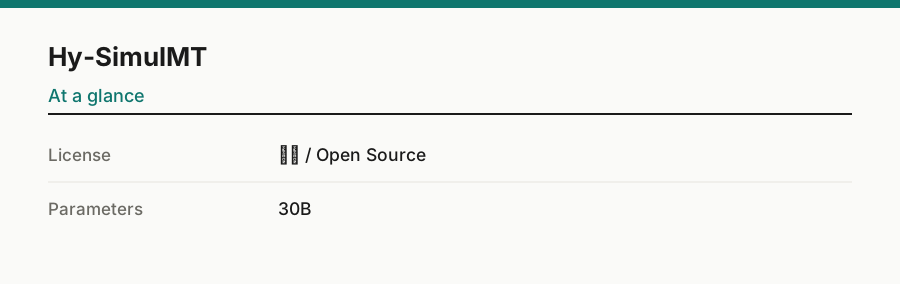
Technical Features: Hy-SimulMT uses a MoE (Mixture of Experts) architecture with a total of 30B parameters, activating approximately 3B parameters at each step. It employs the vLLM inference backend for streaming incremental decoding. Compared to traditional cascaded systems, its modular design delegates voice cloning to an independent TTS component, allowing translation quality and voice naturalness to be optimized separately, thus balancing performance and scalability.
2. Key Features
- Real-time Streaming Speech Interpretation: The speaker's audio can continuously flow into the model, which translates while listening and outputs the translated speech while speaking, enabling real-time bidirectional speech-to-speech translation between Chinese and English. This feature eliminates the delay of traditional solutions that wait until the speaker finishes before translating, representing a core breakthrough in AI interpretation experience.
- Speaker Voice Cloning: The translated output not only accurately reproduces the semantic meaning but also preserves the speaker's original tone and voice. In multi-speaker conversation scenarios, the model can distinguish and reproduce the voices of different speakers, offering listeners a more natural and immersive communication experience.
- Dual Output of Text and Speech: The model supports outputting pure translated text, and the Interleave version can also output the source text simultaneously. Users can choose to enable the accompanying TTS service to output the translated speech, depending on the actual scenario, providing flexible adaptation to various use cases.
- Low-latency Incremental Decoding: Real-world testing shows an interpretation latency of approximately 3 seconds, faster than the 4.5 to 4.7-second response time of human professional interpreters. This capability is made possible by incremental understanding and a self-correcting mechanism that "starts speaking first and then refines," ensuring a continuous and smooth interpretation experience.
- Large-scale Sparse MoE Architecture: The model uses a MoE design with a total of 30B parameters and 3B active parameters, based on the HYV3ForCausalLM architecture. It supports mainstream inference backends like vLLM. The sparse activation mechanism significantly reduces inference costs while maintaining high-quality translation capabilities, making it suitable for real-time online scenarios.
- Modular TTS Integration: Voice cloning and streaming translation are decoupled, with an independent TTS component handling speech synthesis. This modular architecture allows for separate optimization of translation quality and voice naturalness, and also supports integration with third-party TTS services, offering strong scalability.
- Support for Private Deployment and Fine-tuning: In addition to the basic inference service, the project provides the SimulTrain module to support secondary development and fine-tuning. It includes complete one-click deployment scripts and a command-line client, making it convenient for developers to perform deep customization and integration in private environments.
3. How to Use
- Environment Requirements: Requires Linux or Windows operating system, with an NVIDIA GPU environment that supports CUDA. It is recommended that the GPU memory be no less than 16GB. Before deployment, ensure that Python 3.8+ and Git environment are available, and that HuggingFace download permissions are properly configured.
- Clone and Deploy: Execute
git clone https://github.com/Tencent-Hunyuan/Hy-SimulMT.gitand enter the project directory. Runbash deploy.sh --install-server --model tencent/Hy-SimulMT-30B-A3B-Interleavein theSimulInfer/directory to automatically complete the service configuration. - Configure TTS (Optional): If you need voice output and voice cloning, configure the TTS service connection in
config.toml. If you only need plain text translation output, you can skip this step. - Start and Use: After deployment, wait for the terminal to display
Ready: http://127.0.0.1:8080/, then open this address in your browser. Select the translation direction and upload an audio file or start speaking using the microphone. Click 「Stop and finish」 to end the session. Alternatively, you can use the command line to callcurl -N http://127.0.0.1:8080/translate/stream -F direction=en-zh -F [email protected]. - Best Practices: For multi-person conversation scenarios, it is recommended to enable the TTS voice cloning feature to achieve the best communication effect; for long audio translation tasks, adjust the incremental accumulation parameters to balance latency and accuracy; when developers perform secondary integration, it is preferable to use the built-in
simulinfer-clientclient from the repository to obtain translation results.
4. Pros and Cons Analysis
| Pros |
|---|
| Leading Low Latency: Real-world testing shows StreamLAAL has a latency of about 3 seconds, faster than professional human interpreters, making it the lowest-latency solution among open-source simultaneous interpretation models and effectively supporting real-time conversation scenarios. |
| Balanced Translation Quality and Speed: Achieves the best combination of "lowest latency + highest quality" in the RealSI long audio evaluation, with GEMBA scores surpassing four out of five commercial APIs and all other open-source models, demonstrating strong performance. |
| Real-time Voice Cloning: The translated speech can highly replicate the speaker's tone and voice, and in multi-speaker scenarios, it can effectively distinguish between different speakers, significantly enhancing the naturalness and user experience of the translation. |
| Fully Open Source and Customizable: Inference and fine-tuning code are open-sourced, with one-click deployment scripts provided, supporting private secondary development and offering great flexibility for enterprise-level customization. |
| Reaches Human Expert Level: In blind testing comparisons with six CATTI Level 1/2 certified simultaneous interpretation experts, it achieved higher translation quality scores and faster response times, with high credibility in real-world testing quality. |
5. Comparative Analysis with Similar Tools
| Comparison Dimension | Tencent Hy-SimulMT |
|---|---|
| Release and Open Source Status | Released in October 2026, fully open-sourced (via GitHub, HuggingFace, etc.) |
| Chinese-English Simultaneous Interpretation Latency (StreamLAAL) | Approximately 3 seconds |
| Long Audio Translation Quality (RealSI, GEMBA) | Approximately 85 points, outperforming 4/5 commercial APIs, best among open-source models |
| Short Audio Benchmark (FLEURS/RealSI-Sentence) | 90.3 / 84.7, leading in multiple categories |
| Voice Cloning Capability | Supports real-time voice cloning, distinguishable among multiple speakers |
| Private Deployment and Secondary Development | Supports self-deployment and fine-tuning (SimulTrain) |
| Free Trial Access | Free to use via Tencent Hy Translation APP |
From a technical perspective, Hy-SimulMT demonstrates a clear advantage over ByteDance Seed-LiveInterpret 2.0 in terms of open-sourcing and availability, particularly excelling in translation quality and customization capabilities.
In terms of selection recommendations, if an enterprise or developer prioritizes self-control, data privacy, and needs to build a simultaneous interpretation service based on a private environment, or wishes to perform in-depth model fine-tuning and functional customization, Hy-SimulMT should be the preferred choice. Its open-source nature, absence of API call fees, and flexible deployment capabilities can effectively reduce long-term operational costs. If the team is focused on achieving ultra-low latency, requires quick integration, and does not want to build its own infrastructure, while being able to accept a commercial pay-as-you-go service model, then commercial APIs like Seed-LiveInterpret 2.0 are more user-friendly and suitable for rapid deployment in short-term projects or under resource-constrained conditions.
6. Editor's Summary
The emergence of Hy-SimulMT marks the first time that high-quality simultaneous interpretation has transitioned from specialized hardware and premium human services to a more accessible and software-based solution, showcasing solid engineering capabilities and leading value in technological innovation. By combining a 30B-parameter Mixture-of-Experts (MoE) architecture with streaming incremental decoding, the model maintains large-scale translation quality while reducing active inference parameters to the 3B level, effectively resolving the core contradiction between "real-time performance" and "high fidelity." In practical tests, it outperforms multiple commercial APIs in both latency (approximately 3 seconds) and quality (RealSI GEMBA score of around 85), and it has successfully passed blind tests against CATTI-certified Level 1 and Level 2 experts. This achievement itself is a testament to its technical strength.
In terms of practical value, the model provides complete one-click deployment scripts, configurable Text-to-Speech (TTS) components, and a SimulTrain fine-tuning toolchain, covering the full spectrum from API usage to private customization. This significantly lowers the overall barrier for enterprises to adopt real-time translation technology. Moreover, its free trial access allows ordinary users to verify its actual translation performance at no cost.
This model is primarily suitable for professional translation service providers, multinational corporations, international exhibition organizations, academic lecture platforms, and software development teams with real-time captioning and voice translation needs. It is also highly appropriate for individual developers and researchers who wish to conduct secondary development and academic exploration in the field of simultaneous interpretation. As the open-source community continues to perform large-scale fine-tuning and build an ecosystem around the model, and as future efforts focus on multi-language support and more lightweight distilled versions, Hy-SimulMT has the potential to reshape the commercial landscape of simultaneous interpretation services and could become one of the key components of AI-based real-time translation infrastructure.
7. Application Scenarios
- International Conferences and Forums: This application has been officially designated as the AI translation tool for volunteers and frontline service staff at large international events, used for接待 foreign guests and on-site communication. The model can effectively replace human translators for basic communication tasks, reducing operational costs for event organizers.
- Cross-language Business Negotiations and Meetings: In cross-border corporate meetings, it enables real-time Chinese-English bidirectional translation, allowing all participants to speak and listen in their native languages. Combined with real-time voice cloning functionality, the model preserves each speaker's vocal characteristics, reducing communication costs and improving meeting efficiency.
- Simultaneous Interpretation for Speeches and Training: In scenarios involving long, single-speaker presentations such as academic lectures, corporate training sessions, and open classes, the model provides stable and natural translation, making it suitable as an "auxiliary understanding" tool. Its continuous audio stream processing mechanism ensures translation coherence during extended tasks.
- Multi-speaker Interviews and Media Content: In multi-person dialogue scenarios such as interviews, podcasts, and documentaries, the model simultaneously clones the voice of each speaker, enabling listeners to identify who is speaking and achieving a more natural cross-language communication experience among multiple parties.
- Cross-border Tourism and Daily Services: In low-risk communication scenarios at international service points such as airports, hotels, exhibitions, and restaurants, it helps service staff conduct basic face-to-face conversations with foreign tourists, bridging the gap in multilingual talent and enhancing the quality of cross-border services.
8. FAQ
Q: What translation directions and languages does Hy-SimulMT support?
A: The official open-source version currently focuses on real-time speech-to-speech translation between Chinese and English, i.e., Chinese to English and English to Chinese. Support for other languages has not been explicitly stated in the public documentation. Please keep an eye on future version updates.
Q: What hardware requirements are there for deploying Hy-SimulMT?
A: Although the model uses a sparse MoE design and activates only about 3B parameters at a time, the total number of parameters in the full model is 30B. For production environments, it is recommended to configure NVIDIA A100 or equivalent multi-GPU setups. For local development and testing, a GPU with at least 16GB of VRAM is required.
Q: Can Hy-SimulMT be run without TTS?
A: Yes. The core functionality of the model is streaming speech recognition and simultaneous translation, outputting text. Pure text translation does not require a TTS service. If you need voice output or voice cloning, you must configure the TTS service connection in the config.toml file.
Q: Will voice cloning and translation quality affect each other?
A: No. Hy-SimulMT uses a modular design, where the translation model itself is responsible only for ASR and generating translated text. Voice synthesis and voice cloning are handled by an independent TTS component. This design allows both sides to be optimized separately and facilitates integration with third-party TTS systems.
Q: Does the project support fine-tuning on proprietary data to adapt to specific domains?
A: Yes. The project provides the SimulTrain module, which meets the needs of developers for secondary fine-tuning and optimization of the model. It is recommended to use fine-tuning in domains with concentrated professional terminology, such as healthcare, legal, or technology, to improve translation performance in specific scenarios.
Q: Is the project free for commercial use? Are there any usage restrictions?
A: Hy-SimulMT is fully open-source, providing model weights and inference framework code, and supports commercial applications and secondary development. For specific license details, please refer to the LICENSE file included in the GitHub repository to ensure compliant usage.
9. Project Links
- GitHub repository: https://github.com/Tencent-Hunyuan/Hy-SimulMT
- HuggingFace model library: https://huggingface.co/collections/tencent/hy-simulmt
Related
In-Depth Review of GPT-6.1 Terra – OpenAI's High-Efficiency Execution Large Model
GPT-6.1 Terra is a high-efficiency execution large model introduced by OpenAI, designed for office automation and high-frequency Agent task scenarios. It emphasizes enhanced visual understanding, comp...
StarFire X2.6: iFLYTEK's End-to-End Native Audio Modeling Architecture and Domestic Breakthrough in Industrial Deployment
StarFire X2.6 (Spark-X2.6) is an end-to-end native audio modeling architecture launched by iFLYTEK, completing the full training-to-inference loop using entirely domestic computing power. It represent...
In-Depth Review of iFLYTEK's SparkAudio 1.0: A Starry Fire Audio Foundation Model Powered by Fully Domestic Compute Resources
SparkAudio 1.0 is the Starry Fire Audio Foundation Model released by iFLYTEK on October 22, 2026, during the Global 1024 Developer Festival. Trained using fully domestic compute resources, this model ...
BaoCut – Open-Source AI Video Agent Tool with Multilingual Dubbing Support
BaoCut is an open-source AI video Agent tool developed by JimLiu. Its core positioning is to use an "editable timeline" as an intermediate state, enabling human creators and AI Agents to collaborate w...
© All Rights Reserved. Some content on this site is partially generated by AI with human review.