
StarFire X2.6: iFLYTEK's End-to-End Native Audio Modeling Architecture and Domestic Breakthrough in Industrial Deployment
Executive Summary:
StarFire X2.6 (Spark-X2.6) is an end-to-end native audio modeling architecture launched by iFLYTEK, completing the full training-to-inference loop using entirely domestic computing power. It represent...
1. What is StarFire X2.6
StarFire X2.6 (Spark-X2.6) is an end-to-end native audio modeling architecture launched by iFLYTEK, completing the full training-to-inference loop using entirely domestic computing power. It represents a critical move for domestic AI in terms of security and cost-effectiveness. The cloud version, StarFire X2.6-293A30B, supports ultra-long context with millions of tokens, with an input cost of only 0.9 RMB per million tokens, significantly lower than DeepSeek-V4.1-Flash. The on-device version, StarFire X2.6-4B, has been fully open-sourced and demonstrates strong performance in tasks such as office document processing and tool collaboration. The system automatically and accurately schedules between three modes—pure on-device, pure cloud, and edge-cloud collaboration—based on task complexity and data security requirements. This ensures sensitive data remains on the device and simple tasks are executed at low cost, with both code generation and agent execution capabilities reaching industry-leading standards.
Technical Positioning and Domain: StarFire X2.6 belongs to the intersection of natural language processing and multimodal agents. Its core positioning is to build an integrated base model system that spans both the cloud and the terminal. Unlike most pure cloud-based large models in the industry, StarFire X2.6 organically integrates lightweight on-device models with large-scale cloud models through an edge-cloud routing mechanism, providing a tiered computing power allocation strategy for practical scenarios such as office automation, enterprise knowledge management, and software engineering. This makes it a cutting-edge practice in the deployment of edge-cloud collaborative architectures for base large models.
Development Background: This model was primarily developed by the iFLYTEK Research Institute, leveraging the company's over two decades of technical accumulation in speech recognition and natural language understanding. The development motivation stemmed from two practical needs: one is the autonomous control of computing power scheduling and training efficiency for domestic AI chips, and the other is the compliance requirement in government and enterprise markets for data not leaving the domain. The team conducted long-term training on the iFLYTEK self-developed "Feixing 2" domestic intelligent computing platform, with supporting office products such as Loomy and AStudio being deployed simultaneously, forming a complete R&D pipeline from the base model to the application ecosystem.
Core Value: StarFire X2.6 addresses the industry pain point of the difficulty in balancing "security" and "cost" in large model deployment. Through edge-cloud integrated routing scheduling, simple tasks are handled instantly by on-device models, while complex inference tasks are processed by cloud-based large models. This not only reduces cloud computing power consumption but also ensures that sensitive data is processed locally. This architecture provides a practical compliance solution for data-sensitive industries such as education, healthcare, and law, while also reducing the total cost of ownership for large model applications through API pricing lower than the industry average.
2. Key Features
Million-Token Long Context: The cloud-based Spark X2.6-293-A30B model supports a context window at the million-token level, enabling the processing of ultra-long documents, complete technical manuals, or multi-turn complex business conversations in one go. This capability significantly reduces the need to segment and reassemble documents, greatly improving the accuracy of long-text understanding and cross-sectional information association. It is well-suited for scenarios involving long documents such as legal contract reviews, research literature summaries, and enterprise annual report analysis.
Code Generation and Automatic Repair: Ranked first in two industry-leading code benchmarks, SWE Pro and SWE Multilingual, and second only to DeepSeek-V4.1-Flash in the SWE Verified leaderboard. The model is not only capable of generating code from natural language but also of identifying defects in existing codebases, generating patches, and maintaining multi-language projects. It can meet the engineering development needs of various mainstream programming languages, including Python, Java, C++, and TypeScript.
Agent Task Execution: Supports multi-turn tool calling and cross-tool collaborative operations, placing it in the first tier in evaluations such as enterprise operations Agent and MCP-Atlas tool calling. The model can autonomously plan task steps based on user instructions, call external APIs, databases, file systems, and other tools as needed, while maintaining context state consistency across multiple steps. It is suitable for the automated execution of complex business processes.
On-Device Local Intelligence Processing: The open-source Spark X2.6-4B model can run offline on terminal devices such as AI PCs, automotive systems, and robots, handling office tasks like email content analysis, weekly report summarization, and business data organization. The entire processing occurs locally, with data never leaving the device, physically eliminating the risk of privacy leaks and meeting the strict data compliance requirements of industries such as finance and government.
On-Device to Cloud Collaboration Suite: Built-in with two office products, Spark Loomy and Spark AStudio, covering high-frequency office scenarios such as report writing, PowerPoint generation, coding, and data analysis. Loomy focuses on intelligent document processing and can automatically generate structured reports. AStudio is tailored for development scenarios, offering intelligent programming assistance. Both products now support offline processing of local files, balancing efficiency and security.
Data Anonymization and Routing Scheduling: The system includes a routing co-training mechanism based on evaluation models, increasing routing accuracy from an initial 81.2% to 96.1%. Before forwarding on-device tasks to the cloud, the system automatically performs data anonymization. Sensitive data is only uploaded with necessary fields retained, further reducing the risk of data leakage and providing fine-grained security control measures for the edge-cloud collaborative architecture.
3. How to Use
Clarify Use Case Requirements: Before using, select the appropriate invocation method based on task complexity and data sensitivity. Heavy-load tasks such as complex reasoning, ultra-long document analysis, and multilingual code generation are best suited for cloud-based APIs. Tasks involving internal emails, financial data, or customer privacy should prioritize on-device local deployment. For regular tasks of moderate complexity, enable the edge-cloud collaboration mode, allowing the system to automatically assign the optimal computational path.
Cloud API Invocation: Obtain API access credentials for the 293-A30B model via the iFLYTEK Open Platform Model Square (https://maas.xfyun.cn/modelSquare/base/2628905721051136). The API is billed at 0.9 yuan per million tokens for input and 3.6 yuan per million tokens for output. When cache hits occur, the input cost drops to 0.08 yuan per million tokens. Developers can choose between synchronous or streaming interfaces as needed, and refer to the official documentation to complete the full integration process, including authentication, request construction, and response parsing.
On-Device Open-Source Deployment: Download the X2.6-4B weight files from the HuggingFace official repository (https://huggingface.co/XHToken/Spark-X2.6-4B) and perform local deployment on AI PCs, in-vehicle computing platforms, or robot controllers. Ensure the device has sufficient computational resources (recommended: 8GB or more of GPU memory) and supports the required inference framework. Once deployed, the system can operate independently without an internet connection.
Direct Use in Office Products: For non-technical users, the Spark Loomy or Spark AStudio applications can be used directly. These products include built-in model loading and scheduling logic, allowing users to complete daily tasks such as writing reports, generating PPTs, and analyzing data through a graphical interface without needing to understand underlying technical details. They also support processing local files in offline mode.
Configure Edge-Cloud Collaboration: After enabling the edge-cloud routing feature in the application settings, the system will automatically evaluate task difficulty and data sensitivity, dynamically switching between pure edge, pure cloud, and edge-cloud collaboration modes. For scenarios with extremely high data security requirements, you can manually lock the system into "Only Edge Processing" mode, preventing any data from being uploaded to the cloud.
Enterprise Private Deployment: For enterprise users with strict data sovereignty requirements, local private deployment using the Spark Office All-in-One Machine is available. This solution integrates the model, computational power, and storage into a single unit, ready to use out of the box. It supports independent operation on internal networks and is suitable for environments such as government, military, and large state-owned enterprises that require complete isolation from external networks.
4. Pros and Cons Analysis
| Pros |
|---|
| Fully domestically controlled computing power: Trained and deployed entirely on the Feixing 2.0 domestic AI computing platform with tens of thousands of cards, eliminating reliance on overseas high-end GPUs and achieving a true end-to-end self-controlled technical stack. |
| Support for million-token ultra-long context: The cloud version supports input of up to a million tokens, enabling comprehensive understanding of long documents in one go, eliminating the need for cumbersome slicing and reassembly processes, and significantly improving execution efficiency and analytical accuracy for complex tasks. |
| Intelligent scheduling for edge and cloud integration: With a routing accuracy rate of 96.1%, the system can automatically determine whether a task should be processed on the edge, in the cloud, or collaboratively, ensuring response quality while effectively controlling computing costs and forming a differentiated cost advantage. |
| Data security and compliance design: Sensitive data can be processed offline locally, and combined with automatic desensitization mechanisms before uploading to the cloud, this provides a directly implementable compliance solution for highly regulated industries such as education, healthcare, and law. |
| Leading code and agent capabilities: Ranked first in two benchmarks, SWE Pro and SWE Multilingual, the enterprise operations Agent and MCP-Atlas tool calling capabilities are among the top-tier, providing a reliable foundation for developer toolchains. |
5. Comparative Analysis with Similar Tools
| Comparison Dimension | iFLYTEK Spark X2.6 | DeepSeek-V4.1-Flash | Qwen3-235B (Qwen Series) |
|---|---|---|---|
| Core Architecture | End-to-end native audio modeling architecture (cloud-side 293-A30B + edge-side X2.6-4B open-source) | Pure cloud-side MoE architecture | Primarily cloud-based, with some small-parameter versions open-sourced |
| Training Compute Power | Fully domestic compute power (iFLYTEK Feixing No.2 platform with ten thousand GPUs) | Relies on non-domestic compute power (NVIDIA GPU clusters) | Relies on non-domestic compute power |
| Context Length | Millions of tokens | Not explicitly stated to exceed this level | Approximately 32K-128K (depending on version) |
| Input Cost | 0.9 RMB per million tokens (0.08 RMB with cache hit) | Higher than Spark X2.6 | Relatively high, pay-as-you-go |
| Output Cost | 3.6 RMB per million tokens | Higher than Spark X2.6 | Relatively high, pay-as-you-go |
| Code Capabilities | First in SWE Pro and SWE Multilingual, second only to Flash in SWE Verified | Strongest in SWE Verified | High score in HumanEval, moderate in SWE-related evaluations |
| Edge Deployment | Supported, X2.6-4B can run offline with data staying on the edge | No support for local edge deployment | Provides small-parameter open-source versions (e.g., 1.5B/4B) that can be locally deployed |
| Data Security | Edge-cloud collaboration + automatic de-identification, suitable for private deployment in sensitive industries | Relies on cloud API, weak local processing capabilities | Small-parameter models can be privately deployed, but office-specific capabilities are limited |
| Agent Capabilities | Leading in enterprise operations Agent and MCP-Atlas tool calling | Strong general tool calling capabilities | Strong tool calling capabilities |
| Ecosystem Carriers | Comes with AI PC, office-in-one device, recording loop hardware + Loomy/AStudio | Primarily API service, weak hardware ecosystem | Alibaba Cloud's BaiLian platform + ModelScope ecosystem |
Selection Recommendations: For government and enterprise users with high data sensitivity, especially in highly regulated industries such as education, healthcare, and finance, the edge-cloud integrated architecture of Spark X2.6 and its closed-loop domestic compute power represent key differentiators. Its 4B open-source edge model can handle core office tasks locally, with the cloud only intervening when necessary, meeting the policy requirement of "data not leaving the domain" while also controlling long-term operational costs. In comparison, DeepSeek-V4.1-Flash still holds an edge in extreme performance for code reasoning, making it suitable for internet companies with ample GPU resources and no strict data sovereignty requirements.
For small and medium-sized teams requiring flexible deployment, the small-parameter open-source versions of the Qwen3 series and the lightweight models of Llama 4 offer richer community ecosystems and third-party toolchains. However, it is important to note that their Chinese office-specific capabilities and edge-cloud routing mechanisms are not as mature as those of Spark X2.6. If the team's primary focus is on general conversation and creative writing, choosing an open-source version of Qwen or Llama is more appropriate. If the business core lies in office automation and intelligent agent workflow orchestration, Spark X2.6's accompanying product matrix can significantly shorten the path from model to application deployment.
6. Editor's Summary
Starling X2.6 represents a significant practical implementation of domestic large models in the dimension of engineering deployment. Its technological innovation is reflected in two aspects: first, on the training side, based on the domestic intelligent computing platform of Feixing 2 with 10,000 GPUs, the long-range task dynamic parallel training technology reduces the training time for 2000B data with a length of 256K from 4.5 months to 1.2 months, improving efficiency by approximately four times. This validates the feasibility of domestic computing power in supporting large-scale model training and directly addresses industry skepticism regarding the large-scale training capabilities of domestic chip clusters. Second, on the inference side, the industry's first four-layer KV Cache distributed architecture improves inference efficiency by 4.5 times, increasing cache hit rate from 63% to 95.7%, effectively resolving the "can't store, can't compute fast" bottleneck for long-context inference under the constraints of limited memory and bandwidth in domestic chips. This provides a reusable engineering solution for long-text services under domestic computing power conditions.
In terms of practical value, the edge-cloud routing mechanism, combined with a 96.1% routing accuracy, enables the system to find a balance between data security and control of calling costs. The input pricing of 0.9 yuan per million tokens is lower than that of DeepSeek-V4.1-Flash, and with an ultra-low cost of 0.08 yuan after cache hits, it offers a competitive cost-performance ratio for high-frequency calling scenarios. The 4B model on the edge side performs better than the same-level Qwen and Gemma models in office tasks, meaning that enterprises no longer need to purchase large numbers of high-end GPUs to obtain usable local intelligent services, thereby lowering the overall entry threshold for AI applications. This is clearly commercially attractive in the domestic enterprise market, which is highly cost-sensitive.
In terms of target users, Starling X2.6 is more suitable for the following three categories: first, government and enterprise customers and industry clients with rigid data sovereignty requirements, who can meet compliance and audit needs through edge-cloud collaboration and private deployment solutions; second, mid-to-large teams whose core business involves document processing, business analysis, and code development, who can quickly achieve productivity improvements using supporting products such as Loomy and AStudio; third, developers and research institutions focused on the domestic computing power ecosystem, who can perform secondary development and academic research using the open-sourced X2.6-4B model.
Looking ahead, the edge-cloud integrated architecture of Starling X2.6 reflects the industry's shift from a "large model competition" to a "scenario deployment competition." As the routing scheduling mechanism continues to be optimized, edge-side model capabilities further upgraded, and domestic computing power platforms scaled up for deployment, this model has the potential to continue deepening its impact in the enterprise services market. In addition, the expansion of the supporting hardware ecosystem (AI PCs, office all-in-ones, recording rings) will also influence the subsequent competitive landscape.
7. Application Scenarios
Enterprise-grade Edge-Cloud Collaborative AI Services: In large enterprises or group organizations, StarFire X2.6 can automatically route requests based on their type: high-frequency, lightweight interactions (such as calendar queries and email categorization) are handled instantly by the edge-side model, while complex data analysis and strategic report generation are forwarded to the cloud for processing by large models. This mode enables enterprises to maintain service response speed while keeping cloud-side inference costs low, making it particularly suitable for medium to large enterprises with a high volume of daily office interactions.
Smart Office and Document Automation: With StarFire Loomy and AStudio, users can directly generate structured reports, create presentations, and automatically process local emails and multi-format documents. The system supports offline operation, allowing users to draft documents, generate content summaries, and perform format conversions even without an internet connection, making it ideal for office scenarios involving frequent travel or requiring network isolation.
Enterprise Operations Analysis and Decision Support: The edge-side model can read local storage materials such as weekly reports, sales data, and financial statements, automatically organizing operational summaries, generating visual comparison tables, and marking potential risk points and pending tasks. Management can obtain data insights through natural language queries, without relying on data analysts to process the data manually, thereby shortening the data-to-decision pipeline.
Software Engineering and Intelligent Programming: Leveraging its code capabilities, which rank first in two benchmarks—SWE Pro and SWE Multilingual—StarFire X2.6 can assist developers in code generation, defect localization, automatic repair, and multi-language project migration. In continuous integration environments, the model can also automatically generate commit messages or provide code review suggestions based on change records in the code repository, enhancing the overall R&D efficiency of the team.
Government and Enterprise Data Compliance and Private Deployment: For government agencies, financial institutions, and medical organizations, StarFire X2.6 supports fully offline edge-side processing and private deployment on office-in-one machines. Processing of sensitive content such as citizen privacy, patient information, and financial data is entirely conducted locally, and the system can be configured with automatic data desensitization mechanisms to meet compliance requirements under laws such as the Data Security Law and the Personal Information Protection Law.
8. FAQ
Q: How does the edge-cloud routing of Spark X2.6 determine the task distribution path?
A: The edge-side model first evaluates the difficulty of the input task and analyzes the sensitivity of the data. It then selects the optimal path among three modes: pure edge-side, pure cloud-side, or edge-cloud collaboration, based on the user's pre-set security policies. The routing accuracy reaches 96.1%, a metric continuously optimized through collaborative training of the commentary model. Data sent to the cloud undergoes de-identification processing, retaining only the necessary fields required for task execution.
Q: What hardware requirements are there for running the X2.6-4B edge-side model?
A: X2.6-4B is recommended to run on devices with at least 8GB of video memory. It supports terminal forms such as AI PCs, automotive computing platforms, and robot controllers. Actual performance depends on the device's computational power, memory bandwidth, and the optimization level of the inference framework. For specific performance metrics, please refer to the official deployment documentation or conduct practical testing.
Q: How long of a document can the Spark X2.6 handle with its million-token context capability?
A: A million tokens is approximately equivalent to 700,000–800,000 Chinese characters or over 1 million English words. This allows the model to handle ultra-long content such as complete novels, large-scale technical documentation, and annual audit reports. When processing such content, the model does not require slicing or segmenting, maintaining semantic coherence and consistency of cross-chapter information.
Q: How significant is the capability gap between the edge-side model and the cloud-side model? Which tasks are not suitable for edge-side processing?
A: X2.6-4B performs well in tasks such as office document processing, data organization, and simple question-answering, with a task coverage rate of 41.9% on the edge side. However, when it comes to complex mathematical reasoning, large-scale code generation, or deep semantic understanding, its performance is significantly lower compared to the cloud-side 293-A30B model. These high-complexity tasks are automatically routed to the cloud for execution.
Q: Can Spark X2.6 be deployed on non-domestic chips (e.g., NVIDIA GPUs)?
A: The model weights themselves are not restricted to specific hardware architectures, but the inference framework and KV Cache optimization strategies are primarily fine-tuned for the domestic chip ecosystem. When running on NVIDIA GPUs, some acceleration capabilities optimized for domestic chip characteristics may not be fully utilized. Please refer to the officially released compatibility guidelines or contact technical support for cross-platform deployment guidance.
9. Project Links
- iFLYTEK Open Platform Model Square: https://maas.xfyun.cn/modelSquare/base/2628905721051136?sort=0&userSelectCategory=%255B%255D
- GitHub Repository: https://github.com/XHToken/Spark-X2.6
- HuggingFace Model Library: https://huggingface.co/XHToken/Spark-X2.6-4B
- HuggingFace Model Collection Page: https://huggingface.co/collections/abenzerps/spark-x26
Related
In-Depth Review of iFLYTEK's SparkAudio 1.0: A Starry Fire Audio Foundation Model Powered by Fully Domestic Compute Resources
SparkAudio 1.0 is the Starry Fire Audio Foundation Model released by iFLYTEK on October 22, 2026, during the Global 1024 Developer Festival. Trained using fully domestic compute resources, this model ...
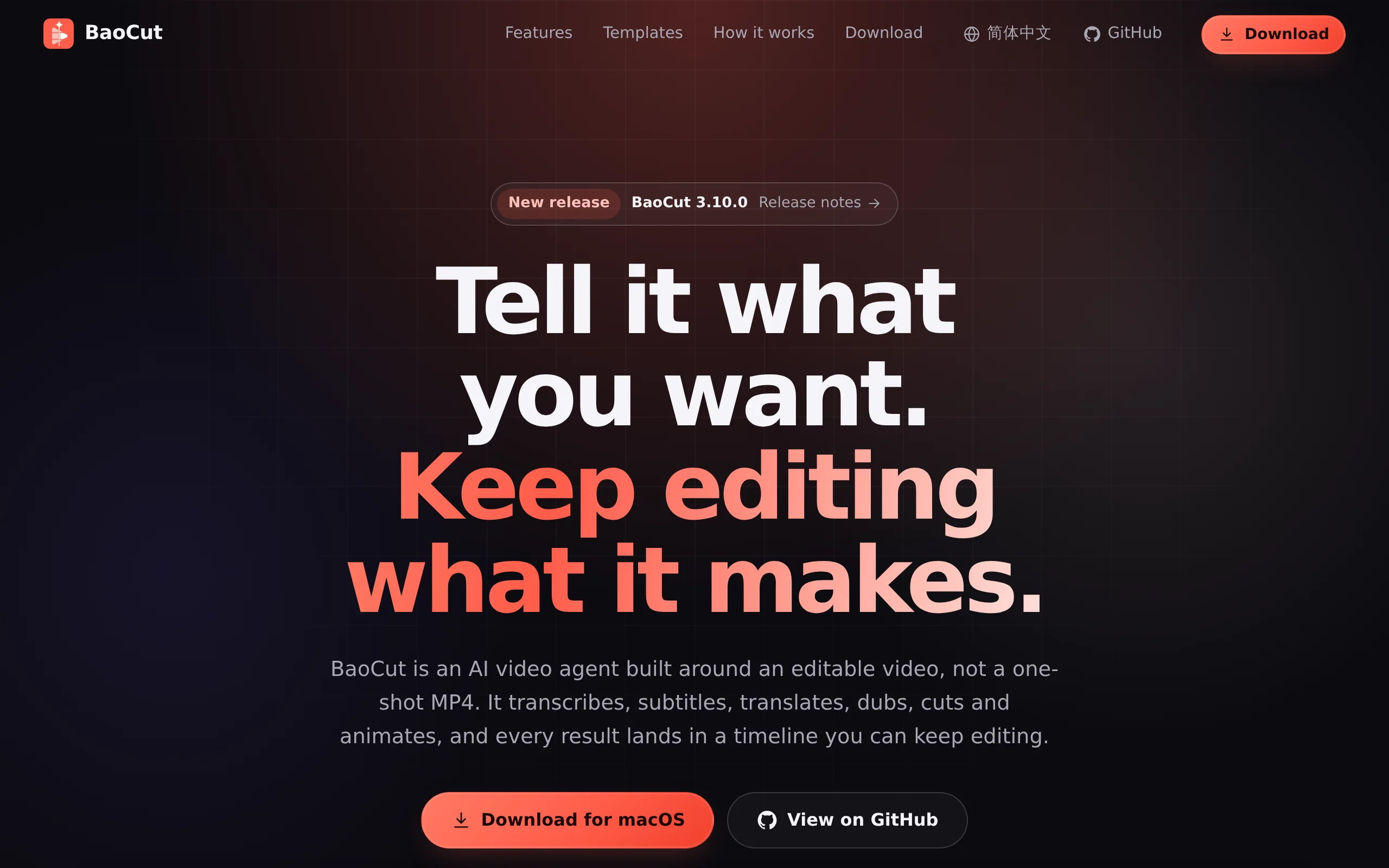
BaoCut – Open-Source AI Video Agent Tool with Multilingual Dubbing Support
BaoCut is an open-source AI video Agent tool developed by JimLiu. Its core positioning is to use an "editable timeline" as an intermediate state, enabling human creators and AI Agents to collaborate w...
Eleven Realtime: ElevenLabs' Architectural Breakthrough and Engineering Practices in Unified Voice Agent Models
Eleven Realtime is a unified voice agent model series introduced by ElevenLabs, featuring two versions: v1 Mini and v1 Max. Its core design philosophy is to integrate speech recognition (ASR), languag...
Ming-3.0: In-Depth Evaluation of Ant Bailing's Open-Source Full-Stack Speech Model Family
Ming-3.0 is a full-stack speech model series open-sourced by Ant Group's Bailing Large Model Team. It introduces five models focused on three core tasks: text-to-speech (TTS), audio understanding and ...
© All Rights Reserved. Some content on this site is partially generated by AI with human review.