
Ming-3.0: In-Depth Evaluation of Ant Bailing's Open-Source Full-Stack Speech Model Family
Executive Summary:
Ming-3.0 is a full-stack speech model series open-sourced by Ant Group's Bailing Large Model Team. It introduces five models focused on three core tasks: text-to-speech (TTS), audio understanding and ...
1. What is Ming-3.0
Ming-3.0 is a full-stack speech model series open-sourced by Ant Group's Bailing Large Model Team. It introduces five models focused on three core tasks: text-to-speech (TTS), audio understanding and dialogue (Audio), and automatic speech recognition (ASR). This series provides integrated capabilities covering the entire speech application workflow with a "synthesis + understanding + recognition" approach. The TTS series supports an innovative "Director Mode" for fine-grained control over emotion, rhythm, and emphasis. The Audio series enables end-to-end understanding of long audio recordings and structured output. The ASR series supports hotword injection and dialect recognition. The models have been deployed in internal Ant Group applications such as Alipay and Aifu APP, offering online experiences and API services.
Technical Positioning and Domain: Belongs to the intersection of natural language processing and speech artificial intelligence, covering three technical directions: text-to-speech, automatic speech recognition, and audio understanding. Its unique positioning lies in providing full-stack speech capabilities in the form of a unified model family, rather than isolated task-specific models. Developers can choose or combine models as needed to integrate into their business workflows, forming a complete closed-loop from speech input to speech output.
Development Background: Developed by Ant Group's Bailing Large Model Team, leveraging the vast amount of speech data accumulated from scenarios such as finance, customer service, and content, as well as business-driven demands. Previously, the team had open-sourced the Ling series of language models, and the Audio series of Ming-3.0 is built upon Ling-3.0 as its linguistic backbone, demonstrating Ant Group's technical continuity in the "language + speech" multimodal direction.
Core Value: Addresses the traditional fragmentation and lack of synergy among three separate systems for "synthesis, recognition, and understanding" in conventional speech solutions. By unifying these three tasks within a single model family, Ming-3.0 enables flexible combinations, while achieving high naturalness in TTS with a 0.5B parameter model and efficient long-audio inference through low-frame-rate audio representations. It strikes a balance between deployment cost and performance, offering an affordable full-stack speech solution for small and medium-sized teams.
Technical Features: The core technical advantages are threefold: first, the Director Mode enables performance-level control over speech generation, allowing fine-tuning of emotion and emphasis through natural language instructions; second, the 6.25Hz low-frame-rate audio representation, combined with a hybrid attention mechanism of KDA and Gated MLA, along with a sparse MoE architecture, significantly reduces computational load for long audio understanding; third, Context ASR addresses dialect and terminology recognition challenges through hotword and context injection without the need for retraining.
2. Key Features
Voice Design (音色设计): Users can customize target voices through text descriptions or by uploading reference audio, without the need to record a large number of samples or perform fine-tuning. This feature lowers the barrier to voice customization and is suitable for scenarios requiring personalized voices, such as audiobook creation and voice acting for virtual characters, enabling non-expert users to quickly obtain desired voice effects.
Director Mode (导演模式): Fine-grained control over the emotional shifts, emphasis placement, and rhythm processing of speech through natural language instructions, achieving performance-level voice generation that traditional TTS systems struggle to accomplish. This mode combines director instructions as conditional inputs with the synthesized text to jointly control acoustic features, allowing the model to deliver nuanced performance layers. It is ideal for content production with high emotional expression requirements, such as audiobooks and radio dramas.
Inline Paralinguistic Tags: Supports inserting inline tags such as [Laughter] and [Sigh] into the synthesized text, explicitly informing the model of the positions of paralinguistic events like laughter, sighs, and coughs. This feature makes the generated speech more vivid and natural, significantly enhancing the realism of dialogue scenarios and character portrayals.
End-to-End Long Audio Understanding: The Ming-3.0-audio series can directly transcribe, summarize, and extract consensus and disagreements from long recordings, while preserving detailed acoustic information such as emotion, speaker identity, and ambient sounds. This capability enables continuous questioning and rapid response to recordings, simplifying the process of organizing meeting or interview transcripts from a two-step workflow of "transcribe first, then analyze" into a single, streamlined step.
Speech Reasoning and Tool Calling: Perform logical reasoning based on the understanding of audio content and call external tools to complete full voice tasks. This feature allows the model not only to "understand" speech but also to perform follow-up actions based on the understanding, providing foundational support for building voice agents.
Context ASR with Hotword Injection: Pass a hotword list and conversation history during recognition, leveraging the context understanding capability of the language model base to inject candidate hotwords and conversation history as conditional information into the recognition process, assisting in determining homonyms and obscure names. This feature enables accurate recognition of accents, place names, and technical terms without requiring additional training for specific scenarios.
Model Composition Workflow: The TTS, Audio, and ASR capabilities can be freely combined as needed and integrated into developers' own business workflows. For example, achieving a complete closed-loop of "voice input → understanding and analysis → voice output," or a customer service record workflow of "recognition → hotword correction → structured output," greatly enhancing the flexibility of integration solutions.
3. How to Use
Online Experience: Visit https://ling.tbox.cn, select the Ming-3.0-audio-flash model in Ling Studio Chat, and upload an audio file to experience the model's audio understanding and conversational capabilities. This entry point is ideal for quickly verifying the model's performance without requiring any local environment setup.
Integrate with API Services: Use Ling Studio to call the APIs of three open models: tts-0.5B, audio-flash, and asr-tiny, integrating speech recognition and speech generation capabilities into your own business workflow. The API method is suitable for production environment integration and requires prior registration on the Ling Studio platform and obtaining access credentials.
Local Deployment: Download the model weights from the Hugging Face model library and load and run them in a local environment. Local deployment is suitable for scenarios with strict data privacy requirements or where deep customization of the model is needed. A compatible GPU environment must be prepared, with specific hardware requirements to be announced in the official detailed configuration documentation.
Integrate into Workflows: Concatenate the TTS, Audio, and ASR capabilities as needed to achieve a complete business workflow. For example, build an intelligent voice assistant workflow such as "Voice input → asr-tiny recognition → audio-flash understanding and analysis → TTS voice announcement." Developers can flexibly arrange the calling order of each model based on business needs.
Key Configuration Notes: When using ASR, you can pass in a hotword list (such as product names, place names) and conversation history via API parameters to improve the accuracy of professional terminology recognition; when using TTS, you can specify a voice description text or a reference audio, and use director instructions to control emotion and rhythm; the Audio model supports continuous questioning on long recordings, and it is recommended to upload in segments for better response speed.
Notes: Before local deployment, ensure that the GPU memory meets the model loading requirements, with asr-tiny being an 8.6B A2B architecture that has higher memory requirements; the dialect recognition capability covers Mandarin, English, and multiple dialects, but the exact list of supported languages should be confirmed by consulting the official documentation; model weights are based on the official Hugging Face collection page. Be sure to verify the version number.
4. Pros and Cons Analysis
| Pros |
|---|
| End-to-end capability coverage: Five models covering three major tasks—text-to-speech, audio understanding, and speech recognition—allow developers to choose or combine models as needed for their workflow, avoiding integration costs caused by fragmented systems. |
| Industry-exclusive director mode: Use text instructions to finely control tone, emphasis, and rhythm, achieving performance-level voice generation that traditional TTS systems struggle to accomplish, creating a differentiated advantage in controllability. |
| High performance with small parameters: tts-0.5B achieves a pronunciation robustness of 93.2%, ranking first on the leaderboard, and a Controlled Voice score of 1069 Elo with open weights, significantly lower deployment costs than comparable large models. |
| Efficient long audio understanding: 6.25Hz low frame rate representation + KDA/Gated MLA hybrid attention + sparse MoE architecture significantly reduces computational load for long audio understanding and interaction, supporting continuous questioning and rapid response. |
5. Comparative Analysis with Similar Tools
| Comparison Dimension | Ming-3.0 (Ant Bailing) | FireRedASR2S (Xiaohongshu) |
|---|---|---|
| Product Positioning | Full-stack voice series covering "synthesis + understanding + recognition" | Integrated industrial-grade ASR system (recognition pipeline) |
| Product Line | 5 models: TTS×2, Audio×2, ASR×1 | 4 modules: ASR, VAD, LID, Punc |
| Capability Coverage | Speech synthesis, long audio understanding and dialogue, speech recognition | Focus on speech recognition, including VAD / language identification / punctuation prediction |
| Representative Models | asr-tiny (8.6B A2B), tts-0.5B, audio-flash | FireRedASR2-LLM (8B+), AED (1B+) |
| Speech Recognition Performance | Average error rate of 4.41% across four evaluation categories (official figures) | Average CER of 2.89% for Mandarin across four benchmarks, average 11.55% for dialects across 19 benchmarks (public benchmarks) |
| Dialect Coverage | Supports dialect recognition + hotword / context injection assistance | Covers 20+ dialect accents, Mandarin-English code-switching, and song transcription |
| Special Features | TTS director mode, paralinguistic tags, context ASR hotword injection without training | Word-level timestamps, confidence scores, streaming / non-streaming VAD |
| Speech Synthesis | ✅ Supported (including voice design and cloning) | ❌ Not supported |
| Long Audio Understanding | ✅ End-to-end transcription + summarization + sentiment analysis | ❌ Requires transcription followed by processing with other models |
| Deployment and Ecosystem | Ling Studio online experience + API, open-source on HF/ModelScope | Open-source weights + code, supports vLLM / TensorRT-LLM acceleration |
| Behind-the-scenes Scenario Validation | Validated in scenarios such as Alipay, AFU APP, and Ant Bao within Ant Group's business | Xiaohongshu business scenarios |
Selection Recommendations: If your business requires full-stack capabilities covering speech synthesis, recognition, and understanding, and you want to achieve flexible combinations with a unified model family, Ming-3.0 is currently the most comprehensive open-source option, especially suitable for scenarios requiring TTS + ASR collaboration, such as audio content creation and intelligent voice assistants. If your business focuses on high-precision speech recognition and has strict requirements for dialect coverage, word-level timestamps, and streaming processing, FireRedASR2S offers greater advantages in recognition accuracy and engineering capabilities, with its support for 20+ dialects and Mandarin-English code-switching making it more suitable for multilingual scenarios.
For global applications requiring general-purpose multilingual recognition capabilities, Whisper Large-V3 remains a reliable choice due to its mature ecosystem and stable multilingual performance. However, it lacks the ability to understand long audio and perform speech synthesis, requiring integration with other models. Overall, Ming-3.0's value lies in "integration," FireRedASR2S's value lies in "recognition depth," and Whisper's value lies in "ecosystem maturity." Developers should choose the appropriate solution based on their business priorities.
6. Editor's Summary
The technical innovation of Ming-3.0 is reflected in three aspects: first, at the architectural level, the Audio series employs a 6.25Hz low-frame-rate audio representation combined with KDA and Gated MLA hybrid attention mechanisms, along with sparse MoE, to maintain the ability to model long-range dependencies while keeping computational demands within acceptable limits. This design approach provides an efficient technical pathway for long audio understanding. Second, at the control level, the director mode and in-line paralinguistic tags in the TTS series elevate the controllability of speech generation to a new height, enabling machine speech for the first time to possess "performing" capabilities. Third, at the engineering level, Context ASR addresses domain adaptation issues through hotword and context injection without the need for retraining, significantly reducing the cost of customized recognition.
In terms of practical value, Ming-3.0's most notable contribution is providing a full-stack voice capability in an open-source format. In traditional solutions, developers had to separately integrate three distinct systems—TTS, ASR, and audio understanding—each with different data formats, interface standards, and deployment methods, resulting in high integration costs. Ming-3.0 addresses this pain point with a unified model family, and the small parameter design of the 0.5B TTS model makes high-quality speech synthesis accessible even to small and medium-sized teams.
In terms of target users, this model family is suitable for three types of developers: first, entrepreneurs in the audiobook content space, who can use Voice Design and director mode to quickly generate high-quality voiceovers; second, developers working on voice applications in scenarios such as customer service and meetings, who can leverage the long audio understanding capabilities of audio-flash to automate note-taking; and third, developers of smart hardware and voice assistants, who can use the TTS+ASR combination to build a complete voice interaction loop.
Looking ahead, the architecture of Ming-3.0 leaves room for future iterations. The combination of low-frame-rate audio representation and hybrid attention mechanisms can be further extended to support longer audio inputs. The control granularity of the director mode is expected to expand from emotion and rhythm to more detailed acoustic features. Additionally, the design of the model composition workflow lays the foundation for integrating more modal capabilities. As Ant Group accumulates more validation data across various business scenarios, the performance of this series in the Chinese speech domain is expected to continue improving.
7. Application Scenarios
Meeting and Interview Minutes Generation: Use audio-flash to directly process long recordings, automatically extracting "agreed-upon solutions, pending decisions, and各方reasons," and structuring the output as meeting minutes while preserving speaker identity and emotional information. This eliminates the need for manual transcription, saving time and improving meeting efficiency.
Audio Content and Character Voiceover: Content teams can use the TTS Voice Design feature to customize voices according to character roles. Directors can control the tone, pacing, and emphasis of dialogue through director mode, and insert paralinguistic tags such as [Laughter] to make characters more vivid. This is suitable for audiobooks, radio dramas, and short video voiceovers, significantly reducing voiceover costs.
Customer Service and Business Speech-to-Text: asr-tiny injects industry-specific hotwords, such as product names and locations, along with conversation context, enabling accurate recognition of customer speech with regional accents. This is applicable to customer service records, Alipay search, and security verification scenarios. The hotword injection mechanism without training reduces the adaptation cycle for new business scenarios from weeks to minutes.
Product Voice Assistant: Combining TTS and ASR connects the "speech input → semantic understanding → speech output" workflow, such as the main dialogue and voice call features in the Afu APP, and the doctor voice cloning assistant. By composing model workflows, developers can quickly build intelligent assistants with full speech interaction capabilities.
Audio-Video Content Moderation and Analysis: Utilize audio-flash for end-to-end understanding of long audio content, identifying inappropriate remarks and sensitive information while preserving emotional and speaker-related data. This helps moderators quickly locate problematic segments, improving the efficiency of content safety governance.
8. FAQ
Q: What is the relationship between Ming-3.0 and the Ling series?
A: Ming-3.0 is the open-sourced audio model series from Ant Bailing, while the Ling series is a language model. The Ming-3.0-audio series uses Ling-3.0 as its language backbone and integrates the KDA and Gated MLA hybrid attention architecture to achieve audio understanding capabilities. The two models have a collaborative relationship between audio and language, with Ming-3.0 leveraging the language understanding power of Ling to achieve more accurate audio content analysis.
Q: How to use the Director Mode? What control dimensions does it support?
A: Director Mode allows users to control audio generation through natural language instructions. Users can add director instructions next to the synthesized text, describing desired emotions (e.g., "excitedly"), emphasis points (e.g., "emphasize 'immediately'"), and pacing (e.g., "slow down the speech rate"). The model treats these instructions as conditional inputs and jointly controls the acoustic feature generation with the text. For specific instruction syntax and examples, please refer to the official documentation.
Q: Does the asr-tiny model require additional training for hotword injection?
A: No. Ming-3.0-asr-tiny leverages the context understanding capability of the language model base to inject a candidate hotword list and the conversation history as conditional information into the recognition process, helping to distinguish homonyms and obscure names. Developers only need to pass the hotword list when calling the API, without needing to perform model fine-tuning for specific scenarios.
Q: What hardware configuration is required for local deployment?
A: Hardware requirements vary across models. tts-0.5B has a smaller parameter count and can run on consumer-grade GPUs. audio-flash and asr-tiny (8.6B A2B architecture) have higher memory requirements and are recommended to be deployed on GPUs with 24GB or more of VRAM. The official has not yet published detailed hardware configuration documentation. It is recommended to refer to the model card information on Hugging Face or contact the official for recommended configurations.
Q: Which dialects and languages does Ming-3.0 support?
A: According to official information, Ming-3.0 supports Mandarin, English, and multiple dialects for recognition. The ASR series uses hotword and context injection to assist in recognizing dialect accents, local names, and technical terms. The complete list of supported languages and dialects is yet to be officially published. Please consult the model documentation for confirmation.
Q: What is the commercial use license agreement for the model?
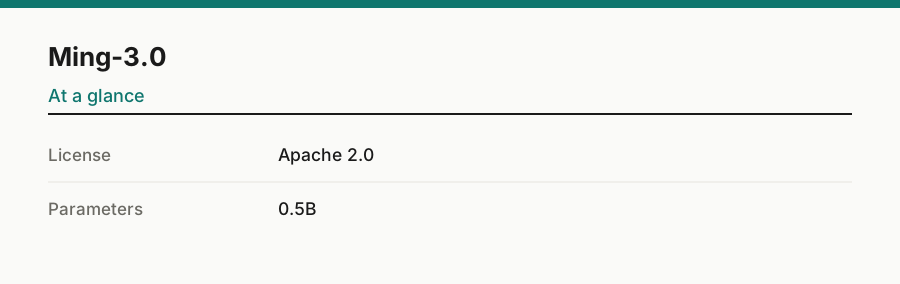
A: The Ming-3.0 series models have been open-sourced on Hugging Face, and the specific open-source license is based on the License marked on the model page. The previously open-sourced Ling series from Ant uses the Apache 2.0 license. For the licensing terms of Ming-3.0, please check the License declarations for each model on the Hugging Face model collection page.
9. Project Links
- Online Experience Platform: https://ling.tbox.cn (Ling Studio Chat, select Ming-3.0-audio-flash for experience)
- Hugging Face Model Repository: https://huggingface.co/collections/inclusionAI/ming-30 (model weights and documentation)
Related
FLUX 3 Max – In-Depth Review of the Video Generation Model from fal and Black Forest Labs
FLUX 3 Max is a post-training video generation model jointly developed by fal Research and Black Forest Labs, based on BFL's self-developed FLUX 3 multimodal foundation model. It supports three workfl...
GPT-Live-1.1 Review: In-Depth Analysis of OpenAI's New Full-Duplex Voice Model
GPT-Live-1.1 is a new voice model for ChatGPT introduced by OpenAI in 2025, succeeding the previous generation GPT-Live-1 as the "front-end engine" for voice interaction. It also introduces the lightw...
MiDashengLM-Spatial – Xiaomi's Open-Source Spatial Audio Understanding Large Model
MiDashengLM-Spatial is an open-source spatial audio understanding large model developed by Xiaomi's Dasheng team. It is the first industry-leading end-to-end model that unifies general audio understan...
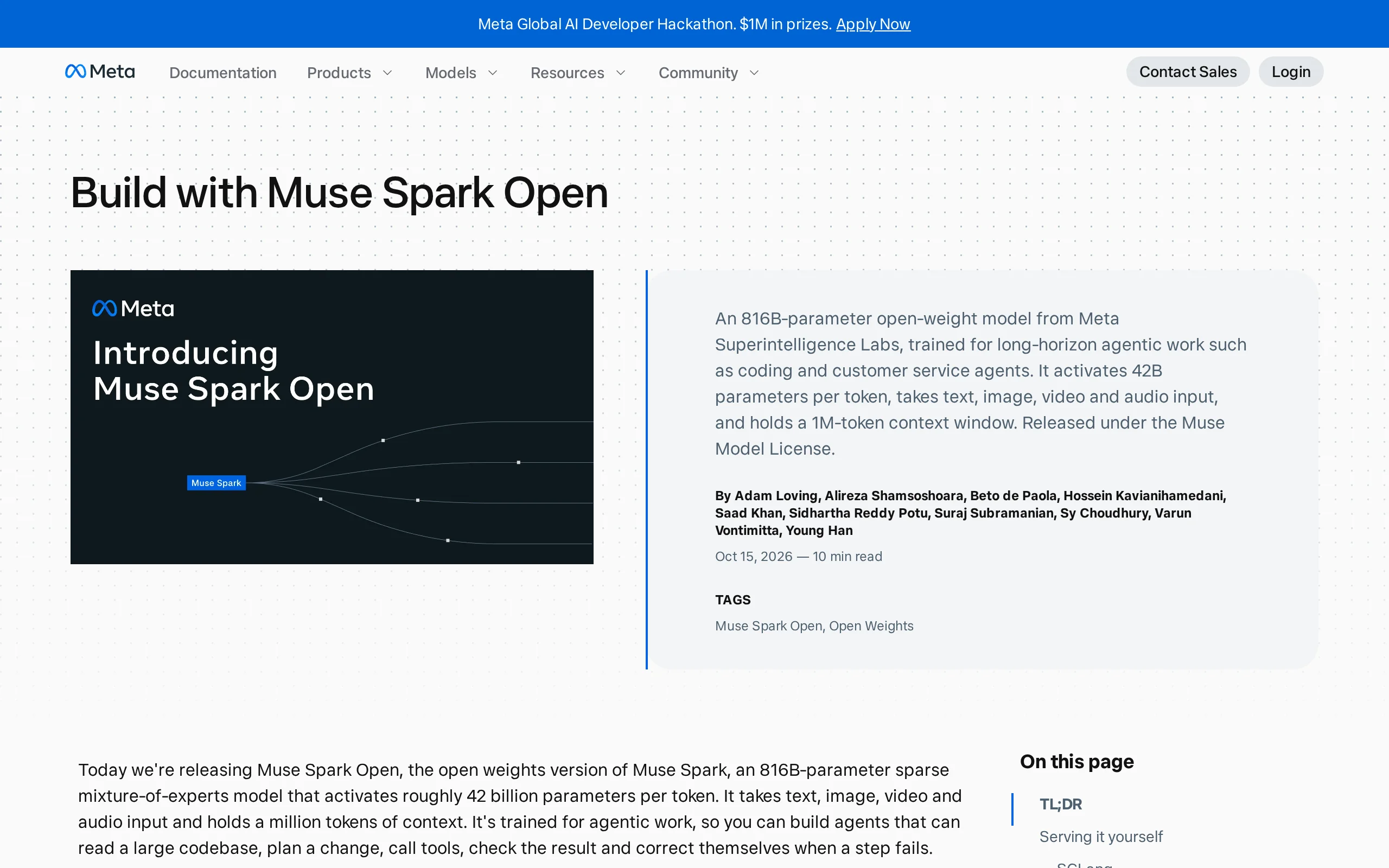
Muse Spark Open – In-Depth Review of Meta's Open-Source Multimodal Large Model
Muse Spark Open is Meta's latest open-source multimodal large model, built using a sparse Mixture-of-Experts (MoE) architecture. It has a total parameter count of 816 billion, with only 420 billion pa...
© All Rights Reserved. Some content on this site is partially generated by AI with human review.