
FLUX 3 Max – In-Depth Review of the Video Generation Model from fal and Black Forest Labs
Executive Summary:
FLUX 3 Max is a post-training video generation model jointly developed by fal Research and Black Forest Labs, based on BFL's self-developed FLUX 3 multimodal foundation model. It supports three workfl...
1. What is FLUX 3 Max
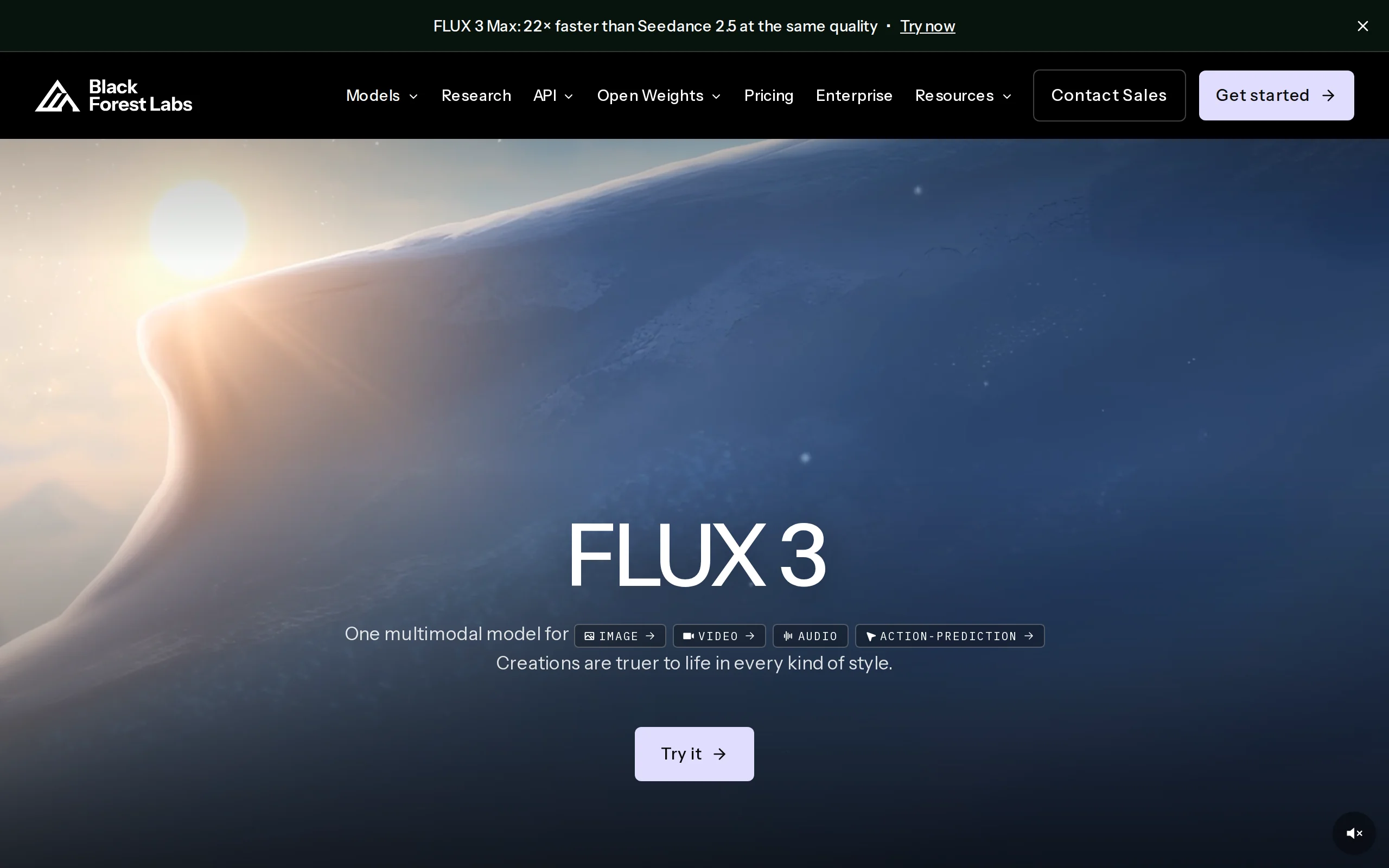
FLUX 3 Max is a post-training video generation model jointly developed by fal Research and Black Forest Labs, based on BFL's self-developed FLUX 3 multimodal foundation model. It supports three workflows: text-to-video, image-to-video, and keyframe interpolation, and can generate video content ranging from 5 to 20 seconds in duration, with a maximum resolution of 1080p and native audio. This model emphasizes extreme inference speed and cost efficiency, completing a 10-second video in approximately 12 seconds. The official claims it is 22 times faster than Seedance 2.5 under the same visual quality. FLUX 3 Max is positioned as a high-quality, low-cost, and high-efficiency commercial video generation solution, aiming to widely deploy cutting-edge video generation capabilities through standardized API formats.
Technical positioning and domain: FLUX 3 Max belongs to the video generation subfield within the artificial intelligence content generation (AIGC) domain, specifically focusing on post-training efficiency optimization for multimodal video diffusion models. Built upon BFL's FLUX 3 foundation model, this model significantly reduces sampling steps through techniques such as distillation and pruning, compressing inference latency to the second level with minimal loss in visual quality. It is a commercial video generation model specialized in efficiency.
Development background: This model was jointly developed by fal Research and Black Forest Labs. Black Forest Labs (BFL) is a company founded by the core team behind Stable Diffusion, with deep expertise in diffusion models for image and video generation. fal Research focuses on AI inference infrastructure and model deployment optimization. Their collaboration aims to create a video model that maintains top-tier visual quality while offering exceptional speed and low cost, addressing the urgent market demand for real-time generation and large-scale commercial applications.
Core value: FLUX 3 Max addresses the current pain point in the video generation field where quality, speed, and cost are difficult to balance. By specializing in post-training efficiency and employing the Draft mode, it significantly reduces the computational cost per generation while maintaining high-quality output, transforming video generation from an experimental tool into a production-level service suitable for large-scale commercial use. Its native audio generation capability eliminates the need for post-production voiceover, greatly shortening the production pipeline from concept to final output.
Technical features: The multimodal unified architecture allows image, video, audio, and text to share a common representation space, with each modality enhancing the others' capabilities; the Self-Flow alignment method offers lower generation error and higher control success rates compared to traditional Flow Matching; it is output through fal's unified API and has already been integrated into 17 platforms including Comfy, OpenRouter, Runware, and HeyGen, demonstrating strong ecosystem distribution capabilities.
2. Key Features
Draft Mode: Quickly generate preview drafts at extremely low cost. After users confirm they are satisfied with the composition, motion, and style, they can render the full-quality final video with one click using the same prompt. This mode reduces trial-and-error costs to a fraction of traditional workflows, making it especially suitable for scenarios like advertising and marketing that require extensive iterative creative validation, effectively lowering the cost of experimentation on the creation side.
Image-to-Video and Keyframe Interpolation: Supports inputting a reference image as the starting frame and specifying an ending frame, enabling controlled generation between the first and last frames. This feature grants creators precise control over the direction of the shot and the pacing of the narrative, offering high practical value in scenarios such as film previsualization, storyboard design, and product motion demonstrations that require structured storytelling.
Native Audio Generation and Audio-Visual Synchronization: The model natively generates accompanying audio and lip-sync dialogue, eliminating the need for post-production voiceover and audio synthesis. This capability bridges the visual and auditory modalities, ensuring that the generated videos are complete, integrated audio-visual products at delivery, significantly simplifying the complex process of separating and handling video and audio in traditional video production.
Extreme Speed Optimization: A 10-second video is generated in approximately 12 seconds. The official claims that, at the same visual quality, it is 22 times faster than Seedance 2.5. Its speed surpasses most real-time video generation requirements, making the "think-as-you-go, instant iteration" workflow possible and greatly enhancing the efficiency of the creative process.
Flexible Output Specifications: Supports resolution selection between 720p and 1080p, allows setting generation durations between 5–20 seconds, and enables toggling of native audio. The model provides a unified API calling interface through platforms like FAL, allowing developers to switch output specifications and generation parameters as needed, adapting to varying quality requirements from social media short videos to professional film content.
Unified Multimodal Understanding and Generation: Based on the FLUX 3 base model, the system shares a unified representation space across image, video, audio, and text modalities, with each modality enhancing the others. This architecture enables the model to deeply understand the semantic content of inputs, demonstrating high instruction-following capability when executing complex cross-modal generation tasks (such as generating a video with a specific emotional tone based on a text description and automatically matching it with background music).
3. How to Use
Environment Requirements and Prerequisites: FLUX 3 Max is a cloud-hosted model, and users can utilize it without requiring a local GPU environment. Before using, you must register for an account on the fal platform or on Black Forest Labs (BFL official website: https://bfl.ai/), and complete identity verification using an API key. For developers who wish to integrate the model into their own applications, basic RESTful API calling capabilities are required.
Select Generation Mode: After logging into the fal platform, choose the workflow mode on the FLUX 3 Max model page. Available modes include: text-to-video (inputting pure text prompts), image-to-video (uploading a starting frame image), and keyframe interpolation (uploading first and last frame images). Selecting the appropriate mode based on your creative needs is the first step toward achieving ideal output.
Input Materials and Parameter Configuration: In the text-to-video mode, you need to provide prompts describing the visual content, style, and camera movement. For image-to-video, upload a reference image and optionally select the "end frame" option to control the direction of the camera movement. Then, set the generation duration (5–20 seconds), resolution (720p or 1080p), and whether to generate audio simultaneously.
Draft Preview and Full-Quality Rendering: It is recommended to first enable the Draft mode to generate a low-cost preview version, allowing you to quickly confirm whether the composition and motion meet your requirements. Once satisfied with the draft, use the same prompts to initiate full-quality rendering for the final output, thereby maximizing the savings in computational costs.
API Integration and Third-Party Platform Compatibility: Production environment users can access the model's capabilities via the unified API provided by fal (API documentation available at fal.ai/docs), which supports batch generation, parameterized calls, and result feedback. Additionally, the model is already integrated with third-party platforms such as Comfy, OpenRouter, Runware, and HeyGen, enabling users to build automated generation workflows based on these platforms.
Notes and Best Practices: Prompts are recommended to be structured descriptions (subject + environment + camera movement + atmosphere) to improve the consistency of generation results; in the keyframe interpolation mode, the visual styles of the first and last frames should not differ too much, as this may affect the coherence of the intermediate transitions; for longer videos (15–20 seconds), it is advised to use the 1080p resolution to achieve more stable visual quality.
4. Pros and Cons Analysis
| Pros |
|---|
| First-tier visual quality: Tied for first place in the independent third-party Artificial Analysis image-to-video leaderboard (Elo score of approximately 1138), achieving top-tier video generation quality in the industry and meeting the needs of professional content production. |
| Exceptional generation speed: A 10-second video is generated in about 12 seconds. Officially claimed to be 22 times faster than Seedance 2.5 under the same visual quality, significantly reducing the waiting time from prompt to final output and greatly improving creative iteration efficiency. |
| Native audio-visual integration: Generates synchronized audio and character lip-sync dialogue, eliminating the need for post-production dubbing. This connects the production pipelines of video and audio modalities, significantly reducing post-production costs and time. |
| Draft mode cost compression: The draft mode quickly produces a preview version at a very low cost, and after confirmation, renders the full-quality version. This reduces the trial-and-error cost at the creation stage to a fraction of traditional workflows, significantly lowering the budget threshold for bulk creative testing. |
5. Comparative Analysis with Similar Tools
| Comparison Dimension | FLUX 3 Max | MiniMax H3 | Seedance 2.5 |
|---|---|---|---|
| Core Architecture | FLUX 3 multimodal unified foundation + efficiency-specialized distillation | Self-developed multimodal architecture with audio-visual joint modeling | ByteDance self-developed diffusion model architecture |
| Generation Duration | 5–20 seconds | 4–15 seconds | Up to 360 seconds (test version) |
| Resolution | Direct output of 720p / 1080p | Direct output of 768p, 2K requires secondary enhancement | Direct output of 1080p |
| Audio Capabilities | Native audio + synchronization of character dialogue and lip movements | Native 32kHz stereo + lip synchronization | Native audio generation |
| Generation Speed | A 10-second video is generated in about 12 seconds | Standard queue speed (faster version requires H3 Max variant) | Standard queue speed |
| Leaderboard Performance | Tied for first in image-to-video generation (about 1138 Elo) | Image-to-video about 1140 Elo, slightly leading overall | Close to the first tier |
| Reference Input | Images, start and end keyframes | Up to 9 images + 3 videos + 3 audio multimodal references | Text and images as primary inputs |
| Open Weights | No, only API calls available | Yes, H3-Base is open-sourced (Hugging Face) | No, only API |
| Distribution Ecosystem | fal unified API + Comfy/OpenRouter/Runware/HeyGen and other 17 platforms | Domestic platforms + overseas API | Dreamina AI + Volcengine API |
Selection Recommendations: If generation speed and single-call cost are the primary considerations, and the video duration requirement is within 20 seconds, FLUX 3 Max is currently the most efficient option in the market, especially suitable for e-commerce materials, advertising concept validation, and social media short videos in high-frequency iteration scenarios. The Draft mode can significantly reduce costs during large-scale creative screening, and this cost advantage is even more pronounced for teams that need to test dozens of creative directions simultaneously.
If flexibility in multimodal reference input and open weights are priorities, MiniMax H3 supports a rich combination of up to 9 images + 3 videos + 3 audio references, and H3-Base is already open-sourced, making it convenient for researchers to perform secondary development. Seedance 2.5, on the other hand, has unique capabilities in long-duration video generation, with the test version already supporting video outputs of up to approximately 360 seconds, making it ideal for content creators who need to generate complete narrative segments in one go and reduce the need for splicing. Veo 3 has a clear advantage in resolution, supporting up to 4K output, and is deeply integrated into the Google AI Studio and Vertex AI ecosystem, making it suitable for users who rely on ultra-high-definition visuals and the Google cloud ecosystem. Overall, FLUX 3 Max's competitiveness lies in achieving the optimal balance among the "speed-quality-cost" triangle, making it the most attractive option in scenarios that prioritize rapid video production and batch processing.
6. Editor's Summary
FLUX 3 Max demonstrates a design philosophy worthy of industry attention in terms of technological innovation. First, its post-training efficiency-specialized path based on a multimodal unified foundation significantly reduces the R&D cycle and training costs compared to training a new model from scratch, while inheriting the semantic understanding and cross-modal alignment capabilities accumulated in the FLUX 3 base model. Second, the application of the Self-Flow alignment method enables the model to outperform traditional Flow Matching approaches in terms of generation error and control success rate, offering a novel technical route for precise control in video diffusion models. Third, the engineering design of the Draft mode embeds the concept of "preview first, refine later" into the product layer, which is a relatively rare and highly practical innovation in video generation tools.
In terms of practical value, the release of FLUX 3 Max significantly lowers the price threshold for high-quality video generation. With its performance metric of generating a 10-second video in 12 seconds, it makes interactive creation methods such as "instant generation and instant modification" feasible. For scenarios highly sensitive to cost and timeliness, such as advertising and marketing, e-commerce content production, and short video creation, this model provides commercially viable solutions. Its native audio generation capability also effectively reduces the manual processing involved in audio-visual separation, making the content delivery pipeline more compact.
The target audience suitable for integrating FLUX 3 Max into their toolchain includes: e-commerce operations teams needing to rapidly produce large volumes of video materials, advertising creative agencies, self-media content creators, and developers looking to integrate video generation capabilities into their applications. For professional post-production professionals in the film and television industry who pursue the highest visual quality, the 1080p resolution limit may present some constraints. However, its speed advantages can still serve as an efficient auxiliary tool in the pre-visualization phase. As this model is gradually rolled out across 17 platforms and further optimized in subsequent versions, its depth and breadth of application in real business scenarios are highly anticipated.
7. Application Scenarios
E-commerce and Virtual Try-On: E-commerce teams can upload product images or model images to the model to generate dynamic display videos, replacing the traditional static image and text photography process. This mode can be used to create main image videos for product detail pages, ad投放 materials, and social media content for product seeding, significantly reducing the production cost and cycle of e-commerce video assets. With the ability to control the first and last frames in image-to-video generation, effects such as dynamic movement of clothing and multi-angle rotation of products can be achieved, enhancing consumer confidence in purchasing decisions.
Advertising and Brand Marketing: Brands can generate dynamic Logo presentations, product texture close-up shots, and conceptual promotional short videos using the text-to-video mode with just one click. The Draft mode allows creative teams to test multiple creative directions in bulk at extremely low cost, quickly converging on the optimal solution before rendering the full-quality version, reducing the campaign launch cycle from traditional weeks to just a few days.
Film Storyboarding and Previsualization: Directors and screenwriters can directly convert script text into dynamic storyboarding videos, enabling rapid validation of visual language, pacing, and style during the early stages of a project. Image-to-video and keyframe interpolation modes can be used to generate continuous scene transition shots, helping production teams establish clear visual references before formal filming, effectively reducing communication costs and the likelihood of rework during the filming phase.
Education and Explanation Videos: Educational content creators can input teaching topics and descriptions of key points, and the model will generate video content such as whiteboard animations and visual demonstrations of concepts and principles, while simultaneously producing voiceovers and lip-sync dialogues. This significantly lowers the barrier to entry and time investment for creating course videos. Native audio synchronization enables teachers to obtain complete explanation videos without the need for additional voice recording, benefiting the large-scale production of online educational content.
8. FAQ
Q: What is the difference between FLUX 3 Max and the FLUX 3 base model?
A: FLUX 3 Max is a performance-optimized version of the FLUX 3 base model, developed by fal Research and Black Forest Labs through post-training. Both models share the same underlying multimodal architecture and knowledge base, but the Max version significantly reduces sampling steps and computational overhead using techniques like distillation. This allows it to generate videos at a speed approaching "12 seconds for a 10-second video," with minimal loss in visual quality. In short, FLUX 3 focuses on the full presentation of multimodal capabilities, while FLUX 3 Max emphasizes inference efficiency and commercial deployment.
Q: What is the difference between the Draft mode and full-quality rendering?
A: Draft mode uses a lower computational load to quickly generate a preview draft, which can be used to verify whether the composition, main subject actions, and overall style meet expectations. The cost of Draft mode is much lower than full-quality rendering. Once satisfied with the draft, you can use the same prompt to initiate full-quality rendering and obtain a complete video at 720p or 1080p resolution. Both modes use the same set of prompts and parameter settings. The purpose of the draft phase is to low-costly explore creative directions and avoid unnecessary computational costs by directly using full-quality rendering.
Q: What input formats does FLUX 3 Max support?
A: The model supports three input formats: pure text prompts (text-to-video), reference images (image-to-video, using the image as the starting frame), and a combination of start and end keyframes (keyframe interpolation, generating transition content between two frames). The image-to-video and keyframe interpolation modes also allow for an optional end-frame image, providing more precise control over the camera direction and final composition of the video. This is particularly suitable for generation tasks requiring strong narrative structure.
Q: Do the generated videos include audio? Can they be generated using Chinese prompts?
A: FLUX 3 Max natively supports audio generation, including ambient sounds, background music, and character dialogue, with synchronized lip movements, eliminating the need for post-production dubbing. Regarding prompts, the model's unified multimodal foundation has strong cross-lingual semantic understanding capabilities, allowing it to generate videos directly using Chinese prompts. However, for prompts involving professional terminology or culturally specific expressions, it is recommended to use bilingual (Chinese and English) descriptions to improve generation accuracy.
Q: How can I integrate FLUX 3 Max into my own application or workflow?
A: You can uniformly call FLUX 3 Max via the fal platform's API (see API documentation at fal.ai/docs). It supports programmatic parameter configuration, batch generation, and result callbacks. The model is also available on 17 third-party platforms, including Comfy, OpenRouter, Runware, and HeyGen. Developers can integrate video generation capabilities using these platforms. The specific integration process is as follows: register for a fal account to obtain an API key, read the API documentation to determine the request parameter format, and then write the calling code or use pre-built nodes from the third-party platforms to complete the integration.
9. Project Links
- Black Forest Labs official website: https://bfl.ai/
- fal platform entry: https://fal.ai/
- FLUX 3 Max model page: https://bfl.ai/models/flux-3-video#flux-3-max
- fal API documentation: https://fal.ai/docs
Related
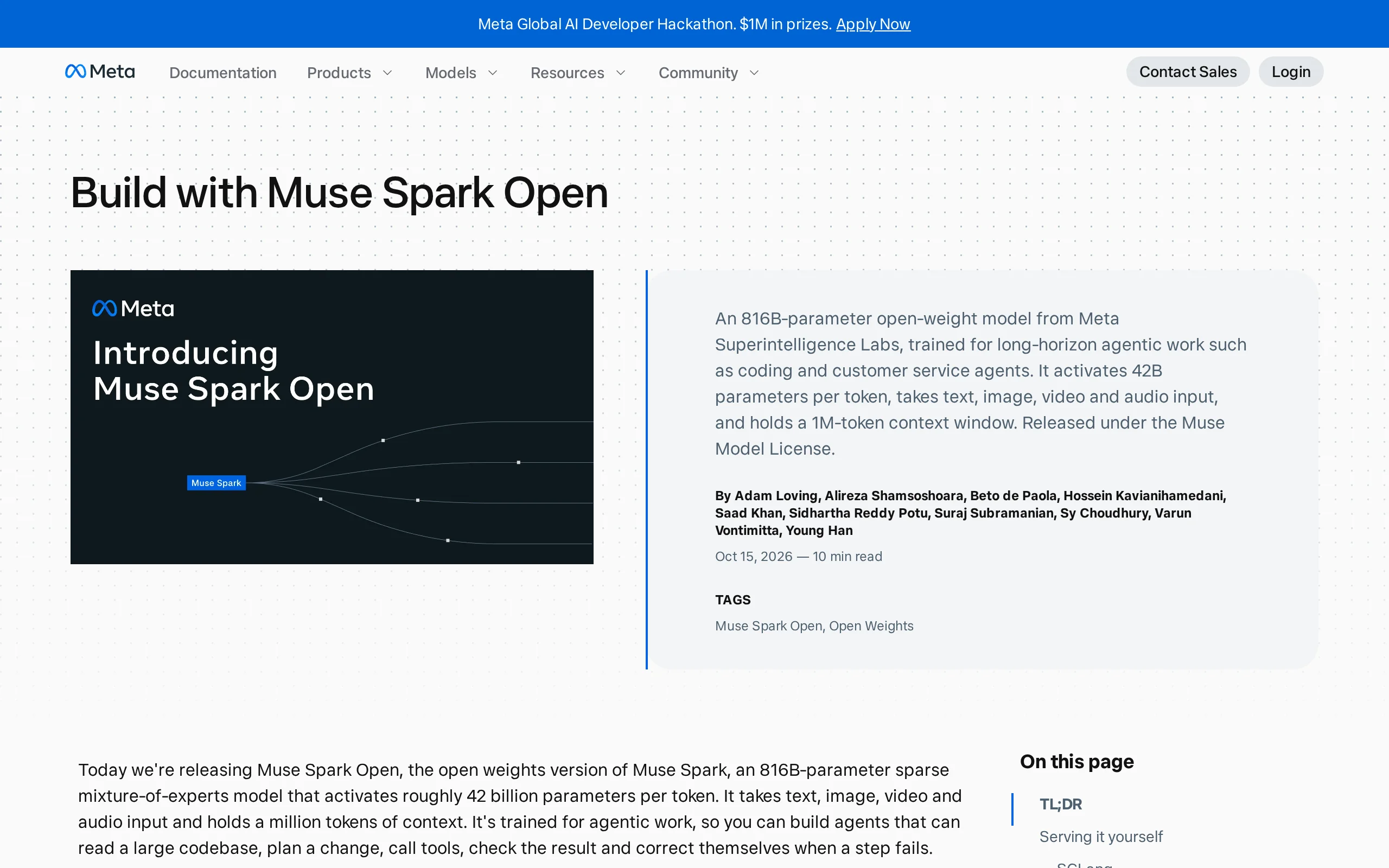
Muse Spark Open – In-Depth Review of Meta's Open-Source Multimodal Large Model
Muse Spark Open is Meta's latest open-source multimodal large model, built using a sparse Mixture-of-Experts (MoE) architecture. It has a total parameter count of 816 billion, with only 420 billion pa...
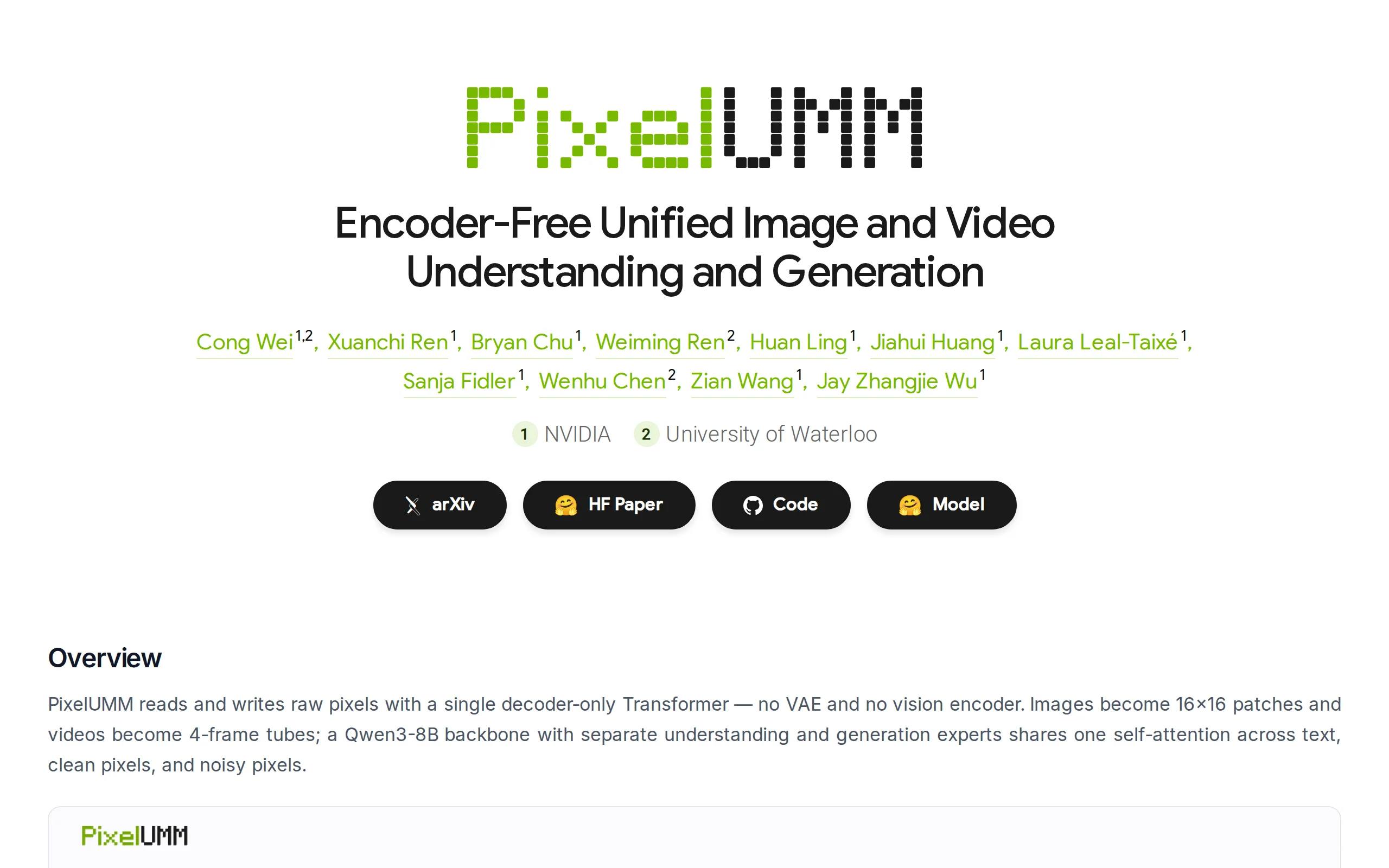
In-Depth Review of PixelUMM: NVIDIA and the University of Waterloo's Encoder-Free Unified Multimodal Model
PixelUMM is an encoder-free unified multimodal model jointly developed by NVIDIA and the University of Waterloo. Its core innovation lies in completely eliminating the VAE and visual encoder from trad...
Mistral Large 4 – Mistral AI's Most Flagship Open-Source Large Model
Mistral Large 4 is the latest flagship open-source large model launched by Mistral AI, a French artificial intelligence company, and is nicknamed "Le Chonk" (the chubby cat). This model employs a fine...
EmbeddingGemma 2 – Review of Google's Open-Source Native Multimodal Embedding Model
EmbeddingGemma 2 is an open-source native multimodal Embedding model developed by Google, built upon the Gemma 4 architecture. It unifies five modalities—text, code, images, video, and audio—into a si...
© All Rights Reserved. Some content on this site is partially generated by AI with human review.