
In-Depth Review of PixelUMM: NVIDIA and the University of Waterloo's Encoder-Free Unified Multimodal Model
Executive Summary:
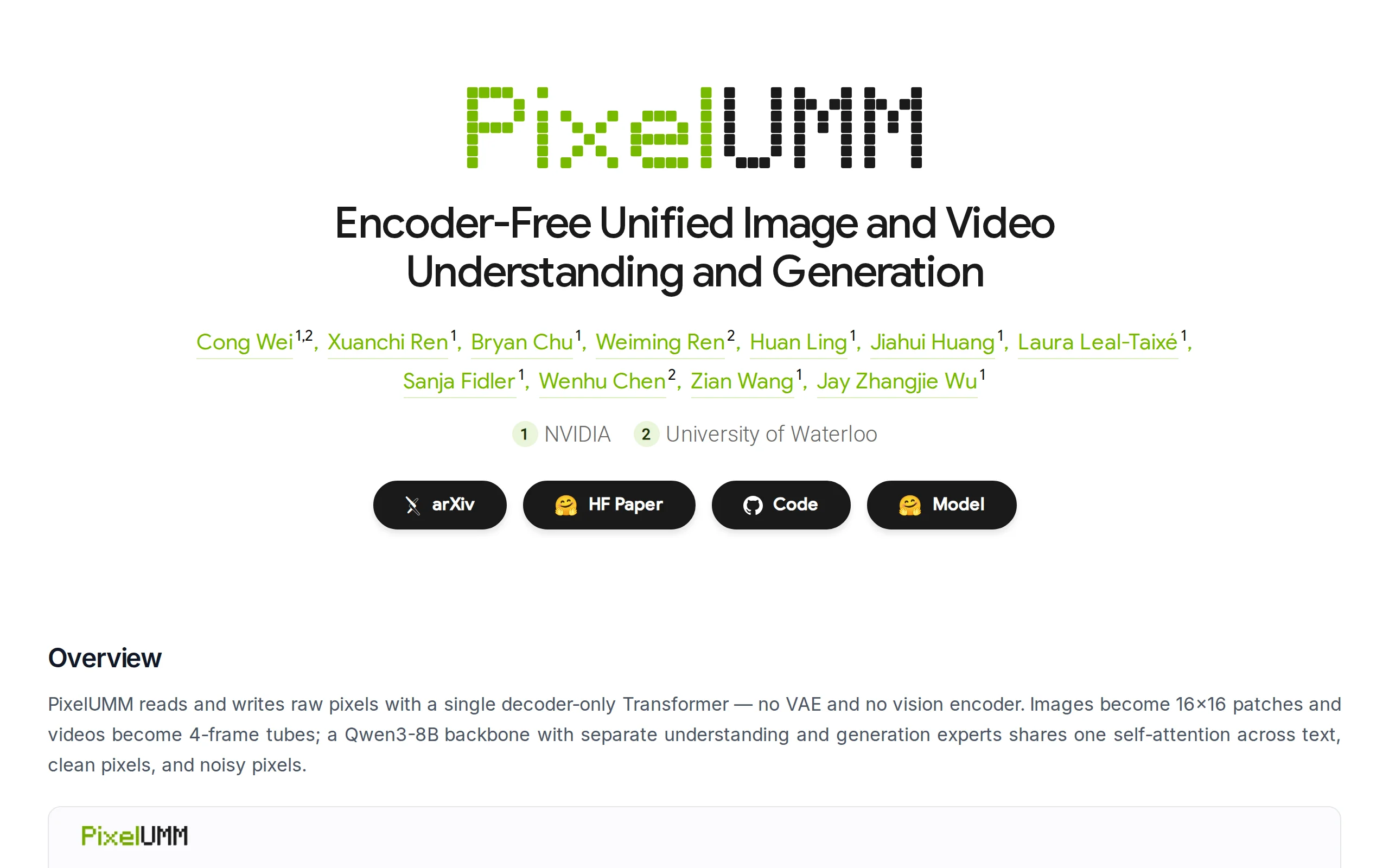
PixelUMM is an encoder-free unified multimodal model jointly developed by NVIDIA and the University of Waterloo. Its core innovation lies in completely eliminating the VAE and visual encoder from trad...
1. What is PixelUMM
PixelUMM is an encoder-free unified multimodal model jointly developed by NVIDIA and the University of Waterloo. Its core innovation lies in completely eliminating the VAE and visual encoder from traditional multimodal systems, constructing a pure Decoder-only Transformer architecture that directly reads and writes images and videos in the original pixel space. The model splits images into 16×16 patches and videos into 4-frame tubelets, with both understanding and generation tasks sharing the same decoder and self-attention mechanism. This achieves end-to-end pixel-level information processing, and the code has been fully open-sourced.
Technical Positioning and Domain: Belongs to the field of Multimodal Large Language Models (MLLM), covering six core tasks: text-to-image (T2I), text-to-video (T2V), image understanding, video understanding, image-to-video (I2V), and video editing. Its unique positioning is the introduction of the "Encoder-Free" architecture paradigm, pushing the design of unified multimodal models toward minimalism.
Development Background: Developed in collaboration between NVIDIA's research team and the University of Waterloo, based on Qwen3-8B as the backbone network to build the Mixture-of-Transformers (MoT) structure. The motivation for development stems from a critical reflection on the information loss, architectural complexity, and training instability caused by VAEs and visual encoders in existing unified multimodal models (such as Emu3, Chameleon, Show-o), aiming to explore a simpler and more efficient path.
Core Value: Addresses the core pain points of traditional unified multimodal models, such as information loss due to latent space encoding/decoding, lengthy inference pipelines, and complex module coupling. By removing all encoders, PixelUMM shortens the generation pipeline to "pixel input → Transformer → pixel output," and experiments have shown that training in the pixel space is more stable than in the VAE space. Ablation experiments also demonstrate that its compression rate and gradient norm achieve an ideal balance.
Technical Features: Utilizes a Mixture-of-Transformers architecture to enable collaboration between understanding and generation experts—both have independent FFNs but share the same self-attention mechanism, allowing text, clean pixels, and noisy pixels to interact within the same attention space. An 8B model achieves the same level of loss with only one-third of the training steps required by a 1.7B model, showcasing clear scaling benefits and training efficiency advantages.
2. Key Features
Text-to-Video (T2V): Supports generating videos up to 832×464 resolution, 96 frames, and 24fps in a 4-second duration, with visual quality comparable to mainstream video diffusion models (e.g., Wan series). This feature is directly trained using pixel-space flow-matching, bypassing the VAE decoding stage, resulting in a shorter generation pipeline and stable quality.
Text-to-Image (T2I): Generates images directly within the same model, without requiring a separate image generation branch or dedicated decoder. A linear output head directly regresses pixel values, supporting flexible resolution settings and enabling the production of high-quality natural images.
Image Understanding: Covers 21 image understanding tasks, including VQA, OCR, chart parsing, and document understanding, achieving performance on par with average 8B-level Vision-Language Models (VLMs). Specific benchmarks include OCRBench 78.0, DocVQA 90.4, and ChartQA 82.96, supporting a variety of enterprise-level document intelligence scenarios.
Video Understanding: Supports mainstream video question-answering benchmarks such as MVBench and Video-MME, offering both dense and sparse input modes to accommodate different computational resource and accuracy requirements. The video is split into input tubelets of 4 frames each, maintaining temporal coherence while controlling the token count.
Image-to-Video (I2V): A clean first-frame image can be injected as a condition into the understanding expert to generate subsequent video frames, without requiring VAE encoding of the conditional frame. This design significantly simplifies the I2V process, only requiring the reference image information to be passed to the generation expert via shared attention.
Video Editing: Uses the input video as a visual condition to perform editing tasks through a multi-modal context conditioning mechanism. Ablation experiments show that this design does not impair the original understanding capability and improves performance by 0.89–3.49 points across four video benchmarks.
3. How to Use
Environment Setup: Clone the official repository
git clone https://github.com/nv-tlabs/PixelUMM, and configure the CUDA environment according to theENVIRONMENT.mddocument inside the repository. You will need an NVIDIA GPU (recommended with at least 24GB VRAM) and the PyTorch deep learning framework.Download Model Weights: Download the default checkpoint S8-F22-R05 from Hugging Face's
nvidia/PixelUMM, and also download the configuration file and tokenizer file for Qwen3-8B as specified in theCHECKPOINT.mddocument. These files must be stored in a local directory for the model to load them.Set Environment Variables: Define the three environment variables
PIXELUMM_CKPT,PIXELUMM_QWEN_DIR, andPIXELUMM_OUTPUT, which should point to the absolute paths of the checkpoint directory, Qwen3-8B directory, and output directory, respectively. This ensures the model can correctly load all components.Validation and Permissions: First, run
check_checkpoint.pyto verify the integrity of the weights and the compatibility of tensor dimensions. Then, apply for the security review permissions fornvidia/Cosmos-1.0-Guardrailon Hugging Face and complete the local login usinghuggingface-cli login. This step is a necessary prerequisite for performing inference.Inference Execution: Use
inference.pyand specify--task t2i(text-to-image),--task t2v(text-to-video),--task image-vlm(image understanding), or--task video-vlm(video understanding). Combine this with parameters such as prompt, resolution, and number of frames to generate content or output understanding results.Batch Processing and Training (Optional): Use
inference_batch.pyalong with a YAML file to execute tasks in bulk. If you wish to perform fine-tuning training, follow the instructions inTRAIN.mdto download the toy dataset, and run the multi-task joint training example usingtrain_toy.pybased on the F22 checkpoint.
4. Pros and Cons Analysis
| Pros |
|---|
| Fully Encoder-free Architecture: Removes VAE and visual encoder, directly reading and writing in the original pixel space, eliminating information loss from latent encoding/decoding while significantly simplifying the model structure and training process. |
| Unified Understanding and Generation: A single Decoder-only Transformer handles four core tasks—text-to-image, text-to-video, image understanding, and video understanding—allowing the understanding expert and generation expert to share the same self-attention mechanism for efficient collaboration. |
| Flexible Conditional Injection Design: Clean conditions such as reference images or input videos can be processed through the understanding expert alone to achieve image-to-video generation and video editing, without requiring additional encoders. The expansion method is simple and does not compromise the original understanding capabilities. |
| Clear and Scalable Training Patterns: An 8B model achieves the same level of loss with only about one-third the training steps required by a 1.7B model, indicating a clear scale-increasing return on investment and good scalability. |
| High Training Stability in Pixel Space: Ablation experiments confirm that the gradient norm in pixel space is almost the same as in VAE space, but the training process in pixel space is more stable. Compression rate experiments also validate the rationality of the patch and tubelet designs. |
5. Comparative Analysis with Similar Tools
| Comparison Dimension | PixelUMM (NVIDIA × University of Waterloo) | BAGEL (ByteDance) | Show-o (ByteDance) |
|---|---|---|---|
| Core Architectural Philosophy | Encoder-Free: Completely remove VAE and visual encoder, enabling end-to-end read/write in pixel space | WAN-based VAE + SigLIP visual encoder, diffusion generation in latent space | VQ-VAE + autoregressive generation, unified understanding and generation with discrete tokens |
| Backbone Network | Qwen3-8B | Qwen2.5-7B-Instruct | 7B-level LLM |
| Total Parameter Count | 15.2B (MoT, dense activation) | 14B MoE (about 7B activation per token) | Approximately 7B dense |
| Visual Tokenization | Image 16×16 patch, video 4-frame tubelet (p16/t4), raw RGB input directly | Compressed to latent via VAE, then projected using patchify | Discrete encoding via VQ-VAE, images converted to discrete token sequences |
| Output Method | Lightweight linear head directly regresses pixels (12.6M parameters) | Pixel reconstruction via VAE decoder | Pixel reconstruction via VQ-VAE decoder |
| Supported Tasks | T2I, T2V, image understanding, video understanding, I2V, video editing | T2I, T2V, I2V, image understanding, image editing, video editing | T2I, image understanding, VQA |
| Image Understanding MMMU | 41.67 | 55.30 | To be officially announced |
| Image Understanding AI2D | 80.12 | 89.20 | To be officially announced |
| Image Understanding ChartQA | 82.96 | 78.50 | To be officially announced |
| Image Understanding CountBench | 94.30 | 82.50 | To be officially announced |
| Open Source License and Ecosystem | Open source, GitHub + HuggingFace, new ecosystem under development | Open source, with high community activity | Open source, primarily for academic use |
Selection Recommendations: If the core requirement is unified multimodal generation and understanding capabilities, and there is a preference for architectural simplicity and end-to-end pixel-level processing, PixelUMM's Encoder-Free design offers unique value. Its video understanding and generation capabilities stand out among models of similar scale, making it particularly suitable for scenarios requiring lightweight deployment and where extremely high image understanding accuracy is not essential. If image understanding accuracy is the primary concern, BAGEL from ByteDance leads significantly on the MMMU and AI2D benchmarks, and its MoE architecture provides more efficient inference performance at the same parameter scale. For academic research and architectural innovation exploration, PixelUMM's pixel-space training paradigm and MoT shared attention design offer new research perspectives. However, for industrial applications that rely on a mature ecosystem, the community accumulation of BAGEL and Show-o may provide greater advantages.
6. Editor's Summary
PixelUMM has made a noteworthy exploration in the design philosophy of unified multi-modal models. From a technical perspective, it dares to "do subtraction" — completely removing the VAE and visual encoder, returning to pixel-level end-to-end processing. This decision is strongly supported by ablation experiments: the gradient norms in the pixel space and VAE space are almost identical, and training stability is actually better. The design of the Mixture-of-Transformers architecture also shows ingenuity, with understanding experts and generation experts collaborating through shared self-attention mechanisms. This approach maintains task specialization while enabling information exchange, and the conditional injection mechanism does not compromise understanding capabilities, even delivering positive gains on video benchmarks.
In terms of practical value, PixelUMM covers six multi-modal tasks with its 15.2B parameter MoT dense model, showing usable performance in video generation, image generation, image understanding, and video understanding. Its comprehensive capabilities in video understanding and generation are highly competitive among open-source models. The training efficiency data (reaching the same loss with an 8B model in just 1.7B training steps, roughly a third of the required steps) also indicates a clear path for scaling. However, it's important to note that its performance on complex image reasoning tasks (such as MMMU, AI2D) lags behind competitors like BAGEL. The grid artifacts introduced by the linear output head also require resolution through the replacement with a convolutional head, which adds extra costs to real-world deployment.
PixelUMM is suitable for developers interested in architectural innovation, enterprise users who require unified multi-modal processing capabilities and have sufficient hardware resources, as well as creators with clear needs for video generation and understanding. Its open-source strategy provides the community with a reproducible template for training unified multi-modal models in the pixel space. In the future, as the community ecosystem expands and output head optimizations progress, this Encoder-Free approach is likely to demonstrate value in more scenarios. However, improving the accuracy of image understanding remains a challenge that needs to be continuously addressed.
7. Application Scenarios
Short Video Content Creation: Input a single line of text to directly generate a video up to 4 seconds long, with a resolution of 832×464 and 24fps, suitable for scenarios requiring rapid production of visual content such as social media and advertising marketing. Creators do not need professional video editing skills to obtain a finished product with visual quality comparable to mainstream video diffusion models.
Image-to-Video and Video Editing: Using the first frame image or original video as a condition, dynamically present and modify content through a multi-modal context conditioning mechanism. It can be used for dynamic product displays in e-commerce (converting static product images into dynamic demonstration videos), film previsualization (expanding storyboard images into dynamic clips), and other creative workflows.
Long Video Understanding and Q&A: Describe, summarize, and perform temporal reasoning on input videos, supporting both dense and sparse input modes to accommodate different precision and computational requirements. Applicable to scenarios such as content moderation (automatically identifying video content), media retrieval (searching video clips by semantics), and meeting notes (extracting key points from recordings).
Document and Chart Analysis: With scores of 78.0 on OCRBench and 90.4 on DocVQA, it supports intelligent enterprise document scenarios such as invoice recognition, report Q&A, and contract information extraction. Simply input scanned documents or charts into the model to obtain structured understanding and responses.
8. FAQ
Q: What is the core difference between PixelUMM and traditional unified multimodal models (such as Emu3, Chameleon)?
A: The core difference lies in the fact that PixelUMM completely removes the VAE and visual encoder, performing end-to-end read and write operations directly in the original pixel space. In contrast, models like Emu3 and Chameleon use VQ-VAE to convert images into discrete tokens. PixelUMM's design eliminates information loss during latent space encoding and decoding, and does not require training an additional discrete codebook, resulting in a more streamlined architecture.
Q: What are the memory requirements for PixelUMM? Can it run on consumer-grade GPUs?
A: The total parameter count of the model is 15.2B (MoT dense activation). Generating videos and images requires significant GPU memory. The official recommendation is to use a GPU with at least 24GB of memory (such as the RTX 4090) for inference. Consumer-grade GPUs with 16GB of memory can attempt image understanding and text-to-image tasks, but video generation may result in memory overflow. It is recommended to use cloud GPUs or professional-grade GPUs.
Q: Why does the default linear output head introduce 16-pixel grid artifacts? How can this be resolved?
A: The linear output head directly regresses hidden states into pixel values, lacking local spatial modeling capabilities, which leads to regular artifacts at the patch boundary (16×16 pixels). Official experiments show that using a Wan-style upsampling convolutional head or a PixelShuffle head can eliminate these artifacts. Among these, the time-priority PixelShuffle head offers the best trade-off between training loss and artifact suppression. Switching the output head requires retraining the model.
Q: What license does PixelUMM use? Can it be used for commercial purposes?
A: The code and model weights of PixelUMM have been open-sourced on GitHub and HuggingFace. The specific license is determined by the LICENSE file in the repository. Additionally, during usage, you must apply for and comply with the access permissions and terms of the nvidia/Cosmos-1.0-Guardrail safety review tool. It is recommended to carefully review the relevant license agreements before commercial use.
Q: Can PixelUMM run on a CPU?
A: Technically, it can run on a CPU, but the inference speed of a 15.2B parameter model on a CPU is extremely slow, especially for video generation tasks that require heavy matrix computations, making it nearly impractical. The official environment configuration explicitly requires a CUDA environment, so it is strongly recommended to use an NVIDIA GPU for inference.
Q: How do I apply for access to Cosmos-1.0-Guardrail?
A: You need to log in to Hugging Face, navigate to the nvidia/Cosmos-1.0-Guardrail model page, click to apply for authorization and agree to the relevant terms, and then wait for approval. Before running PixelUMM, you must complete local authentication using huggingface-cli login.
9. Project Links
- Project Website: https://nv-tlabs.github.io/PixelUMM/
- GitHub Repository: https://github.com/nv-tlabs/PixelUMM
- HuggingFace Model Library: https://huggingface.co/nvidia/PixelUMM
- arXiv Technical Paper: https://arxiv.org/pdf/2609.38597
Related AI Model Articles
Mistral Large 4 – Mistral AI's Most Flagship Open-Source Large Model
Mistral Large 4 is the latest flagship open-source large model launched by Mistral AI, a French artificial intelligence company, and is nicknamed "Le Chonk" (the chubby cat). This model employs a fine...
EmbeddingGemma 2 – Review of Google's Open-Source Native Multimodal Embedding Model
EmbeddingGemma 2 is an open-source native multimodal Embedding model developed by Google, built upon the Gemma 4 architecture. It unifies five modalities—text, code, images, video, and audio—into a si...
Nano Banana 2.1: In-Depth Review of Google DeepMind's Image Generation and Conversational Editing Model
Nano Banana 2.1 (Model ID: gemini-nano-banana-2.1) is the second-generation image generation and conversational editing model officially released by Google DeepMind on October 6, 2026. It belongs to t...
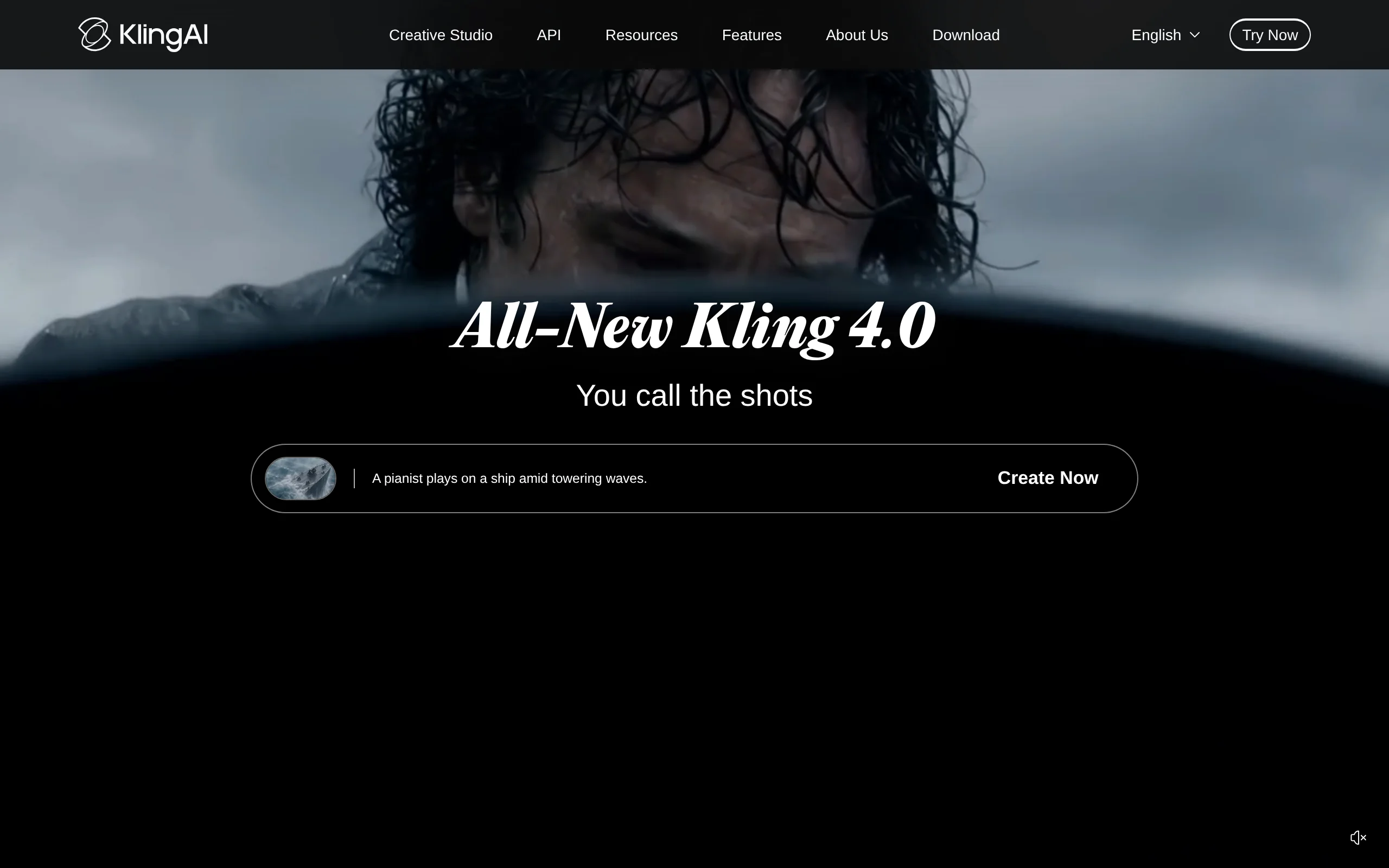
Kling 4.0 – A New Generation AI Video Generation Model Launched by Kuaishou
Kling 4.0 is the latest generation video generation model introduced by Kuaishou's Keling AI. The lightweight version, Kling 4.0 Flash, is now open for early access, with the full version expected to ...
© All Rights Reserved. Some content on this site is partially generated by AI with human review.