
Microsoft-Decision-1: In-Depth Review of Microsoft's New Generation Fast Decision-Making AI Model
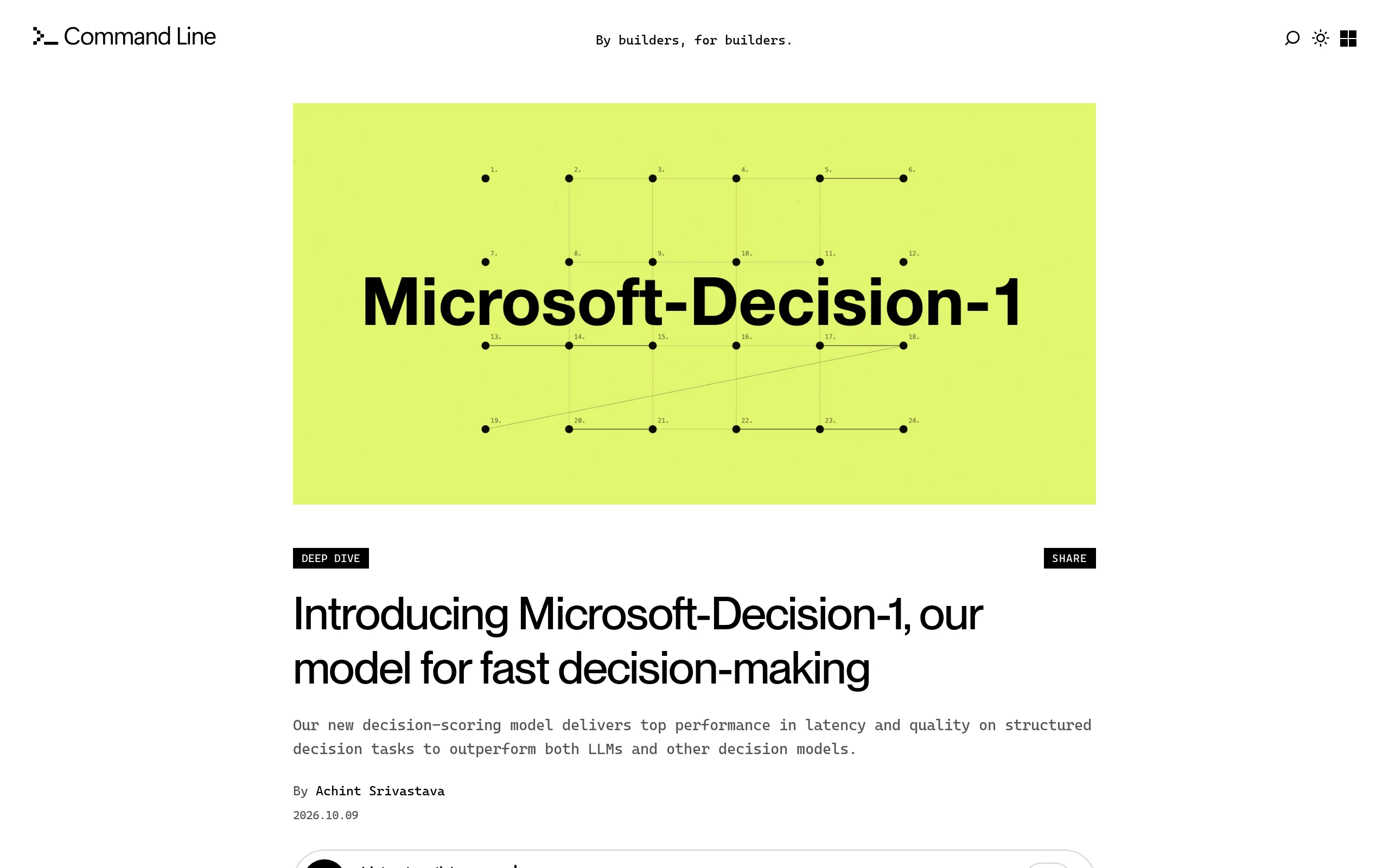
Executive Summary:
Microsoft-Decision-1 is a fast decision-making AI model developed by Microsoft, specifically designed for structured decision-making tasks. It is capable of identifying the optimal solution from a set...
1. What is Microsoft-Decision-1
Microsoft-Decision-1 is a fast decision-making AI model developed by Microsoft, specifically designed for structured decision-making tasks. It is capable of identifying the optimal solution from a set of predefined options and assigning a probability score to each candidate answer, enabling downstream applications to determine whether to execute, retry, or escalate to a human. Built upon the open-source Qwen3.5-9B architecture, the model ranks first in accuracy across 36 benchmark tests. Its inference speed reaches 35 times that of GPT-6 Sol, with an input cost of only $0.042 per million tokens and free output. It has officially launched on the Microsoft Foundry platform, providing efficient and controllable decision-making capabilities for scenarios such as AI Agent, workflow orchestration, and intelligent routing.
Technical Positioning and Domain: Microsoft-Decision-1 belongs to the intersection of natural language processing and decision intelligence, focusing on transforming large language models into structured, fast decision engines. Unlike traditional open-ended generation models, it specializes in the task paradigm of "predefined options + optimal solution selection," using probabilistic scoring instead of free-text output, achieving lower latency and higher controllability in structured decision scenarios, and offering a new technical path for automated decision-making in AI systems.
Development Background: This model was developed and launched by Microsoft, based on the Qwen3.5-9B model widely used in the open-source community, with specialized post-training. Microsoft has long-term technical expertise in decision intelligence, and its research team has accumulated rich experience through the development of multiple large language models and Agent frameworks in the past. The release of Decision-1 aims to address the current pain points of large language models in decision tasks, such as high latency, uncontrollable outputs, and high costs, providing developers with a lightweight, efficient, and reliable decision infrastructure component. Microsoft plans to gradually migrate it onto its self-developed MAI series and OpenAI model foundations.
Core Value: Microsoft-Decision-1 addresses core issues in structured decision scenarios involving large language models, such as high inference latency, mismatched output formats, and poor decision consistency. By undergoing specialized post-training, the model is reshaped into a probabilistic scoring engine, allowing each decision request to be completed with a single forward pass, compressing P50 latency to 1/35th of that of GPT-6 Sol, while reducing the cost of classification tasks by approximately 200 times. This "scorable, routable, and verifiable" decision mechanism provides AI systems with clear confidence metrics when executing critical actions, offering reliable support for building safe human-AI collaboration frameworks.
Technical Features: The model is specifically designed for robust decision-making, with an average decision flip rate of only 1.3% under eight types of input perturbations, and a zero flip rate in scenarios involving option description rewriting or order reversal. It has also passed a comprehensive safety test covering 11 benchmarks and 5,250 requests, addressing scenarios such as harmful content detection, jailbreak attacks, and prompt injection, ensuring high safety while maintaining strong performance on normal tasks.
2. Key Features
Optimal Solution Selection: Automatically filters the best answer from a set of predefined candidate options, while simultaneously outputting a probability score for each alternative. This feature enables the model to not only provide the final decision but also offer confidence information about that decision, allowing downstream systems to perform fine-grained control based on probability thresholds. It is a core capability for achieving explainable AI decision-making.
Routing Distribution: Smartly distributes user requests or task traffic to the most appropriate downstream module, service, or model. The model quickly determines the appropriate destination based on the structural characteristics of the input content, directing different types of tasks to their corresponding processing units. This optimizes the overall system resource allocation and response efficiency, making it ideal for intelligent traffic management in multi-model hybrid architectures.
Content Classification: Quickly categorizes text content to enable automated organization of large volumes of data. The Xbox team has already applied this model to classify tens of thousands of player feedback entries, significantly improving the efficiency and accuracy of user feedback processing and validating the model's practical value in real business scenarios.
Task Prioritization: Determines the processing order for multiple pending tasks, supporting automated sorting in scenarios such as customer service tickets, defect management, and task queues. The model evaluates tasks based on dimensions such as urgency and impact scope, providing a comprehensive score to help teams prioritize critical issues and achieve intelligent workflow orchestration.
Result Validation: Evaluates the quality of AI-generated results and determines whether they pass or require reprocessing. As an AI response assessor, the model scores the text or structured output generated upstream, providing decision-making input for multi-round generation and self-correction mechanisms, effectively enhancing the reliability of AI system outputs.
Workflow Control: As a workflow orchestration component for AI Agents, the model decides whether to continue execution, retry, escalate processing, or hand over to human review. By combining probability scores with business rules, the model constructs flexible decision-branch logic, enabling the Agent to autonomously make reasonable choices for the next action in complex scenarios.
3. How to Use
Platform Integration: Microsoft-Decision-1 is made available to developers through Microsoft's AI development platform, Microsoft Foundry. Users need to register for a Microsoft Foundry account and complete developer identity verification, then create a project instance in the platform console.
Define Decision Scenarios: Convert practical business tasks into structured decision problems with the format of "predefined options + selecting the optimal solution," such as routing distribution, content categorization, priority sorting, etc. Clearly define the candidate option set and its semantic boundaries to ensure the model accurately understands the differentiated meanings of each option.
Submit Requests: Submit the content to be decided in a structured format according to the platform's API specifications, including input text and a list of candidate options, and configure relevant scoring parameters, such as whether to return the probability distribution of all options or whether to enable temperature sampling.
Obtain Probability Scores: The model returns the optimal option along with probability scores for each alternative, rather than open-ended text generation results. Developers can obtain decision results by parsing the structured fields in the API response (such as
choiceandprobability).Drive Downstream Actions: Based on the probability scores, decide whether to execute, retry, escalate processing, or refer to manual review, and trigger the corresponding business logic. It is recommended to set reasonable probability thresholds (such as 0.6 or 0.8), and decisions below the threshold should be automatically referred to human handling.
Integrate into Workflows: Seamlessly integrate into existing applications, AI Agents, and workflow systems via standard API calls. The model is designed as a lightweight decision component that can collaborate with other Azure services and open-source Agent frameworks to achieve an end-to-end automated decision pipeline.
Notes: It is recommended to thoroughly test specific business scenarios before integrating into a production environment to verify the model's decision accuracy. For scenarios involving sensitive data, compliance with Microsoft's data policies must be followed. At the same time, pay attention to the model's input format requirements; unstructured or open-ended requests may not yield ideal decision outcomes.
4. Pros and Cons Analysis
| Pros |
|---|
| Extremely fast inference speed: P50 latency is 35 times that of GPT-6 Sol and 4.5 times that of Quyet-1.0-Large, making it one of the fastest decision-making models tested to date. It can meet the demands of high-concurrency, low-latency real-time decision-making. |
| Leading decision accuracy: Achieved first place in all 36 benchmark tests across nearly 150,000 questions, covering various types of decision tasks, demonstrating strong generalization ability and task adaptability. |
| Extremely low cost: Input cost is only $0.042 per million tokens, with output being free. Internal testing shows that classification task costs are approximately 200 times lower than GPT-6 Sol, significantly reducing the operational cost threshold for large-scale deployment. |
| Strong robustness: The decision flip rate averages only 1.3% under 8 types of perturbations, with zero flip rate in scenarios involving option description rewrites or reversed order, ensuring decision consistency is unaffected by input variations. |
| Comprehensive safety alignment: The model has undergone safety testing covering 11 benchmarks and 5,250 requests, addressing scenarios such as harmful content detection, jailbreak attacks, and prompt injection, achieving a balance between safety and practicality. |
5. Comparative Analysis with Similar Tools
| Comparison Dimension | Microsoft-Decision-1 | Jev (TypeSafe AI) | Quyet-1.0-Large |
|---|---|---|---|
| Model Category | Fast decision-making model, specialized in structured decision tasks | First System One decision model, integrated with RLCD training | Large-scale decision model, focused on heavy-duty decision scenarios |
| Technical Foundation | Based on Qwen3.5-9B fine-tuning, planned migration to MAI/OpenAI | Custom architecture + parallel sampler, RLCD calibrated decision reinforcement learning | Large-scale custom architecture, emphasizes long-context reasoning |
| Decision Speed | P50 latency is 35 times that of GPT-6 Sol and 4.5 times that of Quyet | End-to-end latency of 70–500ms, 40–200 times faster than LLMs on the same task | Moderate latency, higher latency in multi-round reasoning scenarios |
| Accuracy | Ranked first in all 36 benchmarks (nearly 150,000 questions) in Microsoft's internal testing | Official JevBench ranking of 3rd (71.49 points), widely validated in practical testing | High accuracy in long-context decision-making |
| Output Format | Best option + probability scores for all alternative answers | Typed answers with calibrated probabilities (Choice/Score/Noul) | Structured option output, supports explanatory text |
| Robustness | 1.3% flip rate under 8 types of perturbations, zero in option rewriting/reversal scenarios | Calibration is the core selling point, confidence aligns with accuracy | Stable performance under perturbation testing |
| Cost Pricing | Input: $0.042/million tokens, output: free | Input: $0.042/million tokens, output: free | Input: $0.10/million tokens, output: $0.40 |
| Ecosystem Integration | Microsoft Foundry open (OpenRouter in planning) | Official API + SDK, rich community ecosystem | Limited API access, early-stage ecosystem development |
Selection Recommendations: For developers requiring ultra-low latency, high-concurrency decision-making, and strong integration with the Microsoft Azure ecosystem, Microsoft-Decision-1 is currently a cost-effective option, especially in classification tasks and routing distribution scenarios, where its cost advantage is significant. For teams prioritizing highly calibrated confidence and typed outputs, Jev stands out with its RLCD training mechanism and rich open-source community ecosystem, offering superior performance in third-party validation and explainability, making it suitable for decision-making scenarios requiring third-party evaluation support.
Supplementary Notes: In long-context and complex reasoning decision scenarios, Quyet-1.0-Large may be more appropriate, although it has relatively higher latency and cost. GPT-6 Sol, as a general-purpose model, offers the highest flexibility, but it lacks speed and cost advantages in specialized decision tasks, making it more suitable for general-purpose platforms that need to handle a variety of tasks.
6. Editor's Summary
Microsoft-Decision-1 has demonstrated a clear path of technological innovation in the niche area of structured decision-making. It redefines large language models from "text generators" into "probability scoring engines," a structural shift with significant technical implications. By focusing the model's capabilities on decision scoring through specialized post-training, this approach drastically shortens the inference pathway, fundamentally addressing the latency accumulation issue that traditional LLMs face in multi-turn decision-making scenarios. The official latency and cost data (P50 latency is 35 times faster than GPT-6 Sol, and classification cost is reduced by approximately 200 times) highlight the direct benefits of this architectural optimization.
From a practical value perspective, the model outputs decision results in the form of probability scores, providing a quantifiable and verifiable confidence basis for key actions within AI systems. This scoring mechanism naturally aligns with a tiered processing logic of "automatic execution - retry - escalate to human," offering a design space for safety fallbacks in sensitive business scenarios requiring human-AI collaboration. By integrating it into the Foundry platform, Microsoft has lowered the barrier to entry for developers, and the synergy with the Azure ecosystem further enhances its practicality.
Currently, the model is based on the Qwen3.5-9B foundation, which imposes certain limitations on parameter scale and flexibility. Additionally, the claimed leadership in 36 benchmark tests is based on internal Microsoft testing and still requires validation through third-party independent evaluations. The model is planned to migrate to Microsoft's self-developed MAI series and the OpenAI foundation, and its performance and ecosystem compatibility after migration are worth continued attention. Overall, Microsoft-Decision-1 is well-suited for developers with high requirements for inference latency, operational cost, and decision stability, and it holds practical application potential in areas such as intelligent routing, content moderation, and Agent orchestration.
7. Application Scenarios
Intelligent Routing Distribution: In high-concurrency API gateways or multi-model hybrid architectures, intelligently distribute user requests or task traffic to the most suitable downstream service, model, or Agent. Developers only need to submit the request text and a list of candidate services to the model, which will then provide the optimal routing decision along with a probability score, enabling fully automated traffic scheduling and effectively reducing the operational costs associated with manually configuring routing rules.
Content Classification and Moderation: Quickly classify and identify harmful content in massive volumes of user feedback, comments, and tickets. The Xbox team has already applied this model to classify tens of thousands of player feedback messages, successfully validating its practical effectiveness. In content moderation scenarios, the model's safety alignment capabilities can detect harmful requests, providing an efficient automated screening tool for platform content governance.
Task Prioritization: Determine the processing order of tasks in scenarios such as customer service tickets, defect management, and operations alerts. The model scores and ranks tasks based on their descriptions and candidate priority levels, helping teams allocate limited human resources to critical matters first, achieving automated workflow orchestration and efficient resource allocation.
AI Result Validation: As an AI response assessor, evaluate the quality of content generated by upstream models and decide whether to approve, retry, or escalate the processing. In RAG or multi-Agent collaboration frameworks, the model provides structured scoring of the generated results, offering the system a decision-making basis for self-correction and effectively improving the overall quality of AI outputs.
Abnormal Decision Making and Escalation: In high-risk scenarios such as incident response and quality control, decide whether to escalate to human review based on probability scores. When the model's output falls below a confidence threshold, it automatically triggers a human intervention process, establishing a human-machine collaborative safety fallback mechanism to ensure the security and stability of business operations.
8. FAQ
Q: What is the fundamental difference between Microsoft-Decision-1 and regular large language models in decision-making tasks?
A: Regular large language models (such as the GPT series) typically output results in the form of open-ended text generation for decision-making tasks, requiring additional parsing and post-processing to obtain structured decisions, and often leading to higher latency due to multi-round reasoning. Microsoft-Decision-1, on the other hand, is transformed into a structured decision engine through specialized post-training. Each decision request only requires a single forward pass to complete scoring and selection, directly outputting the optimal option and probability score. This provides significant advantages in latency, cost, and decision interpretability.
Q: How is the model's decision robustness demonstrated? What specific optimizations have been made?
A: According to official data, the model exhibits an average decision flip rate of just 1.3% under 8 types of input perturbations (including option description rewriting, order reversal, and synonym substitution), with a flip rate of zero in scenarios involving option rewriting and order reversal. This means that minor changes in input expression do not affect the model's decision consistency, which is crucial for stability in production environments.
Q: What are the prerequisites for using Microsoft-Decision-1? Does it support private deployment?
A: The model is currently available through the Microsoft Foundry platform as a managed service. Developers need to register for a Microsoft Foundry account and call the API according to the platform's specifications. The model is built upon the open-source Qwen3.5-9B, but Microsoft has not yet announced support for downloading model weights or private deployment. Specific deployment options should be awaited in official subsequent announcements.
Q: How should one choose between Microsoft-Decision-1 and other decision models like Jev or Quyet?
A: If the application strongly relies on the Microsoft Azure ecosystem and requires extremely low inference latency and input cost, Microsoft-Decision-1 is a high-priority choice. If calibrated confidence levels with third-party verification and extensive community open-source project support are needed, consider Jev. If the decision scenario involves ultra-long context and complex logical reasoning, Quyet-1.0-Large may be more suitable, though it requires accepting relatively higher latency and cost.
Q: What security validations has the model undergone? Can it effectively defend against prompt injection attacks?
A: The model has passed a security test covering 11 benchmarks and 5,250 requests, addressing core security scenarios such as harmful content detection, jailbreak attacks, and prompt injection. The model maintains high utility for normal tasks while rejecting harmful requests, achieving a balance between security and practicality. However, specific security thresholds and defense boundaries are still recommended to be tested and validated in targeted business scenarios.
Q: How can the probability scores from the model's output be used in downstream business logic control?
A: Developers can set probability thresholds based on business needs (e.g., 0.7 or 0.8). When the highest probability exceeds the threshold, the decision is automatically executed; if it falls below the threshold, retry or manual processing workflows are triggered. This mechanism provides a quantitative basis for building a tiered processing system of "automatic execution - retry - manual intervention," especially suitable for business scenarios sensitive to error costs.
Q: Does Microsoft-Decision-1 support Chinese input and Chinese decision-making scenarios?
A: Built upon Qwen3.5-9B, the model natively supports bilingual Chinese-English and multilingual input. Tasks such as Chinese content classification and Chinese customer service ticket prioritization can be handled normally. For specific performance in Chinese scenarios, it is recommended to validate through the platform's trial interface to confirm the model's decision accuracy in particular Chinese business contexts.
9. Project Links
- Product Official Website: https://commandline.microsoft.com/microsoft-decision-1-model-foundry/
- Official Experience Entry: Accessible via the Microsoft Foundry platform https://foundry.microsoft.com/ (model pages are subject to official launch information)
Related AI Model Articles
In-Depth Review of Clef – Cloudflare's Open-Source Decision Model Family
Clef is a family of decision models open-sourced by Cloudflare. Its core purpose is not to generate open-ended text, but to temporarily define problems within requests and output probabilistic scores ...
In-Depth Review of Mellum2.1: A Technological Leap in JetBrains' Open-Source Agentic Coding Model
Mellum2.1 is an open-source AI programming model launched by JetBrains, built on a 12B Mixture-of-Experts (MoE) architecture, activating only 2.5B parameters during each inference. The core breakthrou...
Naive-N0.5-Flash: NaiveAI's First Open-Source 309B MoE Large Model, Designed for AI Research and Development
Naive-N0.5-Flash is NaiveAI's first open-source MoE large model, specifically designed for programming and AI research and development scenarios. This model is based on the MiMo-V2.5 base model from X...
Mistral Large 4 – Mistral AI's Most Flagship Open-Source Large Model
Mistral Large 4 is the latest flagship open-source large model launched by Mistral AI, a French artificial intelligence company, and is nicknamed "Le Chonk" (the chubby cat). This model employs a fine...
© All Rights Reserved. Some content on this site is partially generated by AI with human review.