
Muse Spark Open – In-Depth Review of Meta's Open-Source Multimodal Large Model
Executive Summary:
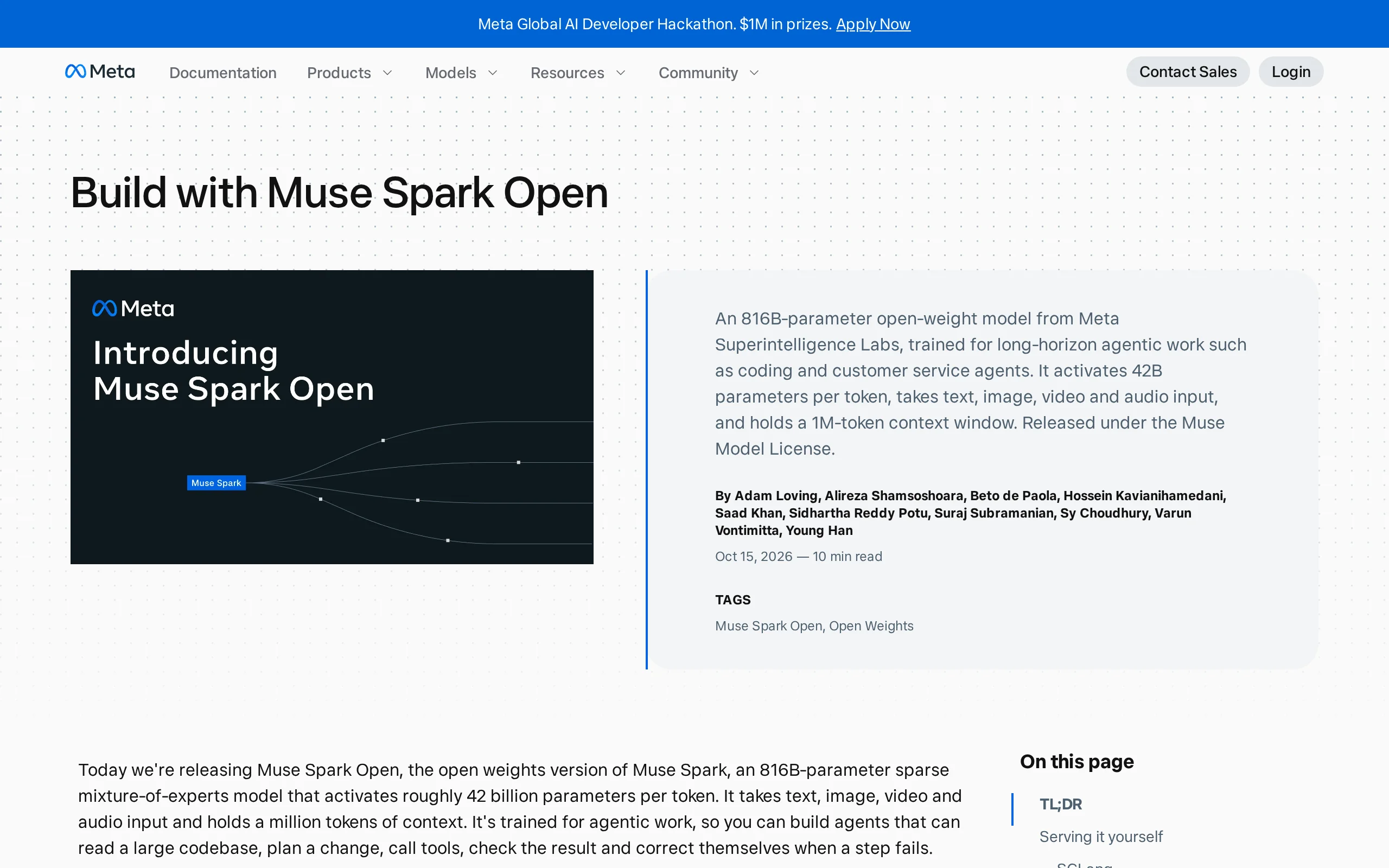
Muse Spark Open is Meta's latest open-source multimodal large model, built using a sparse Mixture-of-Experts (MoE) architecture. It has a total parameter count of 816 billion, with only 420 billion pa...
1. What is Muse Spark Open
Muse Spark Open is Meta's latest open-source multimodal large model, built using a sparse Mixture-of-Experts (MoE) architecture. It has a total parameter count of 816 billion, with only 420 billion parameters activated per inference. It supports a context window of up to 1 million Tokens and can natively process inputs from four modalities: text, image, video, and audio. The model focuses primarily on programming and Agent tasks. After optimization on the MLX framework, it can run entirely locally on two M5 Ultra Mac Studios, bringing large-scale Agent workflows from the cloud to the desktop. The model's weights are fully open-sourced and compatible with seven major inference frameworks, including SGLang, vLLM, and llama.cpp, and supports four major chip platforms: NVIDIA, AMD, Apple, and Intel.
Technical positioning and domain: Muse Spark Open belongs to the intersection of natural language processing and multimodal understanding. It is positioned for ultra-long context processing and multi-step Agent task execution. Its core technology lies in the sparse MoE architecture and distributed inference under a unified memory system, aiming to address the challenges of running large-scale models locally on limited hardware while meeting the extreme context length requirements of complex software engineering and multimodal content processing scenarios.
Development background: This model was developed by Meta and is the largest parameter-scale model among all open-weight models released by Meta in the United States. By fully open-sourcing the weights and covering various use cases from cloud APIs to desktop deployment, Meta aims to seize the high ground in the open-source large model ecosystem for programming and Agent tasks, while expanding its technical influence through multi-framework compatibility strategies.
Core value: Muse Spark Open addresses the hardware barriers for deploying ultra-large models locally. By combining optimizations on the MLX framework with Apple's M5 Ultra unified memory architecture, the full 816 billion parameter model can be hosted on just two Mac Studios. This enables the migration of Agent workflows that were previously only available in the cloud to local environments, offering clear advantages in data privacy and real-time response.
Technical features: The model's differentiated capabilities are reflected in three aspects: first, its 1 million Token context window allows it to process large codebases and lengthy documents in one go; second, its native multimodal input capability provides a foundation for Agent tasks involving tool operations such as video editing; third, its custom GPU kernel acceleration solution delivers 1.03 to 3.95 times performance improvement at the kernel level on NVIDIA and AMD hardware.
2. Key Features
Ultra-long Context Understanding: Supports a context window of up to 1 million Tokens, allowing it to process entire code repositories, multiple technical documents, or long-form video content in one go. This capability enables the model to maintain stable "memory" during extended, multi-step Agent tasks, preventing task interruptions or information loss caused by context truncation.
Native Multimodal Processing: The model can simultaneously receive and understand input from four modalities: text, image, video, and audio. Unlike solutions that rely on "external visual modules," the native multimodal architecture allows the model to perform cross-modal reasoning within the same semantic space, enabling direct information extraction from video content and subsequent actions.
Programming Capabilities: Designed for complex software engineering tasks, the model can perform full-cycle development work, including bug fixing, feature addition, and project building. It achieved a score of 76.4 on the Terminal-Bench 2.1 benchmark and 60 on the DeepSWE 1.1 benchmark, demonstrating its ability to identify and modify issues in real code environments.
Agent Task Execution: Supports autonomous execution of multi-step reasoning tasks over extended periods, such as operating DaVinci Resolve to frame-by-frame inspect video materials, filter high-quality segments, and crop them into vertical formats. These tasks require the model to have integrated capabilities in tool calling, intermediate result evaluation, and strategy adjustment.
Local Execution on Desktop Clients: Deeply optimized for the MLX framework, two M5 Ultra Mac Studios can work together using approximately 1TB of unified memory and 1.2TB/s memory bandwidth, functioning like a supercomputer. This setup can fully accommodate an 81.6 billion parameter model, enabling large-scale Agent workflows to be moved from the cloud to local desktop environments.
Multi-framework and Multi-chip Compatibility: Supports seven major inference frameworks, including SGLang, vLLM, TensorRT-LLM, Hugging Face Transformers, Apple MLX, llama.cpp, and Unsloth. It is also compatible with GPU platforms from NVIDIA, AMD, Apple, and Intel, allowing developers to flexibly choose deployment options based on their existing hardware.
Custom GPU Kernel Acceleration: Meta provides automatically tunable custom Helion GPU kernels for SGLang, achieving 1.03 to 3.95 times kernel-level inference acceleration on NVIDIA and AMD GPUs. It also brings approximately 3% end-to-end performance improvement on AMD MI350.
Cloud API Access: The model is now available on mainstream AI service platforms such as OpenRouter, Groq, and Together AI. Developers can directly call it via standard API interfaces without needing to set up their own inference environment, significantly lowering the barriers to rapid prototyping and business integration.
3. How to Use
Obtain Access Channels: Users who want a quick experience can directly call the model via API interfaces on platforms such as OpenRouter, Groq, or Together AI. After registering an account and obtaining an API key, they can initiate requests in their code. Each platform has different billing methods and rate-limiting strategies, so it is recommended to review the pricing documentation of the corresponding platform before formal use.
Download Model Weights: If local deployment is required, visit the official Meta model collection page on Hugging Face to download the open weights. The total number of model parameters is 816 billion, and the weight files are large in size. Ensure that there is sufficient local storage space and pay attention to network stability during the download process.
Select Inference Framework: Choose an appropriate inference framework based on your hardware environment. Users with NVIDIA or AMD GPUs can use SGLang or vLLM, while Apple chip users should use the MLX framework, and CPU environments can use llama.cpp. Meta provides a custom Helion GPU kernel for SGLang, and NVIDIA and AMD GPU users can benefit from improved inference performance by using SGLang.
Prepare Hardware Environment: For cloud deployment, use NVIDIA or AMD GPU instances. It is recommended to choose large-memory instances to accommodate the model weights. Running the full model on a local desktop requires two Mac Studios equipped with M5 Ultra chips, each supporting up to 512GB unified memory. Combined, they offer approximately 1TB of memory with a bandwidth of 1.2TB/s.
Write Inference Code: Use deep learning frameworks such as PyTorch to write inference scripts. Input can include text, images, videos, or audio prompts, and set the context content to no more than 1 million Tokens. It is advisable to first use small-scale inputs to verify the inference process, then gradually increase the context length.
Execute Agent Tasks: Drive multi-step Agent workflows such as programming or video editing through API or local execution. After integrating the model into the Agent framework, set the task objectives and provide tool calling permissions. The model will autonomously complete subtask decomposition, intermediate result verification, and final output delivery.
Pay Attention to Hardware and Framework Compatibility: Different inference frameworks have significantly varying levels of efficiency in utilizing hardware characteristics and GPU memory management. Apple chip users must use the MLX framework, and NVIDIA GPU users should prioritize SGLang to take advantage of the custom kernel acceleration. Avoid performance degradation caused by mismatched frameworks and hardware.
4. Pros and Cons Analysis
| Pros |
|---|
| Leading parameter scale: With a total of 816 billion parameters, it is the largest model ever made public by Meta, and the model's capacity determines the upper limit of its ability to handle complex tasks. |
| Ultra-long context window: Supports a context window of up to 1 million tokens, and with native multimodal capabilities, it can directly handle multi-step tasks involving large codebases and long video content without requiring external retrieval or chunking strategies. |
| Native multimodal architecture: Text, image, video, and audio modalities are uniformly processed within the same semantic space, enabling direct operation of tool-based Agent tasks such as video editing, without the need for additional adaptation layers for cross-modal reasoning. |
| Open ecosystem and multi-framework compatibility: Weights are fully open, and it supports seven major inference frameworks including SGLang, vLLM, MLX, and llama.cpp. It is compatible with four chip platforms and provides customized GPU kernel acceleration for NVIDIA and AMD. |
| Highly customizable: Developers can fine-tune and perform secondary development on the model using PyTorch. The open weights make adaptation for vertical domains and private deployment possible. |
5. Comparative Analysis with Similar Tools
| Comparison Dimension | Muse Spark Open | Kimi K3 | MiMo-V2.6-Pro |
|---|---|---|---|
| Model Architecture | Sparse MoE, total parameters 816 billion, activated 420 billion | Built using KDA hybrid linear attention mechanism and attention residual technology | Sparse Mixture-of-Experts architecture, full parameters not officially disclosed |
| Context Window | 1 million Tokens | 1 million Tokens | Not disclosed, to be officially announced |
| Multimodal Capabilities | Native support for text, image, video, and audio | Supports multimodal input | Supports multimodal processing |
| Programming Ability | Terminal-Bench 2.1: 76.4; DeepSWE 1.1: 60 | Scores on both Terminal-Bench 2.1 and DeepSWE 1.1 are higher than Muse Spark Open, with DeepSWE reaching 68 | Programming ability is higher than Muse Spark Open |
| Comprehensive Intelligence Index | Artificial Analysis: 39 | Test scores are higher than Muse Spark Open | Comprehensive capabilities are stronger than Muse Spark Open |
| Local Deployment | Can be fully run on two M5 Ultra Mac Studio devices (approximately 1TB unified memory) | Higher local deployment threshold, primarily cloud-based API | Primarily cloud-based API usage |
| Openness | Weights are fully open, downloadable and customizable | Open weights | Open weights |
| Inference Framework | Seven frameworks including SGLang, vLLM, MLX, and llama.cpp, compatible with four chip platforms | Supports mainstream inference frameworks | Supports mainstream inference frameworks |
| Core Positioning | Ultra-long context + native multimodal + desktop local Agent workflow | Comprehensive capabilities, leading in programming and reasoning performance | Emphasizes both comprehensive capabilities and programming ability |
Selection Recommendations: For users prioritizing programming tasks and comprehensive capabilities, Kimi K3 outperforms Muse Spark Open on both Terminal-Bench 2.1 and DeepSWE 1.1, with an 8-point lead on DeepSWE, making it suitable for scenarios with high demands on code task quality. MiMo-V2.6-Pro and GLM-5.3 also demonstrate stronger baseline performance in the comprehensive and programming dimensions, making them more appropriate as general-purpose productivity tools. If the use case emphasizes desktop local execution, data privacy protection, and multimodal Agent tasks—especially for teams that have already invested in M5 Ultra Mac Studio hardware—the fully open weights of Muse Spark Open and its compatibility with the MLX framework offer a distinct advantage.
From an ecosystem perspective, Muse Spark Open provides broader compatibility with multiple frameworks and chip vendors. Support for seven inference frameworks and four chip manufacturers offers significant flexibility in deployment options. However, this ecosystem openness has not yet translated into performance advantages in benchmark tests. The model's practical application value is more concentrated in tasks involving ultra-long context and multimodal tool operations, rather than pure language reasoning and code generation.
6. Editor's Summary
Muse Spark Open has established itself as a benchmark in open-weight models with its total of 81.6 billion parameters and a 1 million Token context window. By combining the MLX framework with Apple's M5 Ultra unified memory architecture, it enables local deployment on desktops, offering a differentiated technical path that avoids reliance on large-scale GPU clusters. From an innovation perspective, Meta's automatically tunable Helion GPU kernel provided for SGLang achieves 1.03 to 3.95 times kernel-level acceleration on both NVIDIA and AMD platforms, validating the practical effectiveness of the optimization direction of "co-designed model architecture and inference kernel."
In terms of practical value, the model truly fills a gap in the intersection of "ultra-long context + multi-modal input + local deployment." The 1 million Token window allows the model to directly handle scenarios that previously required complex engineering solutions, such as reviewing large codebases, analyzing multi-page documents, and processing long video materials. Its native multi-modal capabilities support cross-modal tool calling tasks like operating DaVinci Resolve for video editing. Open weights combined with multi-framework compatibility provide developers with flexible deployment options, ranging from the cloud to local environments.
In benchmark tests, the model's comprehensive and programming capabilities are currently behind domestic open-source models such as MiMo-V2.6-Pro, GLM-5.3, and Kimi K3. This is an unavoidable fact when assessing its competitiveness. At present, the model is more suitable for institutional users who are sensitive to data privacy, require localized processing of ultra-long multi-modal content, and have access to high-end hardware. Individual developers can experience its core capabilities at a low cost through cloud-based APIs.
In the long term, Muse Spark Open's open ecosystem strategy and multi-framework compatibility path provide the foundational conditions for building a developer community. As Meta continues to iterate on the Helion GPU kernel and optimize the MLX framework, the model's inference efficiency has potential for ongoing improvement. Whether its desktop local deployment solution can run on smaller-scale hardware through model quantization or distillation techniques will influence the speed at which the model's user base expands.
7. Application Scenarios
iOS Development and Maintenance: Developers can integrate Muse Spark Open into their software development workflow to fix bugs, add new features, and complete project builds for open-source iOS projects such as Ice Cubes. The 1 million Token context window allows the model to fully read the entire codebase, understand the calling relationships between modules, and validate the effects of modifications in a real compilation environment.
Video Post-Production Editing: The model has native video understanding capabilities and can operate professional editing software such as DaVinci Resolve to perform frame-by-frame material inspection, select high-quality clips, and automatically crop them into vertical formats. A typical workflow for this scenario includes: the model reads video content → assesses image quality and composition → calls the editing tool API to perform cropping → outputs the final product.
Large Codebase Review: Security teams or architects can leverage the 1 million Token context window to load the entire structure and key files of a code repository at once, enabling analysis of dependencies, detection of potential defects, and evaluation of architectural rationality, thus avoiding common omissions in traditional manual reviews of large-scale projects.
Handling Ultra-Long Documents: Researchers can input multi-page technical reports, academic papers, or patent documents directly into the model for structured summarization, targeted Q&A, and cross-document comparisons. The 1 million Token window eliminates the engineering steps of chunking and vector retrieval in traditional RAG solutions, streamlining the workflow.
Comprehensive Multimodal Content Understanding: Content moderation teams can input text descriptions, image screenshots, video clips, and audio tracks simultaneously into the model, enabling cross-modal semantic consistency analysis and identifying issues such as mismatched text and images or non-compliant audio content that are difficult to detect with single-modal reviews.
8. FAQ
Q: What makes the Muse Spark Open model architecture unique?
A: The model employs a sparse mixture-of-experts (MoE) architecture, with a total of 816 billion parameters, but only activates approximately 420 billion parameters per inference. The routing mechanism assigns each Token to a small number of expert networks for processing, significantly reducing computational load during inference while maintaining the large model's capacity. This enables the operation of a super-large model on limited hardware.
Q: Why does Muse Spark Open have lower benchmark scores than some domestic open-source models?
A: The model scored 39 points on the Artificial Analysis comprehensive intelligence index, 76.4 on Terminal-Bench 2.1, and 60 on DeepSWE 1.1, all lower than Kimi K3, MiMo-V2.6-Pro, and GLM-5.3. This gap may stem from differences in training data scale, training strategies, or optimization objectives. Meta has not yet fully disclosed the specific technical reasons.
Q: What hardware configuration is required to run the full model locally?
A: The official solution recommends using two Mac Studio devices equipped with M5 Ultra chips, each with up to 512GB unified memory, totaling approximately 1TB of memory and a bandwidth of 1.2TB/s, working collaboratively through the latest MLX framework. To run the full model on traditional GPU architectures, a large-scale cluster is required, as consumer-grade hardware cannot meet the demands.
Q: Can the model be run after low-precision quantization?
A: Muse Spark Open supports deployment via quantization using frameworks such as llama.cpp, which can reduce memory and storage usage. However, even after high-degree quantization, the 816 billion parameter model still requires memory capacity far beyond that of consumer-grade hardware. For specific quantization bit depths and memory requirements, please refer to the official documentation on the Hugging Face model page or community testing data.
Q: Which inference frameworks and hardware platforms does Muse Spark Open support?
A: It supports seven major frameworks: SGLang, vLLM, TensorRT-LLM, Hugging Face Transformers, Apple MLX, llama.cpp, and Unsloth. It is compatible with chips from NVIDIA, AMD, Apple, and Intel. For NVIDIA and AMD GPUs, it is recommended to use SGLang to take advantage of the custom Helion kernel for acceleration.
Q: Is Muse Spark Open supported for Chinese?
A: The original information indicates that the model focuses primarily on programming and Agent tasks, without specifically mentioning its performance in Chinese. For actual performance in Chinese dialogue and writing, it is recommended to directly test and verify via APIs on platforms such as OpenRouter.
9. Project Links
- Project Website: https://dev.meta.ai/resources/blog/build-with-muse-spark-open
- Hugging Face Model Collection: https://huggingface.co/collections/meta-models/muse-spark-open
Related
MiniMax M3.1 Flash – The Latest Flash Series Model from MiniMax
MiniMax M3.1 Flash is the new generation of the Flash series model launched by MiniMax in 2026. It made its debut under the anonymous name "Space Bunny" across major evaluation benchmarks, with a trai...
Hy Memory 2.0 – Tencent HunYuan's Open-Source Agent Memory Framework
Hy Memory 2.0 is an open-source agent memory framework developed by Tencent HunYuan, featuring a three-tier architecture: "model + framework + application." It includes the Hy-Memory-30A3B model speci...

BlenderWorld – Qwen's Open-Source 3D Creation Agent Evaluation Benchmark
BlenderWorld is an evaluation benchmark for 3D creation agents, jointly developed by the Qwen team with Zhejiang University, The Chinese University of Hong Kong, Fudan University, and National Univers...
Review of Matrix-Game 4.0: Kunlunwanwei Brings Video Large Model Games to Consumer-Level GPUs for the First Time
Matrix-Game 4.0 is the world's first open-source video large model game that can run in real-time on a single consumer-grade GPU. This system employs an innovative "Harness" architectural paradigm, de...
© All Rights Reserved. Some content on this site is partially generated by AI with human review.