
Review of Matrix-Game 4.0: Kunlunwanwei Brings Video Large Model Games to Consumer-Level GPUs for the First Time
Executive Summary:
Matrix-Game 4.0 is the world's first open-source video large model game that can run in real-time on a single consumer-grade GPU. This system employs an innovative "Harness" architectural paradigm, de...
1. What is Matrix-Game 4.0
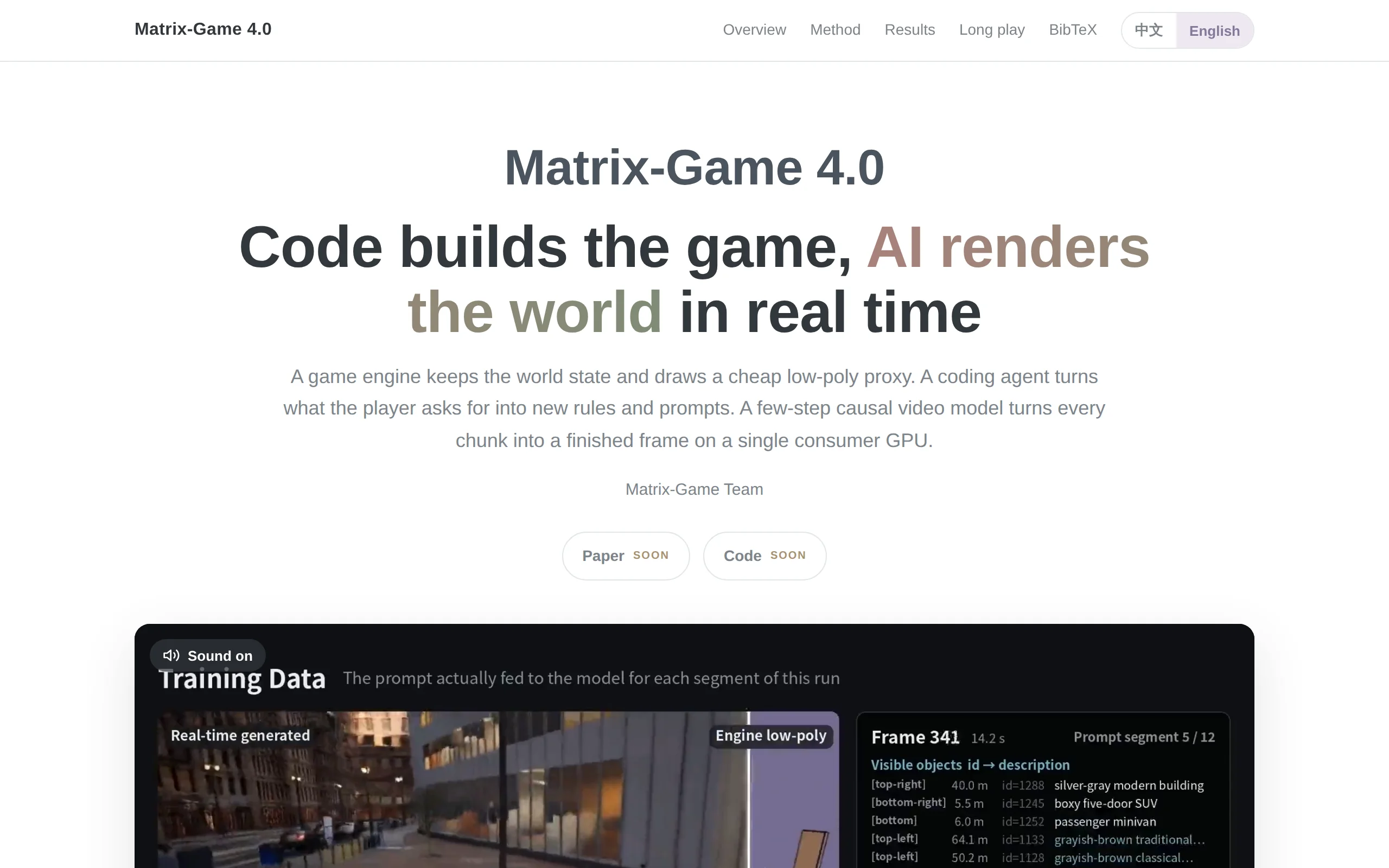
Matrix-Game 4.0 is the world's first open-source video large model game that can run in real-time on a single consumer-grade GPU. This system employs an innovative "Harness" architectural paradigm, deeply integrating video generation models with game engines and Coding Agents—where the game engine acts as the referee, maintaining world state and rules, the Coding Agent rewrites gameplay logic using natural language, and the video model functions as the artist, rendering high-quality visuals in real-time. On a single NVIDIA RTX 5090 GPU, Matrix-Game 4.0 delivers a playable experience at 480p resolution, 60 FPS frame rate, and end-to-end latency below 150 milliseconds, marking the first time that interactive games driven by video generation models have moved out of the multi-GPU cluster environments of the lab.
Technical Positioning and Domain: Matrix-Game 4.0 lies at the intersection of video generation models and interactive gaming systems, with its core focus on exploring practical implementation paths for "world models" in real-time playable game scenarios. By adopting a decoupled architecture, this project addresses three major pain points in previous video model-based games: temporal drift, high interaction latency, and lack of scene controllability, offering a new technical paradigm for small teams to build open-world games at low cost.
Development Background: This product was developed by the Skywork AI team at Kunlunwanwei, based on a deep modification of its self-developed Wan2.2 5B video generation model. The motivation for development stemmed from observations of the high costs associated with traditional game development (3D asset pipelines, reliance on large engines) and the lack of real-time interactivity in existing "world model" projects. The goal is to enable creative teams to drive the generation of high-quality game visuals using natural language.
Core Value: Matrix-Game 4.0 resolves three major challenges in using video generation models for gaming scenarios: uncontrolled world state, unacceptable latency, and inconsistency in gameplay. The engine explicitly manages the world state, eliminating the issue of model memory drift. A latency of 112ms meets real-time playability standards, while spatial memory and dynamic Caption mechanisms ensure stability during extended gameplay. This advancement brings AI-generated games from the concept validation phase into a practical stage where they can be used on consumer-grade hardware.
Technical Features: It utilizes a "Harness" three-tier decoupled architecture (engine manages state, Agent manages rules, and video model manages rendering), achieving controllable video-to-video generation through the concatenation of 148 channels input into a 30-layer causal DiT. The cross-domain structure built on UE5—aligned high-quality visual datasets and dynamic Caption mechanisms—represents its core technical differentiators compared to similar solutions.
2. Key Features
Consumer-grade single-card real-time operation: A single NVIDIA RTX 5090 GPU can deliver a playable gaming experience with 480p resolution, 60 FPS frame rate, and end-to-end latency as low as 112ms. This is currently the only video generation gaming solution that meets real-time standards on consumer-grade hardware, completely eliminating reliance on multi-GPU data center clusters and bringing AI gaming technology within reach of individual developers and small studios.
Natural language-driven gameplay modification: The built-in Coding Agent can directly parse and convert a single natural language instruction (e.g., "Reduce the enemy's movement speed by half") into game rule code and detailed video generation prompts. This mechanism bypasses the traditional 3D asset production pipeline, compressing gameplay iteration from weeks down to minutes, significantly reducing the cost of creative experimentation.
Explicit world state management: The game engine explicitly maintains world states such as health, inventory, collision detection, and win/loss conditions in code form. This state data can be read, modified, and validated at any time. Even when objects move out of the field of view, their states continue to evolve within the engine, eliminating previous issues of drift and inconsistency caused by the "world existing only in the model's memory" approach.
Low-poly to high-detail real-time rendering: The video model re-renders the geometric structure output from the game engine in real time into 3A-grade visuals with lighting and material details. The system has built a pixel-aligned dataset between structure visuals and high-detail visuals based on UE5, ensuring visual quality and spatial consistency of the rendering results, allowing independent creators to produce cinematic-grade visuals without requiring detailed 3D assets.
Long-term consistent gameplay support: Through the collaborative operation of three mechanisms—spatial memory, reference frames, and dynamic captions—the system supports uninterrupted gameplay lasting between 54 to 99 seconds, during which scene structure, character identity, and interaction outcomes remain stable and consistent. At runtime, the system reads the currently visible objects and their real-time states from the engine, dynamically populating the prompt templates to provide precise conditional constraints for the video model on "what to draw" and "where to draw it."
Controllable video-to-video (V2V) generation: Based on a deep modification of the Wan2.2 5B model, the system concatenates the structure visuals and target video input into a 148-channel input for a 30-layer causal Diffusion Transformer. The self-attention mechanism reads spatial memory and historical KV cache to maintain temporal consistency, while cross-attention reads text conditions to achieve semantic control. The video content is generated block by block in a self-regressive manner, enabling precise pixel-level control.
3. How to Use
As an open-source project, the deployment and usage of Matrix-Game 4.0 revolve around the code repository. Below are the specific procedures and operational guidelines:
Hardware Environment Preparation: The project recommends a single NVIDIA RTX 5090 GPU (32GB VRAM) to achieve a 480p/60FPS/112ms latency configuration. Other consumer-grade GPUs (such as RTX 4090) can theoretically run the project but may require reducing the resolution and frame rate targets. It is advised to use Linux (Ubuntu 20.04 or higher) as the operating system, with CUDA 12.x and the corresponding PyTorch environment pre-installed.
Obtaining the Project Code: Clone the project source code from the GitHub repository to your local working directory. The repository address is https://github.com/SkyworkAI/Matrix-Game.git. It is recommended to use the
git clone --depth 1command to fetch the latest stable version and reduce download size.Downloading Model Weights: Download the pre-trained model weight files from the Hugging Face model library (https://huggingface.co/Skywork/Matrix-Game-4.0). The model is based on the Wan2.2 5B architecture and has a large weight file size (in the tens of gigabytes), so ensure that there is sufficient free disk space. Place the weight files in the model directory specified in the project configuration and verify the SHA256 checksum to ensure data integrity.
Configuration and Launch: Modify the configuration file according to the instructions in the project's README, specifying parameters such as the model path, output resolution (default: 480p), and target frame rate (default: 60FPS). Then run the provided launch script (typically
python main.pyor a similar command). After launching, the system will load the video model and the Coding Agent, entering an interactive game state.Inputting Gameplay Instructions: Once the game is running, users can input gameplay modification instructions through the natural language dialogue window (such as adjusting terrain, NPC behavior, designing new rules, etc.). The Coding Agent will parse and convert these instructions into engine rule code and video generation prompts. The system will automatically apply the new rules and render the updated visuals in real time.
Notes and Best Practices:
- Before running, be sure to check the "Environment Requirements" section in the project documentation to confirm the dependency library versions and system compatibility, to avoid loading failures due to inconsistent environments.
- If using a GPU other than the RTX 5090, it is recommended to reduce the generation resolution proportionally to the VRAM capacity (e.g., 360p for 24GB VRAM) and close unnecessary background programs to free up VRAM.
- The project provides an API interface, which developers can integrate into their own game engines or applications to implement more complex world state logic and interactive features.
- The model loading time during the first run is long and is a normal occurrence; subsequent runs will leverage caching to accelerate startup.
4. Pros and Cons Analysis
| Pros |
|---|
| Real-time operation on consumer-grade hardware: A single RTX 5090 can achieve a playable experience with 480p resolution, 60 FPS, and 112ms latency, making it the first video generation gaming solution to run on consumer-grade GPUs worldwide, significantly lowering the technical barrier. |
| Explicitly controllable world state: The game engine maintains world rules through code, allowing the state to be read, modified, and verified, effectively solving the drift issues that previously plagued video generation games where state existed only in the model's memory. This ensures reliable interactive logic. |
| High efficiency in modifying gameplay with natural language: The Coding Agent directly translates user instructions into game rules and code, freeing gameplay iteration from the constraints of 3D asset pipelines. The creative validation cycle is reduced from weeks to minutes. |
| Leading latency performance: The end-to-end latency of 112ms is about 1/90th of Code World Model and 1/5th of StreamRender-H3, achieving real-time interactive gameplay that meets playability standards. |
| Strong architectural innovation: The three-tier decoupled Harness paradigm of "engine + Coding Agent + video model" provides a clear, reusable technical path for integrating world models with game engines. Its open-source design facilitates research and adoption by both academia and industry. |
5. Comparative Analysis with Similar Tools
| Comparison Dimension | Matrix-Game 4.0 | StreamRender-H3 | Code World Model |
|---|---|---|---|
| Core Architecture | Harness paradigm: Engine + Coding Agent + Wan2.2 5B video model, three-layer decoupled collaboration | Rendering model tightly coupled with game engine, relies on data center-level inference | World evolution driven by code generation, rules dynamically generated by code |
| End-to-end Latency | 112ms (real-time playable) | Approximately 545ms (noticeable interaction latency) | Latency significantly higher than real-time standards (about 90 times that of Matrix-Game) |
| Hardware Requirements | Single RTX 5090 (consumer-grade, 32GB VRAM) | 8× NVIDIA GB200 (data center-grade cluster) | Relies on large-scale GPU cluster inference |
| Resolution/FPS | 480p @ 60 FPS (stable output) | Does not meet consumer-grade real-time standards, resolution and frame rate limited by inference performance | Code logic is primary, visual output is not a focus |
| World State Management | Engine explicitly maintains state, readable, modifiable, and verifiable, state is not lost when out of view | Mainly relies on internal model representation, state cannot be explicitly intervened | Code state is manageable, but visual presentation is disconnected from state |
| Gameplay Customization Method | Coding Agent modifies rules via natural language, takes effect in seconds | High modification threshold, requires underlying code changes | Customization via modifying code generation logic |
| Long-term Consistency | Spatial memory + reference frames + dynamic captions, stable for 54–99 seconds | Long-term interaction prone to scene drift and identity loss | Code rules ensure logical consistency, but visual consistency is lacking |
| Open Source License | Open source (GitHub + HuggingFace weights available) | Not open source, research prototype | Full implementation not publicly available |
Selection Recommendations: For developers aiming to implement real-time playable AI video games on consumer-grade hardware, Matrix-Game 4.0 is currently the only open-source solution that can be practically deployed. Its Harness architecture clearly separates the two concerns of "state logic" and "visual rendering," making it a suitable foundational platform for researching the integration of world models with game engines. If a team has access to data center-grade GPU resources and is not strict about latency, they may consider StreamRender-H3's approach, but they will need to address state management and long-term consistency issues independently. For scenarios focusing more on gameplay logic than visual quality (such as text-based adventure games), the Code World Model's approach still offers some reference value, but its interaction latency makes it unsuitable for applications requiring real-time visual feedback.
6. Editor's Summary
From a technological innovation perspective, the core contribution of Matrix-Game 4.0 lies in its proposal of the "Harness" architecture, which separates the responsibilities of "engine manages state, Agent manages rules, and model manages rendering." This design effectively resolves the key contradiction previously faced by end-to-end video generation models when used directly as game engines — the trade-off between state controllability and visual expressiveness. By decoupling the world state from model parameters and delegating it to a deterministic engine, the system eliminates the issue of temporal drift while making game rules programmable. At the same time, through architectural improvements such as 148-channel injection and a 30-layer causal DiT, it establishes a controllable generation pipeline from structured geometric representations to high-fidelity visual outputs. This paradigm provides a reusable technical framework for future research on video generation games and holds significant academic and engineering reference value.
In terms of practical value, Matrix-Game 4.0 achieves a 112ms latency and stable 60FPS output on a single RTX 5090 GPU, moving video generation games from the "laboratory demonstration" stage to a "practical usage by individual developers" stage. Combined with the natural language gameplay modification capabilities of the Coding Agent and the dynamic Caption mechanism, this system enables small teams to rapidly validate game concepts at a very low asset cost, and it shows potential in application areas such as UGC personalization and customization.
In terms of target users, this open-source project is suitable for three types of users: first, game developers, who can use it for rapid prototyping and low-cost content creation; second, AI researchers, who can use it as an experimental platform to explore the integration of world models, video generation, and interactive systems; and third, AI programming learners, who can study the Harness architecture code to understand the system design methodology of "large models + engine."
In terms of potential for development, as next-generation consumer-grade GPUs with higher memory and computational power become available, the current 480p resolution limit is expected to be further surpassed, potentially reaching 720p or even 1080p. Additionally, if the structure-fine image alignment dataset expands to include more styles and genres, the system's generality in content creation will significantly improve. As an open-source project, continuous contributions from the community will also accelerate the refinement of features and the maturation of the ecosystem.
7. Application Scenarios
Rapid Game Prototyping: Small game teams can use Matrix-Game 4.0 to quickly generate interactive game demos by describing gameplay ideas in natural language (e.g., "Design a survival game where players avoid rolling rocks on a volcanic terrain"). Compared to traditional engines that require full 3D asset production processes such as modeling, texturing, and animation, this solution reduces the project validation cycle from weeks to days or even hours, significantly lowering the cost of creative experimentation.
Personalized Game Customization (UGC): Platform-based game companies or communities can open up the rule interfaces of Matrix-Game 4.0, allowing players to customize terrain, NPC behavior, win conditions, and visual styles using natural language commands. Each player can generate a unique gameplay experience based on the same underlying world, achieving a "one-size-fits-none" approach that enhances user engagement and retention.
AI Programming Education and Practice: As an open-source project, Matrix-Game 4.0 provides a complete real-world case for learners in the intersection of AI and game development through its "engine + video model + coding agent" Harness architecture. Developers can study its code structure, data collection pipeline, and model modification strategies to understand how to effectively integrate large models with traditional deterministic systems (game engines), making it a valuable teaching resource for systematically learning interactive AI application development.
Low-Cost Game Content Production: Independent creators and small content studios can produce film-quality visuals with lighting and material details using low-poly geometry combined with video models, without relying on large 3D art teams or commercial engine licenses. This significantly reduces the production cost of high-quality game visual content, making it especially suitable for independent game development scenarios that emphasize unique visual styles and atmospheric storytelling.
8. FAQ
Q: What are the minimum GPU requirements for Matrix-Game 4.0? Can it run on non-RTX 5090 GPUs?
A: The official recommended configuration is a single NVIDIA RTX 5090 (32GB VRAM), which is the minimum threshold to achieve a 480p/60FPS/112ms latency experience. In theory, consumer-grade GPUs with sufficient VRAM (such as the RTX 4090 with 24GB) can run the system, but the generation resolution must be reduced to 360p or lower, and frame rate and latency performance will also decrease accordingly. Data center GPUs (such as A100/H100) can run the system, but they cannot fully leverage the core advantages of consumer-grade deployment of this solution.
Q: Does Matrix-Game 4.0 support multiplayer online functionality?
A: The current release version is a single-player game architecture, where the world state is maintained by a local engine. It has not yet implemented the network state replication and consistency protocols required for multiplayer synchronization. For multiplayer experiences, developers must implement server-side hosting and client-side synchronization logic for the engine state based on the open-source code.
Q: How does the system ensure that scenes and characters do not drift during extended gameplay?
A: The system ensures stability through three mechanisms working in coordination: spatial memory preserves scene structure information, reference frames anchor the visual baseline, and dynamic captions read real-time IDs and attributes of visible objects from the engine and insert them into the prompt templates. Currently, it can maintain stability for uninterrupted gameplay lasting between 54 to 99 seconds. For durations beyond this, a scene switch or state reset mechanism is required to maintain consistency.
Q: Can Matrix-Game 4.0 be integrated into Unity or Unreal Engine?
A: The official API interface is available for external engines to call. Developers can establish bidirectional communication: the external engine handles complex physics simulations and AI logic, sending structured visuals and state data through the API into Matrix-Game 4.0 for video rendering. The refined visuals output can then be used as the main game view. This integration model is suitable for use as a game prototype or as an ambient background layer, but note that API call latency may affect real-time performance.
Q: How can users modify gameplay through natural language? What specific aspects can be changed?
A: Users can directly input instructions in natural language, such as "Add a plant that glows at night" or "Make enemy AI smarter." The Coding Agent will parse the instruction into two parts: one is converted into executable rules for the engine (such as collision detection, NPC behavior trees, etc.), and the other is converted into conditional prompts for the video model (such as visual feature descriptions). The system supports modifications across dimensions such as terrain adjustments, NPC behavior, win/loss rules, item properties, and visual styles. However, changes to the underlying physics engine logic (such as gravity constants) require additional code support.
9. Project Links
- Project Website: https://matrix-game-v4-0.github.io/page/
- GitHub Repository: https://github.com/SkyworkAI/Matrix-Game.git
- HuggingFace Model Library: https://huggingface.co/Skywork/Matrix-Game-4.0
Related

MiniMax M3.1 Flash – The Latest Flash Series Model from MiniMax
MiniMax M3.1 Flash is the new generation of the Flash series model launched by MiniMax in 2026. It made its debut under the anonymous name "Space Bunny" across major evaluation benchmarks, with a trai...
Hy Memory 2.0 – Tencent HunYuan's Open-Source Agent Memory Framework
Hy Memory 2.0 is an open-source agent memory framework developed by Tencent HunYuan, featuring a three-tier architecture: "model + framework + application." It includes the Hy-Memory-30A3B model speci...

BlenderWorld – Qwen's Open-Source 3D Creation Agent Evaluation Benchmark
BlenderWorld is an evaluation benchmark for 3D creation agents, jointly developed by the Qwen team with Zhejiang University, The Chinese University of Hong Kong, Fudan University, and National Univers...

Muse Spark Open – In-Depth Review of Meta's Open-Source Multimodal Large Model
Muse Spark Open is Meta's latest open-source multimodal large model, built using a sparse Mixture-of-Experts (MoE) architecture. It has a total parameter count of 816 billion, with only 420 billion pa...
© All Rights Reserved. Some content on this site is partially generated by AI with human review.