
In-Depth Review of Grok Voice 3.0: SpaceXSI's End-to-End Speech Interaction Model
Executive Summary:
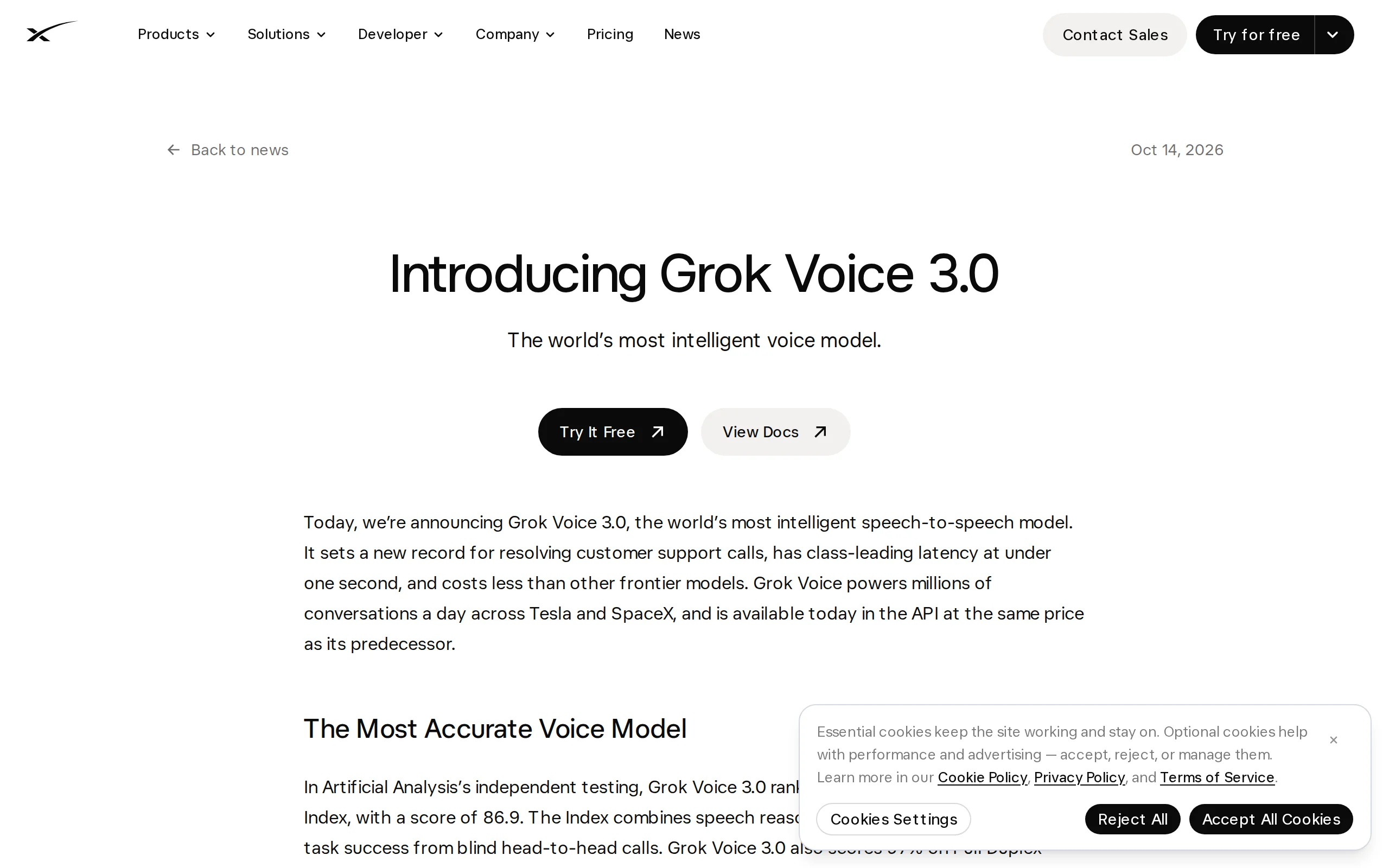
Grok Voice 3.0 is an end-to-end speech-to-speech model launched by SpaceXSI. It ranks first on the speech synthesis leaderboard by the independent testing agency Artificial Analysis with a score of 86...
1. What is Grok Voice 3.0
Grok Voice 3.0 is an end-to-end speech-to-speech model launched by SpaceXSI. It ranks first on the speech synthesis leaderboard by the independent testing agency Artificial Analysis with a score of 86.9, achieving a response latency under 1 second and a single-task operational cost of approximately $0.025, significantly lower than comparable products in the same category. This model employs a direct speech-to-speech modeling architecture, allowing it to output speech responses directly from audio input without relying on intermediate textual representations. Structurally, it eliminates the error accumulation and latency stacking issues inherent in traditional cascaded approaches. Currently, the model supports millions of daily conversations within Tesla vehicles and processes approximately 20,000 multilingual calls per day at the Starlink customer service center, with about 70% of these calls being resolved without human intervention.
Technical Positioning and Domain: Grok Voice 3.0 belongs to the intersection of natural language processing and speech interaction, with its core focus on end-to-end speech dialogue modeling. It is positioned as a full-duplex, low-latency, and complex-task-capable speech agent in the real-time speech assistant market, differentiating itself from traditional pipeline-style speech assistants. The model ranks first on the Artificial Analysis speech synthesis leaderboard, demonstrating its comprehensive capabilities across multiple dimensions, including speech reasoning, task completion rates, and user preferences.
Development Background: Grok Voice 3.0 was developed by the SpaceXSI team, with iterative validation based on large-scale deployment scenarios from Tesla and Starlink. The motivation for its development stemmed from the information loss and response latency issues in traditional speech assistants during multi-module cascading processes. SpaceXSI aims to break through these bottlenecks through end-to-end modeling. The large-scale real user feedback from Tesla's in-car scenarios and Starlink's customer service center provides continuous data support for model optimization, forming a rapid iteration product loop.
Core Value: This model addresses three major pain points of traditional speech assistants: slow response times, rigid interaction, and inability to handle complex tasks. With a response latency under 1 second, it is 40% faster than the same-level GPT-Live-1, achieving a balance between intelligence and speed. Additionally, the model has task execution capabilities, allowing it to call external tools such as calendar management, email replies, and online ordering, upgrading speech interaction from mere information queries to executable operations. In enterprise customer service scenarios, a single agent can independently complete the entire service process, including identity verification, troubleshooting, refunds, and replacement device shipments.
Technical Features: The model uses an end-to-end speech-to-speech architecture, eliminating cascading errors. Its full-duplex dialogue modeling supports simultaneous listening and generation, achieving a 97% score on the Full Duplex Bench. Moreover, the model couples auditory comprehension with reasoning and planning capabilities, forming a complete "understand—plan—execute—respond" loop, which serves as the technical foundation for its ability to independently perform complex operations in agent-based scenarios.
2. Key Features
End-to-end Voice Conversation: Supports direct generation of voice output from voice input, eliminating the need for a text intermediate step. This architecture fundamentally resolves the issue of information loss that occurs in traditional cascaded solutions involving four modules: speech recognition, text understanding, text generation, and speech synthesis. It delivers a natural and smooth real-time human-machine conversation experience. Once the audio signal enters the model, it directly outputs a voice response, with the first response latency compressed to within 1 second.
Full-duplex Interaction: The model can process listening and generation simultaneously, using a streaming encoder to continuously capture user audio streams. It intelligently identifies pauses, interjections, and interruptions, dynamically deciding when to continue speaking or yield. It achieved a score of 97% on the Full Duplex Bench benchmark, supporting user interruptions at any time, with an interaction experience close to that of human conversation. This capability is a core component of Tesla's in-car voice system, which allows for uninterrupted and interruptible scenarios without wake-up commands.
Complex Task Execution: Leveraging the Connectors and Grok Bot tool framework, the model can parse user voice input into task intent and invoke external tools for execution. It supports hands-free operations such as querying schedules, replying to emails, ordering coffee, and booking dinner, elevating voice interaction from mere information retrieval to an intelligent agent capable of executing actions. This forms a complete closed-loop of "understanding—planning—execution—response."
Enterprise Customer Service Capability: A single agent can independently complete the entire service process, including customer identity verification, hardware troubleshooting, issuing refunds, and reshipping devices. This capability is based on the deep integration of auditory understanding and reasoning planning within the model, enabling voice agents to autonomously handle multi-step operations commonly found in customer service scenarios without human intervention. It leads the competition in the EVA-Bench enterprise customer service accuracy test with a score of 74%.
Multilingual Support: The model supports speech recognition and generation in multiple languages. The Starlink customer service center handles approximately 20,000 customer calls daily in various languages. This multilingual capability meets the rigid demands of cross-border customer service scenarios, making it possible for enterprises to deploy a unified voice customer service system globally, without maintaining separate models for different languages.
Low-latency Response Mechanism: Through end-to-end modeling and an optimized inference pipeline, the model keeps response latency under 1 second, 40% lower than the GPT-Live-1 model of the same level. The reduction in latency directly improves the naturalness of the conversation and the user waiting experience, offering practical value in high-real-time-demand scenarios such as in-car systems and call centers.
High Cost-effectiveness: The cost per task run is approximately $0.025, lower than that of comparable products. The API pricing remains the same as the previous generation product, without any price increase due to enhanced capabilities, thereby reducing the economic barriers for large-scale deployment by enterprises. Based on the daily 20,000 calls handled by the Starlink customer service center, the operational cost is among the lowest in the industry.
3. How to Use
Regular User Integration: Users can directly enable voice mode for conversations within the Grok app or Grok Bot. Tesla owners can use voice interaction features directly in their vehicles without additional setup. Users of grok-voice-latest have automatically upgraded to the new version and do not need to perform any manual operations. This mode supports no-wake-up and interruption at any time, ensuring a natural and smooth interaction process.
Developer API Integration: Developers need to register via the SpaceXSI API Console to obtain an API key and then call the Voice Agent API according to the official documentation. This API provides standard RESTful interfaces, supporting the upload of voice streams and real-time return of voice responses. The documentation includes detailed integration guidelines such as authentication, audio format specifications, and streaming transmission protocols.
Tool and Agent Configuration: Developers can enable Connectors and the Grok Bot tool framework within the model to configure specific functions such as schedule inquiries, email sending, and order management. By defining tool calling rules and parameter mappings, the model can automatically invoke external services during conversations, enabling the execution of complex tasks.
Enterprise Scenario Deployment: Enterprise users can integrate Grok Voice 3.0 into their customer service systems and configure business processes such as identity verification, troubleshooting, and refund handling. It is recommended to connect the model with existing CRM and order management systems so that the voice agent can directly read and write business data. Practices at the Starlink customer service center show that this mode can support processing up to 20,000 incoming calls per day.
Performance Optimization and Monitoring: After deployment, it is recommended to continuously monitor key metrics such as response latency, task completion rate, and human intervention rate. Adjust the model's interruption sensitivity, conversation turn-taking strategies, and tool calling permissions based on the characteristics of the business scenario to optimize the interaction experience. In multilingual scenarios, verify the recognition accuracy and response naturalness for each language, and perform targeted configurations when necessary.
Cost Control and Quota Management: The API charges per task, and it is recommended to set daily call quotas and budget limits based on business volume. Developers can view detailed usage statistics and cost breakdowns in the API Console. By analyzing the distribution of task types, they can optimize calling strategies and reduce overall operational costs.
4. Pros and Cons Analysis
| Pros |
|---|
| Comprehensive Intelligence Leadership: Ranked first on the Artificial Analysis speech-to-speech comprehensive leaderboard with a score of 86.9, outperforming competitors in speech reasoning, task completion rate, and human preference, demonstrating a comprehensive technical advantage. |
| Industry-Leading Latency: Response latency is below 1 second, 40% lower than GPT-Live-1, offering a clear experience advantage in real-time interactive scenarios. |
| Lower Operational Cost: The cost per task is approximately $0.025, lower than GPT-Live-1 and GPT-Realtime-2.1. API pricing is the same as the previous generation, which is favorable for large-scale deployment. |
| Natural Full-Duplex Interaction: Achieved 97% on the Full Duplex Bench, with handling of pauses, turn-taking, and interruptions approaching human-like conversation, supporting interruptions at any time. |
| Well-Validated in Enterprise Scenarios: Starlink's real-world testing shows it handles 20,000 calls per day, with 70% requiring no human intervention, and 25% of sales calls resulting in direct deals, validating the model's scalability and practical deployment capabilities. |
5. Comparative Analysis with Similar Tools
| Comparison Dimension | Grok Voice 3.0 | Gemini 3.8 Live | GPT-Live-1 |
|---|---|---|---|
| AA Speech Comprehensive Index | 86.9 (1st place) | 82.6 | Not in Top 3 |
| Speech Inference (Big Audio Bench) | 98.5% | 97.7% | Pending release |
| Human Preference (Arena Elo) | 1070 | 990 | Pending release |
| Task Completion Rate | 94.8% | 89.1% | Pending release |
| Full Duplex (Full Duplex Bench) | 97.0% | 91.9% | Pending release |
| Single Task Cost | $0.025 | Higher (no specific value listed) | Higher than $0.025 |
| Response Latency | Below 1 second | Pending release | 40% higher than Grok |
| EVA-Bench Enterprise Customer Service Accuracy | 74% (highest) | Not leading | Not leading |
Based on the currently available evaluation data, Grok Voice 3.0 outperforms Gemini 3.8 Live in several publicly disclosed metrics, including comprehensive speech intelligence, inference accuracy, task completion rate, full-duplex interaction, and enterprise customer service accuracy. In voice interaction scenarios requiring real-time processing, interruptibility, and support for complex tasks, Grok Voice 3.0 offers more competitive technical specifications.
It should be noted that the specific evaluation data for GPT-Live-1 and GPT-Realtime-2.1 has not yet been fully released, and the above comparison is based on the information that is currently available. When selecting tools, enterprises should consider their specific business scenarios, cost budgets, and compatibility with existing ecosystems. If an enterprise requires deep integration within the Google ecosystem, the Gemini series may be a reasonable choice. However, if higher task completion rates and lower operational costs are priorities based on the current publicly available data, Grok Voice 3.0 is worth prioritizing for testing.
6. Editor's Summary
Grok Voice 3.0 has taken a technically valuable approach in the direction of end-to-end voice modeling. Its core innovation lies in abandoning the traditional "ASR→NLU→TTS" cascaded architecture, instead adopting a direct voice-to-voice modeling method, which eliminates information loss and latency accumulation caused by multi-module serial connections at the structural level. The full-duplex dialogue modeling capability that supports this architecture achieved a score of 97% on the Full Duplex Bench, delivering an interaction experience close to the fluency of human conversation. This technological innovation is not only reflected in benchmark scores, but has also been validated in large-scale real-world scenarios such as Tesla's in-car systems and Starlink's customer service centers—processing millions of in-car conversations and 20,000 customer service calls per day. This level of deployment is highly persuasive among similar voice models.
From a practical value perspective, the model's standout performance lies in its balance of cost and efficiency: the cost per task is approximately $0.025, and the API pricing remains consistent with the previous generation, making it economically accessible for large-scale enterprise deployment. In real-world testing data from Starlink customer service, about 70% of calls were resolved without the need for human intervention, and 25% of sales calls resulted in direct deals before the call ended. These figures indicate that the model has the capability to generate direct commercial value in actual business scenarios.
The primary target users of this model include three categories: first, application developers with voice interaction needs, who can quickly integrate it via the Voice Agent API; second, enterprises requiring large-scale intelligent customer service capabilities, which can follow the deployment model of the Starlink customer service center; and third, scenarios such as in-car systems and smart home devices that prioritize hands-free interaction experiences, which benefit from the model's low latency and interruptible characteristics.
Looking ahead, if SpaceXSI can further improve the transparency of technical details and provide more real-world data for multi-language long-tail scenarios, the competitiveness of Grok Voice 3.0 in the voice interaction market will be further solidified. Whether the model moves toward open-source availability, and how extensive the Connectors tool ecosystem can be expanded, will directly impact the size of its developer community and the boundaries of its applications.
7. Application Scenarios
Smart In-Vehicle Voice Assistant (Tesla): Drivers can check their schedules, reply to emails, order coffee, or book dinner without manual interaction while driving. The model supports wake-word-free operation and allows for interruptions at any time, minimizing distraction risks in driving scenarios. Currently, this model supports millions of in-vehicle conversations daily on Tesla, demonstrating its stability and usability in real-world driving environments.
Enterprise Call Center (Starlink): Starlink's customer service leverages Grok Voice 3.0 to handle approximately 20,000 incoming calls daily in multiple languages, with about 70% of these calls resolved without human intervention. A single voice agent can independently complete the entire workflow, including customer identity verification, hardware troubleshooting, refund approvals, and device replacements, significantly reducing labor costs and average handling time at the call center.
Phone Sales Conversion: In sales call scenarios, the voice agent can directly complete the full transaction loop, including product recommendations, answering questions, and guiding customers through the ordering process. According to Starlink's field test data, approximately one-quarter of sales calls result in an order being placed before the customer hangs up, highlighting the model's conversion efficiency in sales contexts.
Personal Smart Assistant (Grok Bot Voice Mode): Grok Voice 3.0 provides the underlying model support for Grok Bot's voice mode. Users can engage in natural, full-duplex conversations via the mobile app, with the ability to interrupt and resume at any time. Combined with the Connectors tool, users can manage daily tasks using voice commands, elevating voice interaction from simple Q&A to an intelligent assistant capable of executing actions.
8. FAQ
Q: What is the fundamental difference between Grok Voice 3.0 and traditional voice assistants (such as Siri, Alexa)?
A: Traditional voice assistants use a multi-module cascaded approach, processing each step separately — from speech recognition to text understanding, text generation, and finally speech synthesis. This leads to information loss during the transfer between modules and accumulates latency at each stage. Grok Voice 3.0, on the other hand, employs an end-to-end speech-to-speech modeling architecture. Audio signals enter the model directly and are converted into speech responses without passing through intermediate text representations. This architectural design eliminates cascaded errors and is a key reason why it can keep the first response latency under one second.
Q: What languages does Grok Voice 3.0 support?
A: According to official information, the Starlink customer service center handles approximately 20,000 customer calls daily in multiple languages, indicating that the model has multilingual processing capabilities. However, specific details such as recognition accuracy and the full list of supported languages have not yet been officially disclosed. Developers are advised to confirm the exact language support range with the official team before integration, based on their specific business needs.
Q: How can developers integrate Grok Voice 3.0 into their own applications?
A: Developers can register on the SpaceXSI API Console to obtain an API key and follow the official documentation to call the Voice Agent API and integrate it into their applications. The API provides standard capabilities for uploading voice streams and generating real-time voice responses. It also supports enabling Connectors and the Grok Bot tool framework to execute complex tasks. For detailed integration procedures and technical parameters, refer to the API Reference section in the official documentation.
Q: How is the cost of a single task calculated for Grok Voice 3.0?
A: According to publicly available information, the cost of running a single task is approximately $0.025, based on evaluation data from independent testing organizations. The exact billing method may vary depending on the task type, audio duration, and the number of tool calls. Actual costs should be referenced from the pricing provided in the API Console.
Q: Does the model support interruptions and multi-turn conversations?
A: Yes. The model supports full-duplex conversations, enabling it to process listening and generation simultaneously. It can intelligently detect user pauses, interjections, and interruptions, dynamically deciding when to continue speaking or yield. Users can interrupt the conversation at any time, and the model will naturally respond and continue the dialogue. This capability achieved a score of 97% on the Full Duplex Bench.
Q: What specific advantages does Grok Voice 3.0 have over GPT-Live-1?
A: Based on publicly available evaluation data, Grok Voice 3.0 has a 40% lower response latency than GPT-Live-1 and also has a lower cost per task. On the Artificial Analysis speech synthesis leaderboard, Grok Voice 3.0 ranked first with a score of 86.9, outperforming GPT-Live-1 in dimensions such as speech reasoning, task completion rate, and human preference. However, the complete benchmark data for GPT-Live-1 has not yet been fully disclosed. It is recommended to test and evaluate based on specific use cases.
9. Project Links
- Product Official Website/Announcement: https://x.ai/news/grok-voice-3 (Official Announcement)
- Official API Console: https://console.x.ai (Official Developer Entry Point)
- Developer Documentation (Docs): https://docs.x.ai/docs/api-reference/voice (Official API Documentation)
Related
FLUX 3 Max – In-Depth Review of the Video Generation Model from fal and Black Forest Labs
FLUX 3 Max is a post-training video generation model jointly developed by fal Research and Black Forest Labs, based on BFL's self-developed FLUX 3 multimodal foundation model. It supports three workfl...
GPT-Live-1.1 Review: In-Depth Analysis of OpenAI's New Full-Duplex Voice Model
GPT-Live-1.1 is a new voice model for ChatGPT introduced by OpenAI in 2025, succeeding the previous generation GPT-Live-1 as the "front-end engine" for voice interaction. It also introduces the lightw...
MiDashengLM-Spatial – Xiaomi's Open-Source Spatial Audio Understanding Large Model
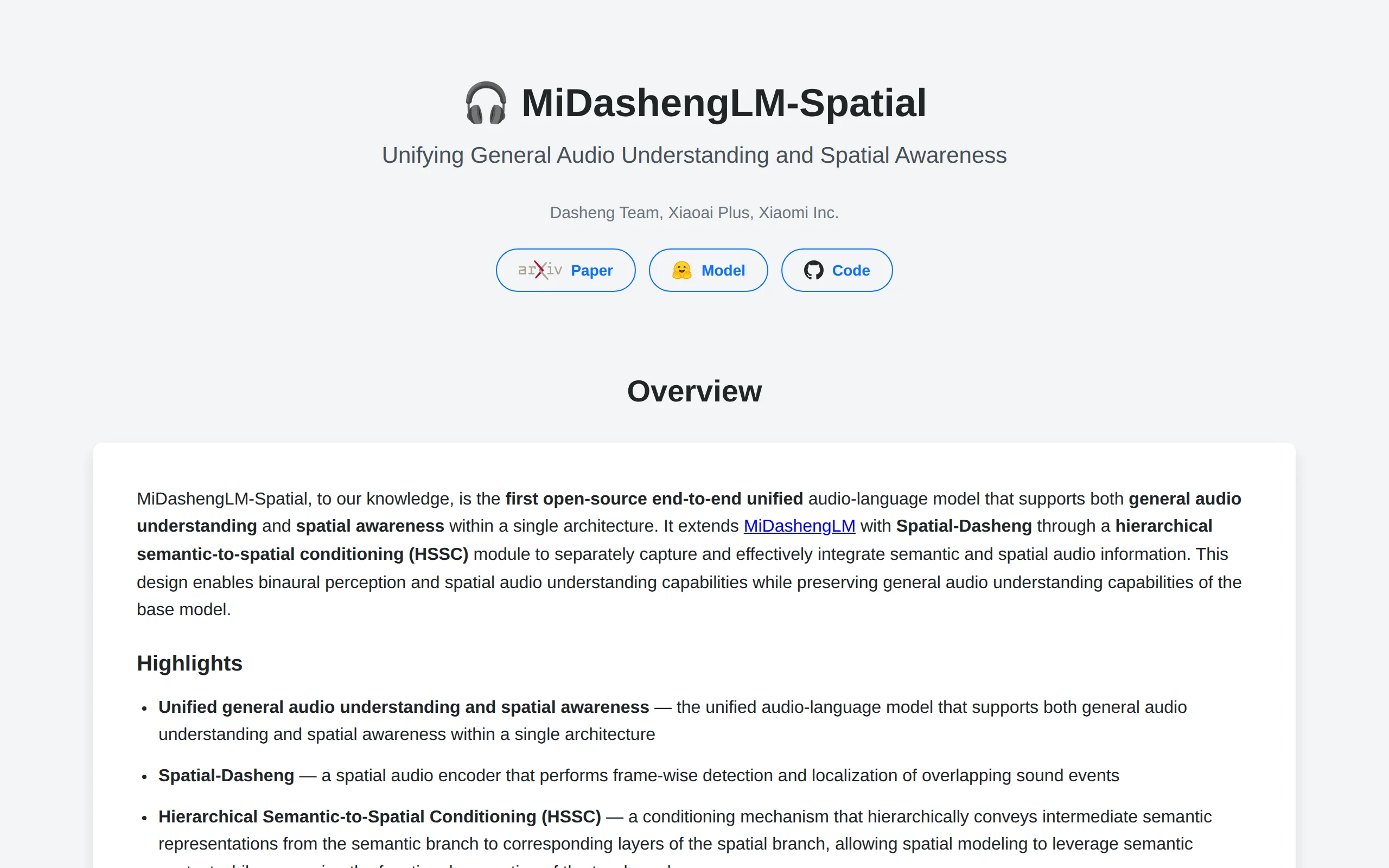
MiDashengLM-Spatial is an open-source spatial audio understanding large model developed by Xiaomi's Dasheng team. It is the first industry-leading end-to-end model that unifies general audio understan...
Muse Spark Open – In-Depth Review of Meta's Open-Source Multimodal Large Model
Muse Spark Open is Meta's latest open-source multimodal large model, built using a sparse Mixture-of-Experts (MoE) architecture. It has a total parameter count of 816 billion, with only 420 billion pa...
© All Rights Reserved. Some content on this site is partially generated by AI with human review.