
MiniMax M3.1 Flash – The Latest Flash Series Model from MiniMax
Executive Summary:
MiniMax M3.1 Flash is the new generation of the Flash series model launched by MiniMax in 2026. It made its debut under the anonymous name "Space Bunny" across major evaluation benchmarks, with a trai...
1. What is MiniMax M3.1 Flash
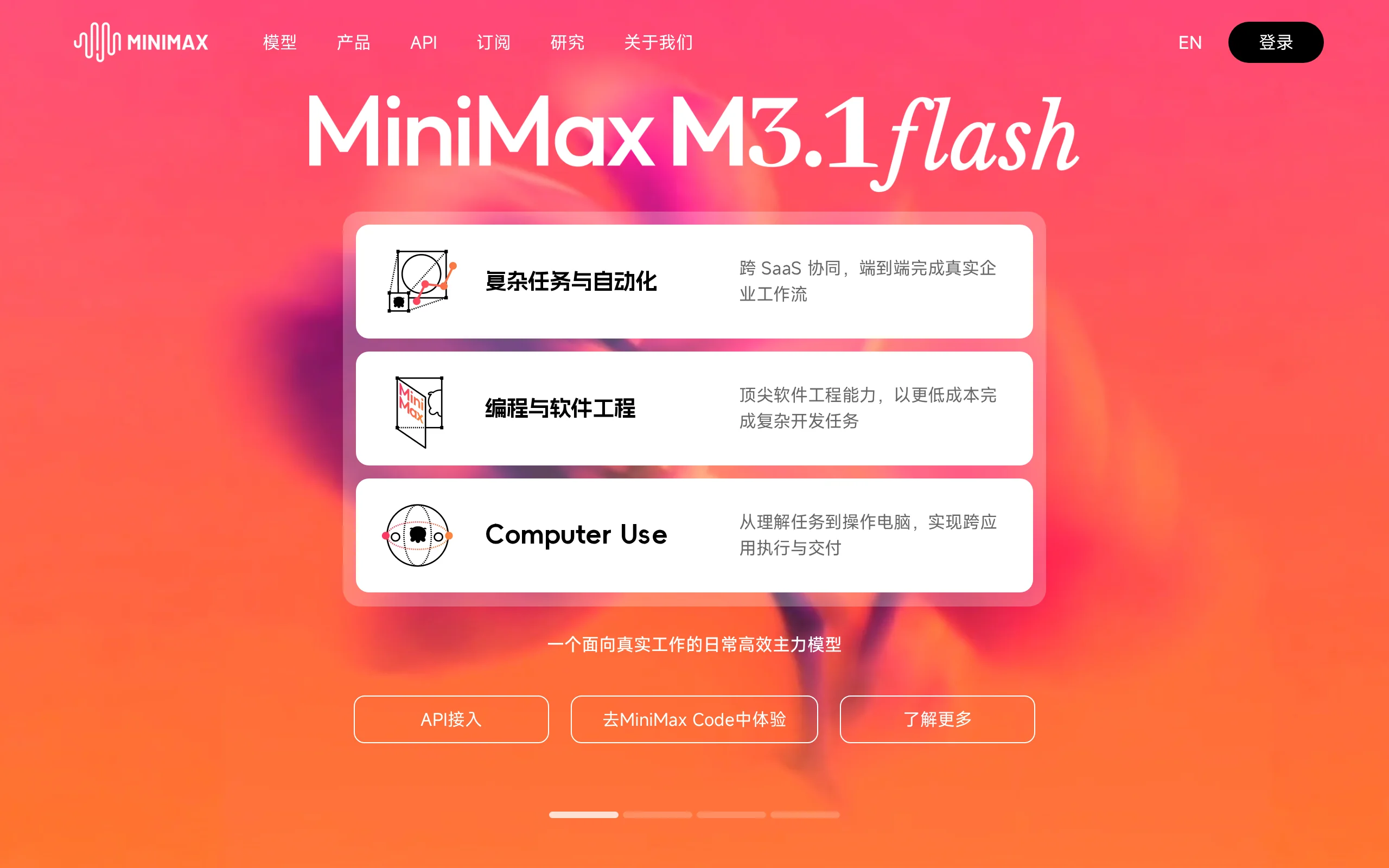
MiniMax M3.1 Flash is the new generation of the Flash series model launched by MiniMax in 2026. It made its debut under the anonymous name "Space Bunny" across major evaluation benchmarks, with a training data volume exceeding 200T Tokens. The model demonstrates outstanding performance in four key areas: Agentic tasks, programming, Computer Use, and cybersecurity, achieving scores of 73.7% on DeepSWE v1.1, 61.7 on OSWorld V2, and 82% on CyberGym. It has now been fully launched on the MiniMax API, MPlan subscription service, and MiniMax Code desktop application. The model weights are planned to be open-sourced shortly thereafter.
Technical positioning and domain: MiniMax M3.1 Flash is a lightweight, efficient inference model in the large language model (LLM) domain. It is positioned as a mid-to-small scale model that balances performance and cost, primarily targeting scenarios requiring high-frequency calls and complex task execution, such as enterprise-level automation, AI programming assistants, and real-world environment interactions. It has established a clear technical advantage in Agentic tasks and toolchain calling.
Development background: As a leading domestic AI large model research company, MiniMax has previously launched multiple generations of dialogue and inference models, accumulating extensive experience in model training and deployment. M3.1 Flash represents the continuous iteration of the Flash series. The development team conducted specialized reinforcement training for long-chain task execution, cross-system tool calling, and real-world environment interaction, aiming to provide complex task processing capabilities comparable to flagship models at significantly lower inference costs.
Core value: This model addresses the prominent challenge in enterprise AI applications of being unable to simultaneously achieve high capability and low cost. By employing an aggressive sparse attention architecture, it achieves high-speed output of over 200 TPS while maintaining a fixed low price throughout the day (input: 1 RMB per million Tokens, output: 4 RMB per million Tokens). It achieves benchmark scores that are comparable to or even on par with flagship models in areas such as programming, Agent automation, and Computer Use, significantly lowering the threshold for implementing complex task automation.
Technical features: The core of the model employs an aggressive sparse attention design, reducing computational overhead by eliminating redundant interactions in attention calculations, thereby significantly lowering the cost per Token. At the same time, it has undergone specialized reinforcement training for multi-step planning, tool calling, and interaction with real operating systems, equipping it with comprehensive capabilities for cross-SaaS workflow execution, long-chain code development, and real-world environment operation delivery.
2. Key Features
Agentic Complex Task Automation: Ranked at the top of the AutomationBench-AA benchmark, capable of integrating real business processes across SaaS systems such as sales, marketing, operations, customer service, finance, and HR. Achieved a score of 76.2 on BankerToolBench, demonstrating multi-step planning and tool chaining capabilities, allowing complex tasks to be decomposed into sequential executable steps while maintaining information consistency throughout the execution process.
Programming and Software Engineering Full-Chain Development: DeepSWE v1.1 score of 73.7%. The model is capable of independently completing the full development lifecycle, including code understanding, feature development, bug fixing, and testing validation, covering the entire process from requirement analysis to code delivery. This capability is suitable for integration into CI/CD pipelines or as an AI programming assistant, with performance in long-chain development scenarios approaching that of flagship models.
Computer Use Real-Environment Interaction: OSWorld V2 score of 61.7, ALE score of 29.6, both leading among domestic models. Through training in real operating systems and cross-application environments, the model has achieved a closed-loop capability to perceive screens, operate software, call tools, and verify results, enabling it to transition from task understanding to actual computer operations and deliverables.
Cybersecurity Professional Tasks: CyberGym score of 82%, covering professional security scenarios such as code auditing, vulnerability patching, penetration testing, malware analysis, and reverse engineering. This capability allows M3.1 Flash to support certain specialized tasks of enterprise security teams at a low cost, offering a new option for security automation.
High-Speed Inference Output: Daily usage output speed reaches 200+ TPS, with P50 stability at 170+ TPS, nearly tripling the performance of previous Flash models. This performance metric significantly enhances user experience in high-frequency interaction scenarios. Combined with a fixed low-price strategy available 24/7, it ensures cost and speed advantages for large-scale commercial use.
Multimodal and Long-Context Support: Trained on over 200T Tokens, the model exhibits strong understanding and information retention capabilities for long texts and cross-document scenarios. Combined with a sparse attention mechanism, it effectively controls computational resource consumption during long-context processing, achieving a balance between long-text capabilities and inference efficiency.
Multi-Platform Product Integration: M3.1 Flash is now available simultaneously on three usage forms: MiniMax API, MPlan subscription service, and MiniMax Code desktop application. It covers different use cases such as developer API calls, fixed-budget subscriptions, and in-IDE programming assistance, forming a relatively complete product distribution system.
3. How to Use
API Calling Method: Visit the MiniMax Open Platform (https://www.minimax.cn/) to register and log in to your account. Create an application in the console to obtain an API Key, and then follow the official API documentation to direct the model parameters to M3.1 Flash to initiate the call. This method is suitable for developers who want to integrate the model into their own applications or business systems.
Subscribe to MPlan Packages: Go to https://www.minimax.cn/m-plan to view available packages and choose to subscribe. MPlan is ideal for users who need to use the model extensively with a fixed budget. After subscription, you will receive a stable call quota, making it suitable for enterprise-level continuous usage scenarios. Specific quotas and pricing are subject to real-time information displayed on the package page.
Install MiniMax Code Desktop Client: Visit the MiniMax Code product page to download the desktop client for your corresponding operating system (Windows/macOS/Linux). After installation, you can directly call M3.1 Flash within the IDE environment for programming assistance such as code completion, code explanation, and bug fixing. This method is aimed at daily programming scenarios and does not require additional API environment configuration.
Model Weight Open Source (Coming Soon): The MiniMax official team has announced that the model weights of M3.1 Flash will be open-sourced soon. At that time, developers can obtain the weight files through official channels for local deployment or secondary development. The exact open-source time and hosting platform will be officially announced later. Please stay tuned to the MiniMax official website and community for the latest updates.
Notes: When using API calls, be mindful of your account's traffic quota and concurrency limits; the specific benefits and pricing of MPlan packages are subject to real-time information on the official page; the MiniMax Code desktop client requires an active internet connection to access cloud-based model services.
4. Pros and Cons Analysis
| Pros |
|---|
| Outstanding agentic capabilities: AutomationBench-AA ranks at the top, achieving 76.2 points on BankerToolBench. It can independently complete real enterprise business flows across SaaS platforms, with stable performance in multi-step planning and toolchain calling, demonstrating strong closed-loop delivery capabilities in practical business automation scenarios. |
| Programming capabilities match flagship models: DeepSWE v1.1 reaches 73.7%, offering a complete chain of capabilities for long-link code understanding, development, fixing, and testing verification. At the same time, its inference cost is significantly lower than that of flagship models, providing high cost-performance advantages in AI programming scenarios. |
| Leading in domestic computer use benchmarks: It ranks first domestically on both OSWorld V2 (61.7 points) and ALE (29.6 points), possessing a closed-loop capability to perceive screens, operate software, and verify results, supporting automated operational tasks in real operating system environments. |
| Significant improvement in inference speed: Daily output speed exceeds 200 TPS, with P50 stability at over 170 TPS, nearly tripling the performance of previous generations. The aggressive sparse attention architecture effectively controls computational overhead, significantly optimizing interactive experience and per-token inference cost. |
| Clear and transparent pricing strategy: The fixed pricing of 1 yuan per million input tokens and 4 yuan per million output tokens is simple and clear, with no complex billing rules, making it easier for enterprises to estimate and plan their costs. The uniform pricing across all hours reduces the complexity of cost management. |
5. Comparative Analysis with Similar Tools
| Comparison Dimension | MiniMax M3.1 Flash |
|---|---|
| Core Architecture | Sparse attention architecture, parameter scale not disclosed |
| Agent Automation (Automation-Bench) | 62.2 |
| Computer Use (OSWorld 2.0) | 61.7 |
| Financial Toolchain (BankerToolBench) | 76.2 |
| Cybersecurity (CyberGym) | 82.2 |
| Programming (DeepSWE v1.1) | 73.7 |
| Code Repository Construction (NL2Repo) | 61.2 |
| Pure Inference (HLE w/o tools) | 43.4 |
| Input Cost | 1 RMB per million Tokens (fixed) |
| Output Cost | 4 RMB per million Tokens (fixed) |
| Cache Hit Cost | 0.1 RMB per million Tokens |
| Peak-Valley Pricing Mechanism | None, same price all day |
| Output Speed | 200+ TPS (P50 stable at 170+ TPS) |
| Open Source Status | Weights will be open-sourced later |
| Multimodal Support | Not disclosed |
| One-Sentence Positioning | Strong Agent capabilities, fixed low price all day |
Selection Recommendations: If the core of your business lies in agentic automation tasks—such as integrating sales, customer service, and financial processes across SaaS systems, or requiring real-world operational delivery capabilities through Computer Use, MiniMax M3.1 Flash's clear advantages on key benchmarks like AutomationBench and OSWorld make it a more suitable choice, and its fixed pricing all day simplifies cost estimation. If multimodal input, cache cost optimization, or flexibility for local deployment are priorities, DeepSeek V4.1 Flash's open-sourced weights, off-peak low-cost cache hit mechanism, and multimodal capabilities are more appealing—especially in scenarios with frequent repeated calls, where the 5x difference in cache hit pricing could lead to significant long-term cost savings. If your use case involves cybersecurity tasks (such as code auditing, penetration testing, reverse engineering, etc.), M3.1 Flash is currently the only option between the two with clear performance data.
6. Editor's Summary
MiniMax M3.1 Flash has demonstrated a clear technical differentiation strategy in the lightweight model category. Its core innovation lies in combining an aggressive sparse attention architecture with agentic task-specific reinforcement training. The former significantly reduces computational overhead while maintaining long-context understanding capabilities, achieving a high-speed output of over 200 TPS and a nearly threefold increase in inference speed. The latter enhances the model's performance through specialized training on multi-step planning, tool calling, and interaction with real operating systems, resulting in leading results on a series of benchmarks that test real-world task closure capabilities, including AutomationBench-AA, BankerToolBench, OSWorld V2, and CyberGym. This technical approach, which integrates "architectural efficiency optimization" with "task capability定向强化" (directed enhancement), allows M3.1 Flash to achieve performance levels comparable to or even superior to flagship models, despite significantly lower inference costs.
From a practical value perspective, M3.1 Flash's pricing strategy is highly competitive — a fixed all-day price of 1 yuan per million Tokens for input and 4 yuan per million Tokens for output, combined with a cost structure of 0.1 yuan per million Tokens for cache hits, makes high-frequency enterprise-level calls and large-scale deployment economically feasible. The simultaneous launch of three usage forms — API, MPlan, and MiniMax Code — also highlights its maturity in productization.
This model is particularly suitable for the following user groups: enterprise IT teams requiring cross-system automation for complex business processes, developers seeking a low-cost, high-capacity AI programming assistant, professional institutions needing real environment interaction and cybersecurity automation capabilities, and small-to-medium-sized teams aiming to maximize model usage within a fixed budget. It should be noted that the model weights are not yet open-sourced, and information on multimodal capabilities is limited. Its performance in localized deployment and cross-modal scenarios remains to be observed. As the weight open-sourcing plan progresses and more capability data is released, the full competitiveness of M3.1 Flash will be further validated.
7. Application Scenarios
Enterprise Automation: Seamlessly integrate sales, marketing, customer service, finance, and HR processes across SaaS systems. For example, automatically follow up on leads, route service tickets, and generate reports between CRM and email systems. With its leading performance on the AutomationBench-AA, it significantly reduces repetitive manual tasks and improves the efficiency of business workflows.
AI Coding Assistant and Software Development: Independently perform code understanding, feature development, bug fixing, and testing verification. Suitable for integration with the MiniMax Code desktop application or CI processes. Supported by DeepSWE's 73.7% capability, it enables long-chain development workflows, helping development teams improve delivery efficiency while maintaining cost control.
Computer Use Digital Employees: Directly operate computers to perform cross-application tasks, such as automatically organizing files, filling out forms, scraping web data, and compiling reports. The OSWorld V2 61.7 branch supports real-world environment interaction, making it ideal for setting up digital employees to handle repetitive computer tasks and free up human resources.
Financial Compliance and Business Processing: Based on its 76.2 score on the BankerToolBench, the model excels in multi-step planning and cross-document consistency, making it suitable for financial scenarios such as reconciling statements, compliance reviews, and cross-file data consistency checks. This scenario requires the model to maintain information accuracy during long workflows, where M3.1 Flash demonstrates a clear advantage.
Cybersecurity Automation: With 82% capability coverage on the CyberGym, it supports code auditing, vulnerability patching, penetration testing, malware analysis, and reverse engineering. It can assist security teams with some specialized analytical tasks, expanding the scope of security testing under resource constraints.
8. FAQ
Q: What is the positioning difference between MiniMax M3.1 Flash and the flagship model?
A: M3.1 Flash is positioned as a lightweight and efficient model in the Flash series, reducing inference costs through a sparse attention architecture. However, its benchmark scores in four specialized capabilities—Agentic tasks, programming, computer use, and cybersecurity—reach or even approach the level of the flagship model. It is not a downgraded version of the flagship model, but rather a product form that is specifically enhanced in certain capability dimensions while controlling costs.
Q: How to call the API interface of MiniMax M3.1 Flash?
A: Visit the MiniMax Open Platform (https://www.minimax.cn/) to register and log in, create an application to obtain an API Key, and then point the model parameters to M3.1 Flash according to the official API documentation to initiate the call. For specific interface parameters, request formats, and sample code, please refer to the official API documentation.
Q: What is the pricing rule for M3.1 Flash, and how is the cost calculated?
A: The input price is 1 RMB per million Tokens, the output price is 4 RMB per million Tokens, and the cache hit price is 0.1 RMB per million Tokens. The pricing is fixed 24/7 with no peak or off-peak time differences. For example, a call that consumes 100,000 input Tokens and 20,000 output Tokens would cost approximately 1 RMB + 0.8 RMB = 1.8 RMB (cache hit scenarios are calculated separately). Specific charges should be referenced from the official billing page.
Q: When will the model weights of M3.1 Flash be open-sourced, and where can they be obtained?
A: MiniMax officially announced that the model weights of M3.1 Flash will be "open-sourced shortly," but no specific timeline or hosting platform has been disclosed. It is recommended to continue following the official MiniMax website and community announcements. Once open-sourced, the weights will be released through official channels immediately. As of the time of this article's publication, there are no downloadable weight resources available yet.
Q: What is the context window length of M3.1 Flash? Does it support multimodal input?
A: As of the time of this article's publication, the official has not yet disclosed the specific context window length or multimodal capabilities of M3.1 Flash. The model was trained on over 200T Tokens and has the ability to retain cross-document information, but the exact context window length remains to be officially confirmed. If your business requires multimodal input, it is recommended to evaluate competitors such as DeepSeek V4.1 Flash, which have confirmed multimodal support.
Q: What specific tasks can the 82% cybersecurity capability of M3.1 Flash perform?
A: This capability covers five specialized cybersecurity tasks: code auditing, vulnerability patching, penetration testing, malware analysis, and reverse engineering. Enterprise security teams can leverage this model for tasks such as vulnerability analysis, code security reviews, and preliminary analysis of malicious samples, thereby expanding security coverage when human resources are limited. However, for critical security decisions, it is still recommended to have them reviewed by professional security personnel.
9. Project Links
- MiniMax Code Product Page: https://www.minimax.cn/ (desktop download entry, subject to official website display)
- MiniMax M3.1 Flash Official Announcement: https://www.minimax.cn/blog/minimax-m31f
- MPlan Subscription Page: https://www.minimax.cn/m-plan
- MiniMax Open Platform (API): https://www.minimax.cn/
Related
Hy Memory 2.0 – Tencent HunYuan's Open-Source Agent Memory Framework
Hy Memory 2.0 is an open-source agent memory framework developed by Tencent HunYuan, featuring a three-tier architecture: "model + framework + application." It includes the Hy-Memory-30A3B model speci...

BlenderWorld – Qwen's Open-Source 3D Creation Agent Evaluation Benchmark
BlenderWorld is an evaluation benchmark for 3D creation agents, jointly developed by the Qwen team with Zhejiang University, The Chinese University of Hong Kong, Fudan University, and National Univers...
Muse Spark Open – In-Depth Review of Meta's Open-Source Multimodal Large Model
Muse Spark Open is Meta's latest open-source multimodal large model, built using a sparse Mixture-of-Experts (MoE) architecture. It has a total parameter count of 816 billion, with only 420 billion pa...
Review of Matrix-Game 4.0: Kunlunwanwei Brings Video Large Model Games to Consumer-Level GPUs for the First Time
Matrix-Game 4.0 is the world's first open-source video large model game that can run in real-time on a single consumer-grade GPU. This system employs an innovative "Harness" architectural paradigm, de...
© All Rights Reserved. Some content on this site is partially generated by AI with human review.