
EdenLive – VAST's Real-time Generative Renderer, Redefining the Paradigm of World Model Rendering
Executive Summary:
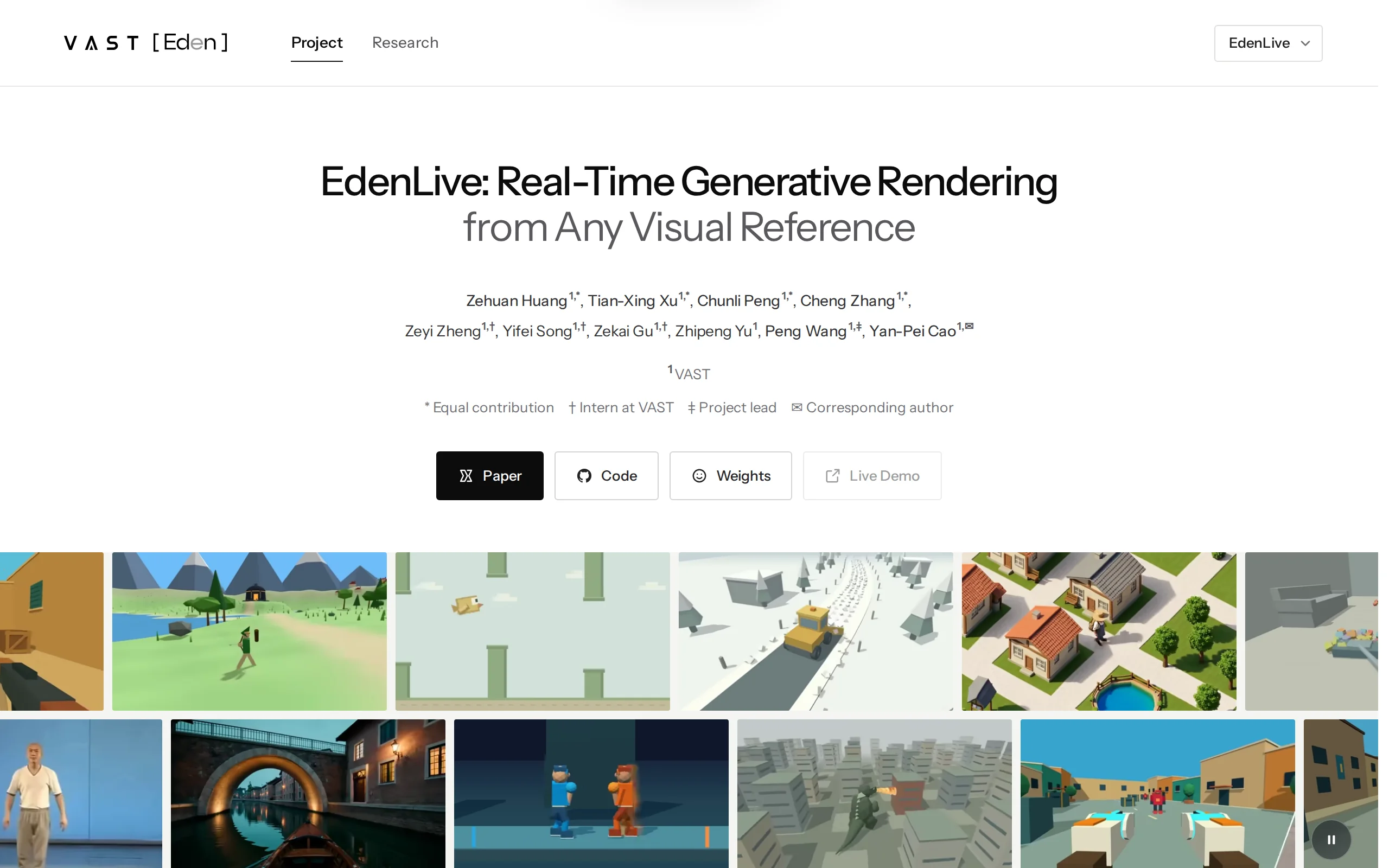
EdenLive is a real-time generative renderer launched by VAST, and a milestone achievement in its world model project, Project Eden. This tool uses a Proxy as the control signal to simplify the image o...
1. What is EdenLive
EdenLive is a real-time generative renderer launched by VAST, and a milestone achievement in its world model project, Project Eden. This tool uses a Proxy as the control signal to simplify the image or reference video, combined with the target first frame and text prompts, to continuously generate realistic or stylized visuals in real time. It can output 720P at over 24 FPS on a single RTX 5090 GPU, with end-to-end latency measured in the hundreds of milliseconds. Its core design lies in decoupling the maintenance of world states from visual rendering, allowing video models to no longer be responsible for implicit state inference, thereby avoiding the accumulation of errors over time. This enables interactive real-time image generation without the need for complete artistic assets. EdenLive has fully open-sourced its model weights, inference code, and technical reports, making it suitable for applications such as game development, pre-production in film and animation, and data generation for embodied intelligence.
Technical positioning and domain: EdenLive belongs to the field of real-time generative rendering, situated between traditional computer graphics rendering pipelines and video generation models. Its unique positioning is not to replace game engines or physics simulation systems, but rather to serve as a visual presentation layer, receiving simplified scene structures from upstream interactive systems and generating high-fidelity final visuals in real time. This fills the technological gap between traditional renderers and generative models.
Development background: EdenLive was developed by VAST (a team under Beijing Wuwen Xinqiong specializing in multimodal large models) as a milestone achievement in the Project Eden world model initiative. VAST has long focused on 3D generation and multimodal large models, accumulating extensive technical expertise in visual generation. The release of EdenLive stems from a rethinking of the implementation path for "world models": rather than having the model implicitly simulate an entire world end-to-end, it is more practical to delegate world state maintenance to deterministic systems, allowing generative models to focus solely on visual rendering. This design philosophy reflects the team's realistic assessment of the capabilities and limitations of generative models.
Core value: EdenLive addresses two major pain points in real-time interactive scenarios involving generative rendering: first, traditional video generation models suffer from error accumulation due to implicit state inference, making them unsuitable for continuous generation over minutes; second, high-quality game or animation production relies on complete artistic assets, which are costly. Through its decoupled architecture of state and rendering, EdenLive enables generative rendering for the first time to achieve real-time interactivity on consumer-grade hardware, significantly lowering the barrier to entry for 3D content creation.
Technical features: EdenLive employs a Proxy-to-Fine generation paradigm, generating production-level visuals using simplified reference images without requiring detailed geometry. Its multimodal conditional control mechanism integrates three types of input: reference video streams, target first frames, and text prompts, enabling flexible switching between arbitrary references and artistic styles. The model uses a streaming inference architecture, achieving real-time output of 720P at over 24 FPS with a 5B parameter scale. This makes EdenLive one of the few open-source solutions that currently combines real-time performance with high artistic style flexibility.
2. Key Features
Real-time Generative Rendering: Using a Proxy simplified image or reference video as a control signal, continuously generate detailed or stylized visuals in real-time. With a single RTX 5090 and 720P configuration, it achieves a frame rate exceeding 24 FPS, with end-to-end latency in the hundreds of milliseconds. It supports continuous generation for minutes, meeting the strict requirements for smoothness in real-time interactive scenarios.
Arbitrary Style Switching: Simply provide the first frame of the target and text prompts to transform the same image into different visual styles such as animation, oil painting, or photorealism. This capability allows creators to avoid rebuilding artistic assets for each style, significantly reducing the marginal cost of multi-style content production, especially useful in pre-production for film and television.
Arbitrary Reference Input: Supports multiple sources such as 2D animation, 3D scenes, and real videos as structural and motion references, without relying on a specific rendering pipeline. Whether it's output from a game engine, screen recordings, or hand-drawn sketches, they can all be used as control signals, greatly expanding the flexibility of input sources.
Proxy-to-Fine Generation: Generate high-quality final images directly from a rough scene structure, without the need to pre-create complete artistic assets. The model uses the scene layout, camera movement, and coarse-grained dynamics provided by the Proxy reference image as conditions to generate refined target visuals, significantly reducing the upfront investment in content production.
Game Interaction Integration: Decoupled from upstream interaction systems while preserving the game UI and operational mechanisms. The game engine explicitly records and updates rules, character positions, and collision detection, while EdenLive focuses on visual rendering, achieving a complete workflow of "state maintenance + real-time rendering," offering a viable architecture for generative game development.
Open-Source Ecosystem Support: Open model weights, inference code, and technical reports, with the added Game Prototype Turbo tool that can generate playable Proxy games from natural language in one click. These can then be connected to EdenLive for real-time rendering, fully enabling the generation process from text to interactive games.
Embodied Intelligence Data Generation: Modify the visual appearance while preserving the original motion trajectory and scene structure, providing diverse data for robot training. This feature addresses the issue of visual uniformity in simulation data, allowing for the rapid generation of multiple visual styles of training samples without re-collecting motion data.
3. How to Use
Get the Code: Clone the open-source repository from GitHub
https://github.com/VAST-AI-Research/EdenLive, ensuring that Git and a Python 3.8 or higher environment are installed locally. It is recommended to use a virtual environment to manage dependencies and avoid conflicts with system Python packages.Download Weights: Download the corresponding model weights from Hugging Face
https://huggingface.co/VAST-AI/EdenLivebased on the model size. The model has a parameter scale of 5B, so choose a suitable version based on your local GPU memory capacity. The official recommendation is to use an NVIDIA RTX 5090 or a GPU with equivalent or higher performance, with a memory capacity of at least 24GB.Prepare Input One (Reference Scene): Provide a Proxy simplified scene or a reference video stream. Sources can include self-built 2D/3D scenes, outputs from game engines, or screen recordings. The reference scene does not need to achieve specific geometric precision; a rough scene structure can serve as an effective control signal.
Prepare Input Two (Target First Frame): Specify a first frame image that determines the overall visual style and appearance. This first frame will act as a style anchor, combining with the structural information from the reference scene to define the final visual style direction.
Prepare Input Three (Text Prompts): Write textual prompts that describe the style and details. These prompts can provide additional information about the visual style, lighting atmosphere, and material details, working together with the reference scene and target first frame to drive the generation process.
Run Inference: Call the inference code, and EdenLive will render the reference scene in real-time into a detailed image or video stream with the specified style. It is recommended to first use the official example configuration for verification, ensuring the environment is correctly set up before connecting custom inputs.
Integrate with Interactive Systems: Continuously input dynamic reference scenes from upstream engines into the model to achieve a rendering loop for real-time interactive scenarios such as games. Pay attention to matching the input frame rate with the model's inference frame rate to prevent latency from increasing due to input backlog.
Experience the End-to-End Demo: Use the open-source Game Prototype Turbo to generate a playable Proxy game through natural language, then connect it with EdenLive for real-time rendering. This allows you to fully go through the generation process from text to a playable game, enabling a quick evaluation of the overall effect.
4. Pros and Cons Analysis
| Pros |
|---|
| Excellent real-time performance: A single RTX 5090 can achieve minute-level continuous generation at 720P, 24FPS or higher, with end-to-end latency measured in hundreds of milliseconds, placing it ahead of other open-source generative rendering solutions. |
| Decoupled architecture ensures stability: The world state is explicitly maintained by the interaction system, while the video model focuses solely on rendering, avoiding error accumulation caused by implicit state inference. This is a key design that enables long-duration continuous generation. |
| Low input requirements: The Proxy reference does not require precise geometry or specific rendering pipelines. A rough scene description is sufficient to generate production-level visuals, significantly reducing the initial asset investment for content creation. |
| Flexible style switching: A single reference image can generate realistic, anime, oil painting, or any other style without needing to recreate assets for each style, offering an efficient pathway for multi-style content production. |
| Fully open-sourced: The model weights, inference code, and technical reports are all open-sourced, with the additional Game Prototype Turbo tool provided. Developers can perform secondary development and customization based on the source code. |
5. Comparative Analysis with Similar Tools
| Comparison Dimension | EdenLive (VAST) | Genie 3 (Google DeepMind) |
|---|---|---|
| Product Positioning | Real-time generative renderer, the rendering layer in world models | General-purpose world model, end-to-end generation of interactive worlds |
| Technical Approach | Decoupled state maintenance and visual rendering, world rules managed by upstream systems | End-to-end autoregressive generation, model implicitly maintains world state |
| Control Signals | Triple control: Proxy reference image + target first frame + text prompts | Text prompts + user operation instructions |
| Real-time Performance | 720P / over 24 FPS, can run on a single RTX 5090 | 720P / 24 FPS, but requires high computational power and TPU-level hardware |
| Art Style Flexibility | Arbitrary reference and style, seamlessly switch between realistic, anime, oil painting, etc. | Primarily photo-realistic style, style switching is not a core design |
| Asset Dependency | No complete art assets required, can generate with simplified Proxy images | No art assets required, but needs large amounts of training data |
| Consistency Duration | Minute-level continuous generation, long-term memory is still under optimization | World consistency maintained for several minutes, visual memory lasts about 1 minute |
| Openness | Fully open-sourced (weights, code, technical reports) | Closed-source research preview, only available in limited scope |
| Hardware Requirements | Consumer-grade GPU can be used for local deployment | Cloud-based high computational dependency, cannot be run locally |
Selection Recommendations: For independent developers or small teams seeking real-time interactivity and local deployment, EdenLive offers the only currently viable open-source solution. Its decoupled architecture allows developers to retain traditional game engine logic for world state management, replacing only the visual rendering with generative rendering, resulting in relatively controllable migration costs. However, note that EdenLive's Proxy-to-Fine generation paradigm still has certain requirements for the quality of reference images, and the 5B parameter model's memory demands mean developers need mid-to-high-end GPUs.
For projects requiring highly deterministic physical simulation or large-scale open-world environments, the traditional game rendering pipeline remains a more reliable choice. EdenLive's current decoupled architecture relies on upstream systems to explicitly maintain world state, and in complex physical interactions or ultra-large-scale environments, the precision and efficiency of state synchronization may become a bottleneck. Additionally, while end-to-end world models like Genie 3 offer greater potential in terms of interactive freedom and scene generalization, their closed-source nature and high computational requirements make them suitable only for teams with ample cloud resources.
6. Editor's Summary
EdenLive's technological innovation lies in its redefinition of the implementation path for world models. Unlike end-to-end solutions such as Genie 3, EdenLive chooses to decouple world state maintenance from visual rendering. This difference in design philosophy brings significant engineering advantages: the video model no longer needs to perform implicit state inference, fundamentally avoiding issues of error accumulation and making minute-level continuous generation possible. From a technical implementation perspective, the Proxy-to-Fine generation paradigm, combined with a multimodal conditional control mechanism, achieves real-time output at 720P resolution and over 24 FPS with a 5B parameter scale. This performance metric holds reference value in the open-source generative rendering domain.
In terms of practical value, EdenLive's most direct contribution is in lowering the barrier to 3D content creation. Traditional game or animation production relies on a complete art asset pipeline, whereas EdenLive allows for the direct generation of production-level visuals using Proxy-simplified inputs. This capability has practical significance for independent developers, small studios, and pre-production teams in the film and animation industry. Additionally, its application in generating embodied intelligence data provides a low-cost pathway for diversifying simulation data, addressing the issue of visual uniformity in robot training.
The primary users of EdenLive include: independent developers aiming to quickly validate game mechanics prototypes at a low cost, pre-production teams in film and animation requiring rapid iteration across multiple styles, and embodied intelligence researchers needing diverse visual data. For AAA projects that prioritize ultimate visual quality or deterministic physical simulation, the current version may not be the optimal choice, but it can serve as an auxiliary tool for pre-visualization or prototype validation.
Looking ahead, EdenLive's open-source strategy lays the foundation for its ecosystem development. As community contributions accumulate, inference optimization, style control precision, and long-term memory capabilities are expected to continue improving. Its exploration in the niche area of real-time generative rendering also provides another viable approach for the practical deployment of world models. The VAST team's technical expertise in 3D generation may bring deeper spatial understanding capabilities to EdenLive, making it a project worth continuing to follow.
7. Application Scenarios
AI Game Development: Independent developers can leverage EdenLive's real-time rendering capabilities to generate production-quality visuals directly from simplified scene inputs, enabling the creation of 3D games at a low cost. Combined with the Game Prototype Turbo tool, developers can even generate playable Proxy game prototypes from natural language descriptions with a single click, then integrate EdenLive's real-time rendering to significantly shorten the cycle from concept to playable demo.
Film and Animation Pre-Production: Directors can use rough sketches to determine composition, camera movement, and character motion paths, then generate realistic, cartoon, oil painting, and other stylized versions with a single click using EdenLive, quickly finalizing the visual direction. This application compresses the weeks-long style testing phase in traditional pre-production into just a few hours, allowing creative teams to thoroughly explore multiple visual possibilities before committing to formal production.
Real-Time Stylized Live Streaming and Video Creation: Creators can use real-person videos as references and render live performances into anime or other stylized visuals using EdenLive, suitable for virtual hosts and short video creation. Compared to traditional motion capture solutions, this method eliminates the need for professional motion capture equipment and character models, significantly reducing the equipment and labor costs associated with virtual content production.
Embodied Intelligence Training Data Generation: While preserving the robot's motion trajectory and scene structure, EdenLive can alter the visual appearance to rapidly generate diverse simulated data for robot training. This application addresses the issue of insufficient visual diversity in data migration from simulation to reality, enabling the generation of training samples under various lighting, material, and style conditions without the need to re-collect motion data, thereby enhancing the model's generalization ability.
Interactive Education and Virtual Experiences: Simplified 3D scenes for educational and exhibition applications can be rendered in high-quality visuals in real-time using EdenLive, providing users with immersive and interactive experiences on browsers or lightweight devices. This scenario is applicable to online education, virtual exhibitions, and digital cultural tourism, allowing users to enjoy near console-level visual quality without requiring high-performance graphics hardware.
8. FAQ
Q: What are the specific hardware requirements for EdenLive?
A: The official recommendation is to use an NVIDIA RTX 5090 or a GPU with equivalent or better performance. It is advised that the GPU memory be no less than 24GB. The model parameter scale is 5B, which results in high memory usage during inference. If using a lower-end GPU, you can adjust the output resolution or frame rate to accommodate the hardware, but the generation quality and smoothness may decrease accordingly.
Q: What is the relationship between EdenLive and traditional game engines (e.g., Unity, Unreal)?
A: EdenLive is not a replacement for game engines but instead collaborates with them as a visual rendering layer. Game rules, character positions, collision detection, and other logic are explicitly recorded and updated by the engine. EdenLive receives a simplified scene structure from the engine and generates high-fidelity visuals in real time. The two components work together through a decoupled architecture that maintains state and handles rendering, achieving a complete workflow.
Q: What input formats does EdenLive support?
A: EdenLive supports three types of input: first, a Proxy simplified image or reference video stream, which can come from various sources such as 2D animation, 3D scenes, or real video; second, a target first-frame image, which determines the overall visual style; and third, text prompts, which provide additional descriptions of style and details. These three inputs work together to drive the generation process.
Q: Is EdenLive supported for commercial use?
A: EdenLive is fully open-sourced, with open model weights, inference code, and technical reports. For specific details regarding the open-source license and its restrictions on commercial use, please refer to the LICENSE file in the GitHub repository.
Q: How is the consistency of the visual style in EdenLive-generated images ensured?
A: Style consistency mainly relies on the target first-frame image and text prompts. In complex scenes, precise control over style details may require multiple iterations and parameter adjustments. The official technical report notes that long-term memory is still under optimization, and detail drift may occur during extended generation sessions. It is recommended to control the duration of single-generation sessions in practical applications.
Q: Can EdenLive be used for real-time interactive games?
A: Yes. EdenLive's architecture is specifically designed for game interaction scenarios, working in a decoupled manner with upstream interactive systems while preserving game UI and operation mechanisms. With a single RTX 5090 GPU, it can achieve real-time rendering at 720P resolution and above 24FPS, with end-to-end latency around 100 milliseconds, meeting basic interaction requirements.
9. Project Links
- Project Website: https://vast-eden.ai/?p=edenlive
- GitHub Repository: https://github.com/VAST-AI-Research/EdenLive
- Hugging Face Model Library: https://huggingface.co/VAST-AI/EdenLive
- Technical Paper: https://assets.vast-eden.ai/assets/edenlive/EdenLive-tech-report.pdf
Related

BlenderWorld – Qwen's Open-Source 3D Creation Agent Evaluation Benchmark
BlenderWorld is an evaluation benchmark for 3D creation agents, jointly developed by the Qwen team with Zhejiang University, The Chinese University of Hong Kong, Fudan University, and National Univers...
MiDashengLM-Spatial – Xiaomi's Open-Source Spatial Audio Understanding Large Model
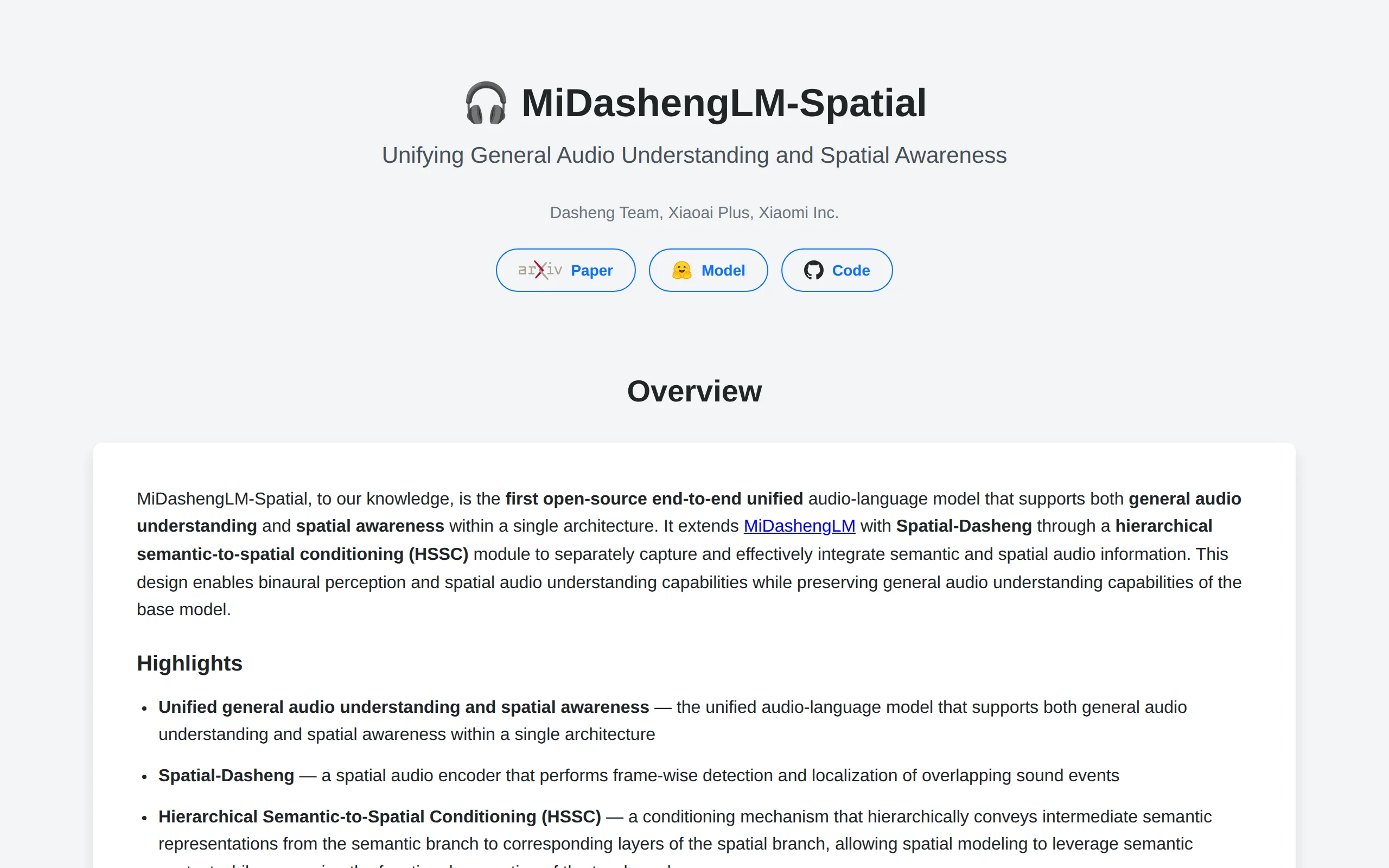
MiDashengLM-Spatial is an open-source spatial audio understanding large model developed by Xiaomi's Dasheng team. It is the first industry-leading end-to-end model that unifies general audio understan...
Review of Matrix-Game 4.0: Kunlunwanwei Brings Video Large Model Games to Consumer-Level GPUs for the First Time
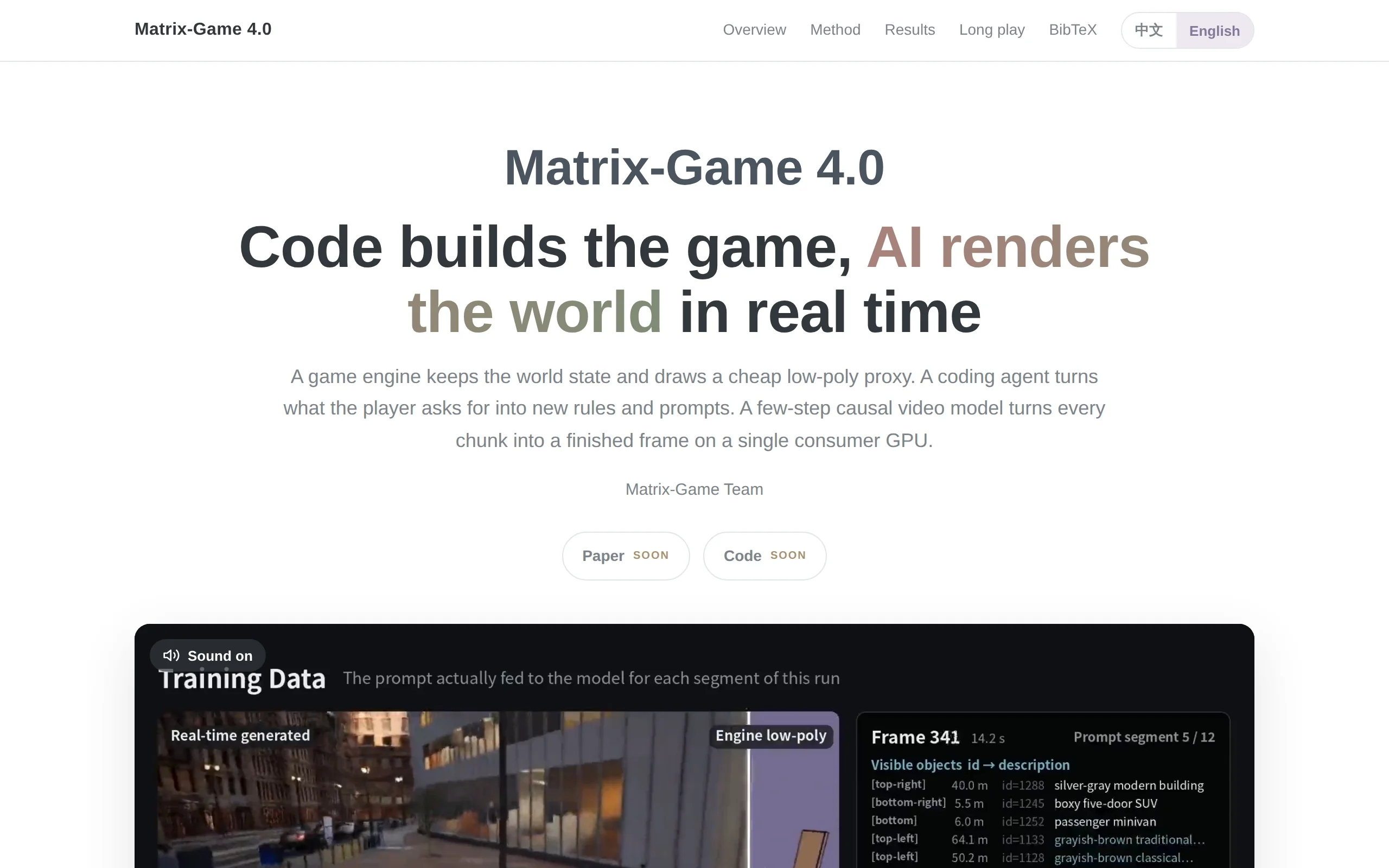
Matrix-Game 4.0 is the world's first open-source video large model game that can run in real-time on a single consumer-grade GPU. This system employs an innovative "Harness" architectural paradigm, de...

In-Depth Review of ArtCraft: Open-Source AI Image and Video Creation Workbench, Reimagining the Creative Workflow with "Control前置"
ArtCraft is an open-source AI image and video creation workbench, with its core design philosophy centered around "prioritizing controllability." This means that before generating the final image, it ...
© All Rights Reserved. Some content on this site is partially generated by AI with human review.