
Void – Open-Source Full-Stack Development and Deployment Tool, Integrating Creation and Deployment
Executive Summary:
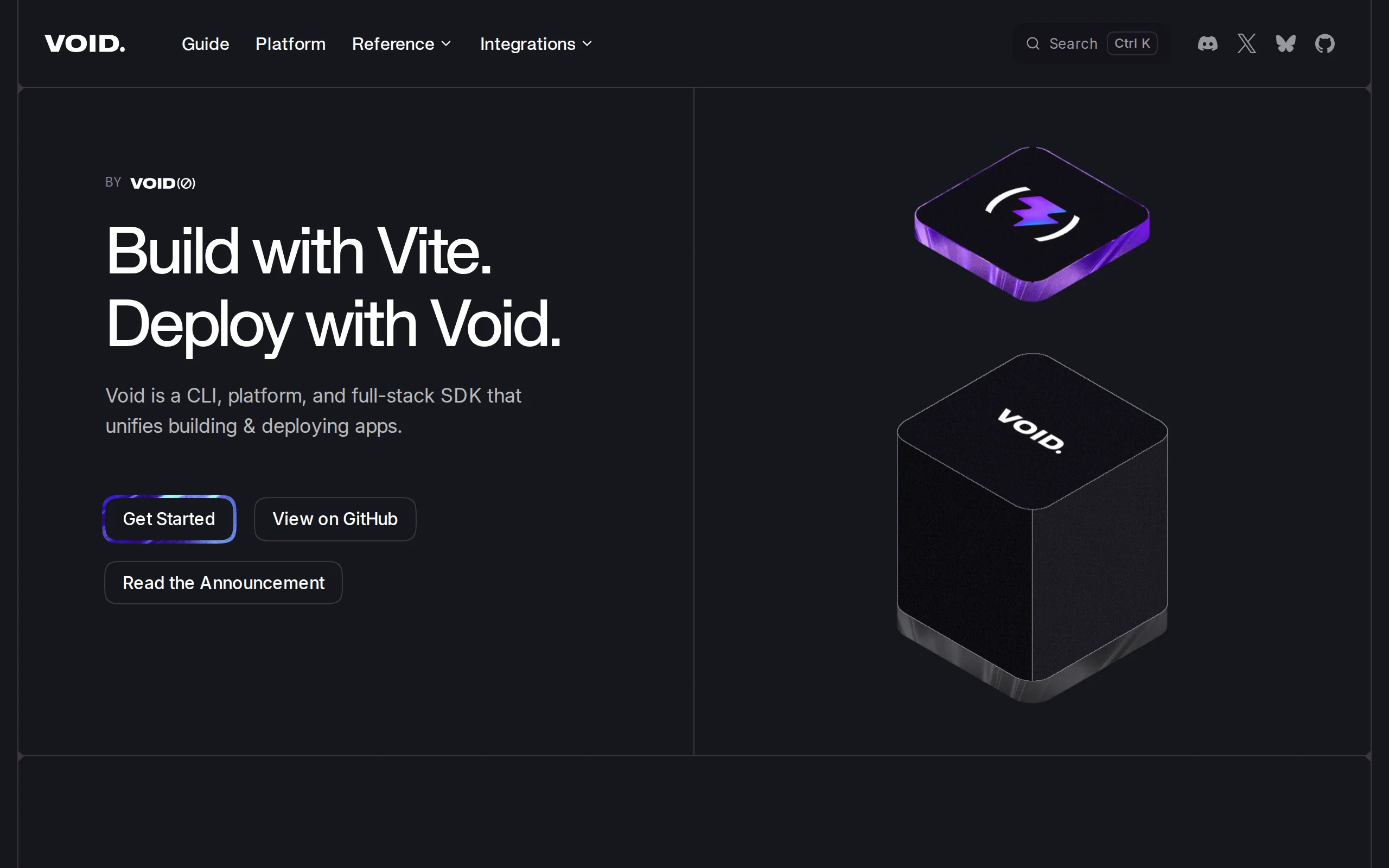
Void is an open-source full-stack development and deployment tool created by the Evan You team, consisting of three components: SDK, CLI, and a team deployment platform. This tool integrates the devel...
1. What is Void
Void is an open-source full-stack development and deployment tool created by the Evan You team, consisting of three components: SDK, CLI, and a team deployment platform. This tool integrates the development workflow for Vite applications—writing code, connecting to databases, and deploying—into a complete workflow. During local development, it automatically configures local resources, and during deployment, it seamlessly connects to Cloudflare services such as D1, KV, and R2 with a single click, eliminating the tedious manual configuration. The team platform allows administrators to centrally manage cloud account permissions, and team members can securely deploy internal applications. Void supports mainstream frameworks such as Nuxt and SvelteKit, and now supports self-deployment to personal Cloudflare accounts, offering developers an end-to-end solution from code to deployment.
Technical Positioning and Domain: Void belongs to the domain of full-stack development and deployment tools, positioned within the Vite ecosystem. It organically integrates backend capabilities, database operations, and cloud deployment. It is both a development framework and a deployment solution, filling the gap in the Vite ecosystem between "development" and "deployment."
Development Background: Void was developed by a team led by Evan You, the creator of Vue.js, who previously spearheaded the development of the Vite build tool and the Vue framework. Based on a deep understanding of the pain points in front-end engineering, the team observed that after completing the development of a Vite application, developers still had to deal with cumbersome tasks such as database configuration, cloud resource binding, and deployment processes. Therefore, they decided to create a tool that integrates creation and deployment into a unified experience.
Core Value: Void addresses the fragmentation of the workflow for full-stack applications from local development to online deployment. In traditional models, developers must separately manage the local development environment, database configuration, cloud resource binding, and deployment process, which involves high switching and configuration costs across multiple tools. Void compresses these steps into a unified development experience through features such as automatic inference of resource dependencies, a built-in type-safe data access layer, and one-click deployment commands.
Technical Features: Its core technical advantages lie in the automatic resource binding mechanism and the design that ensures type safety across the entire stack. The .server.ts file convention allows page components to directly retrieve server-side data with type information, reducing errors during front-end and back-end integration. At the same time, Void's design for consistency between local and cloud environments significantly reduces deployment risks caused by environmental differences.
2. Key Features
Zero-configuration SDK integration: Provides type-safe backend capabilities for Vite applications. The accompanying
.server.tsfile for each page can read data and handle forms, passing typed server-side data to components. This design embeds backend logic into the frontend project structure, allowing developers to gain full server-side capabilities without maintaining a separate API layer.Automatic resource binding: Automatically infers binding relationships based on the resources used by the application. During local development, it uses a local database, and during deployment, it automatically creates corresponding cloud resources. This mechanism eliminates the need to manually write configuration files for resources and removes configuration errors caused by environmental differences.
CLI one-click deployment: Running
npx void deploycompletes the build, resource configuration, database migration, and generates a deployment URL. This command condenses multiple steps of the traditional deployment process into a single instruction, significantly lowering the deployment barrier and reducing the likelihood of human error.Cloudflare full-stack integration: Natively integrates with services such as D1 database, KV storage, and R2 object storage, without requiring manual configuration. Void encapsulates various Cloudflare services into a resource abstraction layer that can be directly called. Developers only need to declare their usage intent, and the tool automatically creates and binds the underlying services.
Multi-framework support: Compatible with Nuxt, SvelteKit, Astro, and TanStack Start. The original framework handles routing and rendering, while Void manages resources, migrations, and deployment. This division of responsibilities allows developers to continue using familiar framework paradigms while enjoying a unified deployment experience.
Team deployment platform: Administrators can install the platform within their own Cloudflare account, and team members can connect and deploy directly. Cloud credentials are not exposed to individuals. This feature resolves issues with cloud account permission management in team collaboration, making the internal application deployment process more standardized and secure.
Consistent local and cloud experience: Uses local database resources during local development and automatically switches to cloud resources during deployment, significantly reducing environmental differences. This design ensures behavioral consistency between the development and production environments, minimizing the classic issue of "works locally but fails in production."
3. How to Use
Environment Setup: Install Node.js 24.21.0 or higher and create an empty project directory. Ensure the Node.js version meets the requirements to avoid compatibility issues caused by an outdated runtime version.
Install Void: Run
npm install -D voidin the project directory to install the development dependency. Void is introduced as a development dependency and will not increase the production environment package size.Initialize the Project: Run
npx void init, and follow the prompts to select a UI framework, starter template, and choose Cloudflare as the deployment target. Void supports mainstream UI frameworks such as Vue, React, and Svelte, and provides multiple starter templates for selection.Local Development: Run
npm run devto start the development server, which automatically uses local database resources. The development server provides hot-reloading capabilities, allowing code changes to be instantly reflected in the browser.Write the Application: Write server-side logic using
.server.tsfiles, and page components automatically receive type-safe data. Server-side files are placed in the same directory as page components, with code isolation between server and client achieved through naming conventions.One-Click Deployment: Run
npx void deploy. On the first run, it will open a browser to log in to your Cloudflare account. The deployment command automatically completes the build, resource configuration, and database migration, and finally outputs the online access address.
Notes: It is recommended to fully test the application's functionality in the local environment before deployment, including data read/write operations and form submissions that involve server-side resources. For migrating existing projects, ensure that the current code is compatible with Void's resource abstraction layer, and adjust the database access methods if necessary.
4. Pros and Cons Analysis
| Pros |
|---|
| Integrated Development and Deployment: Combines encoding, database connection, and deployment into a unified workflow, reducing the cost of switching between multiple tools and improving development efficiency. |
| Type Safety Across the Stack: Server-side data and database query results with types are directly passed to page components, significantly reducing front-end and back-end integration errors and improving code robustness. |
| Zero-configuration Resource Binding: Automatically infers the resources required by the application and creates bindings, eliminating the tedious process of manually writing configurations and lowering the entry barrier. |
| Open Source and Self-Deployable: Uses the MIT open-source license, allowing for code auditing and modification, and supports deployment to personal Cloudflare accounts, ensuring data sovereignty. |
5. Comparative Analysis with Similar Tools
| Comparison Dimension | Void | Vercel | Netlify |
|---|---|---|---|
| Core Positioning | All-in-one full-stack development and deployment tool based on Vite | Full-stack deployment platform for frontend | Frontend static site and serverless function platform |
| Open Source Status | Fully open source (MIT), supports self-hosting | Core platform closed source, managed services available | Platform closed source, some framework components open sourced |
| Underlying Infrastructure | Cloudflare (Workers/D1/KV/R2) | Self-built edge network (hybrid with AWS/GCP, etc.) | Multi-cloud infrastructure primarily based on AWS |
| Resource Binding Method | Automatic resource binding inference, zero configuration | Manual configuration of environment variables and integrations required | Manual configuration of environment variables required |
| Local Development Experience | Automatically provides a local database, consistent with the cloud | Requires setting up a local simulation environment separately | Requires simulating a serverless function environment separately |
| Type Safety | Type-aware components for server-side data/database queries | Requires building type safety manually using solutions like tRPC | Requires building a type safety solution manually |
| Deployment Command | npx void deploy — one command to handle everything |
vercel CLI, similar workflow |
netlify deploy command, requires step-by-step operations |
| Framework Preference | Neutral, supports Vite ecosystem (React/Vue/Svelte all applicable) | Strongly favors Next.js | Neutral, static site-friendly |
| Team Permission Management | Self-hosted platform, credentials remain with administrators | Comprehensive team collaboration features, platform cannot be self-hosted | Comprehensive team features, platform cannot be self-hosted |
| Cost Model | Open source and free, only Cloudflare resource costs apply | Charged by seat and usage, higher costs with large traffic | Free tier plus pay-as-you-go |
Selection Recommendations: For developers working within the Vite ecosystem, Void's full-stack integration experience and automatic resource binding mechanism clearly outperform other platforms. It is particularly suitable for applications requiring complete backend capabilities such as databases and storage, as the one-command deployment process significantly lowers the barrier to entry. For teams that have deeply integrated Next.js, Vercel provides a more mature integration experience. If the project is primarily a static site, the free tiers of Netlify and Cloudflare Pages are sufficient to cover most scenarios.
For teams focused on cost control: Void's open-source model combined with Cloudflare's pricing strategy offers clear cost advantages during traffic growth phases. However, Vercel's pay-as-you-go model may require careful long-term budget planning when traffic is high.
6. Editor's Summary
Void demonstrates a systematic approach to innovation in the development process. By automating resource binding, embedding type safety, and command-ifying the deployment process, this tool addresses multiple high-frequency pain points in full-stack application development. The .server.ts file convention implemented at the framework level unifies the organization of server-side and client-side code. Compared to traditional front-end and back-end separation models, this design significantly reduces context-switching costs in medium and small-sized projects.
From a practical standpoint, Void is well-suited for full-stack application development within the Vite ecosystem. For individual developers, the ability to deploy with a single command simplifies the process of showcasing work and launching side projects. For teams, the self-hosted platform's unified access control resolves security concerns related to cloud credential distribution, making it particularly suitable for deploying sensitive applications such as internal tools and management dashboards.
As an open-source project, the MIT license ensures code auditability and autonomous control. For teams that wish to maintain control over their infrastructure, this model offers greater flexibility. However, due to the project's early release timing, the community ecosystem and third-party use cases are still in the accumulation phase. As the user base grows and documentation improves, Void's influence within the domestic developer community is expected to expand further. Void is more suitable for developers who align with Cloudflare's infrastructure, and can be directly adopted when building new projects.
7. Application Scenarios
Quick Deployment for Individual Developers: After setting up a Vite project, deploy it to Cloudflare with a single command. Obtain an online URL with zero configuration, ideal for side projects and portfolio showcases. Developers can focus on feature implementation, while the deployment process is automatically handled by Void.
Internal Use of AI Programming Tools: Team members use AI to generate internal tools and management dashboards, which are uniformly deployed through the Void platform without requiring each individual to interact with cloud accounts. This scenario fully leverages Void's permission control capabilities, enhancing efficiency while ensuring cloud resource security.
Full-Stack Applications for Small and Medium Businesses: Complete applications requiring a database (D1), caching (KV), and file storage (R2) can be automatically managed and migrated by Void. Typical applications such as blog systems, e-commerce backends, and data dashboards can directly benefit from the zero-configuration resource management mechanism.
Cost-Sensitive Startup Projects: Avoid high-cost, pay-as-you-go billing models like those of Vercel by using open-source solutions combined with Cloudflare's low-cost resources to control expenses. Startup teams can significantly reduce infrastructure costs during the product validation phase, allowing resources to be focused on business development.
Organizations Requiring Data Sovereignty: A self-hosted platform enables code auditing and modification, ensuring data remains within the organization's own Cloudflare account. For companies with compliance requirements, Void's self-controlled and self-managed features are highly attractive.
8. FAQ
Q: What is the difference between Void and traditional front-end and back-end separation development models?
A: Void embeds back-end capabilities into Vite projects, organizing server-side logic through .server.ts files. Developers no longer need to maintain API services separately; page components can directly call typed server-side data. This model reduces the need for defining and debugging front-end and back-end interfaces, making it suitable for medium and small full-stack applications.
Q: Does Void support migration from existing Vite projects?
A: Yes. Install Void in the project directory and run npx void init to complete initialization. Existing server-side logic needs to be rewritten in .server.ts file format, and database access should be modified to use Void's resource abstraction layer. The migration workload depends on the complexity of the existing project's architecture.
Q: Can we switch to other platforms after deploying to Cloudflare?
A: Void's source code is fully open-source, so in theory, it can be adapted to other runtime platforms. However, official support is currently limited to Cloudflare infrastructure. If your project already depends on other cloud platforms, you should assess the migration cost before deciding to adopt Void.
Q: How can database structures be kept synchronized between local development and cloud deployment?
A: Void provides a database migration mechanism. The npx void deploy command automatically executes migration operations. Local development uses local database files, and migration scripts can run both locally and in the cloud, ensuring consistency in data structures.
Q: How does the team deployment platform manage member permissions?
A: After the administrator deploys the Void platform to their own Cloudflare account, members can join via connection methods. Cloud account credentials are stored only by the administrator, and members do not directly access them. They can perform deployment operations through the platform. This mechanism reduces the risk of cloud credentials being leaked.
Q: Which frameworks and UI libraries does Void support?
A: Void is compatible with frameworks such as Nuxt, SvelteKit, Astro, and TanStack Start. It also supports mainstream UI libraries like Vue, React, and Svelte. The original framework handles routing and rendering, while Void manages resources, migrations, and deployment.
9. Project Links
- Product Website: https://void.cloud/
- GitHub Repository: https://github.com/voidzero-dev
Related
MiniMax M3.1 Flash – The Latest Flash Series Model from MiniMax
MiniMax M3.1 Flash is the new generation of the Flash series model launched by MiniMax in 2026. It made its debut under the anonymous name "Space Bunny" across major evaluation benchmarks, with a trai...
Hy Memory 2.0 – Tencent HunYuan's Open-Source Agent Memory Framework
Hy Memory 2.0 is an open-source agent memory framework developed by Tencent HunYuan, featuring a three-tier architecture: "model + framework + application." It includes the Hy-Memory-30A3B model speci...

Review of DeepSeek-V4.1-Flash-1017: Dual Optimization of Performance and Cost in Lightweight Models
DeepSeek-V4.1-Flash-1017 is an iterative version of DeepSeek's lightweight model, now available across the web, APP, and API. The new version is trained using self-supervised reinforcement learning, s...
MiDashengLM-Spatial – Xiaomi's Open-Source Spatial Audio Understanding Large Model
MiDashengLM-Spatial is an open-source spatial audio understanding large model developed by Xiaomi's Dasheng team. It is the first industry-leading end-to-end model that unifies general audio understan...
© All Rights Reserved. Some content on this site is partially generated by AI with human review.