
Review of DeepSeek-V4.1-Flash-1017: Dual Optimization of Performance and Cost in Lightweight Models

Executive Summary:
DeepSeek-V4.1-Flash-1017 is an iterative version of DeepSeek's lightweight model, now available across the web, APP, and API. The new version is trained using self-supervised reinforcement learning, s...
1. What is DeepSeek-V4.1-Flash-1017
DeepSeek-V4.1-Flash-1017 is an iterative version of DeepSeek's lightweight model, now available across the web, APP, and API. The new version is trained using self-supervised reinforcement learning, significantly enhancing its programming capabilities for applications such as game development and 3D modeling, allowing users with no prior experience to complete full projects. At the same time, it shortens task duration and output length, achieving dual optimization in performance and cost, and is compatible with frameworks such as DeepSeek Harness and CodeBuddy.
Technical Positioning and Domain: This model belongs to the category of lightweight large language models (Flash-level) within the natural language processing domain, targeting high-cost-performance scenarios for fast inference. Unlike flagship models that pursue ultimate capabilities, V4.1-Flash-1017 maintains strong baseline performance while focusing on optimizing task execution time, output length, and token consumption. It is designed for production environments with high-frequency calls and cost sensitivity.
Development Background: Developed by the DeepSeek team, it builds on their technical expertise in reinforcement learning and inference optimization. Previously, the team validated the effectiveness of reinforcement learning in enhancing inference capabilities through models like DeepSeek-R1. This time, they extended this technical approach to strengthen the programming capabilities of lightweight models and for the first time made their self-developed search engine capabilities available via API.
Core Value: It addresses the dual pain points of lightweight models—insufficient capabilities in complex programming tasks and high inference costs. Through self-supervised reinforcement learning, the model can build complete projects from scratch, reducing the complexity of user prompts. At the same time, it achieves performance-cost Pareto optimization by compressing output length and execution time without compromising baseline performance, significantly improving the intelligence level per unit cost.
Technical Features: It employs a self-supervised reinforcement learning training mechanism, enabling the model to self-evaluate and self-correct during the generation process, thereby enhancing its long-term task planning capabilities. It supports a 1M tokens context window and a maximum output of 384K tokens, and has been specifically adapted for agent-based coding frameworks such as DeepSeek Harness and Tencent CodeBuddy, forming a complete toolchain from model to framework.
2. Key Features
Wish-based Programming Capability: Trained using self-feedback reinforcement learning, the model can generate complete complex projects such as games and 3D modeling from scratch based solely on the user's described vision. Compared to traditional programming assistance tools, it significantly lowers the barrier for prompt engineering, producing runnable results with fewer prompts and shorter interaction rounds, achieving a score of 77.0 on the DeepSWE v1.1 software engineering benchmark.
Performance-Cost Pareto Optimization: While improving performance across various benchmark tests, the system systematically reduces task execution time and output length. By minimizing redundant token generation, it achieves new performance-cost Pareto optimality across multiple testing frameworks, significantly enhancing model capabilities per unit cost, making it ideal for large-scale commercial use.
Full-End Synchronization and Switching: The web, APP, and API have been uniformly upgraded to the new V4.1-Flash-1017 model, eliminating the need for users to manually specify versions. The API model ID has been updated to V4.1-Flash-1017, ensuring developers automatically receive the latest optimizations upon invocation, reducing version management costs.
Deep Integration with Frameworks: Specialized optimizations have been implemented for mainstream Agentic Coding frameworks such as DeepSeek Harness, Tencent CodeBuddy, and WorkBuddy. Users upgrading to DeepSeek Harness 0.2.1-rc.1 or higher versions will experience optimal performance. Users of Claude Code and Codex can also use this by configuring the DeepSeek API.
Search API Open Access: The self-developed Search and Fetch interfaces are now publicly available for the first time, based on an AI-native search engine architecture that indexes global trillions of web pages. It supports real-time multilingual retrieval. Through strict identification mechanisms, it filters out SEO cheating, GEO manipulation, and low-quality AIGC content, ensuring high relevance and authority of returned results, priced at 5 RMB per 1,000 queries.
Ultra-Long Context Handling: Supports a 1M token context window and a maximum output of 384K tokens, enabling the processing of entire code repositories, lengthy documents, and massive logs in one go. It performs exceptionally well in complex tasks requiring global understanding and cross-file references, reducing context loss caused by multiple rounds of interaction.
Open Source for Self-Deployment: Model weights are now open-sourced on HuggingFace and ModelScope platforms, allowing developers to freely download, deploy, and perform secondary development. This strategy lowers the threshold for enterprise private deployment while providing a foundation for community contributions and ecosystem building.
3. How to Use
Web/APP Usage: Simply visit the DeepSeek official website or open the official APP to start using it. The model will automatically switch to the new version, V4.1-Flash-1017, without requiring any additional configuration. This is ideal for individual users to quickly experience the model's capabilities, including conversation, coding assistance, and internet search functions.
API Calling: Call the model through the DeepSeek Open Platform, where the model ID has been updated to V4.1-Flash-1017. Developers need to register on the platform and obtain an API key, then specify the new model ID in their requests. There is no need to manually specify the old version. Be mindful of the API's rate limits and billing rules when making calls.
DeepSeek Harness User Adaptation: If using the DeepSeek Harness framework, upgrade to version 0.2.1-rc.1 or higher to ensure the best experience with the new model. It is recommended to back up existing configuration files before upgrading and to verify compatibility in a test environment before switching to a production environment.
Claude Code/Codex User Integration: Configure the DeepSeek API to use V4.1-Flash-1017 within the Claude Code or Codex framework. The Search/Fetch functionality is automatically called by the server side and requires no additional setup. It is advised to run small-scale test tasks after integration to confirm that the output quality and response latency meet expectations.
Local Deployment: Download the model weights from HuggingFace or ModelScope and load them in a supported environment. Prepare the corresponding GPU memory based on the model's parameter size and configure an inference acceleration framework to fully leverage the model's performance. For specific hardware requirements, refer to the official documentation.
4. Pros and Cons Analysis
| Pros |
|---|
| Low barrier to entry for wishful programming: Based on self-feedback reinforcement learning, users can generate complete projects from scratch by simply describing their requirements, significantly reducing the barrier for prompt engineering and achieving a leading score of 77.0 on the DeepSWE v1.1 benchmark. |
| Dual optimization of performance and cost: While improving benchmark performance, it also compresses task runtime and output length, reducing token consumption and significantly enhancing model capabilities per unit cost, making it suitable for large-scale commercial use. |
| Comprehensive framework ecosystem compatibility: Specifically optimized for mainstream Agentic Coding frameworks such as DeepSeek Harness, CodeBuddy, and WorkBuddy, and compatible with Claude Code and Codex, with low integration costs. |
| Ultra-long context window: Supports a 1M token context window and a maximum output of 384K tokens, enabling the processing of entire codebases and long documents in one go, reducing context loss caused by multiple rounds of interaction. |
| Flexible open-source strategy: Model weights are available on HuggingFace and ModelScope, supporting free download and private deployment, meeting enterprise needs for data security and customization. |
5. Comparative Analysis with Similar Tools
| Comparison Dimension | DeepSeek-V4.1-Flash-1017 | Claude Opus 5 |
|---|---|---|
| Positioning | Lightweight and fast (Flash-level), focusing on cost-effectiveness | Flagship cutting-edge model, emphasizing maximum capability |
| Context Window | 1M tokens, maximum output 384K | Long context (industry flagship level) |
| DeepSWE v1.1 (Software Engineering) | 77.0 (Leading) | 74.0 |
| Terminal-Bench 4.0 (Terminal Agent) | 42.3 | 51.8 (Leading) |
| Agents' Last Exam (Agent Exam) | 35.4 (Significantly Leading) | 28.6 |
| HLE without Tools (Pure Reasoning) | 42.6 | 56.3 (Clearly Leading) |
| Search Capability | Self-developed Search/Fetch API (5 RMB per 1,000 calls) | Built-in web search |
| Ecosystem Compatibility | DeepSeek Harness, CodeBuddy, WorkBuddy specialized optimization | Claude Code ecosystem |
Selection Recommendations: For cost-sensitive scenarios requiring high-frequency calls in large-scale applications, DeepSeek-V4.1-Flash-1017 offers strong programming and Agent capabilities at a lower cost, thanks to its performance-cost Pareto optimization and open-source strategy. It excels particularly in software engineering tasks (leading in DeepSWE v1.1) and Agent exams (significantly leading in Agents' Last Exam), making it suitable as the default model for production environments.
For high-end scenarios that demand top-tier reasoning capabilities and terminal automation, Claude Opus 5 performs better on the HLE without tools and Terminal-Bench 4.0 benchmarks, making it suitable for tasks with strict requirements on complex logical reasoning and terminal operations. However, its higher calling costs and ecosystem dependency should be carefully considered, and the choice should be based on specific business needs and budget.
6. Editor's Summary
DeepSeek-V4.1-Flash-1017 demonstrates DeepSeek's continued deep commitment to the reinforcement learning approach in terms of technological innovation. The self-supervised reinforcement learning training mechanism enables the model to self-evaluate and correct during the generation process, significantly enhancing its ability to build complete projects from scratch. The application of this technical approach on lightweight models has validated its transferability. The design philosophy of performance-cost Pareto optimization is particularly pragmatic, maintaining or even improving baseline performance while compressing output length and runtime. This provides a reference model for the commercialization of lightweight models in the industry.
In terms of practical value, the model's leading performance on the software engineering benchmark (DeepSWE v1.1, 77.0 points) and the Agent exam (Agents' Last Exam, 35.4 points) proves its usability in real-world development scenarios. Its 1M token context window and maximum output capacity of 384K make it capable of handling full library code and long-form document processing needs. The first-time opening of the search API further expands the model's application boundaries in building network-connected applications.
This model is suitable for the following users: small and medium-sized enterprise developers who require high-frequency calls and have limited budgets, teams aiming to quickly integrate programming capabilities into mainstream Agentic Coding frameworks, and researchers dealing with ultra-long context scenarios. For users seeking the highest level of inference capability, it is recommended to use this model in conjunction with flagship models.
Looking ahead, as self-supervised reinforcement learning technology continues to mature, the capabilities of lightweight models will keep expanding. DeepSeek's persistence in open-source strategies will also attract more developers to participate in ecosystem building, promoting the application and deployment of the model in more vertical scenarios.
7. Application Scenarios
Complex Software Project Development: Developers can describe project requirements in natural language, and the model builds the complete application from scratch, covering the entire workflow from requirement analysis, architecture design to code implementation. Its performance of 77.0 on the DeepSWE v1.1 benchmark indicates its capability to handle real-world software engineering tasks, making it suitable for rapid prototyping and delivery of medium to small-sized projects.
Game and 3D Content Creation: Content creators input game mechanics and scene descriptions, and the model generates interactive games, 3D models, and dynamic scenes. Its wish-based programming capability lowers the technical barriers of 3D content creation, enabling non-professional developers to quickly produce interactive prototypes for demonstration, significantly shortening the content production cycle.
Agentic Programming Workflow: Acts as a code generator, debugger, and automation tool within frameworks such as DeepSeek Harness, Claude Code, and Codex. The model's specialized optimization for mainstream Agentic Coding frameworks allows it to seamlessly integrate into existing development toolchains, enhancing the level of automation in the development process.
Building Networked AI Applications: Developers can connect real-time search and web scraping capabilities to their products through the open Search/Fetch API. The self-developed SEO filtering mechanism of the search engine ensures the authority of returned results, making it ideal for building question-answering systems, sentiment analysis tools, and knowledge base applications that require real-time information support.
Ultra-Long Context Processing: With a context window of up to 1M tokens, it can process entire code repositories, lengthy technical documents, and massive log files in one go. In scenarios such as global understanding of code repositories, cross-file refactoring, and long-document summarization, it minimizes information loss caused by multiple rounds of interaction, improving processing efficiency and accuracy.
8. FAQ
Q: What are the key improvements of DeepSeek-V4.1-Flash-1017 compared to the previous generation?
A: The main improvements are reflected in three areas: first, programming capabilities are significantly enhanced through self-feedback reinforcement learning, achieving a score of 77.0 on the DeepSWE v1.1 software engineering benchmark; second, performance-cost Pareto optimization is realized, making tasks run faster, outputs shorter, and costs lower; third, the self-developed Search and Fetch APIs are now open for the first time, expanding the model's internet connectivity capabilities.
Q: How can I migrate an existing project to V4.1-Flash-1017?
A: Web and APP users need not take any action, as the model has automatically switched. API users need to update the model ID in their requests to V4.1-Flash-1017. DeepSeek Harness users should upgrade to version 0.2.1-rc.1 or higher. It is recommended to validate output quality and response latency in a test environment after migration before switching to a production environment.
Q: How is the Search API for V4.1-Flash-1017 billed?
A: The Search and Fetch interfaces are billed at 5 yuan per 1,000 calls. Developers can assess the calling frequency based on their business needs. For high-frequency scenarios, it is recommended to optimize query strategies to control costs. The search function is automatically called by the Server side and requires no additional configuration in frameworks such as Claude Code or Codex.
Q: Does the model support local private deployment?
A: Yes. The model weights have been open-sourced on the HuggingFace and ModelScope platforms and can be freely downloaded and deployed. Specific hardware requirements depend on the model's parameter size. It is recommended to refer to the official documentation for detailed deployment guides and inference optimization suggestions.
Q: How is DeepSeek-V4.1-Flash-1017 integrated into Claude Code or Codex?
A: Simply configure the DeepSeek API to use it. The Search/Fetch functions are automatically called by the Server side. After integration, it is recommended to first run small-scale test tasks to confirm that output quality and response latency meet expectations, then gradually expand the usage scope.
9. Project Links
- DeepSeek official website: https://www.deepseek.com
- DeepSeek Open Platform (API calling): https://platform.deepseek.com
- HuggingFace model repository: https://huggingface.co/deepseek-ai/DeepSeek-V4.1-Flash-1017
- ModelScope model repository: https://modelscope.cn/models/deepseek-ai/DeepSeek-V4.1-Flash-1017
Related
MiniMax M3.1 Flash – The Latest Flash Series Model from MiniMax
MiniMax M3.1 Flash is the new generation of the Flash series model launched by MiniMax in 2026. It made its debut under the anonymous name "Space Bunny" across major evaluation benchmarks, with a trai...
Void – Open-Source Full-Stack Development and Deployment Tool, Integrating Creation and Deployment
Void is an open-source full-stack development and deployment tool created by the Evan You team, consisting of three components: SDK, CLI, and a team deployment platform. This tool integrates the devel...
Hy Memory 2.0 – Tencent HunYuan's Open-Source Agent Memory Framework
Hy Memory 2.0 is an open-source agent memory framework developed by Tencent HunYuan, featuring a three-tier architecture: "model + framework + application." It includes the Hy-Memory-30A3B model speci...
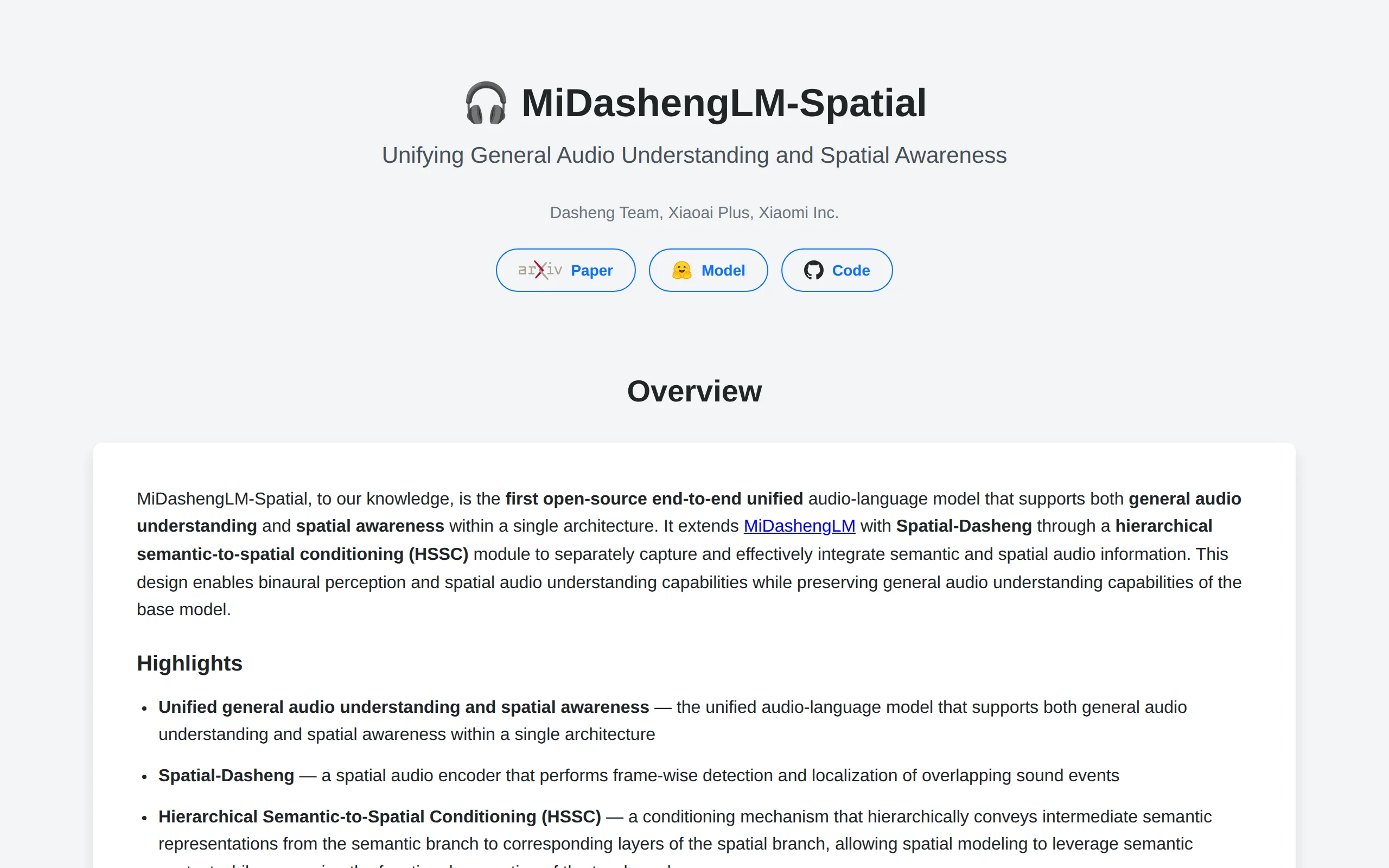
MiDashengLM-Spatial – Xiaomi's Open-Source Spatial Audio Understanding Large Model
MiDashengLM-Spatial is an open-source spatial audio understanding large model developed by Xiaomi's Dasheng team. It is the first industry-leading end-to-end model that unifies general audio understan...
© All Rights Reserved. Some content on this site is partially generated by AI with human review.