
Muse Wonder – Meta's Superintelligence Lab's Cutting-Edge Model Series
Executive Summary:
Muse Wonder is a cutting-edge model series launched by Meta's Superintelligence Lab, built upon the foundation of Muse Spark. It features the ability to maintain cross-conversation long-term memory an...
1. What is Muse Wonder
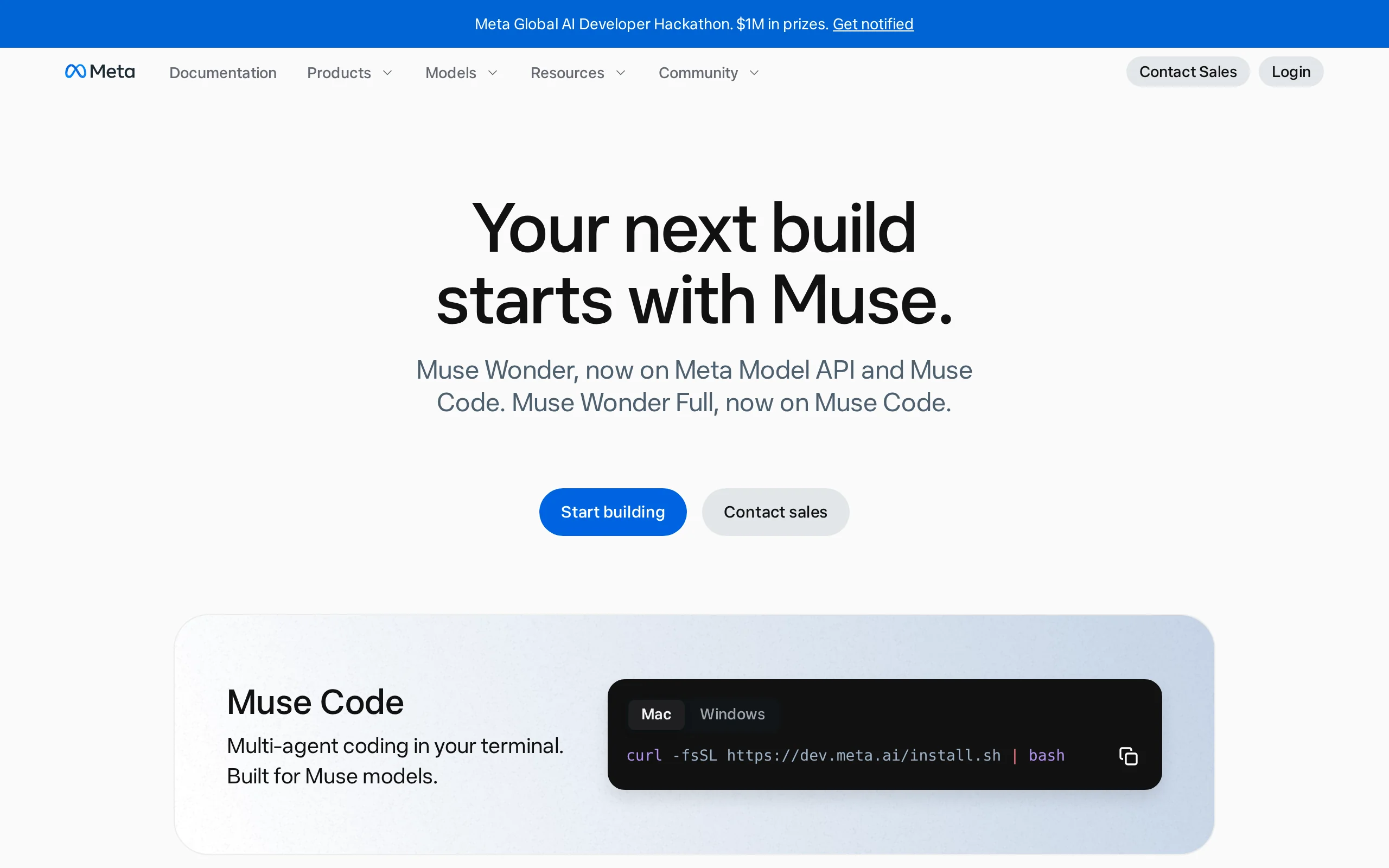
Muse Wonder is a cutting-edge model series launched by Meta's Superintelligence Lab, built upon the foundation of Muse Spark. It features the ability to maintain cross-conversation long-term memory and persistently execute long-duration tasks autonomously. When encountering execution barriers, the model actively switches strategies and confirms with the user before performing critical operations, covering expert scenarios such as insurance claims and legal finance, as well as programming tasks. The model is available in two versions: the standard version, which is open via Meta API and Muse Code, and the full version, which is exclusively available to Muse Code subscribers. Official evaluations show that its long-term memory and long-cycle programming performance have surpassed Claude Opus 5.5.
Technical Positioning and Domain: Muse Wonder belongs to the intersection of large language models (LLM) and agent technologies, focusing on upgrading large models from single-turn dialogue tools into autonomous agent systems capable of executing complex, multi-step tasks. Its unique positioning lies in its ability to cover both lifestyle services and professional programming scenarios. Through the dual mechanisms of Active Memory and Active Focus, it addresses the common issues of forgetting and abandoning tasks midway in traditional large models, making it the first in the industry to prioritize "cross-conversation memory" and "long-task persistence" as core design goals.
Development Background: This model was developed by Meta's Superintelligence Lab, a team co-established by Yann LeCun, Meta's Chief AI Scientist, and comprising top researchers in deep learning and reinforcement learning worldwide. Building upon the Muse Spark model, the team iteratively upgraded it to address pain points in real-world task execution, such as model "stalling" and "deviating from the goal," by designing a specialized post-training alignment solution. This reflects Meta's strategic layout in the direction of superintelligence.
Core Value: Muse Wonder addresses two critical bottlenecks in the practical application of large models—context loss across sessions and interruption in long-task execution. Through the Active Memory mechanism, the model can persist user preferences and key information across multiple rounds of dialogue. Through the Active Focus mechanism, the model can maintain its focus on the goal and continue execution, adjusting strategies autonomously when encountering obstacles. This design significantly enhances the usability of AI agents in real-world scenarios, advancing the model from a "passive response tool" to an "active execution agent."
Technical Features: Muse Wonder employs a larger base model trained on gigawatt-level data centers, enabling effective transfer of post-training benefits to unseen, novel tasks and avoiding overfitting through leaderboard-style training. The model supports multiple levels of reasoning depth adjustment, allowing users to flexibly balance response speed and inference depth based on task complexity. Additionally, it includes a built-in safety alignment framework, providing systematic safeguards in privacy protection and rejection of harmful requests.
2. Key Features
Active Memory for Long-Term Memory: The model can persistently store important user information across different conversation scenarios and actively invoke relevant memory fragments when performing tasks. For example, user preferences mentioned several days ago will automatically take effect in subsequent tasks without needing to be restated, significantly enhancing the coherence and personalization of multi-turn interactions.
Active Focus for Long-Task Persistence: For long-term tasks, the model locks onto the final goal and continues execution. When the predetermined path is blocked, it can autonomously switch strategies instead of halting or abandoning the task. Before performing critical operations (such as payment, deletion, or submission), the model proactively confirms with the user, balancing execution efficiency with operational safety.
Life Agent Tasks: The model supports multi-step tasks in real-life scenarios such as booking a restaurant, checking availability, arranging wedding seating, and verifying insurance claims. After receiving instructions in natural language, the model can autonomously break down the task and execute it step by step, covering the complete closed-loop from information retrieval to final confirmation.
Programming Capabilities: Excels in long-term programming tasks, capable of building full applications and game projects. The model can handle the entire development process, from coding, debugging, to deployment, and ranks first on professional benchmarks such as DeepSWE and SWE-Marathon, surpassing Claude Opus 5.5.
Multimodal Input Support: The model can process input materials in various formats, including images and documents. For instance, when a user takes a photo of a bill and uploads both sides of an insurance card, the model can automatically extract and verify the information, achieving multimodal information fusion and cross-validation.
Tiered Reasoning Depth Adjustment: The model offers multiple levels of reasoning depth options, allowing users to select different depths based on task complexity. As reasoning time increases, the model's performance in mathematical reasoning and logical analysis continues to improve, achieving a flexible balance between efficiency and depth.
Safety Alignment Framework: Trained according to the Meta Superintelligence Scaling Framework, the model systematically refuses to disclose private information or process harmful requests. It achieves a balance between safety and practicality, ensuring both task execution freedom and adherence to safety boundaries.
3. How to Use
Register for a Developer Account: Visit the Meta Developer Platform at https://dev.meta.ai/ and register using your Meta account. Developers must agree to the Meta Developer Service Agreement and complete email verification. It is recommended that enterprise users prepare organizational information in advance to facilitate the activation of commercial usage permissions later.
Obtain an API Key: After logging into the developer console, create a new key on the "API Key" page. This key will be used for authentication when calling the Meta Model API. Please store it securely and never expose it in public code repositories. The console supports creating multiple keys to differentiate between various projects.
Select a Model Version: Specify the model name in your API calls. The standard version uses
muse-wonder-1.0, which is available through the Meta API and Muse Code. The full versionmuse-wonder-full-1.0is only accessible to Muse Code subscribers. The full version has a higher intelligence index (56 vs. 52) and is suitable for tasks requiring deeper reasoning.Configure API Integration: Set the base URL to point to
(link to be updated after official release). The API is compatible with the SDK interface standards of OpenAI and Anthropic. Developers do not need to modify their existing code structure; simply replace the base URL and API Key to complete integration, significantly reducing migration costs.Understand the Pricing Rules: Billing is based on token usage, with input costing $4 per million tokens and output costing $20 per million tokens. Cache reads only cost $0.2 per million tokens. For high-frequency calling scenarios, it is recommended to enable the caching mechanism to reduce costs and improve efficiency. The pricing is on par with Claude Opus 5.5 and is lower than that of more advanced flagship models.
Use the Muse Code Client: Install the Muse Code programming Agent client. After logging in, you can directly call the Wonder model to assist with development. Muse Code deeply integrates the Active Memory and Active Focus capabilities of Muse Wonder, making it ideal for long-term programming tasks. Subscribers can unlock the full version of the model.
4. Pros and Cons Analysis
| Pros |
|---|
| Superior Long-term Memory Capability: Achieves a MemoryBench score of 85.6, surpassing Claude Opus 5.5's 81.5. It leads in cross-conversation memory capability among similar models, effectively addressing context loss in multi-turn interactions. |
| Strong Persistence in Long Tasks: The Active Focus mechanism ranks the model first in long-cycle programming tasks such as DeepSWE and SWE-Marathon. When encountering obstacles, the model can autonomously switch strategies and continue progressing, significantly improving the completion rate of complex tasks. |
| Clear Ecological Integration Advantage: Deeply integrated with the Meta ecosystem (including Instagram, Muse App, etc.), it creates a closed-loop agent experience, offering a complete chain from user data to task execution, with unique data advantages in lifestyle service scenarios. |
| Competitive Pricing: API pricing is on par with Claude Opus 5.5, at $4 per million tokens for input and $20 per million tokens for output, with cache reads at just $0.2 per million tokens. It offers a price advantage at the same level of capability. |
5. Comparative Analysis with Similar Tools
| Comparison Dimension | Muse Wonder | Claude Opus 5.5 |
|---|---|---|
| Core Architecture | Larger base model trained on gigawatt-level data centers, post-training alignment with real-world tasks, supports tiered inference | General flagship large model architecture, balanced optimization for multi-task capabilities |
| Long-term Memory | MemoryBench 85.6, Active Memory enables persistent memory across conversations | MemoryBench 81.5, basic memory capabilities available |
| Long-term Programming | Ranked first in DeepSWE and SWE-Marathon, Active Focus enables autonomous persistence | Strong performance but outperformed by Muse |
| Feature Highlights | Dual mechanisms of Active Memory and Active Focus, dual scenarios for life and programming | Balanced and comprehensive, mature Agent capabilities, broad third-party integration |
| Deployment Method | Only cloud API, open via Meta API and Muse Code | Cloud API, supports multi-platform SDK |
| Pricing Strategy | $4 per million tokens for input, $20 per million tokens for output | $4 per million tokens for input, $20 per million tokens for output |
| Open Source License | Closed-source commercial use, API pay-as-you-go | Closed-source commercial use, API pay-as-you-go |
| Community Ecosystem | Integrated with Meta's full suite, early-stage ecosystem development | Broad third-party integration, mature developer community |
Selection Recommendations: For users requiring long-term memory across conversations and agent capabilities in life service scenarios, Muse Wonder offers a unique advantage with its dual mechanisms of Active Memory and Active Focus, particularly suitable for scenarios such as insurance claims and e-commerce shopping that require persistent user preferences. For developers seeking general-purpose reasoning capabilities and flexibility in third-party integrations, Claude Opus 5.5 remains a reliable choice due to its balanced performance and neutral positioning.
In deep programming scenarios, GPT-5 Codex demonstrates mature performance in code generation quality and debugging toolchains, with a slightly lower pricing model; however, for long-term projects with complex task workflows, Muse Wonder's ability to persist through extended tasks may lead to higher task completion rates. It is recommended that developers conduct small-scale testing based on specific task types and budgets before making a decision.
6. Editor's Summary
Muse Wonder represents a significant technological investment by Meta in the direction of super intelligence. Its core innovation lies in elevating "memory" and "persistence" from auxiliary capabilities to primary design objectives of the model. The Active Memory mechanism persists user information across conversations, addressing the issue of context fragmentation in traditional large models during multi-turn interactions. The Active Focus mechanism, through target locking and autonomous strategy adjustment, overcomes the bottleneck of abandoning tasks midway during long-term operations. These two mechanisms have been quantitatively validated by achieving a score of 85.6 on MemoryBench and securing dual first-place finishes in DeepSWE and SWE-Marathon, forming a differentiated technical barrier.
In terms of practical value, Muse Wonder covers a wide range of scenarios, from daily life services to professional programming. Its multimodal input capabilities and tiered reasoning depth adjustment mechanism allow the model to adapt to diverse needs, ranging from rapid responses to in-depth reasoning. Its pricing is on par with Claude Opus 5.5, making it competitive within the same capability tier. Deeply integrated with the Meta ecosystem, Muse Wonder forms a data and execution loop in scenarios such as Instagram and the Muse App, an advantage that independent model providers find difficult to replicate.
In terms of target users, Muse Wonder is suitable for individual users and developers who require AI agents to handle complex, multi-step tasks. It is particularly beneficial for professionals in fields such as insurance, legal, and finance, where long-term tracking and multi-turn interactions are essential, as well as for engineering teams engaged in long-cycle software development. It should be noted that the model still has a slight gap compared to Claude Opus 5.5 in terms of the maximum depth of general reasoning, and the subscription threshold for full functionality also introduces a certain usage cost.
Looking ahead, with continued investment by Meta's Super Intelligence Lab in post-training alignment and safety frameworks, Muse Wonder's performance in real-world task scenarios is expected to improve further. Its "memory + persistence" design paradigm may also lead large models toward truly autonomous agents, driving the industry's shift from "Q&A tools" to "execution agents."
7. Application Scenarios
Programming Development: Developers use Muse Code to call Muse Wonder to complete long-cycle development tasks from coding to debugging and deployment. When encountering compilation errors or logical flaws, the model autonomously switches strategies to continue progressing. Active Memory remembers the project context and code style preferences, reducing repetitive communication costs and significantly improving development efficiency.
Life Services: Users issue multi-step instructions in natural language, such as booking a restaurant, checking availability, or arranging a wedding seating chart. The model retains user preferences, budget constraints, and scheduling across conversations, autonomously performing information retrieval, comparing options, and confirming reservations, automating what would otherwise be manual, step-by-step administrative tasks.
Insurance Claims: Users take photos of emergency bills and upload both sides of their insurance card. The model automatically extracts key information and verifies the match between the claim amount and insurance policy terms. When anomalies or conflicting terms are detected, the model confirms with the user before proceeding, preventing erroneous actions, while also generating an initial analysis report for the user's reference.
E-commerce Shopping: The model extracts photos from the user's Instagram album, analyzes their aesthetic preferences and style orientation, and designs personalized product solutions accordingly. It completes the entire process from product selection, ordering, to payment. Active Memory records the user's size preferences, shipping addresses, and payment methods, enabling a truly personalized shopping agent.
Professional Documentation: The model interprets rental agreements and organizes personal financial statements, providing preliminary analysis for legal and financial scenarios. It can highlight clauses in contracts that require manual review, flag potential risk points, and generate structured analysis summaries, assisting professionals in improving their work efficiency.
8. FAQ
Q: What is the difference between Muse Wonder and Muse Spark?
A: Muse Wonder is built upon Muse Spark, with three main upgrades: first, it uses a larger base model to enhance generalization capabilities; second, it introduces two new mechanisms—Active Memory and Active Focus—to enable cross-conversation memory and long-term task persistence; third, it undergoes specialized post-training alignment for real-life tasks (such as restaurant reservations and insurance claim verification), significantly improving its performance in practical scenarios compared to its predecessor.
Q: What are the differences between the standard version and the full version of the model?
A: The standard version (muse-wonder-1.0) is available through the Meta API and Muse Code, with an intelligence index of 52; the full version (muse-wonder-full-1.0) is only available to Muse Code subscribers, with an intelligence index of 56. The full version offers greater reasoning depth and enhanced capabilities for handling complex tasks, making it suitable for professional scenarios with higher demands on model performance.
Q: Is Muse Wonder's API compatible with the OpenAI SDK?
A: Yes. By pointing the base URL to (link to be updated after official release), developers can directly use the OpenAI or Anthropic SDK to integrate Muse Wonder into existing projects without modifying the code structure. This design significantly reduces migration costs for developers, enabling existing AI applications to quickly switch to Muse Wonder.
Q: How does Muse Wonder handle user privacy data?
A: The model is trained for safety alignment using the Meta Superintelligence Scaling Framework, systematically rejecting requests that involve privacy leaks or harmful content. User information stored in Active Memory is used only for the current task. Developers can control data retention policies via the API. For specific data handling terms, please refer to the Meta Developer Service Agreement.
Q: What is the billing method for Muse Wonder?
A: It is billed based on token usage, with input costing $4 per million tokens and output costing $20 per million tokens. Cache reads only cost $0.2 per million tokens. For high-frequency calling scenarios, it is recommended to enable the caching mechanism to reduce costs and improve efficiency. The pricing is on par with Claude Opus 5.5 and is lower than that of more advanced flagship models.
Q: What input formats does Muse Wonder support?
A: The model supports multimodal input, including text, images, and documents. For example, users can take a photo of a bill and upload both sides of an insurance card, and the model will automatically extract and cross-verify the information. Currently supported image formats include JPEG, PNG, and other common types, while document support includes PDF and Office formats.
9. Project Links
- Official Announcement: https://about.fb.com/news/2026/10/introducing-muse-wonder-models/
- Developer Platform: https://dev.meta.ai/
Related AI Model Articles
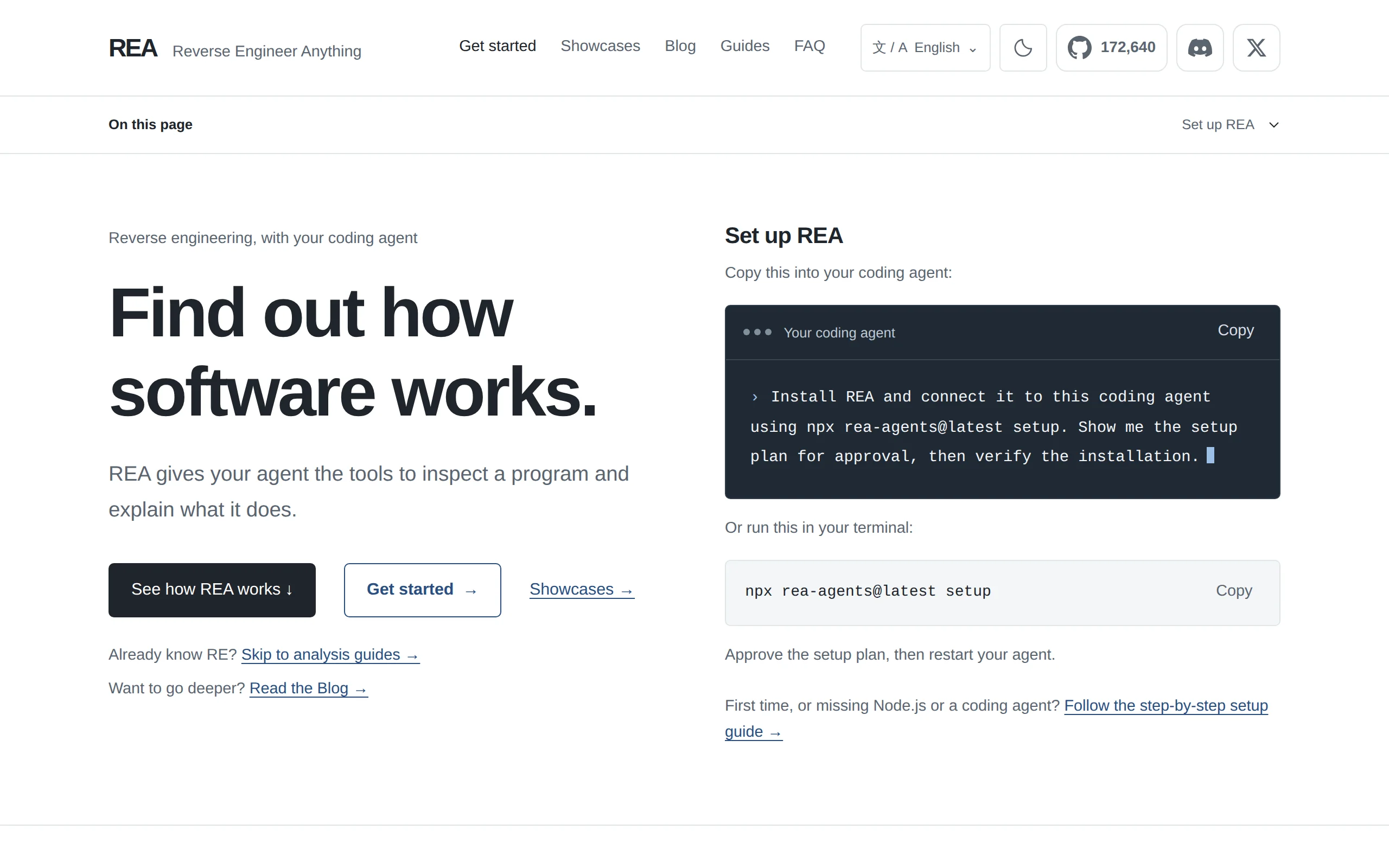
REA: Open-Source Reverse Analysis Tool That Enables AI Agents to Analyze Software Without Source Code
REA (Reverse Engineer Anything) is an open-source general-purpose reverse analysis tool that connects AI programming agents such as Claude Code, Codex, and Cursor with professional reverse engineering...
VeriLoop E2 – A 27B Post-training Model Open-sourced by Tsinghua University
VeriLoop E2 is a 27B post-training model open-sourced by the Robotics Lab at the Shenzhen International Graduate School of Tsinghua University. It is built upon the Qwen3.8-27B base model and is speci...
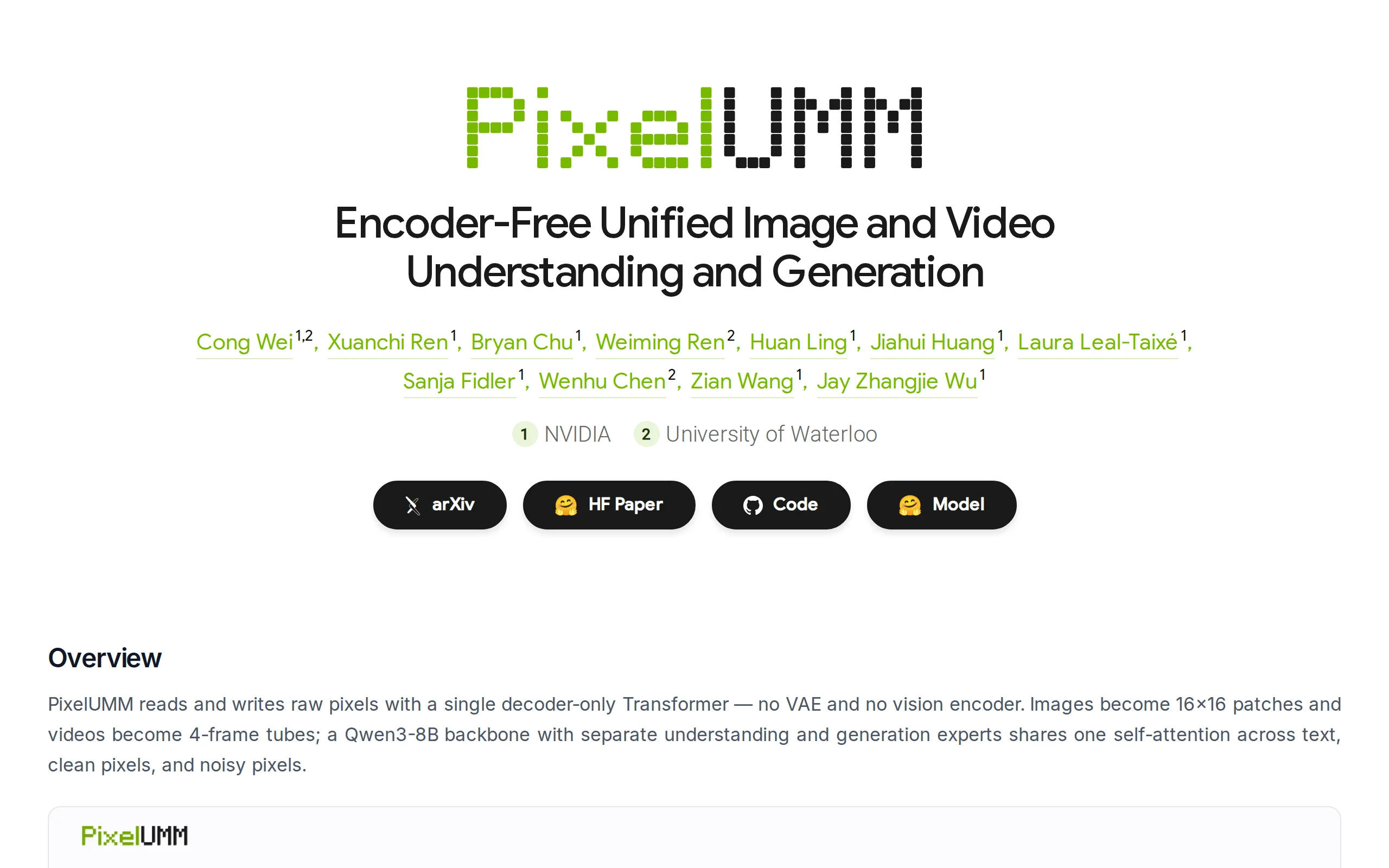
In-Depth Review of PixelUMM: NVIDIA and the University of Waterloo's Encoder-Free Unified Multimodal Model
PixelUMM is an encoder-free unified multimodal model jointly developed by NVIDIA and the University of Waterloo. Its core innovation lies in completely eliminating the VAE and visual encoder from trad...
In-Depth Review of Clef – Cloudflare's Open-Source Decision Model Family
Clef is a family of decision models open-sourced by Cloudflare. Its core purpose is not to generate open-ended text, but to temporarily define problems within requests and output probabilistic scores ...
© All Rights Reserved. Some content on this site is partially generated by AI with human review.