
Qwen 4 (Qwen4-Max Preview): Alibaba's New Flagship Model
Executive Summary:
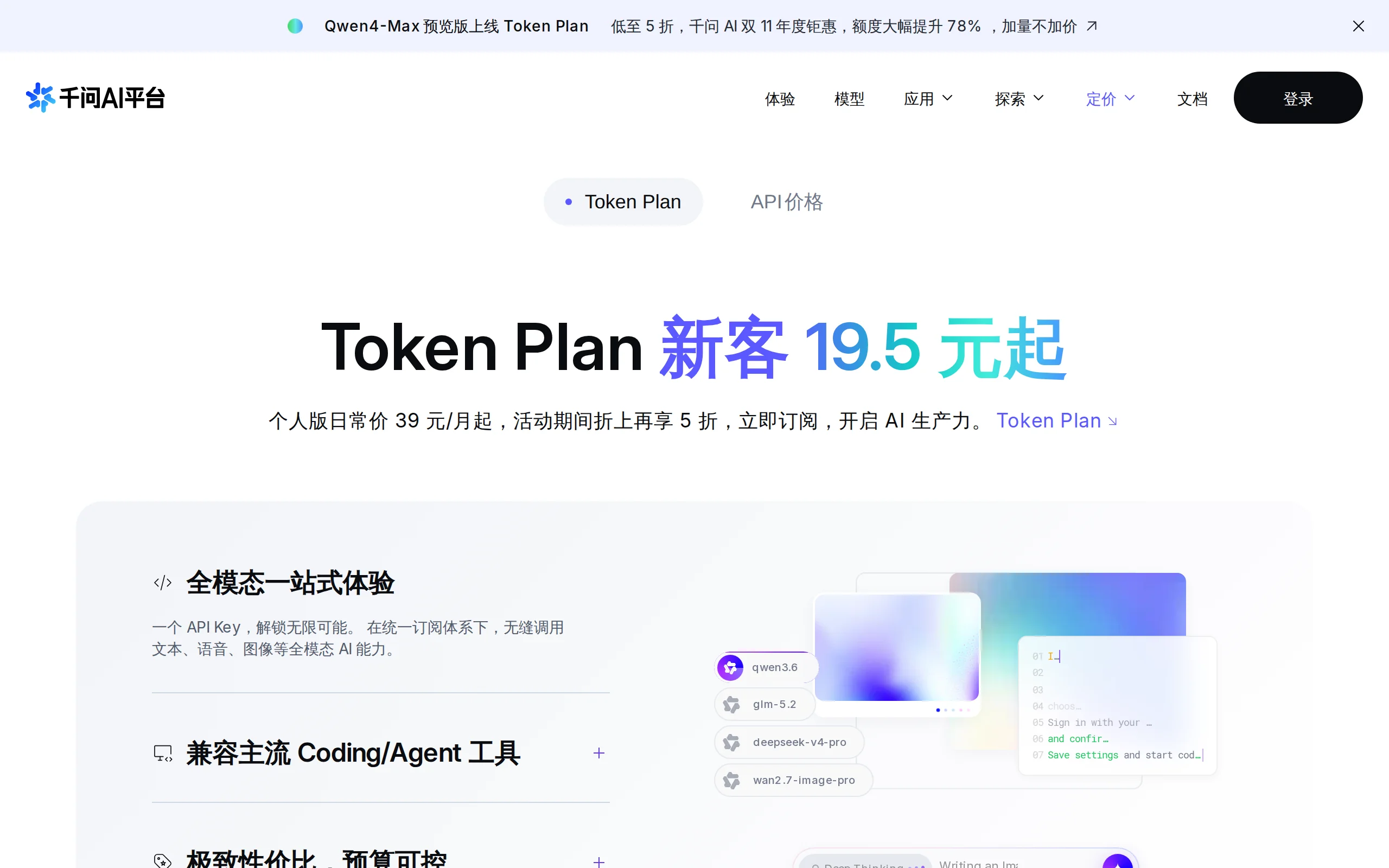
Qwen 4 arrives as Qwen4-Max Preview on the Qwen AI Platform Token Plan. Capabilities, benchmarks, pricing, how to get early access, and how it compares.
1. What is Qwen4-Max Preview
Qwen4-Max Preview is the early access version of Qwen4, Alibaba's latest generation flagship large model, which was first launched on the Qwen AI Platform's Token Plan. This version has achieved significant upgrades in two key capabilities: programming and agentic reasoning. It supports multimodal input including text, images, and videos, and features an ultra-long context window of up to 1 million Tokens. By being compatible with the mainstream interface specifications of OpenAI and Anthropic, Qwen4-Max Preview can seamlessly integrate with existing development toolchains such as Claude Code and Cursor, providing robust support for real-world task scenarios including complex programming, professional office work, front-end design, and specialized software operations.
Technical positioning and domain: Qwen4-Max Preview belongs to the general-purpose large language model (LLM) domain, positioning itself as a flagship-level multimodal AI assistant. It covers multiple application areas, including code generation, agent workflows, and creative design. Its core differentiator lies in integrating ultra-long context, deep reasoning, and multimodal perception capabilities into a unified model architecture, offering a comprehensive solution for developer productivity scenarios.
Development background: This model was developed by the Tongyi Qianwen team under Alibaba Group. Alibaba has deep technical expertise in the large model domain, from the continuous iteration of the Qwen series of open-source models to the commercial deployment on the Qwen AI Platform, forming a complete technical stack and ecosystem. The release of Qwen4-Max Preview marks a significant step for Alibaba in the competition for flagship-level models, aiming to directly compete with international leading models such as Anthropic's Claude series and OpenAI's GPT series.
Core value: Qwen4-Max Preview addresses efficiency bottlenecks developers face when handling large codebases and complex multi-step tasks. With its 1 million Token context window, the model can process an entire codebase in one go without requiring segmentation. Combined with the default-enabled deep reasoning mode and adjustable reasoning budget, it ensures high-quality outputs while flexibly controlling response speed. Its dual compatibility with OpenAI and Anthropic interfaces significantly reduces the migration costs for existing enterprise systems.
Technical features: The model employs a unified multimodal architecture, supporting text, image, and video input, with a video processing limit of approximately 2 hours or 2GB. In terms of reasoning control, the reasoning_effort parameter offers three levels of adjustment: low, medium, and xhigh, allowing users to dynamically balance reasoning depth and response speed based on task complexity. Additionally, the model includes built-in Function Calling, internet search, and JSON structured output capabilities, providing full technical support for building complex Agent workflows.
2. Key Features
Multimodal Understanding Capability: Supports three input modalities: text, images, and video, with a video processing limit of approximately 2 hours or 2GB file size. The model can accurately analyze UI screenshots, design documents, and video content, performing exceptionally well in scenarios such as UI/UX reviews, video content summarization, and design draft reconstruction, providing a unified inference framework for cross-modal information understanding.
Ultra-Long Context Window: With a context window of up to 1 million Tokens, it can process an entire codebase, large technical documents, or lengthy research reports in one go without the need for segmentation. This capability offers significant advantages in scenarios such as cross-file code refactoring, global bug localization, and large-scale project architecture analysis, effectively preventing information loss during long-text processing.
Deep Reasoning Mode: The thinking mode is enabled by default, with the
reasoning_effortparameter offering three levels of adjustment: low, medium, and xhigh. Users can flexibly configure the reasoning depth based on task complexity: use the low setting for simple tasks to speed up response time, and use the xhigh setting for complex logical reasoning or code generation tasks to achieve more rigorous output results, achieving a dynamic balance between quality and speed.Agentic Tool Calling: Natively supports Function Calling and internet search capabilities, allowing the model to perform multi-step tasks by invoking built-in tools. It also supports two structured output formats: JSON Object and JSON Schema, making it easy for developers to directly integrate model outputs into downstream automation processes and build complete agent workflows from task planning to execution.
Programming and Professional Task Capabilities: Deeply optimized for high-value scenarios such as complex programming, front-end design, and professional software operations. It excels in creative tasks such as 3D modeling, web design, and interactive animation generation, capable of generating executable web code, 3D models, or interactive prototypes directly based on textual descriptions or design drafts, significantly improving development and design efficiency.
Multi-Interface API Compatibility: Compatible with three mainstream interface specifications: OpenAI Chat Completions, Responses, and Anthropic Messages. Developers can integrate Qwen4-Max into existing toolchains and agent frameworks such as Claude Code and Cursor without modifying their current code, greatly reducing migration costs and integration complexity.
3. Application Scenarios
Codebase-Level Development and Refactoring: With a super-long context window of 1 million Tokens, developers can input the entire codebase into the model in one go, enabling cross-file refactoring design, global bug detection, and architectural optimization recommendations. In scenarios such as large project maintenance, technical debt cleanup, and modernization of legacy systems, this significantly enhances development efficiency and code quality.
Frontend Design and Creative Generation: Designers and independent developers can describe ideas in text or upload design drafts, allowing the model to directly generate webpage layouts, interactive animations, and even 3D models. This scenario is especially suitable for rapid prototype validation, design concept exploration, and bulk creative output, reducing traditional multi-day workloads to just a few hours and significantly shortening the cycle from idea to implementation.
Agent-Based Office Automation: Through Function Calling and Agentic capabilities, the model can integrate email, calendar, document, and spreadsheet tools, automatically handling repetitive tasks such as meeting minutes generation, cross-platform data aggregation, and periodic report creation. Enterprises can embed the model into their internal OA systems to build automated office workflows and reduce labor costs.
Professional Software Operation Assistance: Act as an "intelligent operation assistant" within professional tools such as CAD design, video editing, and financial software. The model can understand screenshots of software interfaces and guide users through operation steps based on their instructions or even directly control the tools to perform complex operations. This lowers the barrier to entry for professional software, making it ideal for training new employees and assisting non-expert users in completing specialized tasks.
4. How to Use
Register an account: Visit the Qwen AI Platform (https://platform.qianwenai.com/pricing/token-plan) or the QwenCloud Platform (https://qwencloud.com/pricing/token-plan), and complete registration and login using an email address or phone number. It is recommended to prioritize the QwenCloud platform, as its Token Plan is specifically designed for developers and offers more flexible billing options.
Create an API Key: After logging into the console, go to the "API Key" page and click the "Create Key" button to generate an access credential. Please store this key securely to prevent leaks; if the key is accidentally exposed, you can revoke it and generate a new one at any time in the console.
Obtain the Model ID: Look up the model identifier for the Qwen4-Max preview version in the official documentation's model list. This identifier is used for the
modelparameter in API requests. Ensure it matches the documentation exactly to avoid request failures due to incorrect IDs.Choose the integration method: Select the calling method based on your current technology stack. The model is compatible with OpenAI SDK, Anthropic SDK, and native curl requests, allowing direct use without modifying existing code. If using the OpenAI SDK, set the base URL to the QwenCloud address provided in the official documentation and input the model ID and message content into the request body.
Configure inference parameters: Set the
reasoning_effortparameter in the request body (optional values: low/medium/xhigh) to dynamically adjust the depth of inference based on task complexity. Note thatmax_tokensis calculated as the total of "thinking + final response." If long outputs are required, appropriately increase this value to avoid output truncation due to insufficient budget.Local tool integration (optional): Enter the QwenCloud API Key and model ID into development tools such as Claude Code or Cursor to directly call the Qwen4-Max preview version within your local IDE environment. This method is suitable for developers who want to use the new model within their familiar workflow. The configuration process typically only requires changing two fields: the model provider and the key.
5. Pros and Cons Analysis
| Pros |
|---|
| Outstanding programming capabilities: Achieves industry-leading performance in code generation, debugging, and refactoring tasks. With support for up to 1 million Tokens of context, it can handle large codebases and is explicitly positioned as a developer productivity tool. |
| Complete Agentic capabilities: Supports Function Calling, internet search, and structured output. Skilled in multi-round tool calling and long-trajectory tasks, it can autonomously complete the full workflow from planning to execution. |
| Enhanced multimodal perception: Supports three input modalities: text, images, and video. The video processing limit is approximately 2 hours/2GB, and it can accurately analyze interface screenshots, design drafts, and video content. |
| High API compatibility: Compatible with three interfaces: OpenAI Chat Completions, Responses, and Anthropic Messages. It can seamlessly integrate with existing toolchains and Agent frameworks. |
6. Comparative Analysis with Similar Tools
| Comparison Dimension | Qwen4-Max Preview Edition | Claude Opus 4.8 |
|---|---|---|
| Context Window | Officially undisclosed (Qwen3.8-Max in the family has reached 1 million Tokens) | 1 million Tokens |
| Programming Ability | No official benchmark scores; internal testing shows strong performance in 3D modeling and web design | SWE-bench Pro 69.2%, SWE-bench Verified 88.6% – the current benchmark for programming |
| Multimodal Support | Text, image, and video input (video limit is approximately 2 hours / 2GB) | Focuses on text and code; multimodal is not a main feature |
| API Compatibility | Compatible with OpenAI / Anthropic / Responses interfaces | Only supports native Anthropic interface |
| Reasoning Control | reasoning_effort with three adjustable levels (low/medium/xhigh), flexibly balancing speed and quality |
Provides thinking budget and extended thinking toggle, controllable but with coarse granularity |
| Chinese Language Ability | Chinese is a native-level training strength, with deeper understanding of Chinese context, idioms, and local knowledge | Strong Chinese ability, but not natively optimized; localization details are slightly inferior |
| Service Availability | Preview edition is only available until 2026-11-25, will be discontinued after expiration, with no SLA guarantee | Commercial product, provides enterprise-level SLA and 99.9% availability commitment |
| Data Compliance | Domestic platform operation, data processed within the country, compliant with Chinese regulations | Overseas service, data出境 requires assessment, limited in domestic financial/governmental scenarios |
Selection Recommendations: For domestic enterprise users, especially those in industries such as finance, government affairs, and healthcare with strict data compliance requirements, the Qwen4-Max Preview Edition is more attractive due to its advantage of processing data domestically. Its compatibility with multiple interfaces also reduces the cost of migrating from existing OpenAI or Anthropic toolchains, making it a suitable alternative or complementary solution to the Claude or GPT series. However, note the time limit of the preview edition, and it is recommended to use it only for testing and prototype validation before the official release.
For developer teams seeking top-tier programming performance, Claude Opus 4.8 remains the preferred choice for programming tasks, with an actual test score of 88.6% on SWE-bench Verified. If the team is deeply integrated with the OpenAI ecosystem, GPT-5.2's stability and mature ecosystem offer greater advantages. Overall, the Qwen4-Max Preview Edition is better suited for users with clear requirements for Chinese language support, data compliance, and multi-interface compatibility, and can serve as a window to evaluate the capabilities of Alibaba's flagship model before the official release.
7. Editor's Summary
As a preview version of Alibaba's next-generation flagship model, Qwen4-Max demonstrates a clear strategic direction in Alibaba's large model technology roadmap. In terms of technological innovation, the combination of a 1 million Token context window and multimodal input capabilities provides strong competitiveness among current flagship models. Additionally, the three-tier adjustable reasoning_effort inference control mechanism offers users a refined tool for balancing quality and speed, a design approach that is relatively advanced compared to similar products. More notably, its compatibility strategy with both OpenAI and Anthropic interfaces effectively reduces migration costs for users, reflecting Alibaba's pragmatic attitude toward ecosystem development.
From a practical value perspective, the model's performance improvements in three key scenarios—programming, Agentic workflows, and creative design—clearly indicate commercial potential. Particularly its capabilities in 3D modeling and web design provide designers and independent developers with low-cost prototyping tools. However, the time-limited preview period and the absence of official benchmark data are significant drawbacks, meaning its actual performance still needs to be validated through broader community testing. For developers, this version is more suitable as a technical pre-research and capability evaluation window, rather than a long-term dependency for production environments.
Overall, Qwen4-Max preview version establishes a differentiated advantage in three dimensions: Chinese language capability, data compliance, and interface compatibility. It is particularly suitable for domestic developers, enterprises sensitive to compliance, and users adopting a multi-model strategy to focus on. The performance, pricing strategy, and ecosystem development progress of its official release will ultimately determine Alibaba's position in the competitive landscape of flagship large models.
8. FAQ
Q: What is the difference between the preview version and the official version of Qwen4-Max?
A: The preview version is an early access version released before the official version, intended for developers to evaluate the model's capabilities and provide feedback in advance. The preview version may not be as complete in terms of functionality, stability, and performance optimization as the official version, and it has a clear time limit (available until 2026-11-25). The official version is expected to be released after optimization based on feedback from the preview version, with specific release dates and feature adjustments to be announced officially.
Q: What interface formats does the Qwen4-Max preview version support?
A: This model is compatible with three mainstream interface specifications: OpenAI Chat Completions, OpenAI Responses, and Anthropic Messages. Developers can directly invoke it using the OpenAI SDK, Anthropic SDK, or native curl requests without modifying the existing code structure. For specific integration methods and base URL configurations, please refer to the official documentation.
Q: How to handle token limitations in long output scenarios?
A: The max_tokens parameter in the Qwen4-Max preview version is calculated as the total of "thinking + final response," rather than just the final output portion. If you need to generate longer content (such as complete code files or lengthy documents), it is recommended to set max_tokens to a sufficiently large value (e.g., 64000 or higher) to avoid output truncation due to insufficient inference budget.
Q: Does the Qwen4-Max preview version support local deployment?
A: At present, this model is only available through the API on the Qwen AI platform and the QwenCloud platform. The official has not yet announced a local deployment plan. Users can configure the QwenCloud API Key and model ID in tools that support custom APIs, such as Claude Code or Cursor, to achieve the effect of using this model in a local development environment. However, the model itself runs in the cloud.
Q: What is the billing method for the Qwen4-Max preview version?
A: This model is launched first on the Qwen AI platform under the Token Plan, and it uses a billing model based on token consumption. For specific pricing and package plans, please refer to the pricing page of the QwenCloud platform (https://qwencloud.com/pricing/token-plan). It is recommended that developers choose an appropriate package based on actual usage to optimize costs.
Q: How does the Qwen4-Max preview version perform on Chinese tasks?
A: Chinese is a native-level training strength for the Qwen4-Max preview version, and the model's understanding of Chinese context, idioms, classical poetry, and local cultural knowledge is deeper than that of most international models. It has a clear advantage in scenarios such as Chinese document processing, Chinese code comment generation, and localized content creation, making it suitable for applications with a high density of Chinese content.
9. Project Links
- Qwen AI Platform Token Plan Page: https://platform.qianwenai.com/pricing/token-plan (official product page, first release channel for preview version)
- QwenCloud Platform Token Plan Page: https://qwencloud.com/pricing/token-plan (official API service platform)
Related
Bookworm-S2.1 Flash: In-Depth Review of the Scientific Multimodal Large Model Open-Sourced by the Shanghai AI Lab
Bookworm-S2.1 Flash is a scientific multimodal large model open-sourced by the Shanghai AI Lab, built upon the Bookworm-Yuanzheng unified representation architecture. It is capable of understanding ov...
Nex-N2.6 – A Multimodal Agent Model Open-Sourced by Nex-AGI, Shanghai Chuangzhi Academy
Nex-N2.6 is a multimodal agent model open-sourced by Nex-AGI, Shanghai Chuangzhi Academy. It is post-trained based on Zhipu AI's GLM-5.3-Flash and has a total parameter count of approximately 321B, su...
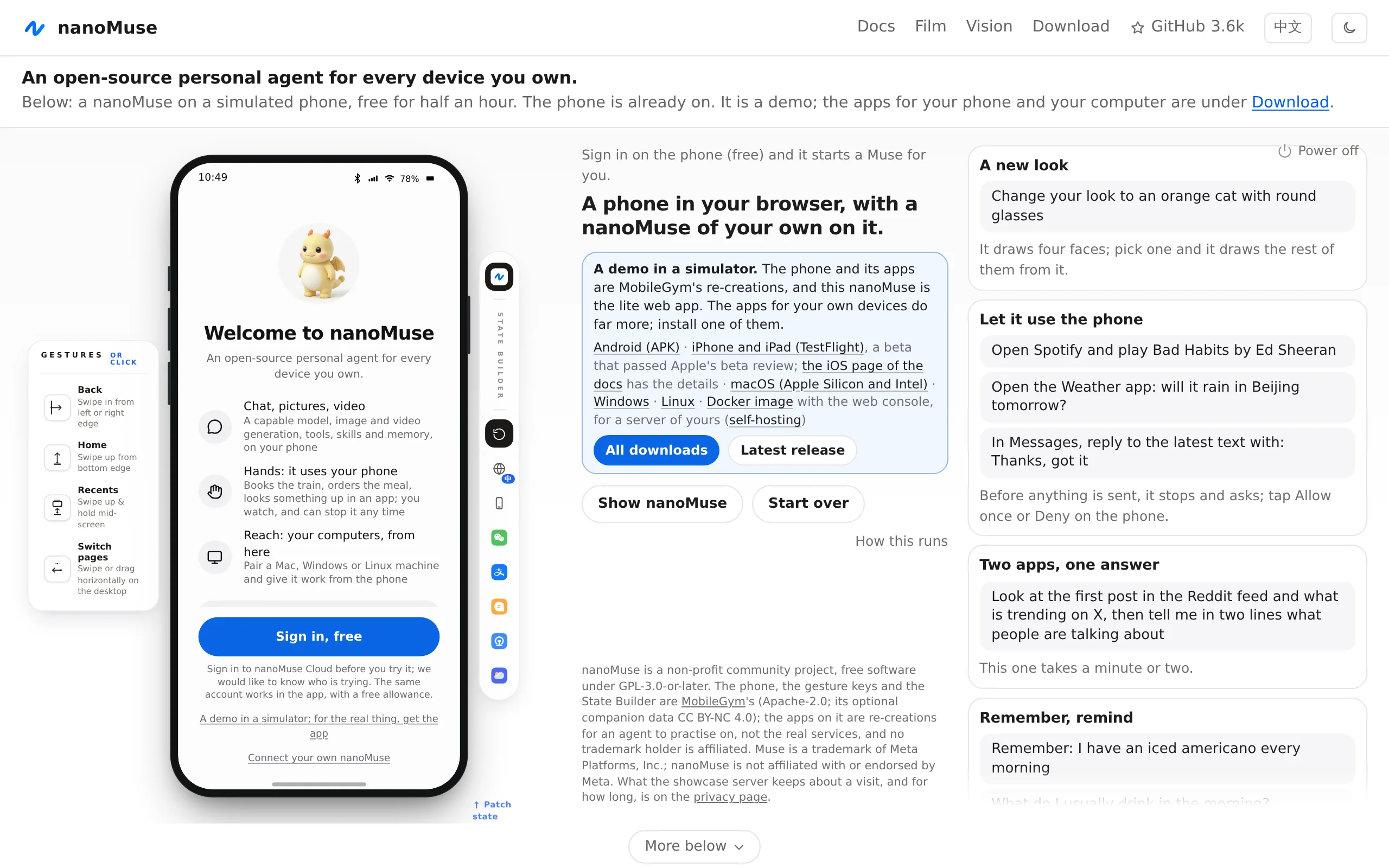
nanoMuse – An Open-Source Personal Agent from Zhejiang University, the Open-Source Version of Muse
nanoMuse is an open-source personal agent project developed by the Zhejiang University team. Its core concept is to allow users to run a complete AI Agent on their own devices, achieving a cross-devic...
MapFlow – An Open-Source Cross-Model LLM Inference Acceleration System from Peking University
MapFlow is a cross-model LLM inference acceleration system developed by the PKU-DAIR team at Peking University, aimed at addressing the pain points of repeated prefill computation when sharing long co...
© All Rights Reserved. Some content on this site is partially generated by AI with human review.