
In-Depth Review of Gemini Decision 1 – Google's First Decision Model
Executive Summary:
Gemini Decision 1 is Google's first dedicated decision model, whose design philosophy differs significantly from traditional generative large language models—it does not perform conversational text ge...
1. What is Gemini Decision 1
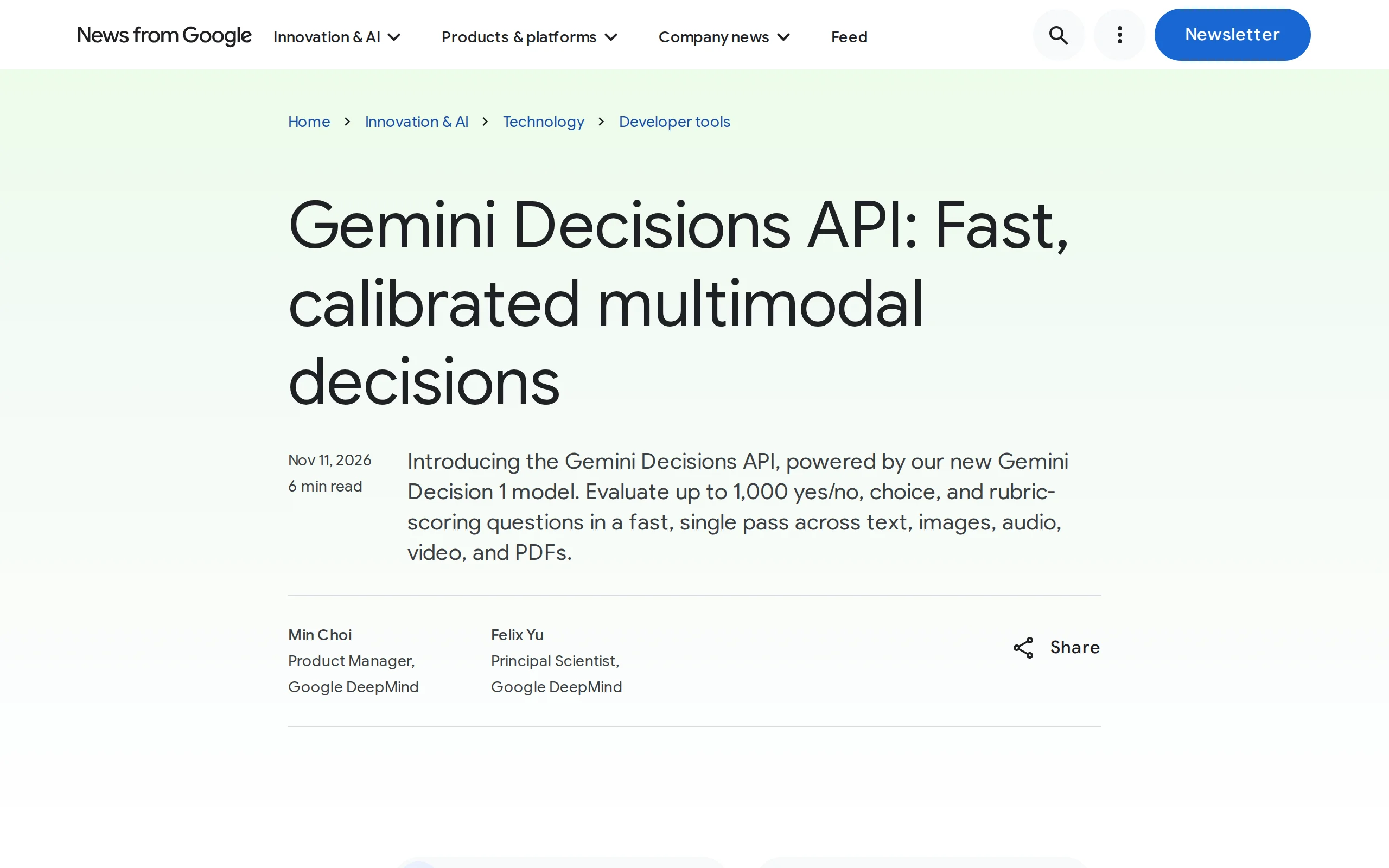
Gemini Decision 1 is Google's first dedicated decision model, whose design philosophy differs significantly from traditional generative large language models—it does not perform conversational text generation, but instead focuses on batch judgment tasks. This model supports answering up to 1,000 true/false questions, multiple-choice questions, or scoring tasks with a single call based on the same multimodal input, and can output answers, option probabilities, and confidence levels ranging from 0 to 1 all at once. The end-to-end latency is controlled within 150–250ms. This architectural innovation gives Gemini Decision 1 a clear advantage in scenarios sensitive to latency and cost, such as tool selection, content moderation, and model routing.
Technical positioning and domain: Belongs to the field of decision intelligence and model routing, representing a significant move by Google in the direction of discriminative AI. Unlike traditional generative models that decode tokens sequentially, this model uses a single forward pass scoring mechanism, directly outputting probability scores for candidate options. This fundamentally eliminates the cost of generating output tokens and serial decoding latency, providing a new technical paradigm for large-scale batch judgment tasks.
Development background: Developed by Google's DeepMind team, built upon the native multimodal architecture of the Gemini series. The motivation for its development stems from the observation that generative models are inefficient in judgment tasks—traditional models require generating answers word by word when responding to true/false or multiple-choice questions, which is both time-consuming and costly. The Google team has migrated the multimodal representation capabilities accumulated from the Gemini series to discriminative tasks, resulting in this differentiated product.
Core value: Addresses three major pain points in batch judgment scenarios: high latency, high cost, and the difficulty of uniformly processing multimodal inputs. Through a shared context reuse mechanism, multiple inputs are encoded only once, and increasing the number of questions has almost no impact on latency or cost, making the "one input, one charge" pricing model feasible. Confidence calibration technology provides a reliable basis for automated routing strategies.
Technical features: Uses calibrated confidence estimation, with each probability output trained to be close to the actual accuracy rate. The calibration error is among the lowest in the industry. Supports native mixed input from five modalities: text, images, audio, video, and PDF. Image and video inputs allow adjustable resolution to flexibly balance visual detail and token cost.
2. Key Features
Batch Judgment Engine: A single API call can answer up to 1,000 questions based on the same shared input, rather than making individual requests for each question. This mechanism offers significant advantages in terms of latency and cost—increasing the number of questions adds almost no additional latency. It is particularly suitable for production environments requiring large-scale parallel judgment, such as batch content moderation or large-scale data classification.
Support for Three Question Types: Supports true/false questions (noul), multiple-choice questions (choice, with 2~255 options), and ordered scoring questions (score), and allows mixing these types within a single request. This provides a flexible modeling approach for complex judgment tasks, such as in customer service ticket classification, where true/false questions can determine whether a ticket contains a complaint, and scoring questions can assess its severity.
Structured Probability Output: For each question, the system returns the answer, normalized probabilities for each option, and a confidence score between 0 and 1. The output can be directly used by code for routing decisions, without the need to parse natural language. This structured output format reduces the complexity of downstream system integration, enabling automated decision pipelines to accurately branch based on probability thresholds.
Native Multimodal Support: Text, images, audio, video, and PDF can be directly combined in a single input for evaluation, without preprocessing or splitting. For example, call recordings and account information can be merged as input, or scanned documents and damaged photos can be analyzed simultaneously. This native multimodal processing capability avoids the cumbersome process of handling and fusing multimodal data separately in traditional approaches.
Confidence-Based Routing and Degradation Handling: The confidence scores output by the model are calibrated to closely reflect the actual accuracy. Developers can set confidence thresholds, and answers below these thresholds are automatically routed to a fallback model or human review. This mechanism provides a safety net for building highly reliable automated systems, especially in scenarios with extremely high accuracy requirements, such as content moderation.
Low-Latency Real-Time Response: End-to-end latency ranges from 150 to 250ms, with model computation accounting for only 50 to 100ms, and latency remaining nearly flat for 1 to 100 questions. This feature makes Gemini Decision 1 ideal for online scenarios with strict real-time requirements, such as instant feedback in interactive applications or real-time model routing, where users experience almost no waiting time.
3. Application Scenarios
Intelligent Model Routing: Functioning as an API entrance router, it makes millisecond-level judgments on query difficulty. Simple daily questions are directly routed to lightweight models for processing, while complex tasks invoke deep reasoning models, reducing overall latency by 40%. This scenario fully leverages the low latency and batch judgment capabilities of Gemini Decision 1, helping enterprises achieve an optimized balance between cost and performance in multi-model architectures.
Content Security Review: Conduct batch policy compliance checks on text, image, audio, and video content. A single call can simultaneously evaluate content across multiple modalities, covering various review dimensions such as pornography, violence, and hate speech. Low-confidence judgment results are automatically forwarded for manual rechecking. Compared to traditional line-by-line review methods, this mode significantly improves throughput and response speed.
Agent Tool Selection: In Agent scenarios, select the most suitable tool from 2 to 255 options in one call. Traditional methods require LLMs to generate tool calls one by one, whereas Gemini Decision 1 directly outputs the applicability probability of each tool through a scoring mechanism, significantly shortening the tool selection time and enhancing Agent response efficiency.
Customer Service Ticket Prioritization and Assignment: Combining call recordings and ticket text, use scoring to automatically classify tickets by severity. The system can simultaneously process voice transcription content and written descriptions, comprehensively determining the urgency and impact scope of the ticket, and automatically routing it to the appropriate handling queue, reducing the workload of manual classification.
Instant Feedback in Interactive Applications: In interactive scenarios requiring second-level responses, such as Stitch quickly generating clickable wireframes or CC instantly selecting a reaction from over 200 expressions. The low-latency feature enables immediate feedback upon interaction, significantly improving the smoothness of user experience and opening up new interaction paradigms for creative tools and social applications.
4. How to Use
Apply for an API Key: Log in to the Google AI Studio platform, create a project, and obtain an API Key. This is a prerequisite for using Gemini Decision 1, and the API Key is used for authentication and call quota management.
Install the SDK Environment: Ensure that the version of the google-genai SDK in your Python environment is ≥ 3.2. Run the command
pip install -U google-genaito install or upgrade. The SDK encapsulates the details of low-level API calls and provides a concise programming interface.Initialize the Client: Create a client instance using
genai.Client()and specify theapi_version="v1beta"parameter. It is important to note that the Decisions API is currently only available in the v1beta version; using other versions will prevent you from calling this interface.Prepare Shared Input: Place the content to be judged in the
inputfield, which supports five modalities: text, image, audio, video, and PDF, and can be used in combination. A single piece of content is charged only once, which is a core feature of this model's pricing model.Define the Question Structure: Define each question in the
questionsdictionary—use thenoultype for true/false questions, thechoicetype for multiple-choice questions (supporting 2 to 255 options), and thescoretype for rating questions. Up to 1000 questions can be defined in a single request, and different question types can be mixed.Initiate Inference Request: Call the
client.decisions.create(model="gemini-decision-1", ...)interface. You can obtain the return results after waiting 150 to 250ms. The request parameters must include the model name, input content, and question definitions.Parse Results and Execute Routing: Read the answer for each question, along with the probability and confidence fields for each option. When the confidence is below a predefined threshold, transfer the task to a fallback model or to manual processing, forming a complete automated decision-making loop.
5. Pros and Cons Analysis
| Pros |
|---|
| Extremely Low Response Latency: End-to-end latency ranges from 150 to 250ms, with nearly the same latency for one question and 100 questions. This makes it suitable for real-time routing, online review, and other scenarios with strict requirements on response speed. |
| Native Multi-modal Support: Text, images, audio, video, and PDF can be directly mixed into a single input for evaluation, without preprocessing or splitting, greatly simplifying the engineering complexity of multi-modal judgment tasks. |
| High Confidence Calibration Accuracy: Each answer comes with a confidence score ranging from 0 to 1, and the calibration error is among the lowest in the industry. Low confidence results can be automatically routed to human agents or fallback mechanisms, providing a reliable basis for automated decision-making. |
| Structured Output Facilitates Integration: Directly outputs answers, probabilities, and confidence scores, skipping the natural language generation step. The high level of structuring allows code to directly consume the results, reducing parsing costs for downstream systems. |
6. Comparative Analysis with Similar Tools
| Comparison Dimension | Gemini Decision 1 | Jev |
|---|---|---|
| Core Architecture | Discriminative architecture, scores via single forward pass, skips token decoding | Generative architecture, outputs via token-by-token decoding |
| Latency Performance | End-to-end latency of 150 |
Higher latency, increases linearly with the number of questions |
| Multimodal Support | Native hybrid input support for text/images/audio/video/PDF | Primarily text-based, limited multimodal capabilities |
| Question Capacity | Up to 1000 questions per session, with mixed question types allowed | Limited question capacity per session |
| Output Cost | Free | Token-based pricing |
| Confidence Calibration | Lowest calibration error, suitable for automated routing | Moderate calibration accuracy |
| Evaluation Performance | Highest across all categories in knowledge and reasoning tasks, with unique advantages in audio/video evaluation | Strong performance in classification and information extraction |
| Access Channels | AI Studio, OpenRouter (launch day), Google Cloud (pending listing) | OpenRouter, etc. |
Selection Recommendations: For online routing and real-time review scenarios where latency and cost are highly sensitive, Gemini Decision 1 is the preferred choice due to its architectural advantage of single forward pass and zero output cost. Its native multimodal support is irreplaceable in judgment tasks involving audio and video, such as call recording analysis and video content review. If the application scenario is primarily text classification and information extraction with less stringent latency requirements, Jev may offer better performance in classification tasks and has a more competitive input cost. For tasks requiring complex reasoning and natural language explanations, traditional generative LLMs remain a necessary option, but Gemini Decision 1 can be used as a pre-router to optimize the overall architecture.
7. Editor's Summary
Gemini Decision 1 represents a significant shift in AI model architecture design—from "generate everything" to "focus on judgment." The Google team has keenly identified that in many real-world business scenarios, enterprises require not the model's conversational or content generation capabilities, but rather fast, accurate, and cost-effective batch judgment capabilities. By skipping the token decoding phase and directly scoring candidate options in one go, Gemini Decision 1 fundamentally redefines the execution path for judgment tasks, compressing latency to 150–250ms while achieving a zero-cost billing model for outputs. This architectural innovation not only improves the efficiency of individual tasks but also achieves a technical breakthrough where increasing the number of questions results in almost no increase in latency or cost, thanks to the shared context reuse mechanism.
In terms of practical value, this model has clear application advantages in scenarios such as model routing, content moderation, and tool selection. The confidence calibration technology reaches the lowest error rate in the industry, providing a reliable quantitative basis for automated routing strategies. Its native multimodal support covers five formats: text, images, audio, video, and PDF, addressing the engineering pain points of previous complex preprocessing requirements for multimodal judgment tasks. For AI infrastructure developers, Agent framework designers, and large-scale content platforms, Gemini Decision 1 offers a brand-new decision-making infrastructure component. Although the API is still in the testing phase and the Google Cloud channel has not yet officially launched, its technical direction and application potential are already clearly visible. As the ecosystem of decision models matures, such discriminative AI tools are expected to become standard components in AI application architectures.
8. FAQ
Q: What is the fundamental difference between Gemini Decision 1 and traditional generative large models?
A: Traditional generative models generate answers by decoding tokens sequentially, while Gemini Decision 1 uses a scoring mechanism with a single forward pass, directly outputting probability scores for candidate options. This architectural difference leads to three key changes: eliminating the cost of generating output tokens (free output), significantly reducing latency (150~250ms), and naturally structured outputs (answer + probability + confidence), without the need to parse natural language text.
Q: Why is the latency for one question and 100 questions almost the same?
A: This is made possible by the shared context reuse mechanism. The input content in the request is encoded only once and reused across all questions, with each question only appending its own question stem and option tokens. As a result, the increase in the number of questions adds almost no computational overhead, which is the technical foundation for this model's ability to perform batch judgments of up to 1000 questions in a single pass.
Q: What does confidence calibration mean, and why is it important?
A: Confidence calibration refers to the model's ability to output probability values that accurately reflect its accuracy. For example, if the model outputs a confidence of 0.9, it means the answer has approximately a 90% chance of being correct. Gemini Decision 1's confidence scores have been specifically calibrated through training, achieving the lowest calibration error in the industry. This allows developers to safely set confidence thresholds, automatically routing answers below the threshold to human review or fallback models, enabling the construction of highly reliable automated decision systems.
Q: What are the prerequisites for using Gemini Decision 1?
A: Three conditions must be met: first, you need a Google AI Studio account and an API Key; second, the google-genai SDK must be installed in the Python environment with a version ≥ 3.2; third, when initializing the client, you must specify api_version="v1beta", as the Decisions API is currently only available in the v1beta version. Additionally, it is recommended to understand the usage limits of the current free tier first.
Q: How is Gemini Decision 1 billed?
A: The input cost is $0.10 per 1 million tokens, while the output is completely free. A single shared input is charged only once, regardless of how many questions are answered based on it. This billing model aligns with the shared context reuse mechanism, making the cost of batch judgment scenarios predictable and relatively controllable. Note that evaluation costs are approximately $345 per million tasks, and this should be taken into account when selecting application scenarios.
9. Project Links
- Product Official Website: https://blog.google/innovation-and-ai/technology/developers-tools/gemini-decisions-api/
- Official Experience Platform: https://aistudio.google.com/
- SDK Repository: https://github.com/googleapis/python-genai (google-genai Python SDK)
Related
Bookworm-S2.1 Flash: In-Depth Review of the Scientific Multimodal Large Model Open-Sourced by the Shanghai AI Lab
Bookworm-S2.1 Flash is a scientific multimodal large model open-sourced by the Shanghai AI Lab, built upon the Bookworm-Yuanzheng unified representation architecture. It is capable of understanding ov...
Nex-N2.6 – A Multimodal Agent Model Open-Sourced by Nex-AGI, Shanghai Chuangzhi Academy
Nex-N2.6 is a multimodal agent model open-sourced by Nex-AGI, Shanghai Chuangzhi Academy. It is post-trained based on Zhipu AI's GLM-5.3-Flash and has a total parameter count of approximately 321B, su...
FashionMind – Google's Open-Source Multimodal Real-Time AI Voice-Fashion Assistant
FashionMind is a multmodal real-time voice fashion assistant open-sourced by Google, built on the Google ADK agent framework and the Gemini Live 2.5 Flash model. This project centers on camera-based v...

In-Depth Review of Loom – Looki's Multimodal Model Series
Loom is a series of multimodal models introduced by Looki, focusing on first-person life understanding and long-term memory construction. This system continuously collects multimodal information such ...
© All Rights Reserved. Some content on this site is partially generated by AI with human review.