
SocialCoach – AI Emotional Intelligence Coach Open-Sourced by the Hong Kong University of Science and Technology (Guangzhou) and Microsoft Research Asia
Executive Summary:
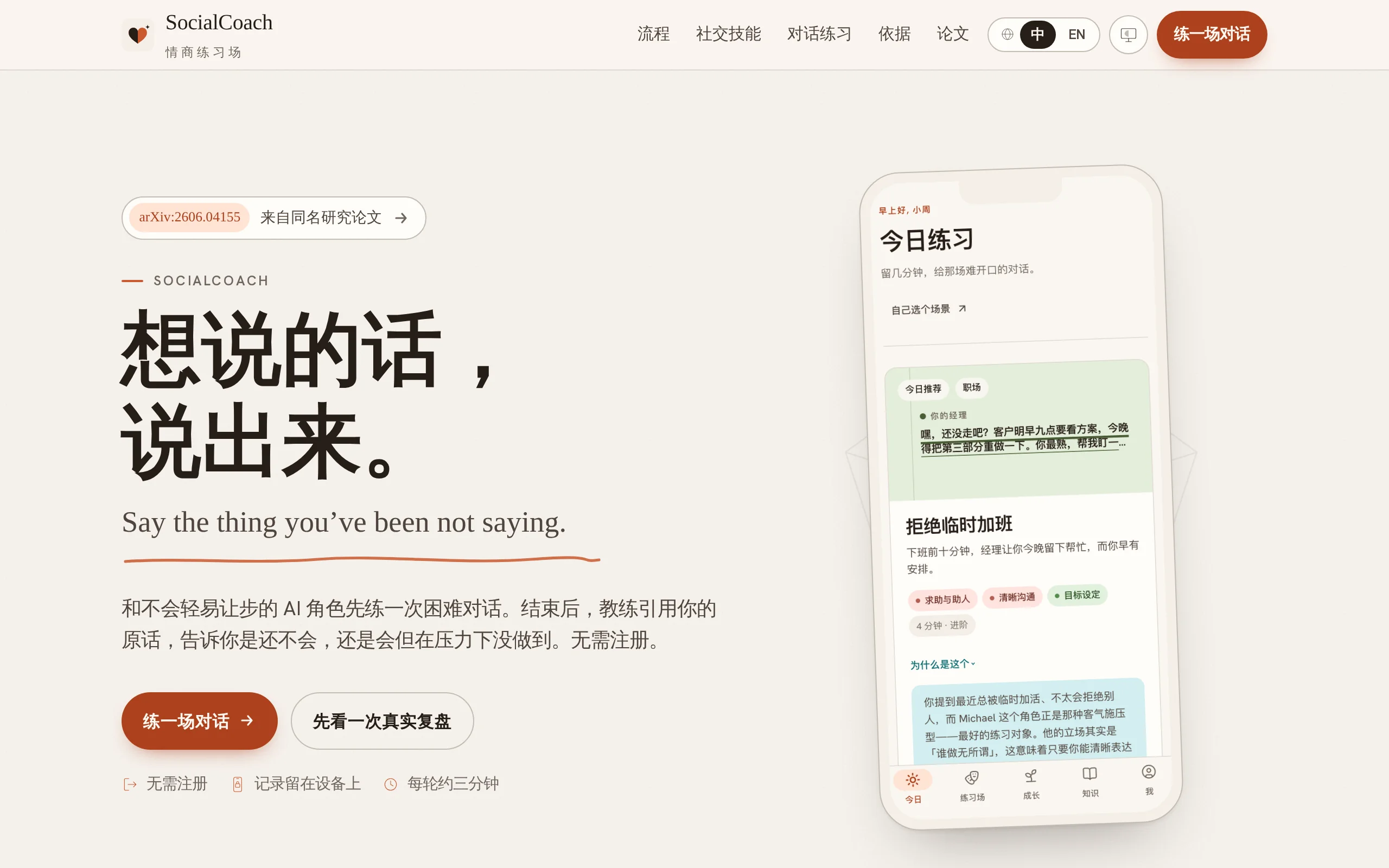
SocialCoach is a one-stop AI social communication training tool open-sourced by the Hong Kong University of Science and Technology (Guangzhou) and Microsoft Research Asia. It focuses on addressing com...
1. What is SocialCoach
SocialCoach is a one-stop AI social communication training tool open-sourced by the Hong Kong University of Science and Technology (Guangzhou) and Microsoft Research Asia. It focuses on addressing communication anxiety and skill gaps in challenging conversation scenarios such as asking for a raise, reminding someone to repay a debt, or declining unreasonable requests. Built on the CASEL social-emotional learning framework, the project includes 46 pre-defined training scenarios across seven major domains, including the workplace, interpersonal relationships, and family. It employs reinforcement learning algorithms to schedule personalized practice sessions based on the user's proficiency in 34 social skills. During training, users engage in multi-round simulated dialogues with AI characters that have clear objectives and emotional boundaries. After the conversation, the system provides feedback by quoting the user's original statements sentence by sentence, and separately scores "communication quality" and "dialogue outcome," thereby precisely identifying issues and guiding targeted improvements.
Technical positioning and domain: SocialCoach falls within the intersection of artificial intelligence and education, focusing on social-emotional learning (SEL) and conversational AI training systems. Its technology stack involves natural language processing, reinforcement learning, dialogue system design, and pedagogical methods, making it an applied open-source project that integrates large language model capabilities with a structured social skill assessment system.
Development background: The project was jointly developed by the Hong Kong University of Science and Technology (Guangzhou) and Microsoft Research Asia, combining the university's research in cognitive science and educational theory with the industry's expertise in large model engineering and system deployment. The motivation for development stems from the widespread "critical conversation" challenges in modern workplaces and daily life—most people lack a safe environment for practice and quantifiable feedback when dealing with sensitive topics.
Core value: The core value of this tool lies in providing a low-risk, high-realism communication practice environment. Users can repeatedly rehearse difficult conversations without worrying about embarrassment or real-world consequences, and receive sentence-by-sentence feedback based on their actual language. This "safe practice + precise feedback" model effectively shortens the transition period from theory to practice, especially offering significant value for high-conflict and high-emotion-loaded conversation scenarios.
Technical features: First, the AI characters are not simple response bots but rather "persistent" characters with their own goals, boundaries, and emotions, capable of behaviors such as rebuttals and bringing up past issues. Second, the feedback mechanism is based on the user's actual language rather than abstract suggestions, achieving independent two-dimensional scoring of communication quality and dialogue outcome. Third, the entire training system is supported by 42 communication strategies and 30 real-world cases, with personalized training recommendations enabled through reinforcement learning.
2. Key Features
Realistic Dialogue Practice: Engage in complete multi-turn dialogue exercises with AI characters that have clear goals and emotional boundaries. These characters will genuinely challenge users, bring up past issues, and even express dissatisfaction, creating a training experience that closely resembles real-life, high-difficulty conversation scenarios rather than simple question-and-answer interactions.
Sentence-by-Sentence Intelligent Feedback: After the conversation, the system will reference the user's original statements and provide detailed sentence-level evaluations, accurately identifying issues in each expression. More importantly, it separately scores "communication quality" and "dialogue outcome"—even if the outcome is unsatisfactory, users can still see their strengths in expression, and vice versa—thereby avoiding misjudgments based solely on outcome.
Personalized Practice Recommendations: Using reinforcement learning algorithms, the system models the user's goals and proficiency in 34 social skills, automatically recommending the most suitable practice scenarios for current weaknesses. As the user accumulates practice data, the recommendation accuracy gradually improves, forming a continuously optimized training loop.
Scenario Library + Customization: The system includes 46 pre-set scenarios covering seven major areas such as the workplace, interpersonal relationships, and family life, including high-frequency challenges like asking for a raise, reminding someone to repay a debt, declining overtime, and discussing responsibilities with a partner. It also supports users in describing their own real-life situations to create custom scenarios, enabling targeted practice.
Bilingual Support (Chinese & English): The interface and practice content support seamless switching between Chinese and English. Users can train their communication skills while simultaneously improving their English expression abilities, achieving a dual benefit in language and communication training.
Open Source & Self-Deployment: The project is licensed under Apache 2.0, with fully open-source code that supports local deployment and commercial use. Users can deploy it with one click using Docker Compose, Vercel, or ModelScope, or integrate it with any large model service compatible with the OpenAI API, offering flexible adaptation to various infrastructure environments.
Data-Driven Practice System: The entire training system is built upon the CASEL five core social-emotional competencies framework, supported by 42 communication strategies and 30 real-world cases in its knowledge base. This ensures the scientific rigor and systematic structure of the practice content from both theoretical and methodological perspectives.
3. How to Use
Online Quick Experience: Directly visit https://socialcoach.aurax.live to start practicing conversations without registration. This is the fastest way to experience SocialCoach's features and is ideal for initially evaluating the tool's suitability.
Local Deployment Preparation: Clone the GitHub repository (
https://github.com/GeminiLight/SocialCoach) to your local environment. You will need to have Node.js and the pnpm package manager pre-installed, as well as an API Key for a large model service that is compatible with the OpenAI interface.Configure Environment Variables: Create a
.env.localfile in the project root directory and fill in relevant configurations such as the LLM Provider and API Key. If using a domestic large model endpoint, be sure to set theLLM_OPENAI_TOKEN_PARAM=max_completion_tokensparameter to ensure compatibility with the local endpoint.Start the Development Server: Run
pnpm installto install dependencies, then executepnpm devto launch the development server. Access the application via your browser at localhost:3000 to begin using it.Production Environment Deployment: Use the project's built-in Docker Compose file or deploy with one click via Vercel or ModelScope. This method is suitable for providing the service externally, running SocialCoach as a long-term online application.
Best Practices Recommendations: On your first use, it is recommended to review the built-in scenario directory to assess your weaknesses. When practicing custom scenarios, try to describe real situations and desired outcomes in detail to enhance the AI role's realism. It is also advised to regularly review and provide feedback on each sentence, and to conduct follow-up practice sessions to verify the effectiveness of improvements.
4. Pros and Cons Analysis
| Pros |
|---|
| Open-source, free, and commercial-use allowed: Utilizes the Apache 2.0 license, with fully open-source code that permits free modification and commercial use, reducing the barrier to entry and supporting self-deployment for privacy protection. |
| Realistic character design: AI characters have clear goals and emotional boundaries, and will genuinely refute and bring up past issues, offering high simulation fidelity and effectively enhancing users' ability to handle real conflicts. |
| Sophisticated feedback mechanism: Provides line-by-line comments using the user's original words, and separately scores communication quality and dialogue outcomes, helping users accurately identify their own issues and strengths. |
| Systematic training framework: Built upon the CASEL framework and 42 communication strategies, and offers personalized recommendations based on reinforcement learning, ensuring a scientific and clear training path. |
| Broad scenario coverage: Includes 46 built-in scenarios spanning seven major areas such as workplace, family, and interpersonal relationships, and supports custom scenarios, offering wide applicability. |
5. Comparative Analysis with Similar Tools
| Dimension | SocialCoach | Yoodli | VirtualSpeech |
|---|---|---|---|
| Product Positioning | AI emotional intelligence conversation coach, for practicing "difficult conversations" | AI speaking/communication coach, for practicing "speaking better," known as the "voice version of Grammarly" | VR/online speaking training platform, combining virtual reality for immersive practice |
| Core Capabilities | 34 social skills training modules (communication strategies, conflict resolution, boundary setting, etc.), emphasizing complex interpersonal scenarios | Oral delivery aspects: speaking rate, filler words, clarity, eye contact, and verbal hesitations | Speech structure, language expression, nonverbal communication, with online courses and virtual environment practice |
| Conversation Format | Engage in multi-round realistic dialogues with a "nitpicky" AI character that has goals and boundaries | Simulate interviewers, clients, or audiences, or upload videos for speech analysis | VR scenario-based speech simulation and public speaking, as well as online recorded practice |
| Feedback Method | Sentence-by-sentence evaluation using the user's original words, with separate scores for communication quality and outcome | Real-time or post-session reports: speaking rate, pauses, filler words, eye contact, and body language | Comprehensive scoring reports, including language expression, body language, and visual aids suggestions |
| Teaching System | CASEL five core competencies framework + 42 strategies / 30 case knowledge base + personalized recommendations via reinforcement learning | Feedback-driven practice, with a weaker personalized recommendation system | Modular online course system + practical exercises |
| Deployment Method | Open source (Apache 2.0), supports self-deployment and commercial use, web-based | Closed-source commercial product, web + app | Commercial SaaS, web + VR devices |
| Covered Scenarios | 46 scenarios, 7 major domains (workplace, interpersonal, family, etc.), supports customization | Interview, speech, presentation, sales conversation, and other "public expression" scenarios | Speech, demonstration, presentation, and sales pitch |
Selection Recommendations: If your main pain points are "not knowing how to start a conversation" and "fear of offending others"—i.e., private conversations involving high emotional conflict—SocialCoach is a more suitable choice. It focuses on "what to say, how to say it, and how to say it without harming relationships," making it ideal for workplace relationship management, family communication, and boundary setting scenarios.
If your primary need is to improve public speaking skills, including quantifiable aspects such as speaking rate, tone, eye contact, and body language, Yoodli and Orai's real-time feedback mechanisms offer greater advantages. VirtualSpeech excels in scenarios requiring high levels of immersion, such as large stage performances or conference presentations. Overall, the four tools have distinct focuses and can be used in combination based on your most urgent communication needs.
6. Editor's Summary
SocialCoach has identified a precise yet widely overlooked entry point in the AI communication training space—those "difficult conversations." Unlike many tools on the market that focus heavily on speech and expression training, SocialCoach centers its core capabilities on high-difficulty dialogues such as interpersonal conflicts and boundary setting. This differentiated positioning gives it unique application value.
From a technological innovation perspective, SocialCoach's biggest highlight is the "realism of AI characters" and the "precision of the feedback mechanism." AI characters come with their own goals and boundaries, making conversations not just one-sided expression practice, but a two-way negotiation requiring genuine responses to the other party's emotions and positions. The design of "commenting on each sentence with the original quote" and "separately scoring communication quality and outcomes" reflects a deep understanding of communication training—it recognizes that good communication does not always lead to good results, and poor communication can sometimes achieve the desired goal. This distinction helps users develop a more accurate self-assessment system.
In terms of practical value, the project's systematic knowledge base, built upon the CASEL educational framework and 42 communication strategies, combined with personalized recommendations through reinforcement learning, forms a complete training loop from "identifying issues—targeted practice—feedback and improvement." The 46 pre-set scenarios and custom scenario features allow it to meet the diverse needs of different industries and social circles.
In terms of target users, SocialCoach is suitable for professionals who frequently handle high-difficulty interpersonal conversations (such as managers, HR personnel, and salespeople), students and job seekers looking to enhance their communication skills, and anyone aiming to improve family relationships and interpersonal boundaries. Its open-source, free, and self-deployable features also make it ideal for educational institutions and corporate training departments to use as an internal tool.
In the future, as large model capabilities continue to evolve and more user practice data is accumulated, SocialCoach still has considerable room for improvement in its personalized recommendations and feedback accuracy. If it can further expand multi-modal support and enhance mobile experience, its application scenarios will become even broader.
7. Application Scenarios
Workplace Communication Scenarios: Include asking for a raise, declining unreasonable overtime requests, and responding to sharp questions during meetings. By engaging in dialogues with an AI supervisor designed with a defensive mindset, users can practice expressing their needs politely and effectively, managing their emotions, and maintaining their stance, enabling them to handle real-world workplace situations with greater composure.
Boundary Setting Scenarios: Involve asking a friend to return money, setting rules with roommates, or refusing unreasonable requests from others. These conversations are often difficult to initiate due to concerns about maintaining relationships. The AI characters in SocialCoach can simulate the other party's procrastination, ignorance, or emotional reactions, helping users practice setting firm boundaries without damaging relationships.
Conflict Resolution Scenarios: Support discussions with a partner about household responsibilities, communication with parents about career choices, and repairing strained interpersonal relationships after an argument. Users can experiment with different ways of expressing themselves in a safe environment, observing the AI's varied responses, and discovering the most effective conflict resolution strategies for themselves.
Social Connection Scenarios: Include welcoming a new colleague, supporting a friend who is feeling down, and naturally joining a conversation with a stranger. The system provides guidance strategies to help users take the first step in unfamiliar or delicate social situations, reducing social anxiety.
Language + Communication Dual Practice Scenarios: When switching to English mode, users simultaneously train their English expression skills and cross-cultural communication strategies. For those preparing for overseas job interviews, study abroad interviews, or international work, customized scenarios allow practice in English interviews, cross-cultural apologies, or business negotiations, achieving dual training benefits.
Educational and Training Scenarios: SocialCoach can be used as a role-playing teaching tool in university psychology, social work, and management courses, allowing students to repeatedly practice interview techniques, conflict mediation, and counseling communication skills in a risk-free environment, addressing the lack of realistic simulation scenarios in traditional classrooms.
8. FAQ
Q: Is SocialCoach completely free?
A: The project itself is completely free and uses the Apache 2.0 open-source license. However, if you deploy and use it yourself, you need to have your own API key for the large model and bear the corresponding API call costs. There are no additional costs when using the official online demo site.
Q: Are there hardware requirements for local deployment?
A: The Web frontend of SocialCoach has low hardware requirements, with the main computational load on the LLM inference server. If you use a cloud-based large model API, a regular computer that can run a Node.js development server is sufficient locally. If you run the large model directly on your local machine, you will need sufficient GPU computing power.
Q: Can SocialCoach be used for commercial projects?
A: Yes. The project uses the Apache 2.0 license, which allows free use, modification, and commercial use. However, if you use an open-source large model for commercial deployment, you must separately confirm whether the license of the large model you are using supports commercial scenarios.
Q: How can I create a custom scenario?
A: In the application, select the custom scenario feature and describe your real-life situation in text, including the conversation partner, relationship context, conflict points, and your desired outcome. The system will automatically generate an AI character with the corresponding goals and emotions based on your description, and you can then start practicing.
Q: How does SocialCoach's scoring mechanism work?
A: The system evaluates from two dimensions: "communication quality" and "dialogue outcome." Communication quality is assessed based on the clarity, politeness, and strategy use of your language expression. Dialogue outcome is determined by the AI character's response to your expressions, such as whether the other party accepts your request or if the relationship deteriorates. These two dimensions are independent of each other.
Q: Which large model services does SocialCoach support?
A: The project is compatible with services that follow the OpenAI API specification. You can connect to OpenAI or compatible domestic large model endpoints by configuring the LLM Provider and API Key in .env.local. When connecting to domestic endpoints, you need to set the parameter LLM_OPENAI_TOKEN_PARAM=max_completion_tokens.
9. Project Links
- Project Website: https://tianfuwang.tech/SocialCoach/
- Online Experience URL: https://socialcoach.aurax.live
- GitHub Repository: https://github.com/GeminiLight/SocialCoach
Related AI Model Articles
Vidu Q4 Preview: A Masterful Demonstration of Expressive Performance and Multi-Subject Consistency in ShengShu Technology's Flagship Video Generation Model
Vidu Q4 Preview is the first publicly available preview version of ShengShu Technology's next-generation flagship video generation model, launched on October 7, 2026. It emphasizes "expressive perform...
EmbeddingGemma 2 – Review of Google's Open-Source Native Multimodal Embedding Model
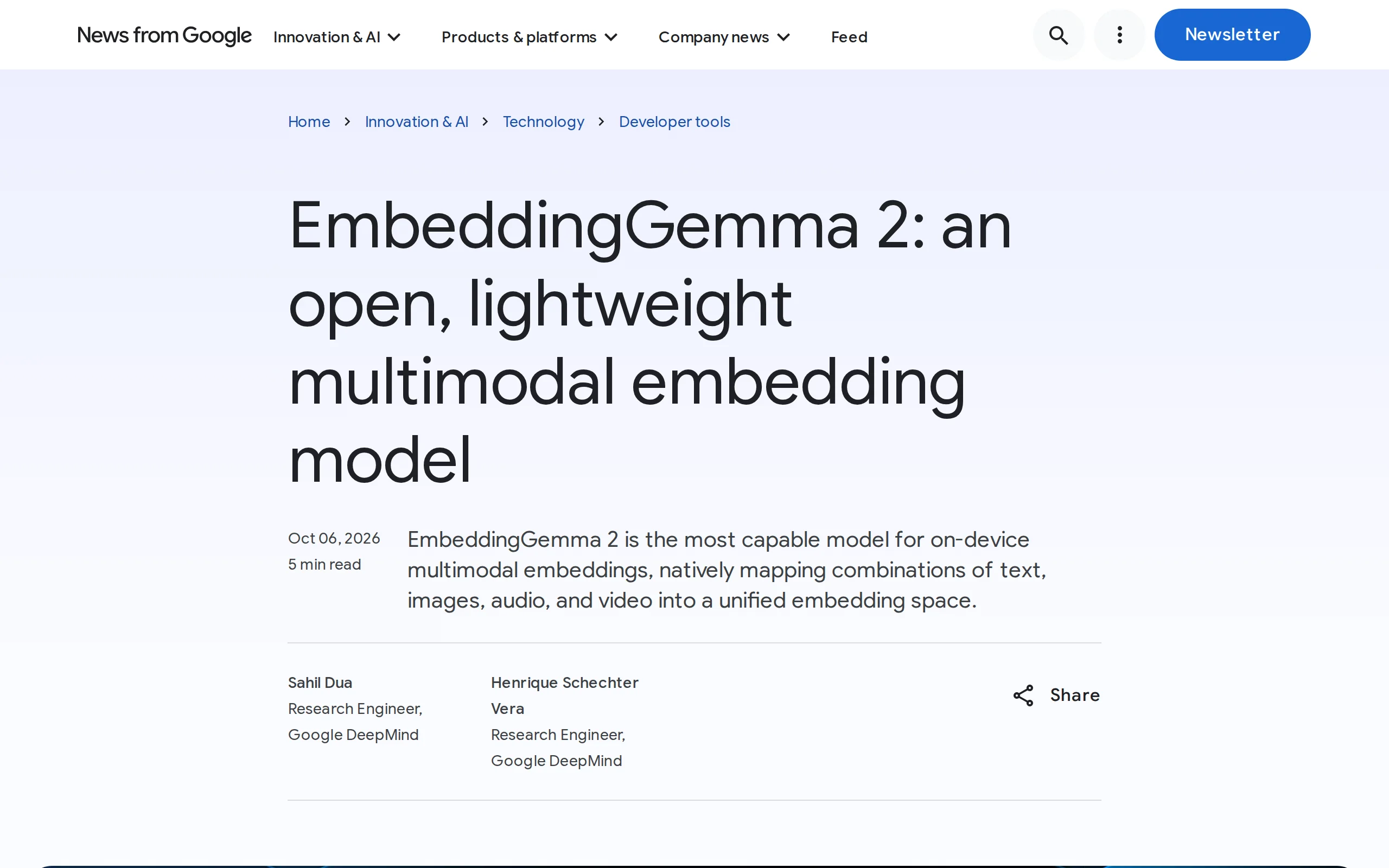
EmbeddingGemma 2 is an open-source native multimodal Embedding model developed by Google, built upon the Gemma 4 architecture. It unifies five modalities—text, code, images, video, and audio—into a si...
Kling 4.0 – A New Generation AI Video Generation Model Launched by Kuaishou
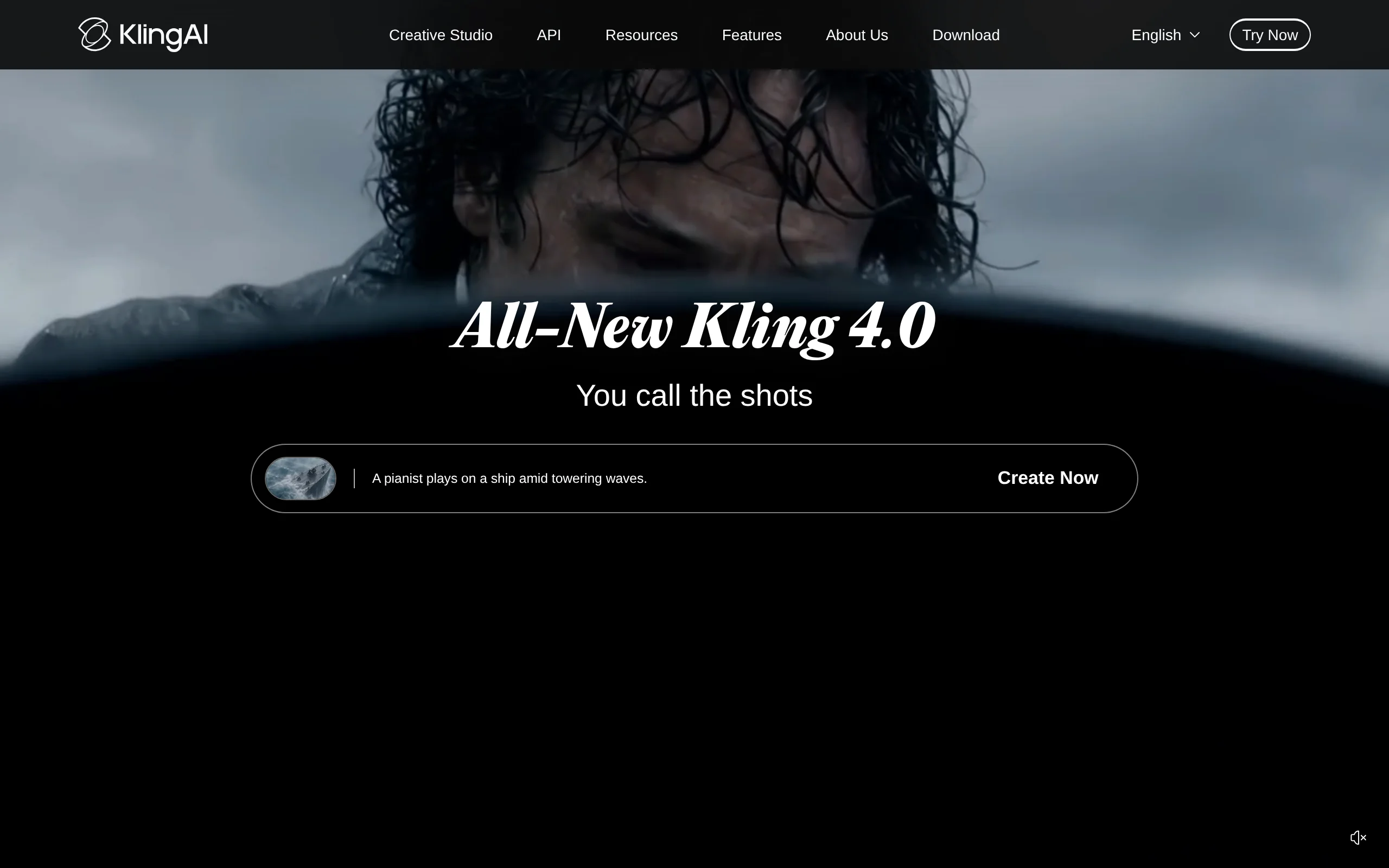
Kling 4.0 is the latest generation video generation model introduced by Kuaishou's Keling AI. The lightweight version, Kling 4.0 Flash, is now open for early access, with the full version expected to ...

Space Bunny – Anonymous Free Multimodal Large Language Model Tops Daily Usage on OpenRouter
Space Bunny (Space Bunny) is a free large language model that was anonymously launched on the OpenRouter and OpenCode platforms. Within just 3 days of its release, it climbed to the top of the daily u...
© All Rights Reserved. Some content on this site is partially generated by AI with human review.