
R2T2 – In-Depth Review of NetEase Youdao's Open-Source Low-Latency True Streaming Speech Recognition Model
Executive Summary:
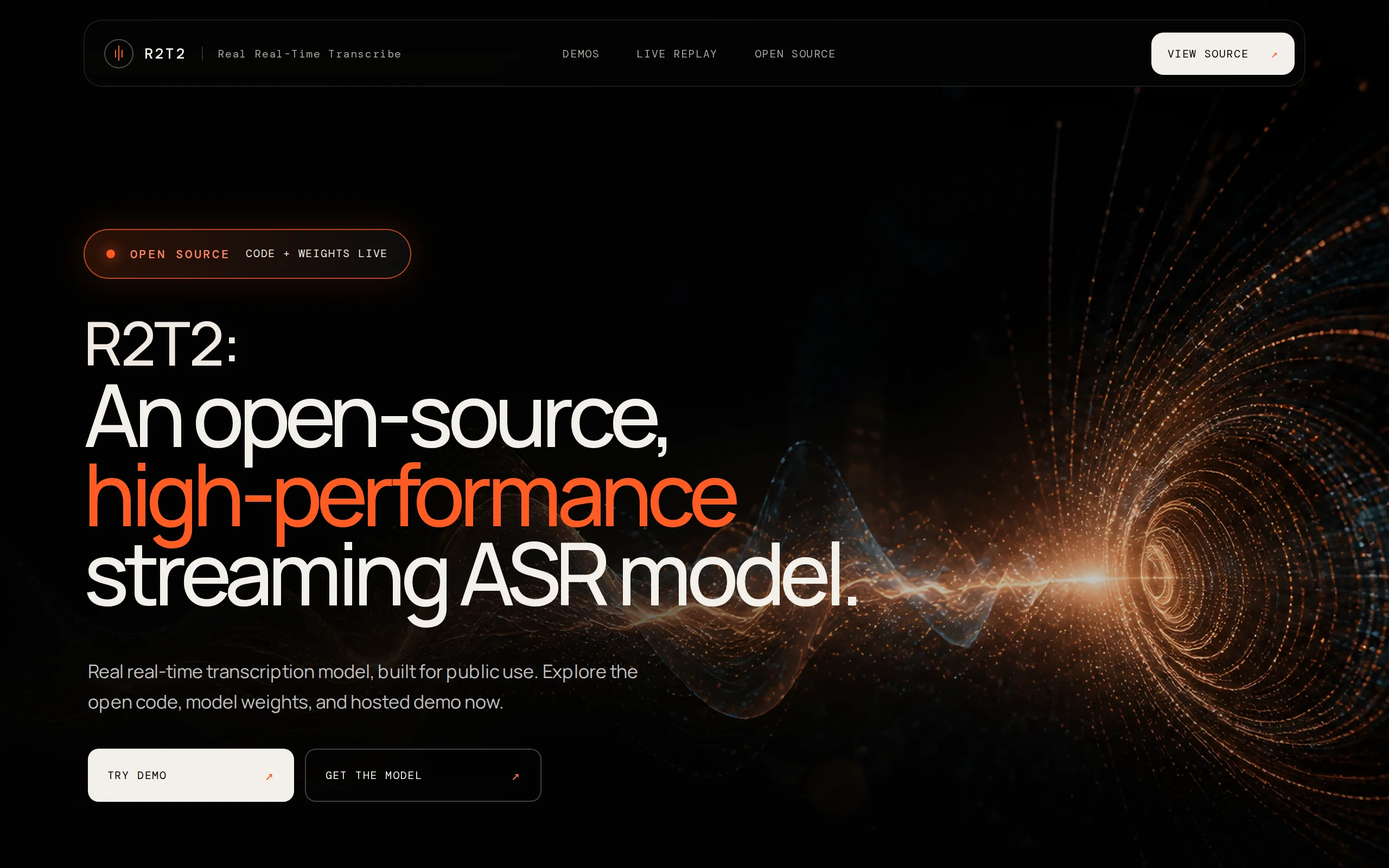
R2T2 (Real Real-Time Transcription) is a low-latency true streaming speech recognition model open-sourced by NetEase Youdao, built upon the Qwen3-ASR architecture. It employs an append-only mechanism ...
1. What is R2T2
R2T2 (Real Real-Time Transcription) is a low-latency true streaming speech recognition model open-sourced by NetEase Youdao, built upon the Qwen3-ASR architecture. It employs an append-only mechanism to achieve stable output with "no backtracking of already displayed text." The model supports adjustable chunking strategies ranging from 80ms to 2s, optimized for both Chinese and English while retaining multilingual capabilities. It offers an average latency of approximately 200–600ms and provides multiple backend deployment options, including vLLM, Transformers, and llama.cpp/GGUF, making it suitable for latency-sensitive production scenarios such as real-time subtitles, voice agents, and simultaneous interpretation frontends.
Technical positioning and domain: R2T2 belongs to the intersection of automatic speech recognition (ASR) and streaming speech processing. Its core innovation lies in combining "true streaming" with "output stability." Unlike traditional streaming ASR models, R2T2 ensures that once text is output, it is not modified by subsequent audio input through its append-only mechanism. This feature gives it a unique advantage in scenarios with strict requirements for output consistency, such as real-time subtitles and voice interaction.
Development background: This project was primarily developed by the AI team at NetEase Youdao, leveraging their accumulated speech recognition experience in educational scenarios. It is based on the open-source Qwen3-ASR model from Alibaba's Tongyi Lab and involves further development. The motivation for development stems from real-world business challenges such as subtitle flickering and incorrect execution of voice agents. The team achieved this by training the model with constraints to learn how to determine "which prefixes are stable enough to be output."
Core value: R2T2 addresses the fundamental challenge in streaming recognition of balancing "low latency" with "output stability." Traditional streaming models often rewrite previously output text due to subsequent audio input, whereas R2T2 uses a Commit/Wait decoding mechanism to implement an "irreversible output" strategy, significantly reducing subtitle reading interference and the risk of incorrect agent execution, while maintaining accuracy levels close to offline recognition.
Technical features: The model employs stable-prefix learning and token-level audio segmentation in its data construction methods, combined with a context-conditioned generation mechanism. This ensures semantic constraints while preventing previous outputs from being overturned. Its adjustable latency-accuracy trade-off (via parameters such as chunk size and rollback window) allows it to flexibly meet diverse requirements, from real-time subtitles to high-precision offline transcription.
2. Key Features
True Streaming Recognition: Supports adjustable chunk-based continuous audio input (80ms to 2s) with synchronized text output, delivering a real-time transcription experience where text appears as the user speaks. This feature is built on a streaming decoding architecture that generates partial results even before the audio stream is complete, making it suitable for real-time captioning and voice interaction scenarios. Users can flexibly adjust chunk size based on specific business requirements for latency and accuracy.
"Append-only" No-Regret Mechanism: Once text is submitted, it cannot be modified by subsequent audio input. This feature provides significant differentiation in the streaming ASR domain. Through the Commit/Wait decoding strategy, the model evaluates the current stable prefix upon each audio segment arrival. If the prefix is sufficiently stable, it is committed as immutable text; otherwise, the context is cached, effectively preventing caption flickering and rewriting of voice Agent actions.
Low-latency High-accuracy Recognition: According to official data, the average latency is approximately 200–600ms, with streaming accuracy approaching that of offline recognition. The model maintains high recognition accuracy through stable prefix learning and forced temporal alignment training, ensuring output stability without a noticeable loss in offline recognition performance. A single model can effectively handle both streaming and offline tasks.
Support for Hotwords and Contextual Priors: Enables injection of prior information such as prompts, domain-specific terms, and proper nouns, significantly improving the hit rate for obscure terms like names, product names, and technical jargon. This functionality is achieved through a contextual conditional generation mechanism, where prior information is fed as a condition during decoding. It is ideal for customized recognition needs in professional domains such as meetings, healthcare, and finance.
Multilingual and Cross-lingual Capabilities: Specifically optimized for Chinese-English bilingual recognition, while retaining cross-lingual streaming recognition capabilities for French, German, Italian, Japanese, Korean, Russian, Spanish, and Arabic. This feature allows the model to meet deployment requirements for internationalized business and multilingual scenarios without requiring separate model training for each language.
Flexible Multi-backend Deployment: Supports multiple inference backends including vLLM, Transformers, and llama.cpp/GGUF, and can launch a WebSocket service to provide real-time recognition interfaces externally. It is highly engineering-friendly and easy to integrate into production environments. The community has rapidly developed ecosystem resources such as GGUF quantization, Core ML compatibility, and offline tools, reducing the barriers to private deployment and secondary development.
3. How to Use
Environment Preparation and Repository Cloning: First, clone the project repository by executing
git clone https://github.com/netease-youdao/Confucius4-R2T2.git. It is recommended to use Conda or uv to create an isolated Python 3.12 environment to avoid dependency conflicts. Alternatively, you can directly use the official providedqwenllm/qwen3-asrDocker image to skip the environment configuration steps.Model Weight Download: Download the corresponding weights based on the selected inference backend from HuggingFace or ModelScope. When using the vLLM or Transformers backend, download the full weights for
Confucius4-R2T2; when deploying with llama.cpp/GGUF, download the quantized versionConfucius4-R2T2-GGUF. Note that the weight files are large, so it is advisable to plan storage space in advance.Run Example for Verification: First, run the offline or streaming example to verify that the environment configuration is correct, using the command
./run_example.sh audio.wav --model_path ... --infer_mode stream_vllm --language Chinese --chunk_size_ms 160. This step can help confirm whether the model is loaded correctly, the inference pipeline is functioning normally, and the parameters are set properly. It is recommended to use the official test audio for verification.Write Streaming Recognition Code: Load the
R2T2ASRModel.LLMclass, callinit_streaming_state()to initialize the streaming state, then split the audio into chunks at a 16kHz sampling rate. Loop through and call thestreaming_transcribe()method to process each audio chunk, and finally callfinish_streaming_transcribe()to end the recognition process. For CPU/llama.cpp deployment, use ther2t2_llamamodule'sstream_llama_hybridorstream_llama/onetime_llamamode.Start Real-time WebSocket Service: Execute
./run_start_server.sh start --model_path ... --vad_model_path checkpoints/vad/Stream-VAD --port 8272 --gpu 0to start the real-time recognition service. The client sends 16kHz mono int16 PCM audio data tows://localhost:8272/asr_stream_api_v1, and sends theYOUDAO_ONETIME_ASR_STREAM_EOSsignal to terminate the session at the end.Parameter Optimization and Best Practices: Adjust parameters such as
language,chunk_size_ms,context/hotword, andunfixed_token_numbased on your business scenario to achieve a balance between latency, accuracy, and terminology hit rate. Smaller chunks result in faster responses but riskier recognition, while larger chunks offer more stability but higher latency. It is recommended to determine the optimal configuration through A/B testing.
4. Pros and Cons Analysis
| Pros |
|---|
| True streaming with no backtracking: Once text is output, it is final like "a stone dropped cannot be retrieved," avoiding subtitle flickering and agent misexecution, significantly enhancing user experience and system reliability in real-time interaction scenarios. |
| Low latency with adjustable settings: Average latency is approximately 200–600ms, supporting chunk sizes from 80ms to 2s, allowing switching between faster and more stable performance based on the scenario, suitable for multiple levels of requirements from real-time subtitles to high-precision transcription. |
| Balanced offline capabilities: The addition of streaming constraints does not significantly compromise offline recognition accuracy, allowing a single model to handle both streaming and offline tasks, reducing model maintenance and deployment costs. |
| Ecosystem and engineering-friendly: Built on the Qwen3-ASR foundation, it quickly gained support for GGUF, llama.cpp, Core ML, and offline tools after open-sourcing, providing production-level backends such as vLLM, Transformers, and WebSocket. |
| Controllable input priors: Supports context/hotword prompts, improving recognition rates for names, product names, and terminology, meeting the customization needs of vertical domains. |
| Multilingual support: Optimized for Chinese and English, while retaining multilingual streaming recognition capabilities, meeting the needs of international business operations. |
5. Comparative Analysis with Similar Tools
| Dimension | R2T2 | GPT-Realtime-Whisper |
|---|---|---|
| Core Architecture | Based on Qwen3-ASR, employs append-only mechanism and Commit/Wait decoding, true streaming output with no backtracking | OpenAI-managed streaming STT API, follows Realtime/transcription session framework, closed-source architecture |
| Latency Performance | Officially reported average latency of approximately 200–600ms, with 80ms–2s chunk size adjustable | Third-party testing shows TTFS p50 of ~556ms, TTFT p50 of ~1838ms, metrics not fully comparable to R2T2 |
| Accuracy Reference | README provides streaming and offline results across multiple Chinese and English test sets, requires business validation | Third-party sample mean WER of 5.1%, but with significant long-tail distribution, requires language-specific validation |
| Controllability | Code under Apache-2.0 license, weights under separate agreement, supports hotwords/context/WebSocket, allows private deployment and secondary development | Closed-source API, controllability mainly in session configuration, audio parameters, and post-processing |
| Deployment Method | vLLM/HF/llama.cpp/GGUF/WebSocket, supports private deployment and offline operation | Cloud API hosting, relies on OpenAI infrastructure, no local deployment possible |
| Ecosystem & Community | Community provides many quantization and offline tools, based on the Qwen3-ASR ecosystem, active GitHub open-source repository | Better integration with OpenAI Realtime ecosystem, transcription session, and cloud dialects |
Selection Recommendations: For enterprise users requiring private deployment and strict data compliance, R2T2 is a more suitable choice. Its Apache-2.0 code license and support for multiple local inference backends allow the model to be fully deployed in internal networks. Additionally, the hotword and context mechanisms enable customization and optimization for vertical domains. In contrast, GPT-Realtime-Whisper and Spark-ASR-2.0, as closed-source API services, offer simpler integration and eliminate infrastructure concerns, but factors such as data transfer and long-term costs must be carefully considered.
For developers seeking rapid integration and a comprehensive ecosystem, especially teams already within the OpenAI or Iflytek ecosystem, closed-source API solutions still offer advantages in development efficiency and feature richness. R2T2, however, is better suited for teams with certain AI engineering capabilities who wish to deeply customize the recognition model or build private speech products. Its "no regrets" characteristic provides unique differentiation value in speech Agent and real-time interaction scenarios.
6. Editor's Summary
R2T2 demonstrates clear technological innovation in the field of streaming speech recognition. Its "append-only" irreversible mechanism effectively addresses the core issue of output instability in traditional streaming ASR systems. By employing Commit/Wait decoding and stable prefix learning, R2T2 establishes an engineering-feasible balance between low latency and output consistency. This design philosophy is not only applicable to subtitle generation but also provides a new technical pathway for scenarios such as voice agents and real-time interactions that require strict output determinism.
From a practical value perspective, R2T2's support for multiple backends and its WebSocket service encapsulation enable it to be directly integrated into production environments. The adjustable chunking mechanism, ranging from 80ms to 2s, offers flexible latency-accuracy adjustment for different scenarios. The hotword and context features effectively resolve real-world challenges in recognizing domain-specific terminology.
In terms of target users, R2T2 is primarily aimed at development teams and researchers with a certain level of AI engineering capability, especially enterprise users requiring private deployment and high data compliance standards. Its open-source nature and community ecosystem reduce the barriers to secondary development, but the restrictions on weight licensing and high resource consumption imply that users need to have the corresponding technical expertise and cost evaluation capabilities. In the future, as the community continues to refine lightweight solutions such as GGUF quantization and Core ML compatibility, R2T2 is expected to be deployed on more edge devices and client-side scenarios. Its potential for multilingual expansion and streaming simultaneous interpretation is also worth noting.
7. Application Scenarios
Real-time Meeting Subtitles: In online meetings and offline forums, R2T2 can generate finalized subtitles in real-time as participants speak, reducing reading disruptions caused by subtitle revisions. Its "no regrets" feature ensures that once subtitles are displayed, they do not flicker or change due to subsequent audio input, significantly enhancing the reading experience for hearing-impaired individuals and cross-language attendees. It also supports hotword injection, allowing for the pre-insertion of meeting-specific terminology.
Voice Agent Instruction Entry: During the instruction recognition phase of a voice agent, R2T2 can reliably identify spoken corrections such as "transfer 300 to 3000," reducing the risk of misexecution by the agent. Using an append-only mechanism, the system deterministically handles user instruction revisions, preventing execution confusion caused by fluctuating recognition results. This is suitable for interactive scenarios such as smart home control and mobile assistants.
In-car and Smart Hardware Voice Interaction: In low-latency scenarios such as in-car navigation, phone calls, and vehicle control commands, R2T2 outputs non-reversible instruction text to ensure deterministic system execution. Its adjustable chunking mechanism, with latency ranging from 80ms to 2s, meets the real-time requirements of in-car environments, while its multilingual support fulfills the internationalization needs of exported vehicle models.
Call Center Real-time Assistance: In call center agent scenarios, R2T2 can transcribe speech in real-time while the agent is speaking and instantly deliver the transcription as prompts. It balances latency, terminology, and hotword injection with private deployment compliance requirements. By injecting hotwords for product names and business terms, recognition accuracy is improved, and private deployment meets data security regulations in industries such as finance and government services.
Classroom and Accessibility Transcription: R2T2 provides a stable character-by-character stream for hearing-impaired individuals or classroom note-taking scenarios, reducing flickering and post-hoc revision costs. Its streaming output feature makes transcription content visible in real-time, and the append-only mechanism ensures that displayed content is not rewritten, making it ideal for high-output stability requirements in educational support and accessibility applications.
8. FAQ
Q: What is the core difference between R2T2 and conventional streaming speech recognition models?
A: R2T2 employs an append-only mechanism, where text that has already been displayed will not be modified by subsequent audio, implementing an output strategy of "no regrets once committed." Traditional streaming models typically revise previously output content based on later audio, leading to subtitle flickering or rewritten Agent actions. R2T2 uses a Commit/Wait decoding strategy, evaluating a stable prefix at each audio segment arrival. Only when the prefix is sufficiently stable is it committed as non-modifiable text, thereby ensuring output determinism.
Q: How does R2T2 balance latency and accuracy?
A: R2T2 supports adjustable chunk sizes ranging from 80ms to 2s, allowing flexible trade-offs between latency and accuracy by adjusting the chunk_size_ms parameter. Smaller chunks yield faster responses but riskier recognition, while larger chunks provide more stability at the cost of higher latency. According to official benchmarks, the average latency is approximately 200–600ms, and streaming accuracy is close to offline recognition. It is recommended to determine the optimal configuration through A/B testing based on specific business scenarios.
Q: What deployment backends does R2T2 support? How should one choose?
A: R2T2 supports three inference backends: vLLM, Transformers, and llama.cpp/GGUF, and can also launch a WebSocket service. vLLM is suitable for high-throughput production deployment in GPU environments, Transformers is ideal for rapid prototyping and verification, and llama.cpp/GGUF is appropriate for CPU inference and edge devices. When choosing, consider hardware resources, inference speed, and deployment complexity comprehensively.
Q: Are the model weights of R2T2 fully open-sourced? Are there any restrictions on commercial use?
A: R2T2's code is licensed under Apache-2.0, but the model weights are subject to additional protocol constraints. Before commercial use, carefully review the weight license terms to ensure they meet your business requirements. It is recommended that enterprise users conduct a legal review prior to use, especially in scenarios involving commercial products or large-scale deployment.
Q: Which languages does R2T2 support? How effective is it for Chinese and English?
A: R2T2 has been specifically optimized for both Chinese and English, demonstrating strong performance in streaming and offline recognition on respective test sets. It also retains cross-lingual recognition capabilities for French, German, Italian, Japanese, Korean, Russian, Spanish, and Arabic. For specific use cases, it is recommended to evaluate performance using business-related corpora.
Q: How can custom hotwords or domain-specific vocabulary be added to R2T2?
A: R2T2 supports injecting prior information such as prompts, domain-specific terms, and proper nouns through the context/hotword parameter. When calling the streaming recognition interface, pass the hotword list as a contextual condition. The model will prioritize these words during decoding, thereby improving the hit rate for obscure terms such as names, product names, and technical jargon.
9. Project Links
- Project Website: https://r2t2.ai/
- GitHub Repository: https://github.com/netease-youdao/Confucius4-R2T2
- HuggingFace Model Library: https://huggingface.co/netease-youdao/Confucius4-R2T2
Related AI Model Articles
Vidu Q4 Preview: A Masterful Demonstration of Expressive Performance and Multi-Subject Consistency in ShengShu Technology's Flagship Video Generation Model
Vidu Q4 Preview is the first publicly available preview version of ShengShu Technology's next-generation flagship video generation model, launched on October 7, 2026. It emphasizes "expressive perform...
VoxMem – An Open-Source Audio Large Model Memory Benchmark from the University of Melbourne and Others
VoxMem is an audio large model memory benchmark introduced jointly by the research team from the University of Melbourne and the University of New South Wales. This benchmark pioneers a two-dimensiona...
EmbeddingGemma 2 – Review of Google's Open-Source Native Multimodal Embedding Model
EmbeddingGemma 2 is an open-source native multimodal Embedding model developed by Google, built upon the Gemma 4 architecture. It unifies five modalities—text, code, images, video, and audio—into a si...
MAI-Transcribe-2-Streaming: In-Depth Evaluation of Microsoft's Real-Time Streaming Speech-to-Text Model
MAI-Transcribe-2-Streaming is Microsoft's first real-time streaming speech-to-text model, capable of continuously outputting text while speech is being delivered. It supports 60 languages and automati...
© All Rights Reserved. Some content on this site is partially generated by AI with human review.