
TencentDB Agent Memory – Layered Memory System for AI Agents

Executive Summary:
TencentDB Agent Memory is an open-source, MIT-licensed layered memory system for AI agents from Tencent Cloud Database. Its L0–L3 progressive architecture plus context offloading and Mermaid task canv...
1. What Is TencentDB Agent Memory
TencentDB Agent Memory is an open-source, MIT-licensed layered memory system for AI agents from Tencent Cloud Database. Its L0–L3 progressive architecture plus context offloading and Mermaid task canvases deliver short-term compression and long-term personalized memory. In production tests it cut token usage by up to 61.38% while raising task success by 51.52%, with native plugins for OpenClaw, Hermes, and similar agent frameworks.
Technical positioning and domain: Agent infrastructure focused on memory—not generic prompt tuning or RAG alone. It targets context overflow in long tasks and missing cross-session user profiles, acting as the “memory hub” of an agent stack.
Development background: From Tencent Cloud Database engineers with deep storage/retrieval expertise, motivated by OpenClaw/AutoGPT-style limits: finite context, high token bills, no durable personalization. DB experience applied to agent memory with lightweight, auditable design.
Core value: Fixes long-horizon agents via context offloading (tool dumps → external store + structured summaries) and L0–L3 abstraction from raw dialogue to user profiles—lowering cost while improving continuity and accuracy.
Technical characteristics: Four-layer progressive memory; Mermaid task graphs preserve structure after offload; human-readable artifacts for full traceability; default local SQLite + sqlite-vec, optional Tencent Cloud VectorDB (TCVDB) hybrid retrieval.
2. Key Features
- L0–L3 progressive memory: L0 raw logs → L1 atomic facts/preferences via LLM extraction → L2 scenario clustering (coding, research, etc.) → L3 user profile. Concrete evidence plus fast high-level retrieval.
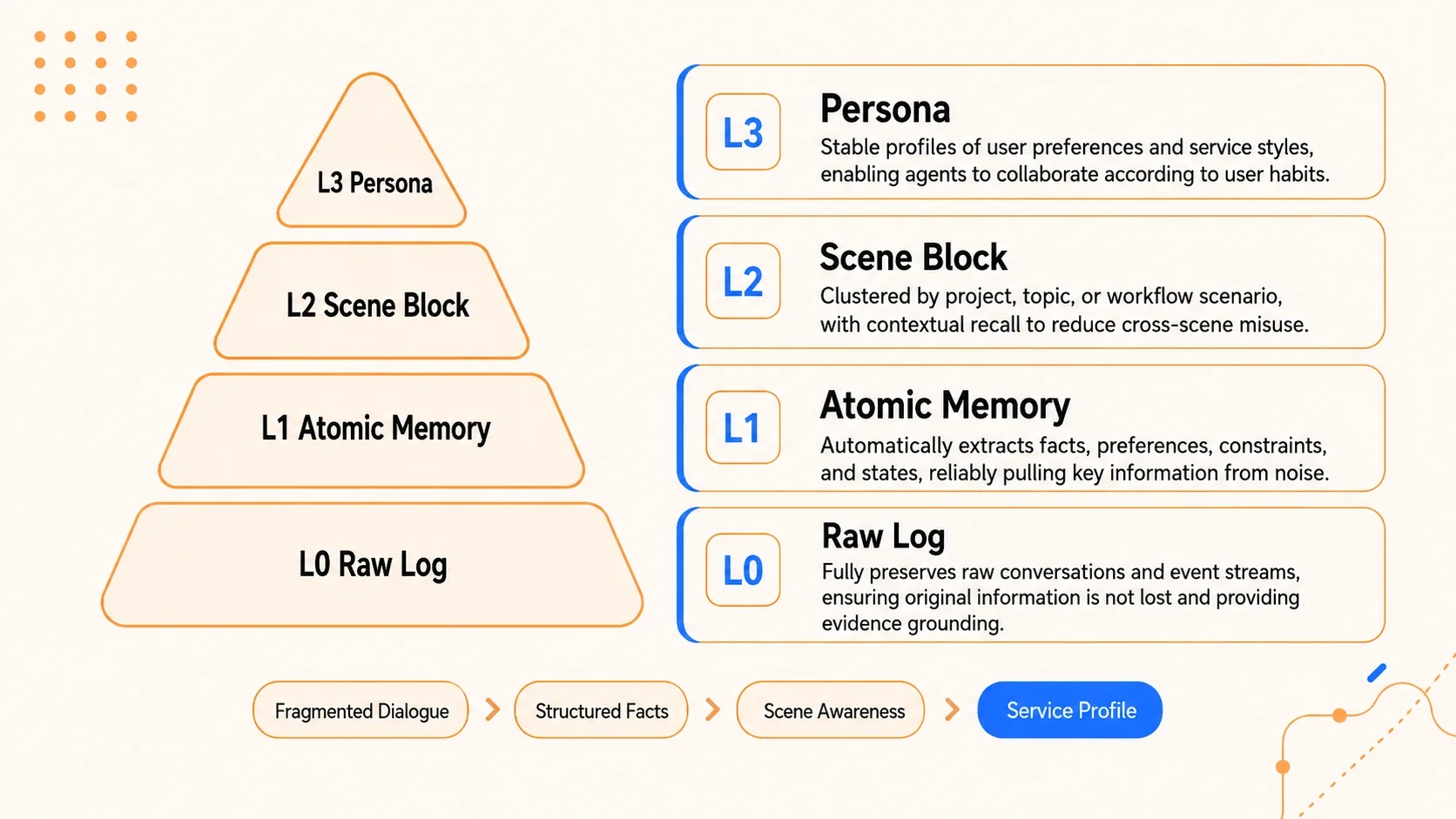
Context offloading + Mermaid canvas: Raw tool outputs (API payloads, web pages) move off-context; a Mermaid graph captures steps, dependencies, and state—often shrinking active context to 30–50% of original size.
White-box traceability: Markdown/JSONL/Mermaid files at every layer—drill from L3 profile down to L0 dialogue for debug and audit.
Pluggable storage: Zero-dependency SQLite + sqlite-vec by default; TCVDB for BM25 + vector hybrid at scale.
One-click framework plugins: Native OpenClaw/Hermes integration via a single install command—no core agent rewrites.
Live token monitoring: Per-operation token stats with before/after panels to quantify savings.
3. How to Use
Requirements: OpenClaw (v0.5.0+) or Hermes; Linux (Ubuntu 20.04+), macOS 12+, or Windows 10/11. TCVDB optional with Tencent Cloud credentials.
Install plugin:
openclaw plugins install @tencentdb-agent-memory/memory-tencentdbRestart gateway:
openclaw gateway restartConfirm with
openclaw plugins list→ statusactive.Optional TCVDB config in OpenClaw YAML:
memory:
  backend: tencentdb
  tencentdb:
    endpoint: "https://your-instance.tcvdb.tencent.com"
    api_key: "your-api-key"
Restart gateway after changes.
Validate: Run a multi-step task (e.g., “Research latest AI agent papers and write a report”). Inspect
~/.openclaw/memory/—l0_dialogue.jsonl,l3_profile.md, etc.
4. Pros and Cons
| Pros |
|---|
| Proven cost/quality lift: Up to 61.38% fewer tokens, +51.52% success in multi-session tests. |
| Fully auditable memory: Human-readable layers—no opaque black-box compression. |
| Zero-deps local mode: SQLite install in one command. |
| Production-tested on long tasks: Coding, research, docs, workflows validated in real runs. |
5. Comparison with Similar Tools
| Dimension | TencentDB Agent Memory | Mem0 |
|---|---|---|
| Focus | Layered memory + short-term compression | Lightweight personalized fact store |
| Architecture | L0–L3 progressive | Vector store + LLM fact extraction |
| Short-term compression | Offload + Mermaid canvas | No dedicated mechanism |
| Traceability | Full human-readable chain | Mostly opaque |
| Deploy | Local SQLite default | External vector DB typical |
| Integration | OpenClaw/Hermes plugin | Broad SDKs |
| License | MIT | Apache 2.0 |
| Best for | Long tasks + cross-session memory on supported agents | Large-scale user memory platforms |
Selection advice: OpenClaw/Hermes teams with long workflows and cost pressure → TencentDB Agent Memory. Multi-tenant personalization at scale → Mem0 (+ your vector infra). Fully autonomous agents in Letta's runtime → Letta despite migration cost.
6. Editor's Review
TencentDB Agent Memory is a rare systematic design for agent memory—both short-term compression and long-term profiles, not just fact snippets. Offload + Mermaid is a clever way to keep structure while dropping raw tool blobs.
Hard numbers (61% tokens, +51% success) matter for enterprise rollouts. White-box files are a debugging superpower as agents go multi-session and multi-agent.
Gaps: framework coverage and docs depth. If adapters expand, this could become a category reference.
— Deduct for ecosystem/docs; core tech and measured impact are strong.
7. Use Cases
Coding assistants: Remember repo conventions, patterns, and todos across days-long projects.
Deep research: Offload web dumps; Mermaid graph preserves investigation path without refeeding raw HTML.
Workflow orchestration: Checkpoint ETL/report pipelines with resumable Mermaid state.
Personalized support: L3 profiles carry preferences and history across sessions.
Long document analysis: Summarize prior sections into memory while analyzing later chapters without context breaks.
8. FAQ
Q: Other agent frameworks?
A: Native OpenClaw/Hermes only for now; generic adapters planned.
Q: SQLite limits?
A: Fine under ~100k entries per session memory; migrate to TCVDB beyond that.
Q: Inspect memory contents?
A: Files under ~/.openclaw/memory/ — L0 JSONL, L1 JSONL, L2 Markdown chunks, L3 profile Markdown.
Q: Are savings guaranteed?
A: 61.38% / +51.52% are averages from Tencent's four task categories—your mileage varies with context length and tool verbosity.
Q: Time to build L3 profile?
A: Rough shape after 5–10 turns; stabilizes around 20+. Seed manually or bootstrap from historical logs/RAG for cold start.
Q: Multi-user/multi-agent?
A: Separate storage per instance; set instance_id in config; use TCVDB as shared backend for teams.
9. Project Links
Related AI Model Articles
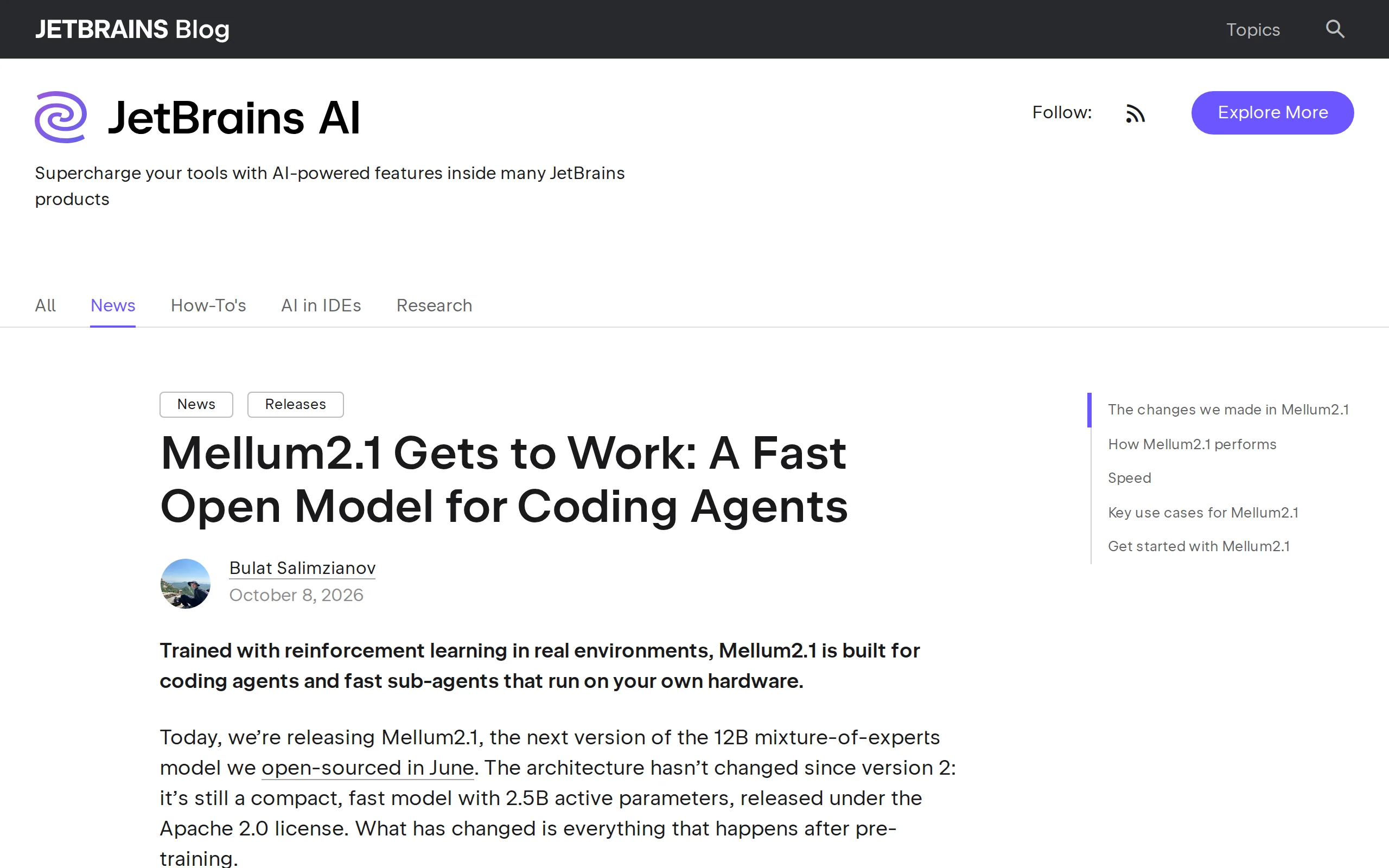
In-Depth Review of Mellum2.1: A Technological Leap in JetBrains' Open-Source Agentic Coding Model
Mellum2.1 is an open-source AI programming model launched by JetBrains, built on a 12B Mixture-of-Experts (MoE) architecture, activating only 2.5B parameters during each inference. The core breakthrou...
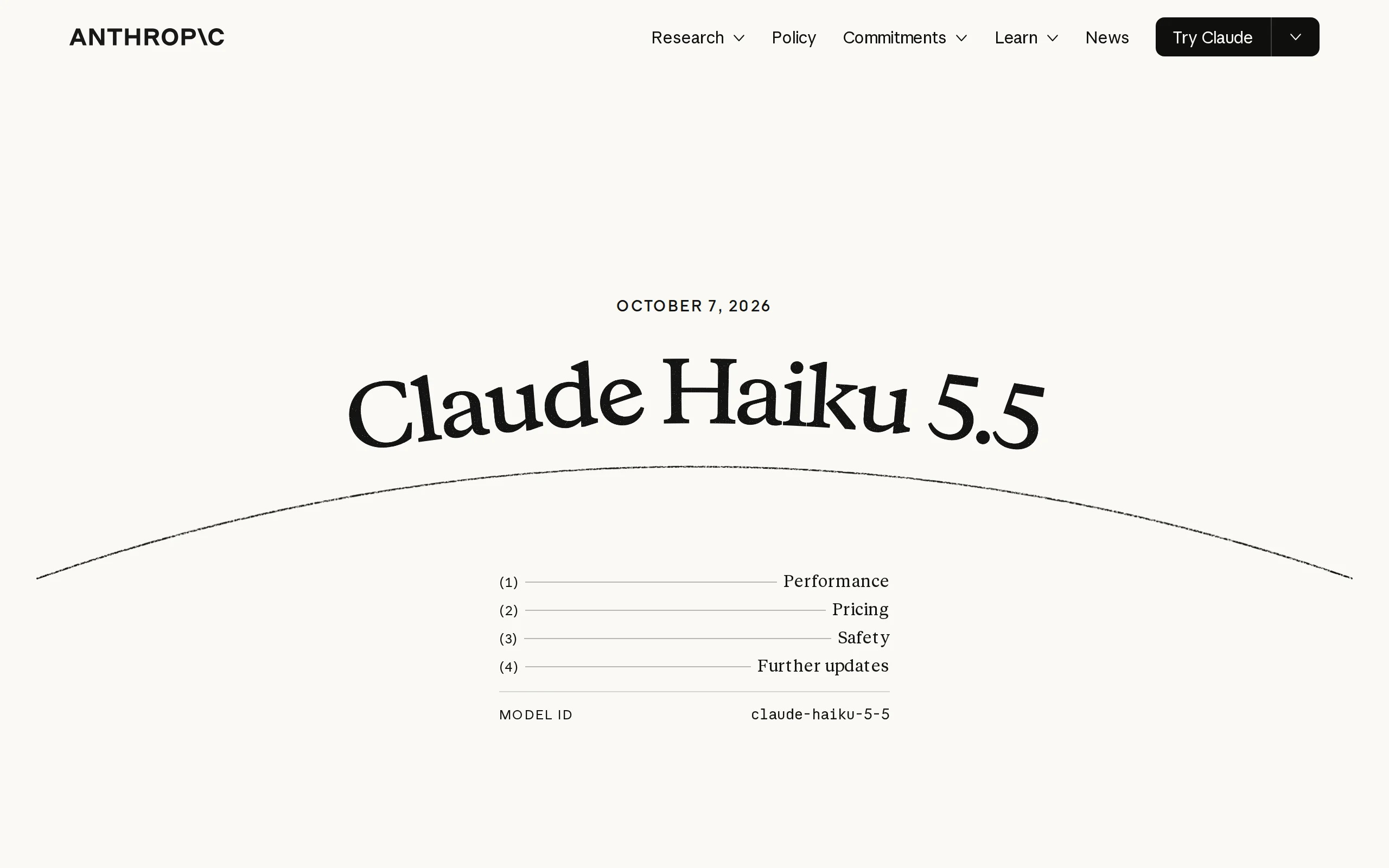
Claude Haiku 5.5 – Anthropic's Most Lightweight Model
Claude Haiku 5.5 is the latest small language model officially released by Anthropic on October 7, 2026. It is positioned as a high-value product with the tagline "cheapest, fastest, and most capable....
Ling-3.1-flash – A New Generation Large Model Launched by the Bailing Team at Ant Group
Ling-3.1-flash is a new generation large language model launched by the Bailing team at Ant Group. It employs a hybrid linear Attention architecture and MoE sparse activation technology, with a total ...
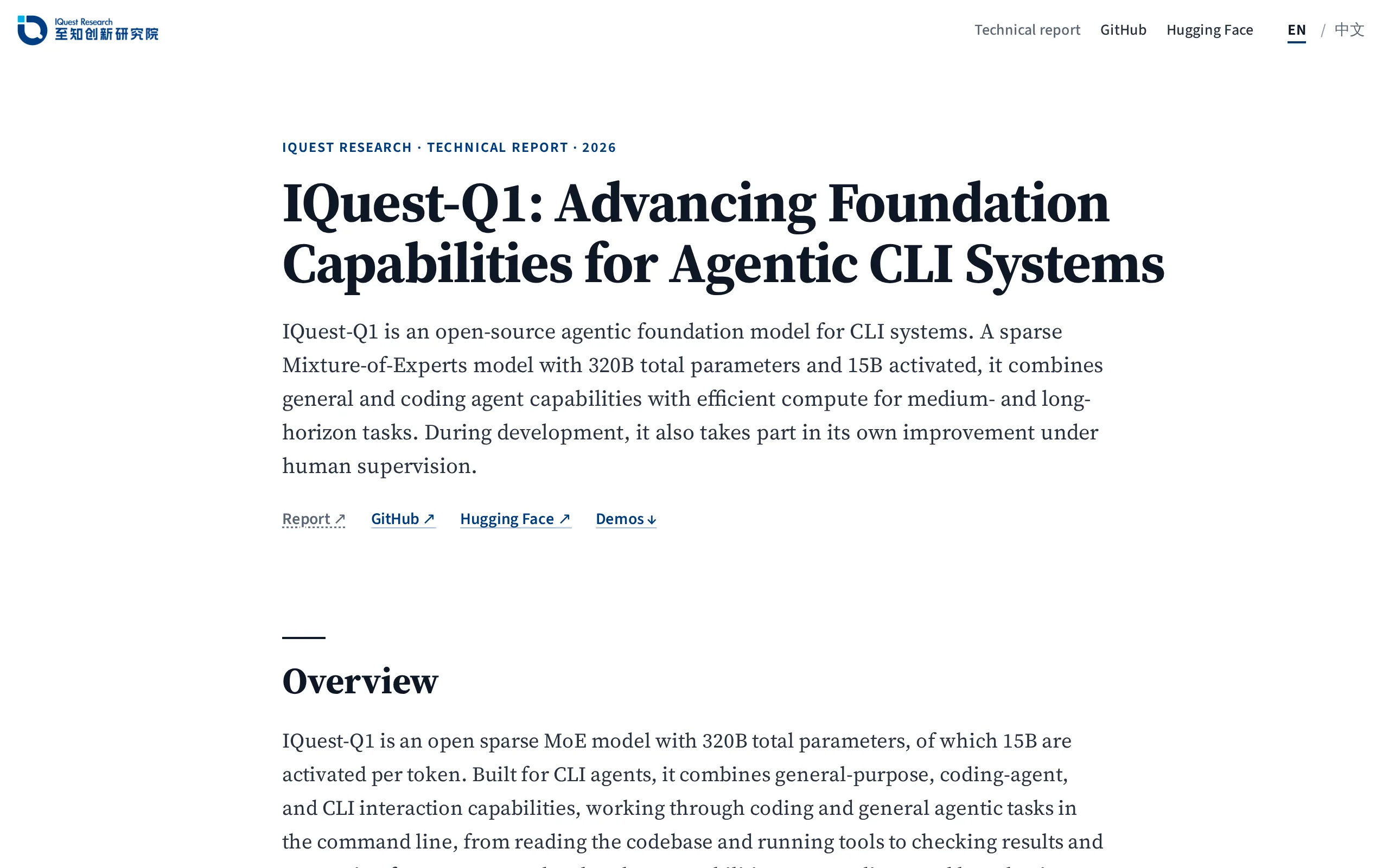
IQuest-Q1 Review: A 320B Sparse MoE Open-Source Agent Foundation Model Specializing in Code and Long-Horizon Agent Tasks
IQuest-Q1 is an open-source Agent foundation model developed by IQuestLab, with a core focus on code generation and Agent task execution. The model employs a sparse MoE architecture, featuring a total...
© All Rights Reserved. Some content on this site is partially generated by AI with human review.