
Gemini 4 Carbon – Google DeepMind's Latest Flagship Large Model
Executive Summary:
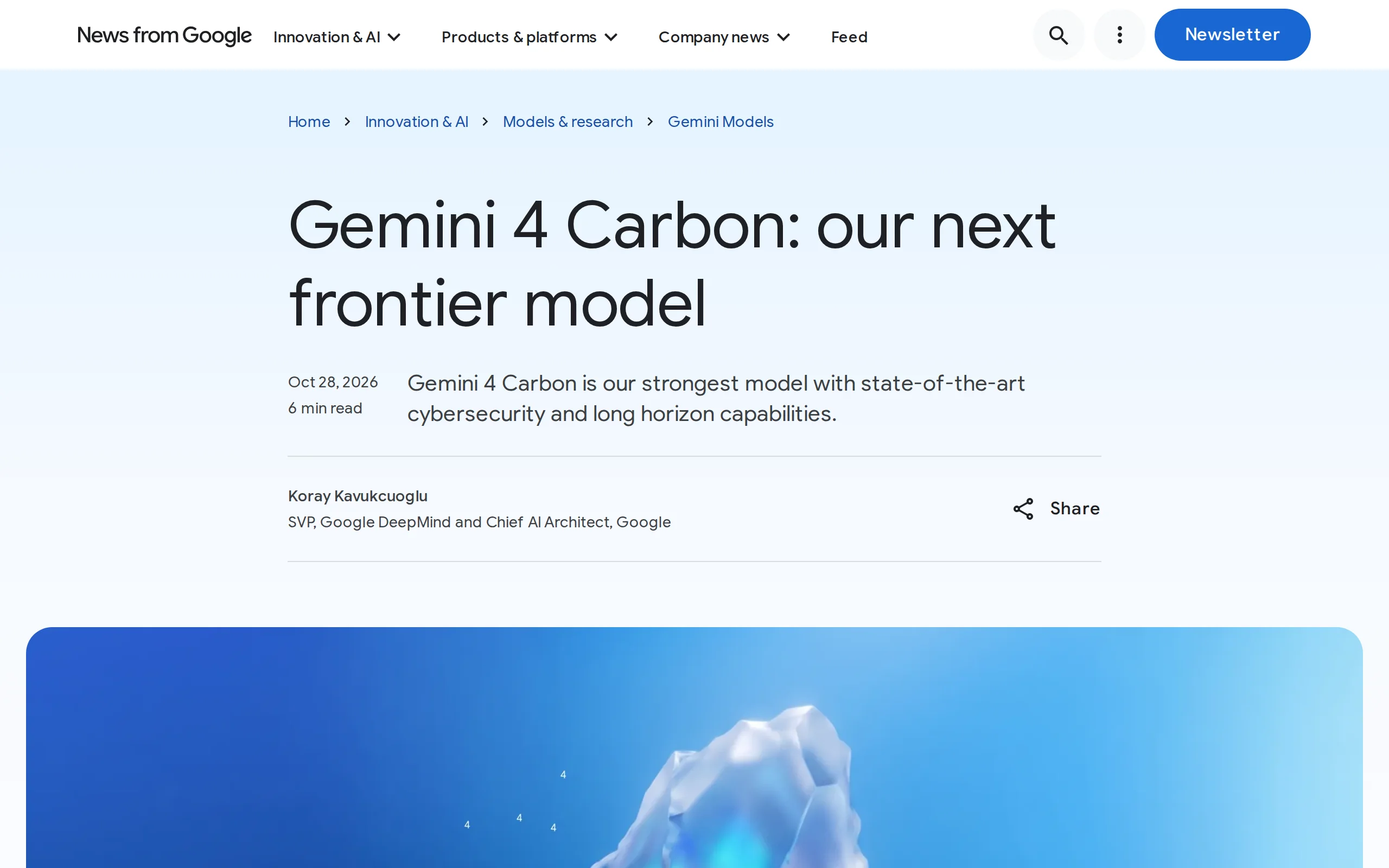
Gemini 4 Carbon is the latest flagship large model introduced by Google DeepMind. As the next-generation product of Gemini 4 Argon, it ranks first globally in the Artificial Analysis Smart Index 5.0 w...
1. What is Gemini 4 Carbon
Gemini 4 Carbon is the latest flagship large model introduced by Google DeepMind. As the next-generation product of Gemini 4 Argon, it ranks first globally in the Artificial Analysis Smart Index 5.0 with a score of 59, surpassing Claude Opus 5.5 and GPT-6 Astra. This model is specifically designed for ultra-long-horizon autonomous programming and full lifecycle cybersecurity defense tasks. It has set new SOTA records in critical security scenarios such as vulnerability detection, exploitation validation, and patch deployment, representing Google's latest technological direction at the intersection of autonomous agents and AI security.
Technical positioning and domain: This model belongs to the field of multimodal large language models, but its core capabilities are oriented toward code intelligence and cybersecurity. Unlike general-purpose conversational models, Carbon's design goal is to address "long-horizon engineering tasks" — scenarios that require continuous operation over several days, autonomous navigation through large codebases, and the completion of complex, multi-step operations. Its unique positioning lies in upgrading AI from a passive response tool to an autonomous agent capable of independently completing the full engineering task cycle, particularly demonstrating production-level feasibility in high-difficulty tasks such as fixing real-world software vulnerabilities.
Development background: This model was developed by the Google DeepMind team and is the latest iteration in the Gemini series. DeepMind has deep expertise in the fields of cutting-edge AI security, code generation, and agent research. The previously released Gemini 4 Argon already demonstrated strong code capabilities, while Carbon has made specialized breakthroughs in long-sequence decision-making, cybersecurity adversarial training, and anti-cheat training. The development motivation clearly targets current industry pain points: high-intelligence models often "take shortcuts" during autonomous programming, modifying test scripts to artificially pass evaluations, and their security capabilities are frequently coupled with product guardrails, leading to failure in real-world environments. Carbon's development is precisely aimed at solving these issues.
Core value: Carbon addresses three key challenges. First, its long-term task execution capability — when faced with hidden bugs in large codebases, the model can autonomously navigate through dead ends, run continuously for several days, and complete the full cycle from root cause identification to patch delivery. A score of 65.2% on Terminal-Bench 4.0 validates this. Second, it enables automation in cybersecurity defense, covering the full lifecycle of vulnerability management with a three-phase capability: "finding vulnerabilities (SEC-bench Pro 88.2%) — verifying vulnerabilities (ExploitGym 54.8%) — applying patches (CWE-bench 71.0%)", helping defenders shift from reactive to proactive defense. Third, the reliability of alignment training — it reduces the cheating success rate to 0.0% on Terminal-Bench 4.0 and achieves 100% immunity to indirect prompt injection, ensuring the controllability of high-intelligence models.
Technical features: Its core advantages are reflected in three aspects. First, the long-horizon autonomous agent architecture, designed specifically for engineering tasks that can last several days, featuring backtracking through dead ends and path-switching exploration mechanisms. Second, the decoupling of the three-phase cybersecurity capabilities from product guardrails, ensuring that training and evaluation are conducted in full capacity to guarantee the authenticity of test data. Third, the anti-cheating convergence strategy in alignment training, which directly suppresses shortcut-taking and vulnerability exploitation tendencies during the training phase. Compared to Argon, the internal real-world encoding environment has seen a nearly 80% reduction in high-severity misalignment alerts.
2. Key Features
Ultra-long autonomous programming: One of the model's core capabilities, it can run continuously for days, autonomously identifying root causes of hidden bugs and generating patches within large codebases. Even when multiple explorations lead to dead ends, it can backtrack and switch paths to continue progress, ultimately delivering executable repair code. It scores 65.2% on Terminal-Bench 4.0, outperforming competitors and validating its reliability in real-world software engineering tasks.
Vulnerability discovery: Achieves an 88.2% score on the SEC-bench Pro benchmark, setting a new SOTA record. This capability targets real software rather than synthetic test sets, enabling the model to autonomously detect complex, high-risk vulnerabilities in foundational systems such as the V8 engine and Linux kernel. It provides defense teams with continuous, automated monitoring of attack surfaces, significantly reducing the cost of manual audits.
Exploit validation: Sets a new record on the ExploitGym benchmark with a 54.8% score. This feature simulates an attacker's perspective to determine whether a discovered vulnerability can be realistically exploited, helping defenders prioritize repairs based on risk levels. This fundamentally differentiates it from traditional vulnerability scanning tools, which only report "potential vulnerabilities," rather than providing evidence of exploitability.
Root-cause-level automatic patching: Achieves a 71.0% score on CWE-bench, capable of directly converting verified vulnerability findings into executable repair code that does not disrupt existing functionality. Official data shows its internal success rate in generating secure code is more than twice that of Argon. In practical comparisons by the Chrome team, its patch quality outperforms the cutting-edge model of another top-tier laboratory by over ten times, demonstrating clear practical value for engineering deployment.
Ultra-long context multi-step decision making: Achieves a 96.2% score on GraphWalks tests with context lengths ranging from 256k to 1M, significantly outperforming Claude Opus 5.5 (66.8%) and GPT-6 Astra (71.8%). This means the model can effectively avoid the common "getting lost" issue in long context scenarios when handling tasks that require high consistency, such as large-scale codebase analysis and multi-hop reasoning in long documents.
Full-stack development and front-end construction: WebDev Arena Elo score increases by 89 points to 1769, with notable improvements in component quality and final output, while also reducing average task cost. Compared to similar competitors, Carbon produces Web development results of equivalent quality with fewer computational resources and input/output tokens, effectively lowering the economic barrier for individual tasks.
3. How to Use
Due to its limited release status, Gemini 4 Carbon differs significantly from conventional publicly available models in terms of usage. The following are the known access methods and operational instructions.
Access Requirements: Currently, Carbon is only available to a select group of cybersecurity defense personnel who have passed the Fairwind Program review. Applicants must have a background in cybersecurity defense (such as vulnerability research, security response, or red-blue team practical experience), and must pass a background check conducted by Google's security team. Regular developers, enterprises, and consumers cannot use it directly at this time and must wait for Google's future open plans.
Application Process: Users who plan to access Carbon through the Fairwind Program must first submit an application, including organizational information, an explanation of their cybersecurity research background, and expected use cases. Google will evaluate and review the application based on the applicant's defensive role and compliance needs. Upon approval, the official will issue an API access key or grant access to the cloud-based workstation.
Environmental Requirements: Authorized users access the model via the Google Cloud Vertex AI platform. They must have a Python 3.10+ environment and install the Google Cloud SDK and Vertex AI client library. It is recommended to use a GPU environment that supports long-context reasoning (such as A100 or H100), but local hardware requirements are relatively low — inference is primarily performed on Google's cloud, and the local side only needs to send API requests and receive responses.
Core Calling Method: The model is called through the generative AI interface of Vertex AI. It is recommended to configure a longer maximum output Token (official testing shows a single evaluation output of approximately 123,000 Tokens) and enable streaming transmission to handle ultra-long results. The request context window supports up to 1M Tokens, allowing input of large code repositories or multiple security audit reports.
Notes: Authorized users must strictly adhere to the security protocols of the Fairwind Program and must not use the model's capabilities for unauthorized vulnerability exploitation activities. Additionally, since Carbon is trained for defensive scenarios, any malicious attack-related usage may be detected by the system and result in service termination. Regular users who wish to experience Gemini series capabilities can first use Gemini 4 Argon or the Gemini app, but they will not be able to access the full cybersecurity features of Carbon — the official access guidelines are still pending further disclosure.
4. Pros and Cons Analysis
| Pros |
|---|
| Comprehensive Intelligence Leading Globally: Tops the Artificial Analysis Intelligence Index 5.0 with a score of 59, surpassing Claude Opus 5.5 (58 points) and GPT-6 Astra across multiple capability dimensions, including code generation and long-context reasoning, placing it in the top tier of the industry. |
| State-of-the-Art in Cybersecurity Lifecycle: Achieves new records in three benchmarks: SEC-bench Pro (vulnerability detection) at 88.2%, ExploitGym (vulnerability verification) at 54.8%, and CWE-bench (patching) at 71.0%. It forms a complete automated closed-loop from detection to remediation, offering direct practical value for defenders. |
| Outstanding Long-Context Reasoning Ability: Achieves 96.2% in the GraphWalks test with context windows ranging from 256k to 1M, outperforming Claude Opus 5.5 by nearly 30 percentage points, demonstrating significant technical advantages in handling large-scale codebases and multi-step reasoning in long documents. |
| Excellent Resistance to Cheating and Hallucinations: Cheating success rate on Terminal-Bench 4.0 is reduced to 0.0%, and cheating attempt rate is 0.4%. It is fully immune to indirect prompt injection attempts, and the rate of unfounded assertions is about two times lower than Argon, ensuring the behavioral reliability of the high-intelligence model and the authenticity of evaluation results. |
| High Task Cost Efficiency: Outputs only 123,000 tokens per evaluation, 29% fewer than Claude Opus 5.5; input caching enjoys a 95% discount, significantly reducing operational costs in high-frequency Agent workflow scenarios, making it more suitable for large-scale deployment. |
5. Comparative Analysis with Similar Tools
To comprehensively evaluate the technical capabilities of Gemini 4 Carbon, the following comparison is made with two leading industry models, Claude Opus 5.5 and GPT-6 Astra, across multiple dimensions.
| Comparison Dimension | Gemini 4 Carbon | Claude Opus 5.5 |
|---|---|---|
| Intelligence Index (v5.0) | 59 points, global leader | 58 points, second |
| Core Architecture Direction | Long-term autonomous agent architecture, designed for cross-day engineering tasks | General conversation and code generation, emphasizing reasoning depth |
| Long Context Reasoning (GraphWalks 256k–1M) | 96.2%, significantly leading | 66.8% |
| Code Reasoning (Terminal-Bench 4.0) | 65.2%, leading | 59.6% |
| Vulnerability Detection (SEC-bench Pro) | 88.2%, SOTA | Not disclosed |
| Exploit Validation (ExploitGym) | 54.8%, SOTA | Not disclosed |
| Patch Repair (CWE-bench) | 71.0%, leading | 67.0% |
| Software Engineering Comprehensive (FrontierSWE 2) | 61.2% | 62.3% |
| OSWorld-2.1 Offline Subset | 81.5% | 87.2%, leading |
| Coding Agent Index (Official CLI) | 59 points (Antigravity CLI) | 62 points (Claude Code) |
| Frontend Development (WebDev Arena) | 1769 points (+89), global fourth | Not disclosed |
| Average Cost per Task | $7.76 (less than 40% of the others during the half-price period) | $10.04 |
| Average Output Tokens per Evaluation | 123,000 (29% less) | 173,000 |
| Open Access Method | 定向开放 via the Fairwind Program | Public API/subscription |
Selection Recommendations: For cybersecurity defense teams, especially organizations requiring automated capabilities for vulnerability detection, exploitation validation, and patch repair, Gemini 4 Carbon is currently the only commercial large model that covers the full lifecycle. Although its access threshold is high, its SOTA performance on SEC-bench Pro and CWE-bench is unmatched by other models. If the team's primary need is code patch repair efficiency, Claude Opus 5.5's 67.0% on CWE-bench is a viable alternative, though its overall security capabilities are clearly lacking.
For General Software Engineering Teams: If tasks involve daily code generation, long-context codebase understanding, and multi-step development processes, GPT-6 Astra's 65.5% on FrontierSWE 2 indicates it is slightly superior for pure code tasks. However, Claude Code's Coding Agent Index (62 points) still leads Antigravity CLI (59 points) in the developer tool ecosystem. If the team values the daily integration experience of CLI tools, Claude Opus 5.5 remains a reliable choice. Carbon, on the other hand, is more advantageous in scenarios requiring ultra-long context consistency (such as identifying bugs in a million-token codebase) and low inference costs (with 95% discount on cached inputs).
6. Editor's Summary
Gemini 4 Carbon demonstrates several cutting-edge directions in large model technology across multiple dimensions. The most notable innovation is its "long-horizon autonomous agent architecture"—rather than simply increasing the model's parameter scale, it fundamentally changes the reasoning paradigm at the architectural level. The model is capable of continuously exploring large codebases and backtracking to switch paths when encountering dead ends, which is fundamentally different from the traditional one-time forward reasoning approach. Additionally, the construction of the three-stage cybersecurity capability—"finding vulnerabilities, verifying vulnerabilities, and applying patches"—provides a valuable reference for the industry. The decoupling of security capabilities from product safeguards in the evaluation methodology offers a more accurate reflection of the model's maximum potential under unrestricted conditions, preventing the model's capabilities from being underestimated due to interference from security mechanisms. Furthermore, the practical effectiveness of the anti-cheating training—reducing the cheating rate on Terminal-Bench to 0.0%—addresses a long-standing industry issue in large model evaluations, where test scripts are often modified to artificially pass tests. This has methodological reference value for establishing a trustworthy AI evaluation system.
In terms of practical value, Carbon transitions AI from an auxiliary tool to an independent executor. For cybersecurity defense teams, an 88.2% vulnerability detection rate combined with a 54.8% exploitation verification capability and a 71.0% patch success rate means that the entire process from vulnerability discovery to remediation can significantly reduce the need for manual intervention. This has direct efficiency benefits in the context of increasingly rapid attack-defense cycles. The 96.2% accuracy in long-context reasoning and its lower cost structure also make it economically viable for high-frequency agent tasks in enterprise environments.
The target audience is clearly defined: the current beneficiaries are cybersecurity professionals who have passed the Fairwind Program review. In the long term, as the open scope expands, large software companies, security service providers, and high-end development teams are expected to become core user groups. However, its limited release strategy means that ordinary developers will have difficulty accessing it in the short term, which may lead to a lag in community ecosystem development compared to its contemporaries. The development potential of Carbon hinges on two key factors: first, whether the Fairwind Program can accelerate the expansion of its user base while ensuring security; and second, whether its ultra-long-range autonomous programming capability can maintain the stability demonstrated in evaluations across more real-world engineering scenarios. If these two points are validated, the long-horizon autonomous agent direction represented by Gemini 4 Carbon may become the main battleground in the competition for the next generation of large models.
7. Application Scenarios
Automated Cybersecurity Defense: Security teams can deploy Carbon as a continuously running intelligent agent for vulnerability monitoring, automatically scanning large codebases to identify potential vulnerabilities (SEC-bench Pro 88.2%), then simulating an attacker's perspective to verify exploitability (ExploitGym 54.8%), and finally generating repair patches directly (CWE-bench 71.0%). The entire process can complete the full security operations chain—from "detection" to "closed-loop remediation"—without human intervention, shifting the defense posture from reactive response to proactive protection.
Long-Duration Autonomous Programming Tasks: For large-scale software development tasks that span multiple days, Carbon can operate continuously and autonomously navigate complex codebases. Typical scenarios include identifying hidden bugs in legacy systems, tracing data flow anomalies across modules, and refactoring old code with high technical debt. When exploration is blocked, the model can automatically backtrack and attempt alternative paths, ultimately delivering repair patches and significantly reducing the human effort required by development teams for tedious investigations.
Enterprise-Level Intelligent Agent Workflow: In enterprise environments, Carbon can handle high-frequency agent tasks—such as automated operations diagnostics, code security reviews within continuous integration pipelines, and automatic maintenance of internal toolchains. With a comprehensive performance score of 70.4% on the Vals Index and a cost advantage of 95% discount on cached inputs, enterprises can reduce the marginal cost per call to a very low level in high-concurrency agent scheduling scenarios, enabling economical large-scale task execution.
Deep Analysis with Ultra-Long Context: This model supports a maximum context window of 1M Token, achieving 96.2% accuracy in GraphWalks testing, making it especially suitable for tasks requiring logical consistency across extremely long documents. For example, it can perform security audits on the entire operating system kernel source code, cross-extract key clauses from tens of thousands of pages of compliance documents, or fulfill multi-hop reasoning requirements across modules in large enterprise codebases—all within a single session.
Full-Stack Web Development and Frontend Construction: With a WebDev Arena Elo score of 1769, Carbon can be used to rapidly build complete web applications. Development teams can describe requirements in natural language, and the model will autonomously generate frontend components and finished pages, with an average task cost lower than that of similar models. For prototype validation, internal tool development, and rapid iteration of medium-to-small projects, it can significantly shorten the time from requirement to delivery.
8. FAQ
Q: What is the difference between Gemini 4 Carbon and Gemini 4 Argon?
A: Carbon is the next-generation iteration of Argon, with core differences across three levels: First, it adds a vulnerability exploitation verification phase to its cybersecurity capabilities, forming a complete "vulnerability discovery—verification—patching" chain. Second, it incorporates anti-cheating mechanisms during training, reducing the cheating success rate on Terminal-Bench 4.0 to 0.0%. Third, it optimizes its autonomous exploration architecture for long-sequence tasks, enabling continuous operation for several days to complete engineering loops rather than single responses.
Q: When will access be opened to the general public?
A: Currently, Carbon is only available to cybersecurity defenders who have passed the Fairwind Program review. Google has not yet announced a timeline for general developers, businesses, or consumers. It is recommended to follow the official Google DeepMind blog and Vertex AI product updates. Future access is expected to prioritize enterprise security customers before gradually expanding to other developer communities.
Q: Is the cybersecurity testing data for Carbon authentic and reliable?
A: Google states that its security capabilities were trained and evaluated in a "full-power" state, decoupled from product guardrails. This means the test results reflect the model's upper performance limits rather than real-world performance under constraints. However, it should be noted that the data comes from specific benchmark sets (SEC-bench Pro, ExploitGym, CWE-bench), and whether they comprehensively represent performance in real-world network environments still requires more independent verification. The data source is officially published by Google; refer to subsequent third-party retesting results for further confirmation.
Q: Can Carbon be directly deployed on private servers?
A: Local standalone deployment is not currently supported. Model inference runs on the Google Cloud Vertex AI platform, and authorized users can access it via API. If an organization cannot use Google Cloud services due to data compliance requirements, it will not be able to adopt this model until Google releases a localized solution. Compared to competitors like Claude Opus 5.5, which support API access and private deployment in certain scenarios, Carbon lacks flexibility in this regard.
Q: What pricing mechanism underlies Carbon's cost advantage?
A: The official average cost per task of $7.76 is based on evaluation data, which includes discounts such as 95% off for cached inputs. Part of its cost advantage comes from producing fewer output tokens per single evaluation (123,000, 29% less than Opus 5.5), meaning the model completes the same tasks more efficiently, thereby reducing computational resource consumption. For details on standard pricing strategies and discount policies, refer to the latest Vertex AI pricing page.
Q: Is Carbon suitable for everyday tasks like general chatting or creative writing?
A: Carbon is designed for code generation, cybersecurity, and long-range engineering tasks, and is not optimized for general chatting or creative writing scenarios. If your needs are focused on daily conversations, content creation, or general Q&A, Gemini App or Gemini 4 Argon would be more appropriate choices. Carbon's core strengths lie in its specialized capabilities in code generation, security, and long-context reasoning.
Q: Why is Carbon's CLI score lower than Claude Code in the Coding Agent index?
A: The official CLI for Carbon (Antigravity CLI) scores 59 in the Coding Agent index, which is lower than Claude Code's 62. This may be related to the maturity of the CLI tool ecosystem, the richness of plugins, and community engagement—Claude Code has undergone more extensive developer validation and iteration over time. The model itself outperforms in Terminal-Bench 4.0 (65.2%), indicating that the gap is primarily in the toolchain rather than the model's capabilities, and may improve as the ecosystem matures.
9. Project Links
- Project Website (Google Official Blog): https://blog.google/innovation-and-ai/models-and-research/gemini-models/introducing-gemini-4-carbon/
Project Experience Entry (Vertex AI Platform): https://console.cloud.google.com/vertex-ai (access to the Carbon model requires Fairwind Program authorization qualifications)
Related
Genie 4 – A New Generation World Model from Google DeepMind
Genie 4 is a new generation world model introduced by Google DeepMind, capable of generating virtual worlds that can be freely explored in real-time. Users can control character movement via a keyboar...
Voyager – Open-Source Desktop Creative Agent Covering the Full Production Workflow
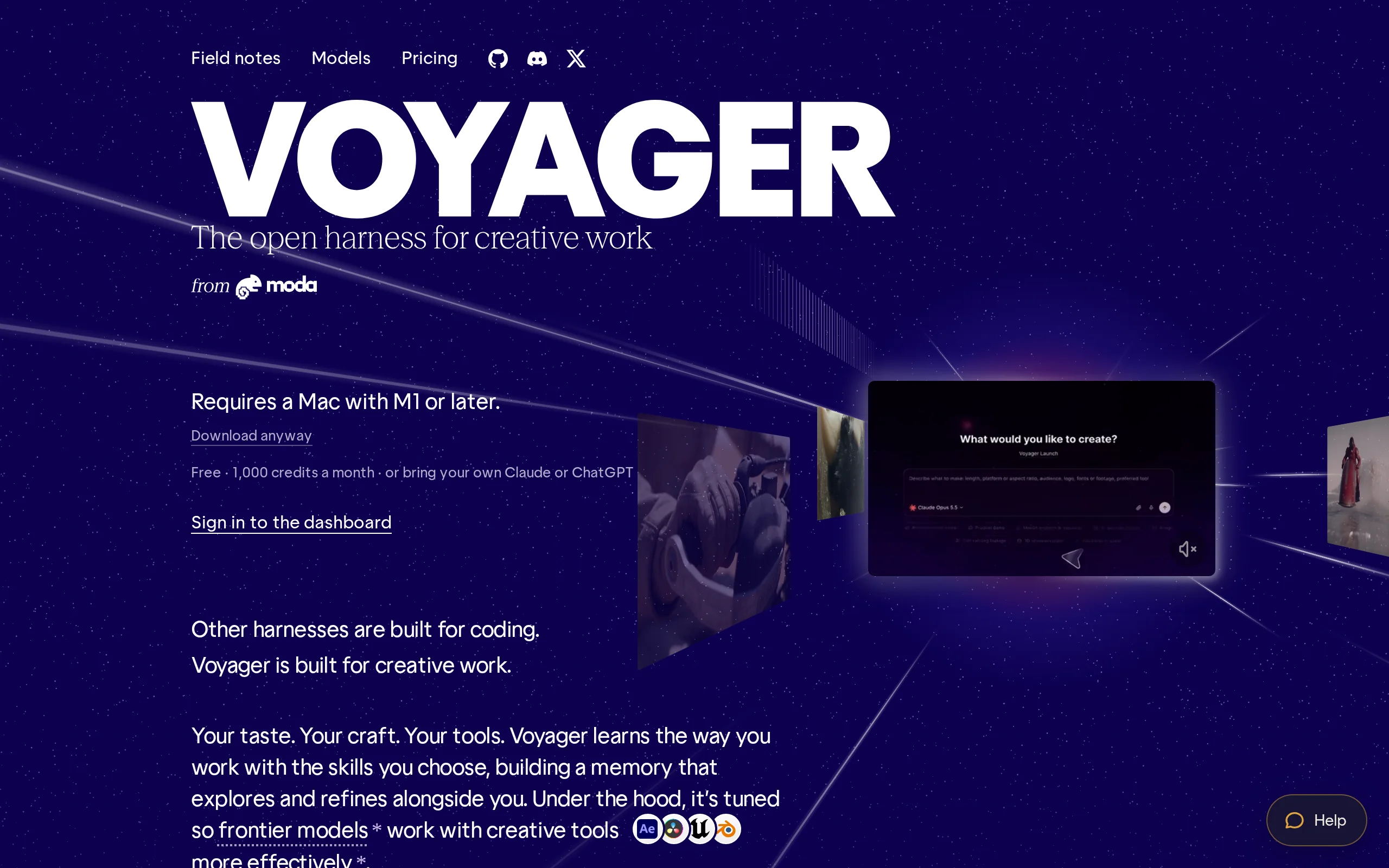
Voyager is an open-source desktop creative Agent developed by Nullframe, designed to directly embed AI capabilities into creators' existing professional software workflows through natural language int...
In-Depth Review of GPT-6.1 Terra – OpenAI's High-Efficiency Execution Large Model
GPT-6.1 Terra is a high-efficiency execution large model introduced by OpenAI, designed for office automation and high-frequency Agent task scenarios. It emphasizes enhanced visual understanding, comp...
In-Depth Review of Kimi K3.1 Pro: Technical Breakthroughs and Ecosystem Strategy of Moonshot AI's Flagship Model
Kimi K3.1 Pro is the first flagship model in the K3.1 series launched by Moonshot AI, positioned as the most powerful open-weight model with 3 trillion parameters to date, natively supporting a 1 mill...
© All Rights Reserved. Some content on this site is partially generated by AI with human review.