
Genie 4 – A New Generation World Model from Google DeepMind
Executive Summary:
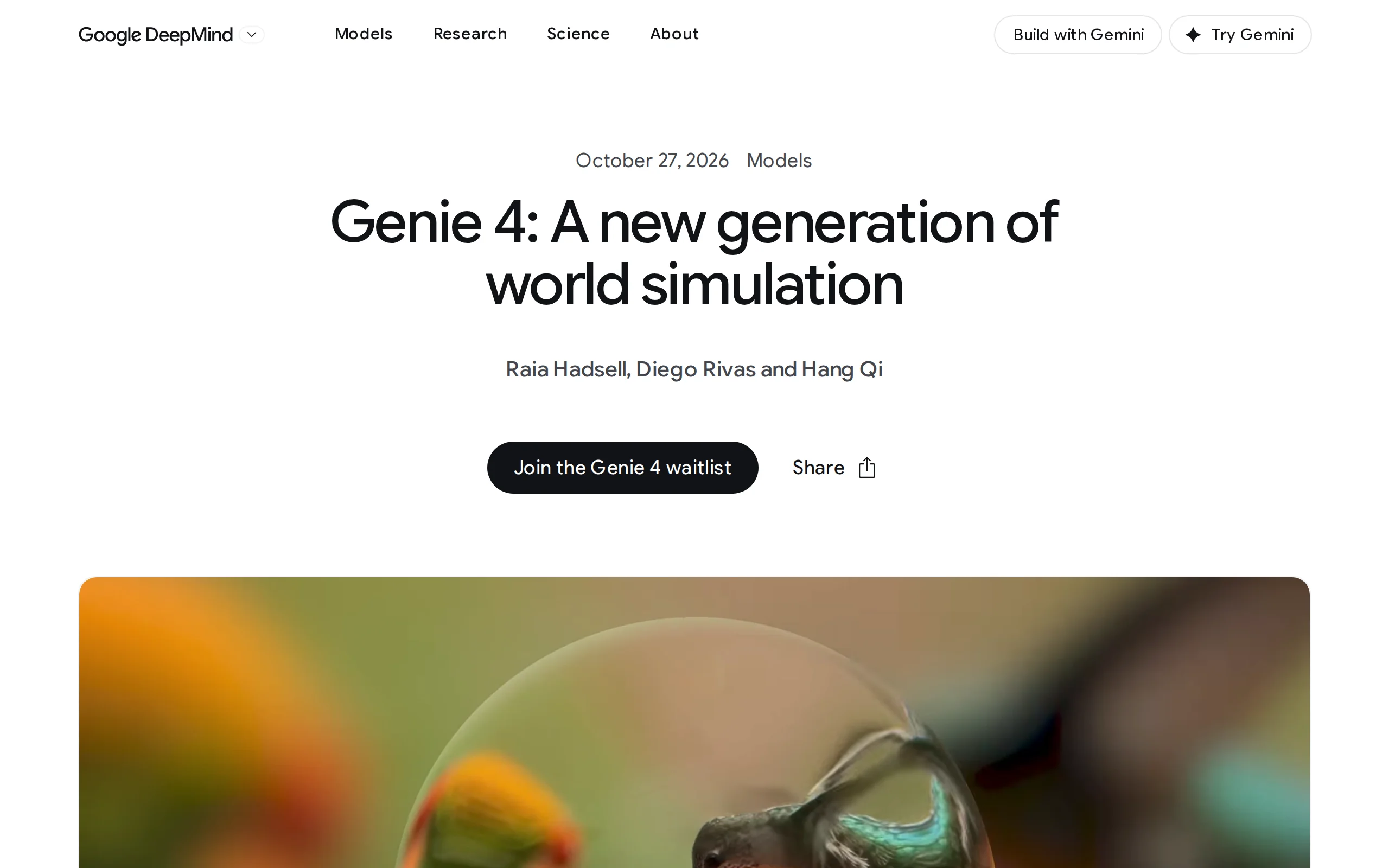
Genie 4 is a new generation world model introduced by Google DeepMind, capable of generating virtual worlds that can be freely explored in real-time. Users can control character movement via a keyboar...
1. What is Genie 4
Genie 4 is a new generation world model introduced by Google DeepMind, capable of generating virtual worlds that can be freely explored in real-time. Users can control character movement via a keyboard, modify weather conditions, add characters or objects, and interact with virtual characters through text prompts. This model is the first to support native audio and interactive dialogue capabilities, integrating multiple technologies from the Gemini family—Gemini handles reasoning and planning, while Genie is responsible for environment rendering, forming a complete agent loop. Genie 4 can be applied in areas such as robot training, film previsualization, game prototype validation, and industrial simulation. The current simulation duration is approximately 2 minutes, and it has been made available to trusted testers through a research preview.
Technical positioning and domain: Genie 4 belongs to the cutting-edge intersection of world models (World Model) and computer vision, focusing on real-time interactive virtual environment generation. It directly transforms text prompts into explorable and modifiable 3D simulation scenes, breaking through the limitations of traditional video generation models that are "only viewable, not interactive."
Development background: Developed primarily by the Google DeepMind team, Genie 4 continues the research trajectory of the Genie series, which learns world dynamics from video. It deeply integrates technical capabilities from Gemini Omni, Gemini 3.8 Flash, and Gemini 4 Argon, representing an important technological layout for DeepMind in the areas of general world simulation and embodied intelligence.
Core value: Genie 4 addresses the core pain points of traditional AI video generation, which lacks interactivity and controllability, upgrading static content generation to an open, real-time responsive simulation environment. Each user action becomes a variable that influences the evolution of the world, providing a new experimental platform for agent research, robot training, and creative prototyping.
Technical features: Based on an implicit pixel-level world simulation architecture, it supports real-time text guidance and synchronized native audio generation. It leverages the reasoning and verification capabilities of the Gemini agent to maintain causal coherence in long-term simulations, showing significant improvements in visual realism, physical simulation accuracy, and interaction freedom compared to previous generations.
2. Key Features
Real-time Generation of Explorable Worlds: With a text description input from the user, Genie 4 can instantly generate a virtual environment that can be freely explored, without the need to pre-build 3D scenes or write complex logic, significantly lowering the technical barriers to creating virtual worlds. It is ideal for rapid prototyping and creative exploration.
Real-time Keyboard and Text Control: Use a standard keyboard to control character movement and camera perspective. During runtime, you can input prompts at any time to modify weather, add characters, or change scene elements. The Gemini agent automatically integrates the current scene state to understand user intent, delivering a truly dynamic interactive experience.
Native Audio Generation: Genie 4 is the first to support synchronized generation of ambient sounds, background music, and character dialogues with world simulation. Audio and visual scenes are aligned in real-time, making it the first native multimodal model in the Genie series and greatly enhancing the immersion and realism of the simulation.
Interactive Character Dialogue: Virtual characters can generate spoken responses and actions in real-time based on user input and world events, breaking free from the limitations of traditional games that rely on pre-set dialogues and behavior trees. NPC responses are more flexible and context-aware, opening up new possibilities for interactive storytelling.
Realistic Physics Simulation: Built-in capabilities to simulate physical laws such as collision detection, aerodynamics, and gravity ensure natural and fluid character movements, which can be guided by real-time user commands. This makes the generated scenes more closely aligned with the operational rules of the real world at a physical level.
Gemini 3.8 Flash Agent Closed-loop: As a real-time guiding agent, Gemini 3.8 Flash continuously observes the generated visuals, breaks down tasks into specific steps, and verifies the execution results frame by frame. When user intervention or environmental changes occur, it adjusts the planning strategy instantly, ensuring causal coherence in long-term simulations.
Gemini 4 Argon Task Decomposition: In research experiments, Gemini 4 Argon decomposes user instructions into continuous text captions, which are injected in real-time into Genie 4 to drive the rendering process. This enables the simulation to dynamically adapt as tasks progress, laying the technical foundation for scenarios such as complex task training for robots.
Cross-industry Prototyping Tool: Supports a variety of "from zero to one" scene generation needs, including film previsualization, game concept validation, historical scene reconstruction, and enterprise industrial simulation. It can serve as a creative verification and solution demonstration tool across multiple industries.
3. How to Use
Environment Requirements and Prerequisites: Genie 4 is currently primarily accessed through the Project Genie web interface. It is recommended to use modern browsers such as Chrome or Edge, and a stable internet connection is required. For developers to call the API, access permissions to the Gemini API are necessary; specific hardware requirements have not yet been disclosed.
Join the Waiting List: Submit your application information on the official Project Genie website to join the testing waiting list for Genie 4. Currently, Genie 4 is in the research preview phase and is gradually made available only to trusted testers.
Wait for Access Approval: After submitting your application, you must wait for review and scheduling by the Google DeepMind team. Once access is granted, the official team will send you usage instructions via email or account notification.
Access the Project Genie Creation Interface: After obtaining access, enter the Genie 4 creation interface through the Project Genie portal. The interface provides input areas for environment prompts and character prompts.
Input Prompts to Generate the World: Use a text description to define the target scene. You can simultaneously provide environment prompts (describing the overall appearance of the scene) and character prompts (describing the perspective and position of the character). Genie 4 will generate an explorable virtual world in real time based on the description.
Keyboard and Camera Control: Once inside the generated world, use a standard keyboard to control character movement and camera perspective. You can freely roam and explore the world, observing its details and dynamic changes.
Modify the Scene with Real-Time Instructions: During the simulation run, directly input new text prompts to modify the weather, add characters or objects. The Gemini agent will automatically understand and execute the modification instructions based on the current scene state.
Interact and Dialogue with Characters: Initiate direct conversations with virtual characters. The characters will generate real-time responses based on the current context, with voice synthesized natively by the model, eliminating the need to call external voice systems.
Advanced Usage for Developers: Testers can invoke Genie 4 via the Gemini API or AI Studio, integrating it into workflows such as game prototype development, film pre-visualization, or robot simulation, to build custom application solutions.
4. Pros and Cons Analysis
| Pros |
|---|
| Outstanding real-time interactive capabilities: Users can control the virtual world in real-time through keyboard and text input, with each action triggering dynamic evolution of the scene. This breaks the traditional AI video's "non-interactive" limitations, offering significantly higher interaction freedom compared to similar products. |
| Native multimodal integration: For the first time, visuals and audio are generated synchronously. Environmental sounds, background music, and character dialogue are aligned in real-time with the visual scene, eliminating the need for external TTS or audio engines, and substantially enhancing immersion and realism. |
| Enhanced by Gemini agent reasoning: The large language model handles task planning and result verification, while Genie is responsible for rendering visuals. Their collaboration ensures the simulation has reliable causal logic and multi-step reasoning capabilities, surpassing the coherence and logic of pure generative models. |
| High physical simulation accuracy: Real-time simulation of physical laws such as collision, gravity, and aerodynamics is supported. Character movements are natural and fluid, and can be guided in real-time by user instructions, closely resembling real-world physics behavior. |
| Novel intelligent NPC dialogue mechanism: Virtual characters can dynamically generate speech and actions based on environmental changes and user input, breaking away from the limitations of pre-set dialogue in traditional games, and providing a better experimental platform for interactive storytelling and agent research. |
5. Comparative Analysis with Similar Tools
| Comparison Dimension | Google Genie 4 | World Labs Marble | NVIDIA Cosmos |
|---|---|---|---|
| Technical Approach | Real-time generation route, pixel stream frame-by-frame prediction, user interaction drives continuous world evolution | Persistent 3D route, generates complete 3D scenes in one go, scenes remain constant when the camera moves | Pre-trained world foundation model, trained for physical AI, supports video prediction and generation |
| Underlying Representation | Implicit pixel-level world simulation, no explicit geometric structure | 3D Gaussian splatting (appearance) and low-polygon collision mesh (geometry), can integrate with physics engines | Latent space video prediction model, supports multi-modal input and controllable generation |
| Interactive Capabilities | Strong: keyboard control, real-time text rewriting, intelligent NPC dialogue, the world continuously responds to operations | Weak: mainly camera roaming and area editing, no dynamic characters or real-time event response | Moderate: supports text-conditioned generation and controllable actions, but not real-time interactive exploration |
| Consistency Performance | Weakness: object constancy begins to drift after about 2 minutes of simulation | Strength: objects are permanently present, object states remain stable after view switching | Strong: maintains relatively consistent scene structure across multiple frames |
| Audio Capabilities | Native generation of ambient sounds, music, and character dialogue, with real-time audio-visual synchronization | No audio generation support | No native audio generation support |
| Input Methods | Text prompts and reference image first frame | Text, single image, multiple images, 360° panorama, video, 3D structure layout (Chisel), most comprehensive coverage | Text, images, video clips, supports action-conditioned input |
| Editing Capabilities | Real-time prompt editing, no post-hoc modification capability | Native integration of AI editing tools, supports local repainting, material swapping, world expansion, and multi-world stitching | Supports controllable generation parameter adjustment, no built-in editing tools |
| Export Capabilities | No export, the world exists only within the session | Can export Gaussian splatting, mesh (compatible with Unreal/Unity/Blender), panoramas, and videos | Supports exporting video frame sequences for downstream training |
| Applicable Scenarios | AI agent research, interactive experiences, robot strategy validation | Film pre-visualization, game level prototyping, architectural visualization, VR/AR content production | Physical AI training, autonomous driving simulation, robot strategy learning |
Selection Recommendations: For research projects requiring real-time interaction and dynamic character dialogue, such as AI agent development, interactive narrative validation, and robot strategy testing, Genie 4 offers an irreplaceable interactive simulation environment with its keyboard + text control, native audio, and intelligent NPC mechanisms. However, its simulation duration limitations and lack of export capabilities are major usage constraints, making it suitable for short-term task validation rather than long-term production workflows.
For workflows requiring persistent, exportable assets, such as film pre-visualization, game level prototyping, and 3D content creation, World Labs Marble's 3D Gaussian splatting solution is more appropriate. Its scene persistence and export capabilities can directly interface with mainstream engines like Unreal, Unity, and Blender. Meanwhile, NVIDIA Cosmos and Sora are each tailored for robot training data generation and high-quality video content creativity validation, respectively, with relatively limited interactive capabilities but differing focuses on generation quality and stability.
6. Editor's Summary
Genie 4 continues the core concept of the Genie series, which is "learning the dynamics of the world from video," and through deep collaboration with the Gemini family of models, it achieves a qualitative leap from "automatically generated videos" to "real-time interactive living worlds." Its highlight lies in unifying the reasoning and planning capabilities of large language models with pixel-level world rendering capabilities within the same system, enabling the simulation process to possess reliable causal logic and dynamic response capabilities. This design approach provides a valuable reference for the development of world models.
From a practical perspective, Genie 4 demonstrates promising application potential in areas such as film pre-visualization, game prototype validation, robot training, and news education. Particularly in robot training scenarios, the collaborative mechanism where Gemini is responsible for breaking down task steps and Genie handles environment simulation can generate a large number of interactive training scenarios at a relatively low cost, helping to reduce the time and financial investment required for real-world experiments. However, limitations such as the current simulation duration of approximately 2 minutes, the inability to export scene assets, and the restriction of research previews to only trusted testers keep Genie 4 in the laboratory validation stage, still some distance away from production-level applications.
The core audience for Genie 4 includes AI agent researchers, professionals in the gaming and film industries, robot algorithm engineers, and cross-industry teams requiring rapid visual prototype validation. Its long-term development potential depends on the ability to extend simulation duration, the completeness of asset export capabilities, and a significant expansion of access. As the world model technology roadmap continues to evolve, Genie 4's demonstrated capability of "immediately usable interactive worlds" is expected to become a crucial infrastructure for generative AI as it transitions from content creation to simulation and decision-making.
7. Application Scenarios
Pre-visualization (Pre-vis) in Film and Television: Directors and art teams use text to generate immersive virtual scenes, allowing real-time adjustments to camera angles, lighting atmosphere, character dialogue, and movement positioning. Multiple filming approaches can be quickly validated without the need to build physical sets, effectively shortening the pre-production phase and reducing trial-and-error costs.
Game Prototyping: Game developers can create explorable game environments within seconds using prompts, enabling them to test visual styles, material rendering, physical feedback, and basic interactive gameplay mechanics. This allows for rapid evaluation of creative ideas before full-scale development, minimizing the consumption of development resources on unfeasible concepts.
News and Historical Education: Photojournalists can convert two-dimensional historical photographs into dynamic, explorable scenes, allowing readers to "step into" historical sites. Educational institutions can simulate the development of events such as floods or wildfires, enhancing the immersive and emotional impact of teaching content, making abstract historical and scientific concepts more tangible and intuitive.
Robot Training Simulation: Humanoid robots and robotic arms can repeatedly practice complex tasks in a virtual environment. Gemini is responsible for breaking down tasks into executable steps, while Genie 4 generates realistic environmental feedback. This allows for the accumulation of extensive training experience at a reduced cost and risk, with the learned skills then being transferred to physical robots.
Industrial Simulation for Enterprises: Manufacturing and engineering companies can rapidly generate complex industrial scenarios from scratch, used for environmental testing, production process validation, and emergency response simulations. This reduces the time and material costs of conducting experiments in real factory environments and improves the efficiency of solution evaluations.
8. FAQ
Q: What is the core difference between Genie 4 and standard AI video generation models (such as Sora)?
A: Genie 4 features real-time interactive capabilities, allowing users to control the evolution of the virtual world through keyboard and text input. In contrast, standard AI video generation models produce fixed video clips that cannot be manipulated or dynamically modified in real time. Additionally, Genie 4 natively supports audio generation and NPC dialogue, significantly expanding the dimensions of the interactive experience.
Q: What is the duration of a single simulation in Genie 4?
A: According to officially released information, the current single simulation duration in Genie 4 is approximately 2 minutes. Beyond this duration, the constancy of objects in the scene (i.e., the ability of objects to maintain consistent appearance and state across multiple viewpoint switches) begins to drift, affecting the coherence of the simulation. This is also one of the main technical limitations of the current version.
Q: How can one gain access to Genie 4?
A: Currently, Genie 4 is only available to trusted testers for research preview. Regular users must visit the Project Genie website to submit an application and join the waiting list. Once access is granted, users can interact with Genie 4 through the Project Genie interface. Developers can also apply to use Genie 4 within the Gemini API or AI Studio environments.
Q: Can scenes generated by Genie 4 be exported or saved?
A: The current version does not support export functionality. The generated virtual world exists only within the session and cannot be exported into standard formats such as video, 3D mesh, or panorama. Users also cannot make post-hoc modifications; all adjustments must be made in real time during the simulation using prompt inputs.
Q: Does Genie 4 support multilingual input, such as Chinese?
A: The official documentation showcases examples using English prompts, and it has not yet clearly specified the range of multilingual support. Considering that the Gemini model itself has strong multilingual capabilities, it is theoretically possible for it to understand Chinese input. However, the exact performance remains to be confirmed through official announcements or practical testing.
9. Project Links
- Project Website: https://deepmind.google/blog/genie-4-a-new-generation-of-world-simulation/ (Official announcement)
Related
Voyager – Open-Source Desktop Creative Agent Covering the Full Production Workflow
Voyager is an open-source desktop creative Agent developed by Nullframe, designed to directly embed AI capabilities into creators' existing professional software workflows through natural language int...
In-Depth Review of GPT-6.1 Terra – OpenAI's High-Efficiency Execution Large Model
GPT-6.1 Terra is a high-efficiency execution large model introduced by OpenAI, designed for office automation and high-frequency Agent task scenarios. It emphasizes enhanced visual understanding, comp...
In-Depth Review of Kimi K3.1 Pro: Technical Breakthroughs and Ecosystem Strategy of Moonshot AI's Flagship Model
Kimi K3.1 Pro is the first flagship model in the K3.1 series launched by Moonshot AI, positioned as the most powerful open-weight model with 3 trillion parameters to date, natively supporting a 1 mill...
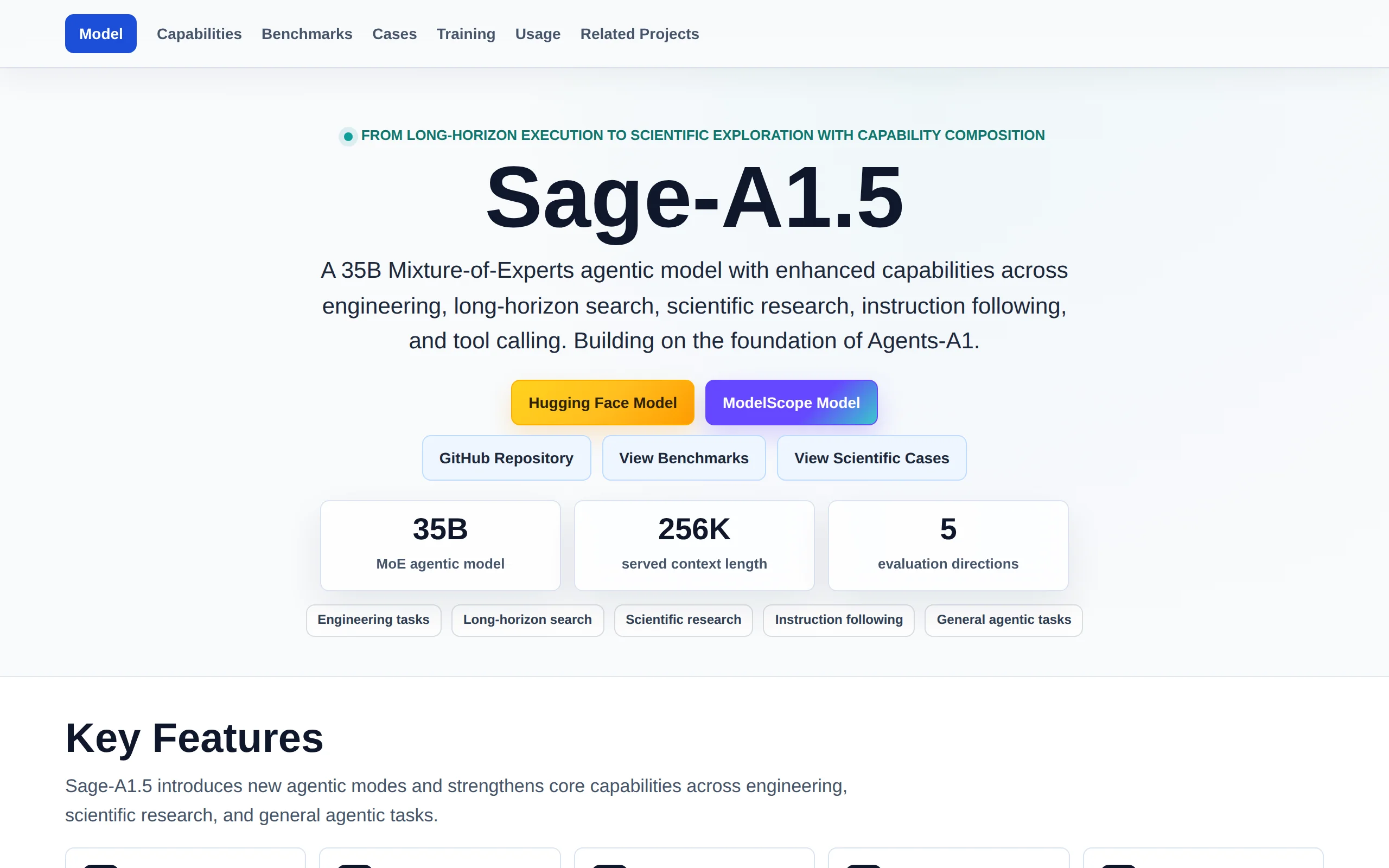
Sage-A1.5 – A Scientific Agent from the Shanghai AI Lab with General and Specialized Capabilities
Sage-A1.5 is a 35B-scale scientific agent with general and specialized capabilities, developed by the Shanghai Artificial Intelligence Laboratory. It is built upon the long-range task capabilities of ...
© All Rights Reserved. Some content on this site is partially generated by AI with human review.