
WorldSonus: In-Depth Review of the Real-Time Streaming Voiceover Framework Open-Sourced by HKUST and Shanghai Jiao Tong University
Executive Summary:
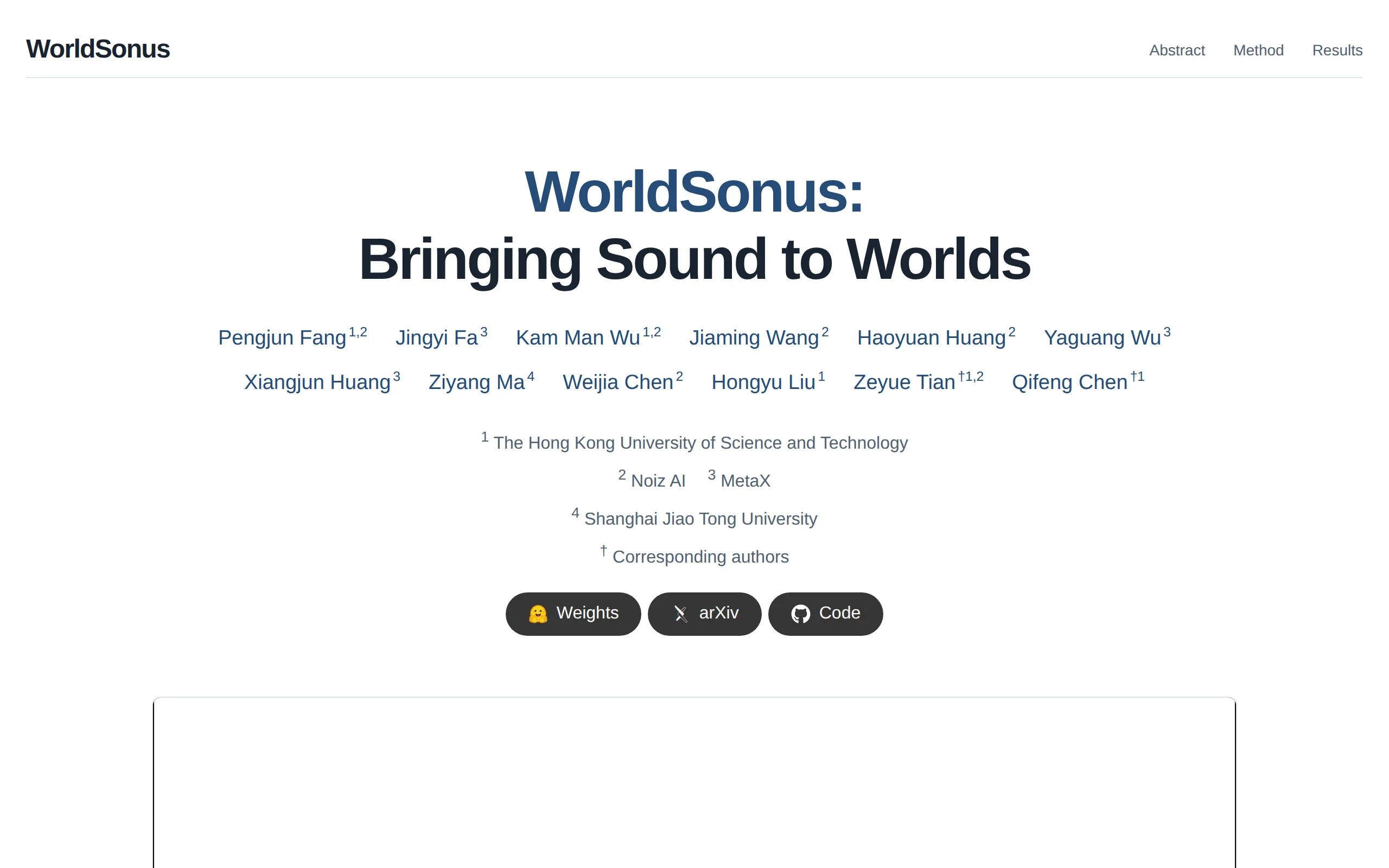
WorldSonus is a streaming voiceover framework open-sourced by the Hong Kong University of Science and Technology in collaboration with Noiz AI, MetaX, and Shanghai Jiao Tong University. Its core posit...

1. What is WorldSonus
WorldSonus is a streaming voiceover framework open-sourced by the Hong Kong University of Science and Technology in collaboration with Noiz AI, MetaX, and Shanghai Jiao Tong University. Its core positioning is to achieve real-time interactive voiceover capabilities, enabling "audio generation and output during video streaming." The framework performs incremental generation in 100ms chunks, with a single chunk computation time of only 41.2ms. It can continuously output 48kHz stereo audio, maintains a constant memory usage, and supports unlimited-length streaming. Unlike traditional offline bidirectional voiceover models, WorldSonus employs a causal AR-Diffusion architecture combined with a 5-second Ring-KV cyclic buffer, enabling long-term generation with bounded memory under strict causal constraints. It also supports seamless switching of audio effect prompts during generation, with left and right audio channels dynamically adjusting in real-time based on the sound source location and camera movement.
Technical positioning and domain: WorldSonus belongs to the video-to-audio (V2A) direction within the field of audiovisual speech generation, specifically targeting high-real-time-demand applications such as interactive world models, game engines, and virtual live streaming. Its unique technical positioning lies in introducing streaming generation capabilities into video voiceover tasks, breaking the limitations of traditional offline models that require the full video input before generating audio, and providing a new paradigm for real-time audio generation in human-machine interaction.
Development background: This framework was jointly developed by the Hong Kong University of Science and Technology, Noiz AI, MetaX, and Shanghai Jiao Tong University. The research team has deep expertise in video generation and audio understanding, while partner Noiz AI possesses engineering capabilities in generative audio technologies. The development motivation stems from the rapid growth of interactive world models (e.g., GameGen-X) and game engines—systems that require real-time rendering of environmental sound effects corresponding to the visual stream, which existing offline bidirectional voiceover models cannot satisfy due to their lack of immediate feedback.
Core value: WorldSonus addresses three major key challenges in real-time video voiceover: first, high-quality generation under causal constraints; second, dynamic modification of instructions during the generation process; and third, alignment of channel spatial information with visual motion. By controlling generation latency within real-time limits (RTF 0.41), this framework makes it possible for "sound to follow the visuals wherever they go," significantly expanding the application boundaries of video voiceover in real-time interactive scenarios.
Technical features: The core technical advantages are reflected in four aspects: a block-based causal streaming generation architecture enables infinite-length generation with bounded memory; dual time-scale visual conditioning decouples long-range planning from local rendering; ShiftNCE training-period alignment distillation improves audiovisual synchronization accuracy with zero inference overhead; and a time-varying prompt scheduling mechanism supports seamless switching of prompts during generation. These innovations collectively form a complete technical solution that combines real-time performance, flexibility, and high audio quality.
2. Key Features
Real-time Streaming Dubbing: Utilizes a block-based causal streaming generation architecture, incrementally outputting audio in 100ms blocks. Each block's computation time is only 41.2ms, achieving an RTF of 0.41. Thanks to its constant memory usage, this feature supports the generation of video streams of unlimited duration, completely eliminating the limitations of offline models that require full-segment processing.
Mid-Process Voice Switching: During generation, text-to-sound instructions can be rewritten at any time. The system seamlessly switches prompts at the boundary of the most recent block, preserving the conversation state without needing to recalculate historical frames. This capability is supported by four time-variant scheduling strategies during training (mid-process switching, instruction removal, instruction addition), enabling the model to learn smooth transitions.
Spatial Stereo Output: Outputs 48kHz stereo audio, with the sound source location and camera movement reflected in real-time across the left and right channels. Thanks to the fine-grained rendering mechanism where frame-aligned tokens are directly fed into the flow head, spatial information in the audio channels remains precisely synchronized with the visual content.
Modular Plug-and-Play: This framework is independent of the visual backbone network and only requires "already generated video frames" as input. As a result, it can be flexibly integrated with any world model or game engine. This decoupled design ensures that WorldSonus has excellent system integration capabilities, without requiring modifications to existing visual generation pipelines.
Open-Domain General Capabilities: Beyond interactive scenarios, its audio quality still outperforms offline bidirectional models on general video datasets such as VGGSound. Official data shows that on five test sets, the FAD metric is comprehensively better than bidirectional baseline models like AudioX and ThinkSound, which have access to the full video. This indicates that the causal architecture does not come at the cost of audio quality.
Stable Long-Range Generation: Under a 5-second Ring-KV cyclic caching mechanism, continuous generation of 30 seconds of audio remains stable with no drift or collapse. After each new block is generated, the oldest KV cache is entirely replaced, maintaining a constant memory window and ensuring consistent generation quality in infinitely extended dialogue streams.
ShiftNCE Alignment Distillation: A frozen Synchformer is used as the teacher model during training, and through contrastive learning, the audio-visual synchronization capability is distilled into the AR hidden state. Positive samples are time-aligned windows, while negative samples are windows from the same video but offset by several blocks. High-similarity offsets are filtered out as pseudo-negative samples. There is zero additional overhead during inference, and ablation experiments show that removing this leads to a degradation of the DeSync metric from 0.831 to 1.067.
3. How to Use
Environment Setup: Requires Python 3.10 or higher, an NVIDIA GPU with CUDA support, and FFmpeg/ffprobe installed. Ensure that the GPU driver is correctly installed. It is recommended to have at least 8GB of VRAM for a smooth inference experience.
Clone the Code: Execute
git clone https://github.com/NoizAI/WorldSonus.gitto clone the project repository, then navigate into the project directory withcd WorldSonus.Install Dependencies: Run
bash scripts/setup.sh .venvto automatically create a virtual environment and install CUDA 12.4 compatible PyTorch. Then executesource .venv/bin/activateto activate the environment, followed bypip install -e '.[features]'to install the project and all its feature dependencies.Download Model Weights: Run
python scripts/download_model.py --output assetsto fetch the main WorldSonus model weights. Then executepython scripts/download_encoders.py --output assetsto obtain the weights for the DINOv3 visual encoder and the T5Gemma 2 text encoder.Offline Full-Length Dubbing: Run
python -m worldsonus.infer --video input.mp4 --prompt "sound effect description text" --output output.wavto generate a 48kHz stereo WAV file. The framework automatically performs feature extraction, generation, and decoding. You can use--start 5 --seconds 10to extract a video segment, or omit--promptfor pure video-conditioned generation.Streaming Real-Time Generation and Playback: Adding the
--streamparameter enables chunk-based incremental audio generation. When combined with--pcm-stdout, raw PCM data can be piped directly toffplay -f f32le -ar 48000 -ac 2 -i - -nodisp -autoexit, allowing for real-time playback as the audio is generated.
4. Pros and Cons Analysis
| Pros |
|---|
| Real-time streaming architecture: 100ms chunk generation, single chunk computation takes only 41.2ms, RTF of 0.41 meets real-time interaction requirements, and constant VRAM allows for unlimited duration streaming. |
| Seamless mid-stream modification: Prompt words can be replaced at any time during generation, with Ring-KV and audio-visual states remaining unchanged, preserving session state and adapting to interactive creation scenarios. |
| Spatial stereo sound: Outputs at 48kHz stereo, aligning sound source location with camera movement in real-time, achieving a 90% user preference rate in spatial audio evaluations. |
| Modular integration: Only receives pre-generated video frames, does not rely on specific visual backbones, and can be connected to any world model or game engine, resulting in low system adaptation costs. |
| Audio quality surpasses offline models: FAD metrics are comprehensively better than bidirectional baselines such as AudioX and ThinkSound, and the causal architecture does not compromise basic audio quality. |
5. Comparative Analysis with Similar Tools
| Comparison Dimension | WorldSonus | ThinkSound | AudioX |
|---|---|---|---|
| Core Architecture | Causal Streaming AR-Diffusion | Bidirectional Diffusion + Multimodal LLM Chain-of-Thought Reasoning | Bidirectional Diffusion Model |
| Visual Conditioning | Only past + current frame (strictly causal) | Requires full video clip | Requires full video clip |
| Generation Method | 100ms chunked streaming output | Offline generation of full segment | Offline generation of full segment |
| Real-time Performance | RTF 0.41 (41.2ms/chunk) | Non-real-time | Non-real-time |
| Output Format | 48kHz stereo | Stereo | Stereo |
| Mid-process Text Modification | Supported, seamless switching at chunk boundaries | Not supported | Not supported |
| FAD (VGG10s) | 1.79 | 2.18 | Pending official release |
| FAD (Inter30s) | 2.03 | 7.00 | Pending official release |
| DeSync (VGG5s) | 0.686 | 0.481 (best in field) | Pending official release |
| Long-term Stability | No drift for 30s | No streaming capability | No streaming capability |
| Open Source License | CC BY-NC 4.0 (non-commercial) | Apache 2.0 (commercial use allowed) | Pending official release |
From a technical selection perspective, if the application scenario prioritizes real-time interaction—such as world model dubbing, virtual live streaming, or game engine integration—WorldSonus's causal streaming architecture is currently the only solution capable of meeting the "generate and output simultaneously" requirement, and its audio quality outperforms offline bidirectional models on most metrics. However, attention must be paid to its non-commercial license restrictions, and legal risks should be carefully evaluated for commercial projects.
If the application scenario emphasizes extreme accuracy in audio-visual synchronization and does not have strict latency requirements, ThinkSound's advantage in the DeSync metric (0.481 vs. 0.686) is worth noting. However, its lack of support for mid-process text modification and inability to perform streaming output limits its interactivity. For teams seeking the shortest development cycle and requiring a stable, mature solution, traditional offline dubbing tools remain a reliable choice. However, they cannot match WorldSonus in terms of audio quality and real-time performance.
6. Editor's Summary
WorldSonus has made groundbreaking innovations at the technical architecture level. Its block-based causal streaming generation approach effectively resolves the contradiction between real-time performance and generation quality in the field of video dubbing—by incrementally denoising audio in a continuous latent space with a granularity of 100ms, combined with a 5-second Ring-KV cyclic buffer to achieve bounded memory, the framework maintains strict causal constraints while achieving a real-time performance of RTF 0.41. The dual-timescale visual conditioning design decouples long-range planning (semantic tokens at the block level fed into the AR backbone) from local rendering (frame-aligned tokens directly fed into the flow head), addressing the classic challenge of achieving both global coherence and local precision. The ShiftNCE training period alignment distillation provides an effective paradigm for improving synchronization accuracy without any inference overhead, and the ablation experiment data (DeSync deteriorating from 0.831 to 1.067) is highly convincing.
In terms of practical value, WorldSonus fills a technical gap in the niche area of real-time interactive video dubbing. The fact that it outperforms offline bidirectional models across five test sets on the FAD metric demonstrates that the causal streaming architecture does not compromise audio quality for real-time performance, establishing a reliable baseline for future research. Particularly commendable is its modular design—accepting only "already realized video frames" as input, which means that any world model or game engine can be seamlessly integrated, significantly reducing the system integration cost for technical implementation.
In terms of target users, WorldSonus is primarily aimed at three categories of developers: first, researchers working on world models and interactive video generation who need real-time dubbing for generated video streams; second, developers of game engines and virtual reality applications who require dynamic spatial audio to enhance immersion; and third, teams working on virtual live streaming and digital human technologies who need to adjust audio effects in real-time during broadcasts. It is important to note that its CC BY-NC 4.0 non-commercial license restricts direct use in commercial scenarios, and commercial teams should pay attention to potential future commercial licensing arrangements.
Looking ahead, the causal streaming generation paradigm established by WorldSonus provides a scalable technical framework for the video dubbing domain. As the community continues to perform secondary development and optimization on its open-source code, further improvements in the DeSync metric, support for longer context windows, and richer mid-stream control capabilities are expected. In the broader trend of real-time interactive multimodal content generation, the technical direction set by this framework holds strong reference value and evolutionary potential.
7. Application Scenarios
World Models and Game Engines Real-Time Voice Synthesis: Generate ambient audio in real-time for the visual streams of interactive world models and game engines such as GameGen-X and LingBot-World 2.0. WorldSonus only receives pre-generated video frames, ensuring that the audio follows the visual wherever it goes, achieving true streaming audio-visual synchronization and significantly enhancing the immersion of interactive virtual environments.
Virtual Broadcasting and Digital Human Interaction: Synchronize audio with the live video stream as it is generated. The host can change the audio effects mid-broadcast through voice or text commands, without needing to pause and re-record. This mid-broadcast text modification capability ensures seamless audio effect transitions, offering viewers a richer live streaming experience.
Real-Time Music Accompaniment for Long Video Streams: In scenarios such as movie trailers and AI-generated long-form videos, 48kHz stereo music can be produced block by block without waiting for the entire video to render. Streaming generation significantly reduces post-production time, and the long-term stability with no drift within 30 seconds ensures consistent output quality.
VR/AR and Simulation Training Environments: In virtual simulations, autonomous driving training, and military exercises, generate spatial audio aligned with the camera for dynamic perspective visual streams. Stereo output accurately reflects the source location and camera movement, enhancing the realism of the training environment and improving task execution efficiency.
Embodied Agent Perception Systems: Provide real-time audio-visual synchronization signals for embodied agents such as robots, enabling them to receive stereo environmental feedback alongside visual input. This scenario leverages WorldSonus's real-time performance and modular integration advantages to assist agents in sound source localization, navigation decision-making, and human-machine interaction.
8. FAQ
Q: What is the core difference between WorldSonus and offline video voice-over models?
A: WorldSonus employs a strictly causal streaming generation architecture, relying only on past and current video frames, and outputs audio in 100ms increments, supporting infinite-length streaming and dynamic text changes during generation. In contrast, offline models require the full video input and generate audio in one continuous pass, making it impossible to dynamically modify instructions during the generation process. Real-time performance and interactivity are the fundamental differences between the two.
Q: How can I change the audio effect prompts during the generation process?
A: Prompts are compressed into a token set by T5Gemma 2 and cached within cross-attention. When changing prompts mid-generation, simply replace the cached token set at the nearest block boundary. The Ring-KV and audio-visual states remain stationary. During training, four time-varying schedules were intentionally introduced: mid-generation switching, instruction removal, and instruction addition. As a result, the model has learned to smoothly transition between different prompts.
Q: Can WorldSonus be used for commercial purposes?
A: Currently, it cannot be used commercially. The model weights are licensed under CC BY-NC 4.0, which restricts usage to academic research and non-commercial purposes. For commercial projects requiring use, you must contact the copyright holder to obtain commercial authorization. In comparison, ThinkSound uses the Apache 2.0 license, allowing direct commercial use.
Q: What is the memory usage like? How long of a video can it process?
A: Thanks to the Ring-KV cyclic caching mechanism (W=50 blocks), memory usage remains constant and does not increase with video length. The official team has verified that continuous generation for 30 seconds shows no drift or collapse, and in theory, it can support infinite-length streaming. Actual memory requirements depend on the input video resolution; it is recommended to have at least 8GB of GPU memory for a smooth experience.
Q: Does WorldSonus have any requirements for video frame rate?
A: The official documentation does not specify a particular frame rate, but the system aggregates frame tokens at a fixed time scale (3 frame tokens aggregated into 1 block-level semantic token). It is recommended to maintain a stable input video frame rate to achieve consistent audio-visual synchronization. If the frame rate fluctuates, consider normalizing it during the preprocessing stage.
9. Project Links
- Project Website: https://noizai.github.io/WorldSonus/
- GitHub Repository: https://github.com/NoizAI/WorldSonus
- Hugging Face Model Library: https://huggingface.co/FF2416/WorldSonus
- arXiv Technical Paper: https://arxiv.org/abs/2610.08760
Related
Voyager – Open-Source Desktop Creative Agent Covering the Full Production Workflow
Voyager is an open-source desktop creative Agent developed by Nullframe, designed to directly embed AI capabilities into creators' existing professional software workflows through natural language int...
Hy-SimulMT – In-Depth Review of Tencent HunYuan's Open-Source Simultaneous Interpretation Large Model
Hy-SimulMT is an open-source simultaneous interpretation large model developed by the Tencent HunYuan team, specifically designed for real-time speech-to-speech translation between Chinese and English...

In-Depth Review of GPT-6.1 Terra – OpenAI's High-Efficiency Execution Large Model
GPT-6.1 Terra is a high-efficiency execution large model introduced by OpenAI, designed for office automation and high-frequency Agent task scenarios. It emphasizes enhanced visual understanding, comp...

StarFire X2.6: iFLYTEK's End-to-End Native Audio Modeling Architecture and Domestic Breakthrough in Industrial Deployment
StarFire X2.6 (Spark-X2.6) is an end-to-end native audio modeling architecture launched by iFLYTEK, completing the full training-to-inference loop using entirely domestic computing power. It represent...
© All Rights Reserved. Some content on this site is partially generated by AI with human review.