
HeyGen Voice – HeyGen's Self-Developed Voice Model
Executive Summary:
HeyGen Voice is a self-developed voice model launched by HeyGen, an AI digital human company, on October 9, 2026. It has topped the Controlled Voice sub-list on the Artificial Analysis TTS leaderboard...
1. What is HeyGen Voice
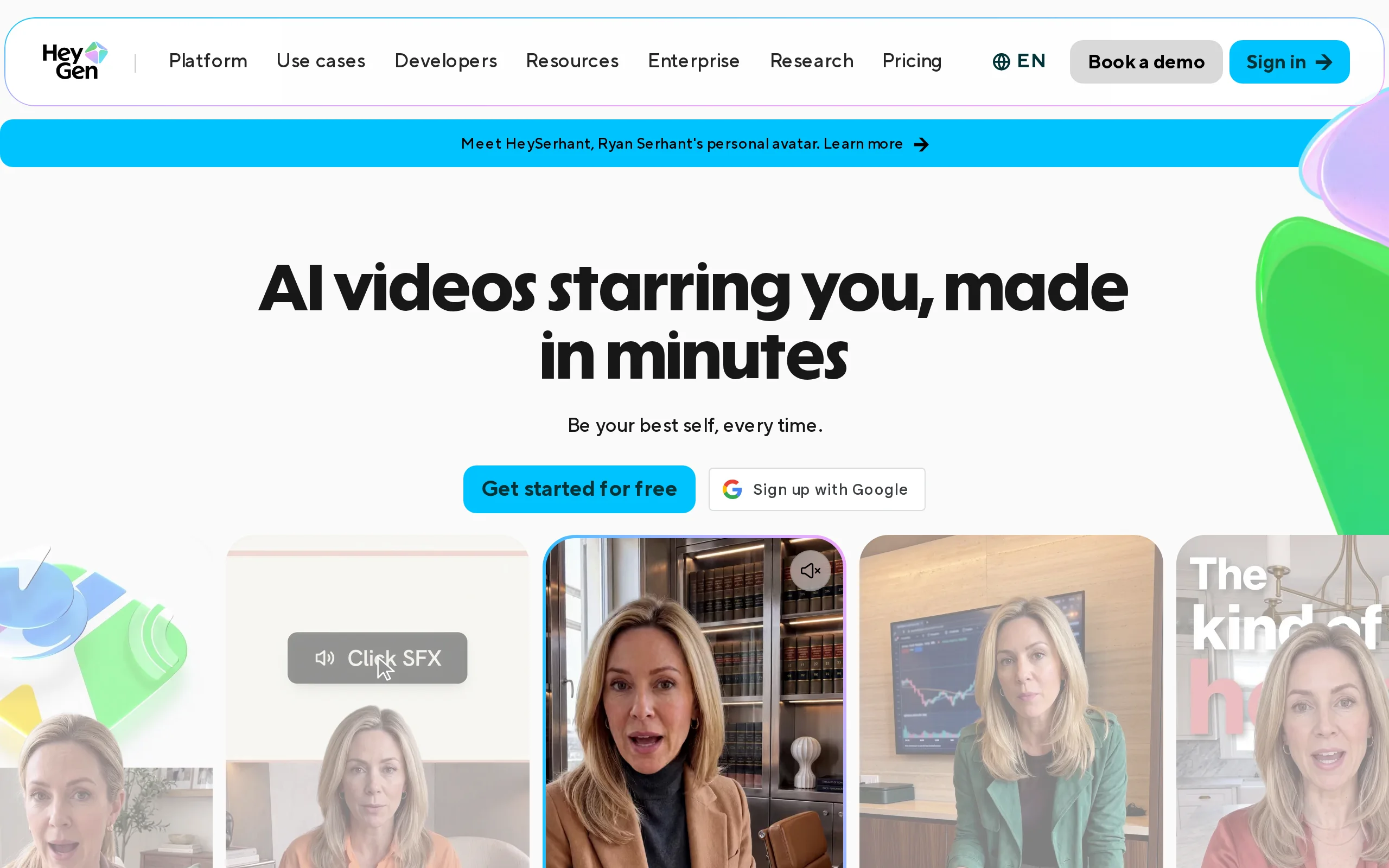
HeyGen Voice is a self-developed voice model launched by HeyGen, an AI digital human company, on October 9, 2026. It has topped the Controlled Voice sub-list on the Artificial Analysis TTS leaderboard. This model can preserve the tone, emphasis, emotion, and rhythm of the user's own voice, allowing digital humans to perform scripts without a noticeable robotic or reading tone. HeyGen Voice shares the same end-to-end technical stack with Avatar V and is freely available on the HeyGen platform and API, providing a low-cost technical pathway for high-quality digital human voiceovers.
Technical Positioning and Domain: Belongs to the field of text-to-speech (TTS) and voice cloning, focusing on high-quality TTS capabilities in digital human scenarios. Its unique positioning lies in sharing the same technical stack with the digital human identity model, rather than piecing together third-party TTS providers as traditional solutions do, thereby addressing the industry's long-standing pain point of mismatch between voice tone and facial expressions and lip movements from the source.
Development Background: Developed by HeyGen, a company that has long specialized in AI digital human video generation, accumulating deep expertise in speaker identity modeling and lip synchronization technology. The release of HeyGen Voice marks the completion of HeyGen's technical loop in self-developed voice technology, freeing it from reliance on third-party voice models and achieving unified generation of "identity + voice" by the same model.
Core Value: Solves the long-standing issues of "robotic reading tone" and audio-visual asynchrony in digital human voiceovers. Through dual-parameter decoupled control, users can freely balance between "resembling themselves" (similarity) and "vivid performance" (expressiveness_boost). The model is freely available on the HeyGen platform and API, significantly lowering the entry barriers for high-quality digital human voiceovers.
Technical Features: Uses the same end-to-end technical stack as Avatar V, where identity features and voice are generated by the same model; supports two pathways: Instant Clone (cloning with just 3 minutes of recording) and Professional Clone (training with over 20 minutes of data, with retraining capabilities); has a tiered parameter system for instant and professional voice use, enabling capability isolation across different product forms.
2. Key Features
End-to-end unified technology stack: HeyGen Voice and Avatar V share the same core model, generating identity features and voice from a single model. This design fundamentally reduces issues of asynchrony between voice tone and lip movements, expressions. This eliminates the audio-visual synchronization loss typically introduced by integrating third-party TTS providers in traditional approaches.
Dual-parameter decoupled control: When cloning, set the similarity parameter; when synthesizing, separately input the expressiveness_boost parameter. This decouples "how similar it is to the original person" and "how vivid the performance is" into two independently adjustable dimensions. HeyGen Studio recommends setting identity to similarity: max + expressiveness_boost: 0.5. Users can flexibly balance fidelity and expressiveness.
Instant Clone: Voice cloning can be completed using the first 3 minutes of a recording, with modeling done in seconds and no need for training wait time. This path is suitable for quick previews and temporary voice-over scenarios, but the cloned model cannot be retrained and must be recreated instead.
Professional Clone: Requires 1 to 10 audio clips totaling over 20 minutes for training, and supports retraining and iteration afterward. This is an additional service priced at $99/month, requiring explicit authorization from the individual. It is ideal for formal projects with high requirements for voice fidelity.
Hierarchical parameter system: Instant voice supports expressiveness control, while professional voice supports seed, speed, and pitch control. If parameters are mismatched with the clone type, the system will directly return a parameter error, indicating that the underlying architecture strictly isolates capabilities for different product forms to prevent misuse.
Free open access: Available free of charge on the HeyGen platform and API, allowing direct use for voice-over in digital human videos. This strategy significantly lowers the entry barrier for high-quality digital human voice synthesis, making it especially user-friendly for content creators and small businesses.
Leaderboard validation capability: Ranked first on the Controlled Voice subcategory of the Artificial Analysis TTS leaderboard, according to official claims, surpassing all major competitors. This ranking is based on independent third-party evaluations, providing external validation of the model's capabilities.
3. How to Use
Registration and Login: Visit the HeyGen official website (www.heygen.com) to register an account and log in. API users need to obtain an API Key from the developer dashboard for subsequent API calls. It is recommended to prepare recording materials for cloning in advance, with the duration depending on the type of cloning.
Select Usage Entry Point: Use HeyGen Studio directly via the web interface, which provides a complete set of digital human video editing tools; or call the API with the endpoint POST /v3/models/audio/tts. Both entry points support all core capabilities of HeyGen Voice.
Create a Voice Clone: In the voice management panel, choose either Instant Clone or Professional Clone. Instant Clone completes the process after uploading the first 3 minutes of a recording, while Professional Clone requires uploading 1 to 10 recordings, totaling over 20 minutes. Once training is complete, the clone can be used.
Adjust Synthesis Parameters: For Instant Voice, set the expressiveness parameter to control expressiveness. For Professional Voice, parameters such as speed (speech rate), pitch (tone), and seed (random seed) can be adjusted. Note that parameters must not be mismatched with the clone type, or the system will return a parameter error message.
Input Script and Generate: Enter the text to be performed in the digital human video editor, and select the cloned voice. Generate a video/audio preview to check the effect. If not satisfied, adjust the parameters and regenerate. Once the effect is confirmed, export the video or audio for formal release.
Best Practices Recommendations: For Professional Clone, recording materials should be captured in a quiet environment, avoiding background noise and echoes. Speak at a natural and steady pace and tone to ensure the stability of the cloned voice. For projects requiring multilingual performance, it is recommended to include voice samples in multiple languages during cloning to enhance multilingual expression.
4. Pros and Cons Analysis
| Pros |
|---|
| End-to-end audio-visual synchronization: Built on the same technical stack as Avatar V, identity and voice are generated by a unified model, fundamentally eliminating synchronization issues between voice tone and lip movements, expressions, and reducing post-production correction costs. |
| Dual-parameter decoupled control: The similarity and expressiveness_boost parameters are independently adjustable, allowing users to finely balance between "resembling the person" and "performing vividly," combining fidelity with expressiveness. This level of flexibility is relatively outstanding among peer products. |
| Platform and API free access: Available free of charge on the HeyGen platform and API, significantly lowering the threshold for high-quality digital human voiceovers. This is particularly beneficial for content creators and small businesses, offering a cost advantage. |
| Third-party leaderboard validation: Ranked first on the Artificial Analysis TTS leaderboard's Controlled Voice subcategory. Independent evaluation results confirm the model's expressive advantages under controlled conditions, providing external reference for selection. |
5. Comparative Analysis with Similar Tools
| Dimension | HeyGen Voice | MAI-Voice-2 | OpenAI TTS-1 |
|---|---|---|---|
| Core Architecture | Shares an end-to-end technical stack with Avatar V, enabling unified generation of identity and voice | Independent TTS model, zero-shot cloning, fine-grained emotional tags | Based on GPT-style Transformer architecture, with natural language instructions controlling style |
| Benchmark Performance | #1 on Artificial Analysis TTS leaderboard's Controlled Voice subcategory | Official blind test shows 72.1% preference over the previous version; did not top third-party TTS leaderboards | Mid-to-high tier on Artificial Analysis leaderboard |
| Cloning Method | Instant Clone (within 3 minutes) + Professional Clone (20 minutes+, retraining available) | Zero-shot cloning, only requires 5-60 seconds of reference audio, no training needed | Does not support voice cloning |
| Emotional Control | Dual parameter decoupling with similarity + expressiveness_boost | Fine-grained emotional tags (sadness, whisper, excitement, etc.) | Controls emotion and style via natural language instructions |
| Language Coverage | Depends on cloned data for accent fidelity; platform supports 177+ languages and dialects | Supports 15+ languages, including code-switching like Hindi-English and Spanish-English | Primarily targets multilingual general scenarios, with strong Chinese support |
| Speaker Consistency | Same end-to-end stack, natural audio-visual synchronization | Long text optimization, no drift over hours for audiobooks/podcasts | Good for short texts, consistency fluctuates with long texts |
| Deployment Method | Only cloud-based API, tied to the HeyGen platform ecosystem | Open-source model, supports self-deployment | Cloud-based API, accessible via the OpenAI platform |
| Open Source License | Closed-source commercial solution | Open-source (specific license details refer to official documentation) | Closed-source API service |
Selection Recommendations: For digital human video generation scenarios, HeyGen Voice has a natural advantage in audio-visual synchronization due to its shared end-to-end stack with Avatar V, making it ideal for enterprises and creators requiring batch generation of high-quality digital human videos. If the project emphasizes speaker consistency in long-text scenarios, MAI-Voice-2 is more suitable due to its open-source nature, self-deployment capability, and support for several hours of content without drift, fitting well for audiobooks and podcasts.
For applications requiring rapid integration and with sufficient budget, both OpenAI TTS-1 and ElevenLabs v2 offer mature API services. ElevenLabs excels in emotional expressiveness and fine-grained control, making it more suitable for creative projects that emphasize vocal performance. OpenAI TTS-1, on the other hand, is more convenient for controlling style via natural language instructions, making it ideal for rapid prototyping.
6. Editor's Summary
HeyGen Voice's technological innovation is primarily reflected in its architectural design. By adopting the same end-to-end technical stack as Avatar V, it generates both identity features and voice from the same model. This design differs from traditional approaches that stitch together third-party TTS providers, eliminating at the architectural level the structural issue of asynchrony between voice tone and facial expressions. The dual-parameter decoupled control (similarity and expressiveness_boost) provides users with fine-tuning capabilities at the interaction level, making "resembling the person" and "performing vividly" two independent dimensions, which has clear practical value in real-world digital human video production.
In terms of practical value, HeyGen Voice is freely available on the HeyGen platform and through its API, significantly lowering the cost barrier for high-quality digital human voiceovers. The instant cloning feature, with its second-level modeling capability, is ideal for quick auditioning and draft verification, while professional cloning is tailored for formal projects requiring high voice fidelity. These two paths address the diverse needs of different user types. Its first-place ranking on the Controlled Voice sub-list of third-party benchmarks provides an externally verifiable measure of the model's capabilities.
This model is suitable for content creators, corporate training teams, marketers, and sales teams requiring the bulk generation of personalized videos. For users already familiar with the HeyGen platform, HeyGen Voice can be seamlessly integrated into existing workflows without additional learning costs. However, for teams requiring localized deployment or open-source models, HeyGen Voice's closed-source commercial nature may not meet these needs, and alternatives such as MAI-Voice-2 can be considered.
Against the backdrop of increasingly fierce competition in the digital human space, HeyGen Voice offers a differentiated technical approach with "unified modeling of identity and voice," providing the industry with another viable engineering reference. Its future iteration directions, including multilingual capability expansion and long audio stability optimization, are worth watching.
7. Application Scenarios
Corporate Training Videos: Generate training course videos in bulk using digital avatars of CEOs or instructors, preserving the original tone and authoritative feel of their voices. No need for repeated recordings. Suitable for new employee onboarding, product knowledge dissemination, compliance training, and other scenarios, significantly reducing recording time and production costs.
Marketing and E-commerce Content: Small business owners can overcome camera anxiety by using digital humans paired with their own voice to efficiently produce product explanation videos, brand story videos, and promotional content. The preserved naturalness of the voice helps build audience trust, thereby improving conversion rates.
Multilingual Localization: After cloning a voice once, the digital human can naturally perform scripts in multiple languages, replacing the costly process of hiring real human voice actors. The HeyGen platform supports over 177 languages and dialects, making it ideal for product launches and brand promotion targeting global markets (e.g., 196 countries).
Sales and Customer Communication: Sales teams can use personal digital avatars to generate personalized outreach videos in bulk, using their own voice to build trust and increase customer response rates. Ideal for cold lead acquisition, customer follow-ups, and periodic check-ins that require personalized engagement.
Content Creators and Influencers: Bloggers and influencers can clone their own voice for video narration, maintaining a consistent voice across multiple platforms while reducing the time cost of repeated recordings. This supports a higher frequency of content updates.
8. FAQ
Q: Is HeyGen Voice completely free?
A: The core text-to-speech capabilities of HeyGen Voice are free to use on the HeyGen platform and API, including instant cloning and basic TTS calls. However, Professional Voice Clone is an add-on service priced at $99/month, which requires personal authorization and involves training with 30 minutes to 3 hours of voice recordings to create a custom voice clone.
Q: What is the difference between instant cloning and professional cloning?
A: Instant cloning uses the first 3 minutes of a recording and completes in seconds, without requiring training. However, the model cannot be retrained and must be recreated if changes are needed. Professional cloning requires uploading 1 to 10 audio clips totaling over 20 minutes for training, supports retraining and iteration, offers higher voice fidelity, and is suitable for formal production scenarios.
Q: How can I adjust the balance between "resembling the person" and "expressive delivery"?
A: This is achieved through dual parameter decoupling control. During cloning creation, the similarity parameter is set to control voice similarity. During synthesis, the expressiveness_boost parameter is separately passed to control the level of expressive delivery. The recommended configuration in HeyGen Studio is similarity: max + expressiveness_boost: 0.5, which can be adjusted based on specific needs.
Q: What languages does HeyGen Voice support?
A: HeyGen Voice itself relies on the fidelity of the cloned data to preserve accents. Its language capabilities match the language of the cloned audio recordings. The HeyGen platform as a whole supports over 177 languages and dialects. Cloning multilingual voice samples can yield better performance in multilingual expression, and the platform supports content localization for global markets.
Q: Why do parameter errors occur when setting parameters?
A: HeyGen Voice has a layered parameter system for instant and professional voices. Instant voices only support expressiveness control, while professional voices support seed, speed, and pitch control. When parameters are mismatched with the cloning type, the system will directly return a parameter error to ensure capability isolation across different product forms.
Q: What is the relationship between HeyGen Voice and Avatar V?
A: Both share the same end-to-end technical stack. Avatar V is the core model, and HeyGen Voice is a new output format within the same technical stack. Identity features and voice are generated by the same model, fundamentally reducing synchronization issues between voice and lip movements or expressions, without the need to integrate third-party voice providers.
9. Project Links
- Product Official Website: https://www.heygen.com/
- Official AI Voice Generator Entry: https://www.heygen.com/tool/ai-voice-generator
- Official Pricing Page: https://www.heygen.com/pricing
- Official Documentation (HeyGen Voice): https://developers.heygen.com/docs/models/heygen-voice
- Official Organization Page (GitHub): https://github.com/HeyGen-Official/
Related AI Model Articles
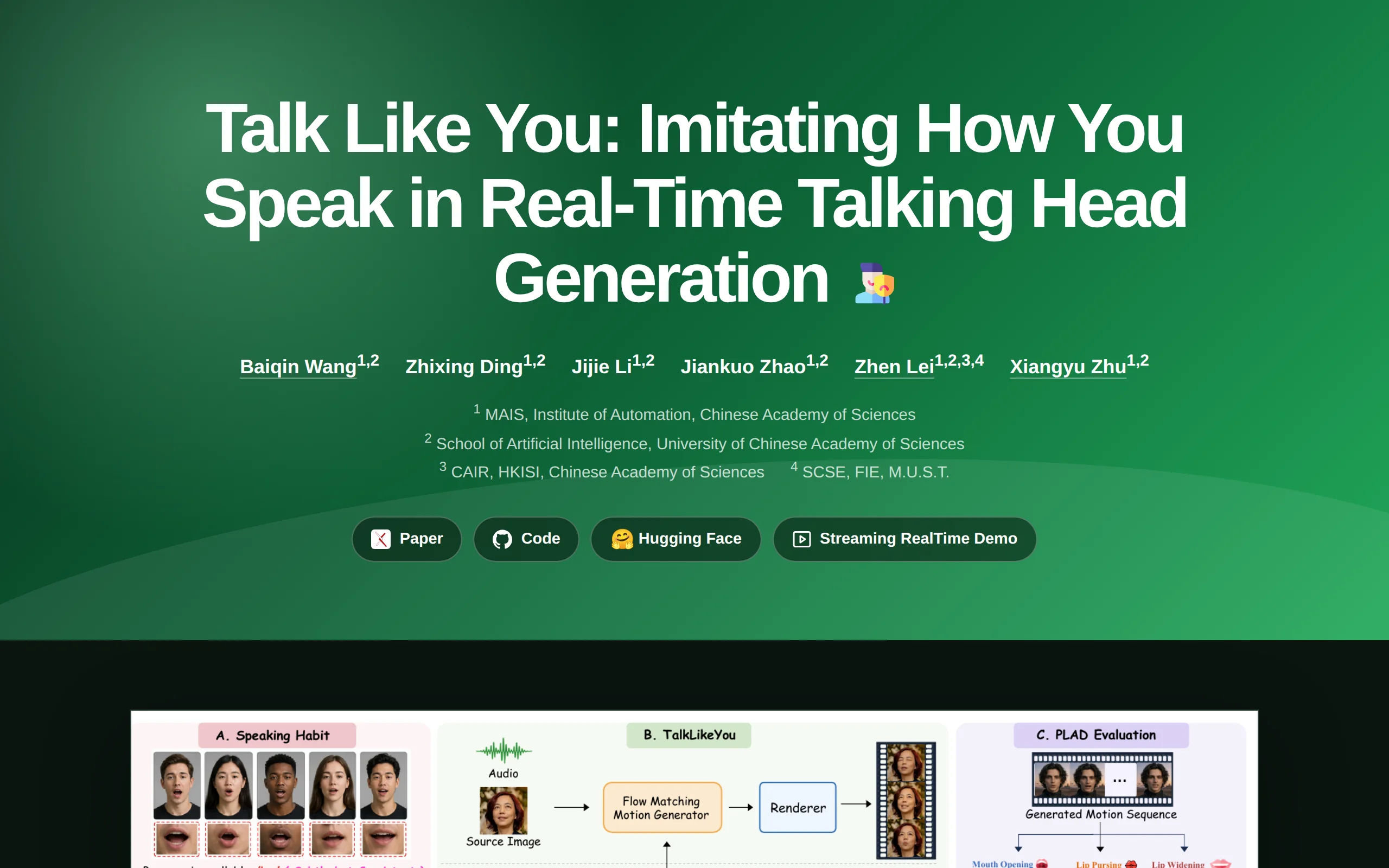
TalkLikeYou — In-Depth Review of the Open-Source Real-Time Digital Human Framework from the Institute of Automation, Chinese Academy of Sciences
TalkLikeYou is an open-source real-time digital human (talking head) generation framework developed by the Institute of Automation, Chinese Academy of Sciences. Its core capability lies in generating ...
Vidu Q4 Preview: A Masterful Demonstration of Expressive Performance and Multi-Subject Consistency in ShengShu Technology's Flagship Video Generation Model
Vidu Q4 Preview is the first publicly available preview version of ShengShu Technology's next-generation flagship video generation model, launched on October 7, 2026. It emphasizes "expressive perform...
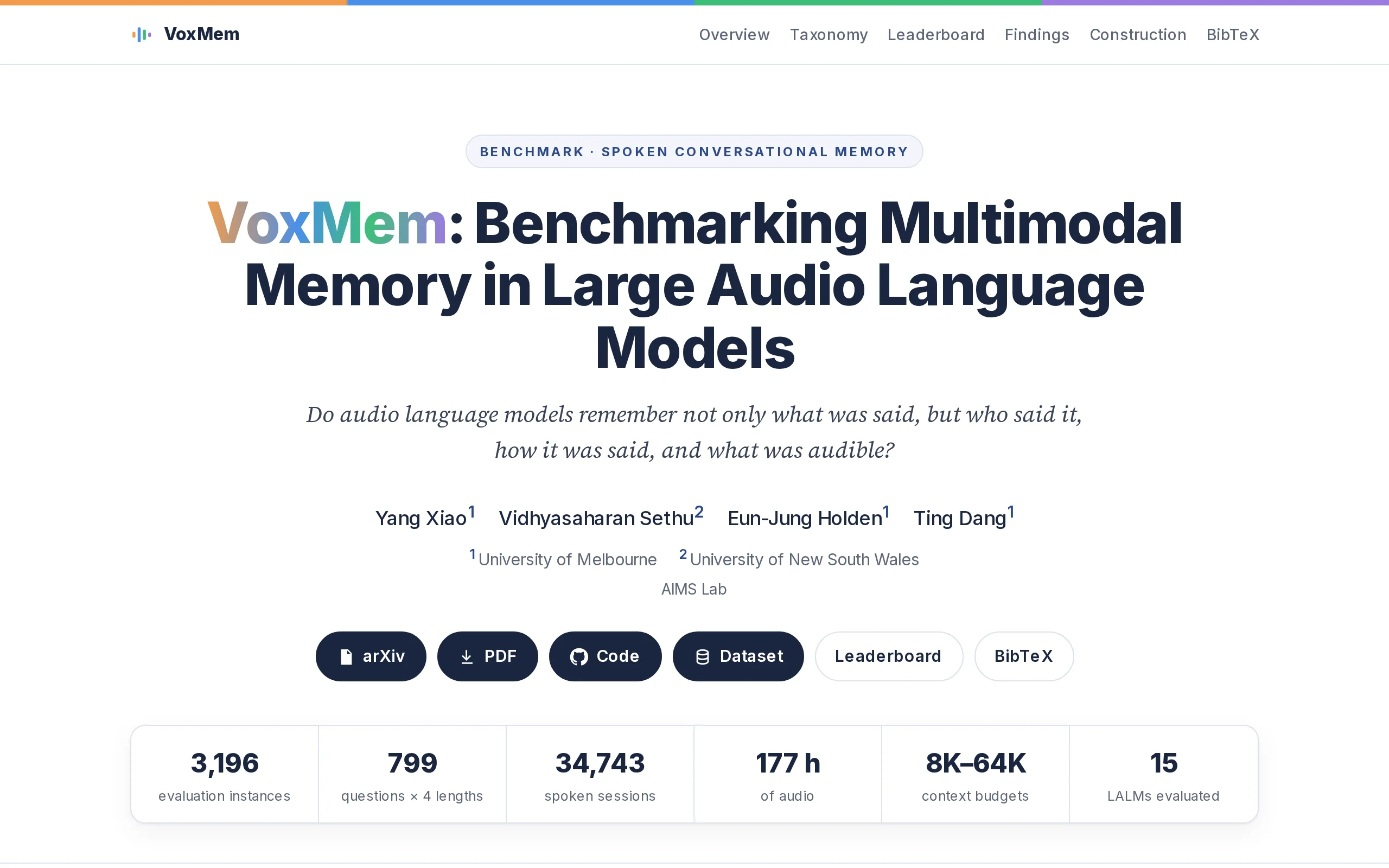
VoxMem – An Open-Source Audio Large Model Memory Benchmark from the University of Melbourne and Others
VoxMem is an audio large model memory benchmark introduced jointly by the research team from the University of Melbourne and the University of New South Wales. This benchmark pioneers a two-dimensiona...
EmbeddingGemma 2 – Review of Google's Open-Source Native Multimodal Embedding Model
EmbeddingGemma 2 is an open-source native multimodal Embedding model developed by Google, built upon the Gemma 4 architecture. It unifies five modalities—text, code, images, video, and audio—into a si...
© All Rights Reserved. Some content on this site is partially generated by AI with human review.