
TalkLikeYou — In-Depth Review of the Open-Source Real-Time Digital Human Framework from the Institute of Automation, Chinese Academy of Sciences
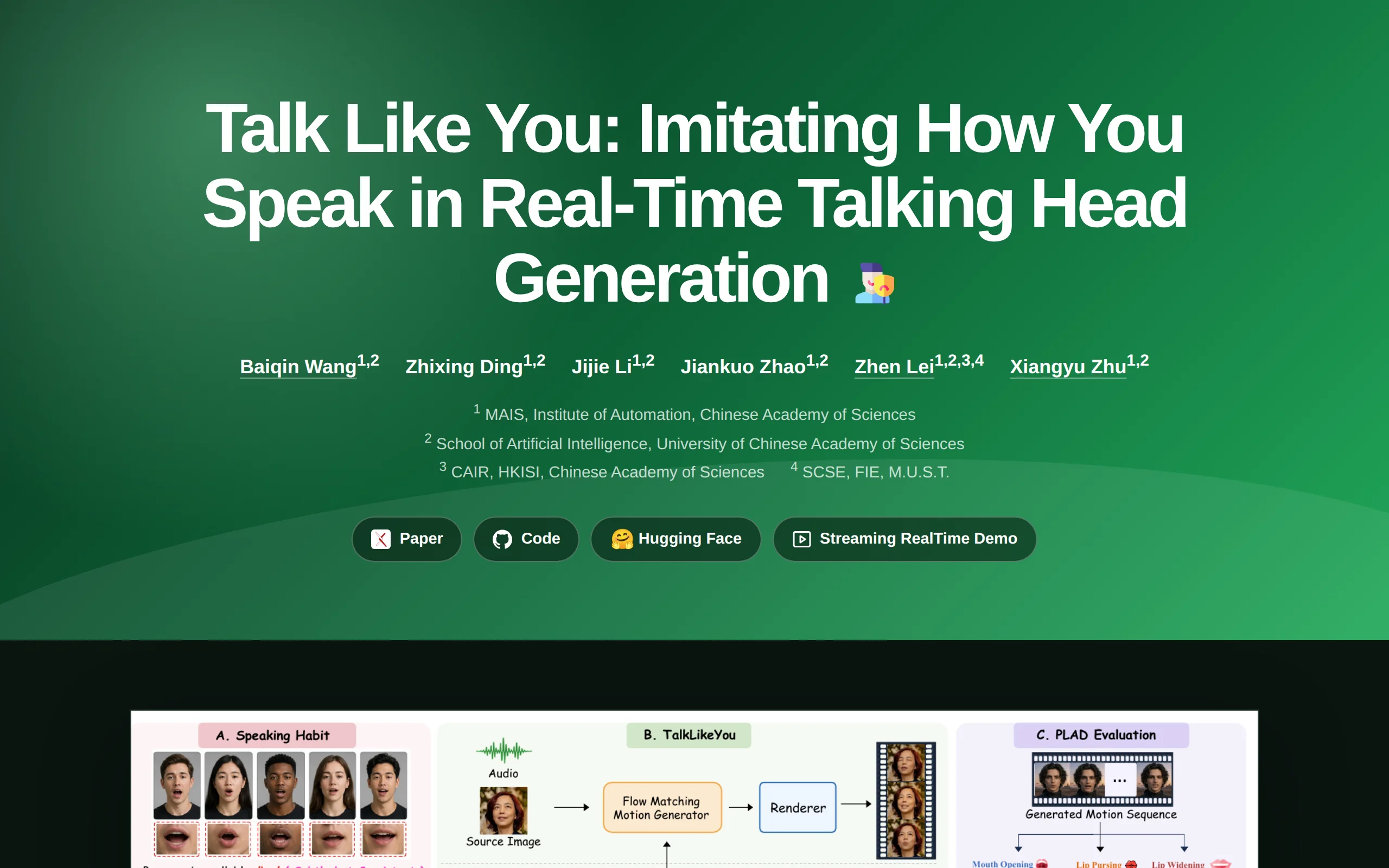
Executive Summary:
TalkLikeYou is an open-source real-time digital human (talking head) generation framework developed by the Institute of Automation, Chinese Academy of Sciences. Its core capability lies in generating ...
1. What is TalkLikeYou
TalkLikeYou is an open-source real-time digital human (talking head) generation framework developed by the Institute of Automation, Chinese Academy of Sciences. Its core capability lies in generating speech from a single portrait photo and an audio clip, with the mouth movements accurately mimicking the personalized speaking habits of a specified individual. By leveraging motion space modeling and one-step sampling technology, the framework achieves a real-time generation speed of 32.43 FPS on a single RTX 3090 GPU, breaking the previous balance limitations between speed and visual quality in digital human generation. The project's code and model weights are fully open-sourced, providing a low-cost, high-efficiency technical foundation for applications such as virtual anchors, video dubbing, and digital avatars.
Technical positioning and domain: It belongs to the intersection of computer vision and multimedia generation, specifically focusing on the direction of audio-driven talking head generation. Its uniqueness lies in modeling individual speaking habits as an independent object, rather than the generic, one-size-fits-all mouth shapes used in previous solutions.
Development background: Developed by the team at the Institute of Automation, Chinese Academy of Sciences, the research was motivated by the lack of individual speaking style modeling in existing digital human frameworks, as well as the difficulty in achieving generation speeds that meet real-time interaction requirements. The team integrated motion space modeling, Flow Matching generative models, and a two-stage training strategy to systematically address these bottlenecks.
Core value: It solves two major pain points in digital human applications: one is real-time performance, with generation speed increased to 32.43 FPS through one-step sampling, supporting streaming dialogue scenarios; the other is personalization, as it is the first to model speaking habits as a pluggable low-dimensional vector, allowing users to flexibly switch or blend styles using predefined IDs or reference videos, thereby overcoming the previous limitation of "one-size-fits-all" generation results.
Technical features: It employs a lightweight architecture combining "motion parameter generation + rendering synthesis," avoiding direct generation in high-dimensional pixel space. It constructs an interpolable unified habit space, supporting the switching, blending, and even interpolation-based creation of new speaking styles. The two-stage training strategy significantly improves the similarity of habit imitation, and together with the self-developed PLAD evaluation metric, it provides the first industry-standard quantitative benchmark for "speaking habit similarity."
2. Key Features
Photo-to-Speech: Users can upload a static portrait photo and an audio clip to generate a video where the person in the photo naturally speaks. This feature is based on motion space modeling, first parsing the photo into lightweight motion parameters, then synthesizing the final video through a renderer. It ensures the stability of identity features while achieving high frame rate output, making it especially suitable for applications such as reviving old photos and creating virtual tour guides.
Habit Mimicry: A core differentiating feature, allowing users to specify a real person's speaking habits and transfer them to the target photo. It supports two entry points: one is to quickly switch styles using the officially preset
--person-idnumber; the other is to provide a reference video with at least 100 frames, enabling the habit extractor to automatically encode the person's lip motion statistical features. Both methods are mapped to the same low-dimensional habit space, and even allow interpolation and mixing to create entirely new speaking styles.Real-time Streaming Generation: Based on one-step Flow Matching sampling technology, it achieves a generation speed of 32.43 FPS on an RTX 3090 GPU with less than 4GB of VRAM usage. Compared to image diffusion methods that require dozens of iterative steps, this approach compresses inference latency to near real-time levels, supporting interactive scenarios requiring streaming output such as live broadcasting and online customer service.
Video Dubbing: The framework allows for the complete replacement of a person's lip movements in an existing video, while preserving the original head pose and temporal sequence. Users simply need to point
--sourceto a video file and add the--pose-mode sourceparameter to achieve precise alignment of lip movements with the target language, making it suitable for professional applications such as film dubbing and localization of content for international markets.Interactive Digital Human: The framework seamlessly integrates with large language models and speech recognition/synthesis modules to create digital avatars capable of real-time conversation. Thanks to its low-latency generation capabilities, users can engage in natural multi-turn voice interactions with the digital human, making it ideal for scenarios requiring "face-to-face" communication such as intelligent customer service, exhibition hall guides, and virtual assistants.
Stylized Avatar Driving: In addition to realistic portraits, the framework also supports driving non-realistic styles such as sketches, oil paintings, anime, and 3D characters. This is made possible by its decoupled motion parameters and rendering architecture, allowing different stylized character models to reuse the same set of motion generation logic, greatly expanding the creative expression possibilities.
PLAD Similarity Evaluation (Built-in Metric): The project has developed its own Person-specific Lip-shape Alignment Distance (PLAD) metric, projecting lip movements onto three articulation axes: mouth opening amplitude, lip closure, and lip stretching. Similarity is calculated by comparing the distribution histograms of the reference person. This metric provides, for the first time, an objective quantitative method to assess whether "speaking habits are similar," facilitating researchers in comparing the personalization modeling performance of different approaches.
3. How to Use
Environment Requirements: It is recommended to use Linux as the operating system; Python 3.10, CUDA 12.1, and FFmpeg must be installed; NVIDIA GPU memory should be at least 12GB (official testing was conducted on RTX 3090, with peak memory usage under 4GB).
Download and Installation: Clone the main repository of TalkLikeYou from GitHub, then run
conda env create -f environment.yamlto create and activate the environment; if you prefer manual configuration, install the CUDA version of PyTorch and then executepip install -r requirements.txtto install the remaining dependencies.Download Model Weights: Use the Hugging Face command-line tool to run
hf download doubi-killer/TalkLikeYou, which will download the pre-trained weights to the root directory of the repository. These weights include all components such as the motion generator, habit extractor, and renderer.Basic Inference: Prepare a portrait photo and an audio clip (input video should be 25 FPS), and run the following command:
python -m talklikeyou --source photo_path --audio audio_path --person-id 192 --sampling-steps 1Here,
--person-idrefers to the pre-defined speaking habit ID provided by the official, and it can be replaced with other IDs to switch styles.Custom Habits: Replace
--person-idwith--habit-reference reference_video_path. The reference video should contain at least 100 frames of the person speaking. The system will automatically extract the person's lip movement habits and apply them to the target photo.Video Dubbing Mode: Point
--sourceto a video file and add the--pose-mode sourceparameter. In this mode, only the lip region is replaced, while the original head movement and temporal sequence are fully preserved.
Notes: It is recommended to use GPU inference for real-time performance; for reference videos, choose segments with a frontal face, even lighting, and no occlusions to improve habit extraction accuracy; when switching between custom habits and pre-defined IDs, the model supports interpolation and blending between the two, enabling smooth style transitions.
4. Pros and Cons Analysis
| Pros |
|---|
| Personalized Habit Modeling: The first open-source framework in the industry to model individual speaking habits of the mouth as a core objective. It supports dual entry points with predefined IDs and reference videos, and can interpolate and blend to generate new habits, significantly outperforming competitors' "one-size-fits-all" average mouth shapes. |
| Real-time Generation Performance: Achieves 32.43 FPS with a single-step Flow Matching sampling, using less than 4GB of memory on an RTX 3090 GPU. It is nearly 100 times faster than the image diffusion-based Sonic approach, providing real-time performance for streaming interactions. |
| Excellent Visual Quality and Synchronization: The FID score of 7.71 is less than one-third of the second-place competitor, while the Sync-C score of 8.73 is the highest among comparison methods, proving that it balances lip synchronization accuracy and frame visual quality, rather than compromising on image quality for speed. |
| Innovative Quantitative Metrics: Developed the PLAD evaluation metric, providing the first objective quantitative standard for "speaking habit similarity" (measured at 0.62 in practice), greatly enhancing reproducibility and ease of comparison in this niche research area. |
| Fully Open-Source Pipeline: The code, weights, and technical paper are all freely available, supporting both academic research and commercial applications. This lowers the technical entry barrier in the digital human field and promotes rapid growth of the community ecosystem. |
5. Comparative Analysis with Similar Tools
| Comparison Dimension | TalkLikeYou (Institute of Automation, Chinese Academy of Sciences) | SoulX-LiveAct (Soul AI Lab) | Sonic (Representative of Image Diffusion Approach) |
|---|---|---|---|
| Core Positioning | Real-time talking head generation + imitation of personal speaking habits | Real-time digital human + hour-level long-term stable generation | Fast audio-driven talking head generation |
| Technical Approach | Two-stage motion space modeling (lightweight parameters + renderer synthesis) | Autoregressive diffusion (AR Diffusion), pixel-level generation | Image diffusion model generates frames directly |
| Generation Speed | 32.43 FPS (single RTX 3090 card) | 20 FPS (dual H100/H200 cards) | Approximately 0.33 FPS (dozens of iterations) |
| Speaking Habit Modeling | ✅ Supports numbering/reference video/interpolation hybrid, PLAD 0.62 | ❌ Does not model personal lip habits | ❌ Does not model personal lip habits |
| Duration Limit | Segment-level generation (no long-term optimization) | Hour-level or even infinite duration, constant memory usage | Segment-level generation |
| Action Range | Lips + head pose | Full-body actions, controllable expression/gesture/emotion | Lips + head pose |
| Driving Method | Audio-driven (photo/video) | Image + audio + text instruction-driven | Audio-driven |
| Deployment Cost | Single RTX 3090 card, memory <4GB | Dual H100/H200 cards, high infrastructure requirements | Single high-end GPU card, longer inference time |
| Open Source License | Fully open-source (code + weights) | Not open-sourced | Open-source code |
| Community Ecosystem | Institute of Automation background, paper and code published simultaneously | Corporate team, focused on commercial applications | High community activity |
Selection Recommendations: For scenarios requiring real-time streaming interaction and emphasizing personalized speaking styles, such as virtual anchors or digital customer service agents, TalkLikeYou offers the most competitive balance between speed and personalization, with a significantly lower single-card deployment cost compared to SoulX-LiveAct's dual-card solution. If the project prioritizes full-body motion expression and continuous stability over several hours (e.g., virtual concerts, 24/7 live streaming), SoulX-LiveAct's autoregressive architecture and constant memory design are more suitable. While Sonic is slower, its image diffusion approach still holds advantages in the subtlety of expressions, making it ideal for short video production scenarios that demand ultra-high visual quality but do not require real-time performance.
6. Editor's Summary
The emergence of TalkLikeYou holds clear technical innovation value: its "motion space modeling + one-step sampling" architectural design breaks away from the conventional mindset of directly generating images in the pixel space. By decomposing the generation process into two stages—lightweight motion parameter learning and rendering synthesis—it significantly reduces computational complexity. This approach aligns with recent trends in parameterized human modeling such as NeRF and 3DMM, but successfully applying it to real-time talking head generation and achieving a practical performance of 32.43 FPS is relatively rare among open-source solutions. The details of the two-stage training strategy—first learning "what is habitual" on a dataset of 380 individuals, then training generalization capabilities on a large-scale dataset with periodic replays to prevent forgetting—demonstrate the team's deep consideration of training dynamics, resulting in an increase in habit similarity from 0.33 to 0.64.
In terms of practical value, this framework reduces the hardware requirements for digital human technology to a single consumer-grade GPU, with memory usage under 4GB. This means that small teams or even individual developers can build virtual avatars with personalized lip movements at a relatively low cost. When combined with large models and voice processing pipelines, it enables the rapid development of conversational digital human applications, showing strong potential for engineering implementation. The introduction of the PLAD metric also provides a quantitative benchmark for research comparisons in this niche area, helping to promote standardization and development within the industry.
In terms of target users, this tool offers clear value to academic researchers (studying personalized talking head generation and motion space modeling), application developers (building virtual anchors, dubbing tools, and digital customer service agents), and content creators (producing stylized voice-over videos). Its limitations include a limited range of motion modalities and unverified long-term stability, but for scenarios focused on segment-level generation and fine-grained lip control, these trade-offs are reasonable.
Looking ahead, the team is expected to continue iterating in directions such as expanding the range of motions (expressions, gestures), improving long-term generation stability, and supporting more stylized rendering options. As the open-source community accumulates application feedback and third-party evaluations are added, this framework has the potential to become a foundational open-source component in the field of real-time digital humans.
7. Application Scenarios
Virtual Anchors and Live Streaming E-commerce: Merchants or individual creators can use TalkLikeYou to generate virtual anchors with their own speaking habits, enabling 24/7 live streaming without the need for real people to appear on camera. Thanks to its ability to run in real-time with just 4GB of VRAM, it can be locally deployed on regular workstations, combined with streaming tools like OBS to build low-cost virtual live streaming setups.
Multilingual Video Dubbing and Film Localization: By inputting the original video as
--sourceand pairing it with audio files in the target language along with the--pose-mode sourceparameter, TalkLikeYou can generate dubbed videos with natural lip-sync matching the target language. The approach that preserves original head movements significantly enhances the viewing experience of dubbed content, making it suitable for scenarios such as localization of overseas content and course subtitle dubbing.Digital Avatars and Virtual Customer Service: After integrating with large language models and speech recognition/synthesis modules, TalkLikeYou can create digital avatars capable of real-time conversations, applicable in scenarios requiring "face-to-face" interaction such as bank lobbies, government service centers, and museum guides. Its streaming generation capability ensures smooth conversations, allowing users to perceive the immediate response of digital humans.
Personalized Educational Course Recording: Establish a unique digital avatar for teachers or trainers, replicating their distinct explanation pace and lip movement habits, for mass recording of online courses or remote teaching. Compared to real people repeatedly recording, this solution significantly reduces time costs while maintaining consistency in the teaching style.
Creative Content and Style-Based Character Animation: Supports animating non-realistic styles such as sketches, oil paintings, anime, and 3D characters, providing Up主s and animators with a toolchain to quickly produce speaking videos for their characters. On short video platforms, such stylized digital human content has high recognizability and potential for wide dissemination.
8. FAQ
Q: What input formats does TalkLikeYou support? Are there any requirements for audio and photos?
A: Photos support common image formats (JPG/PNG, etc.), and should be clear with a frontal face. Audio supports mainstream formats (WAV/MP3, etc.). If input is video, it must be 25 FPS. It is recommended that photos have even lighting and minimal facial occlusion to ensure the stability of identity feature extraction.
Q: How can I make the generated character mimic the speaking habits of a specific person?
A: There are two methods: first, use the official preset --person-id number to switch directly; second, provide a reference video of at least 100 frames using the --habit-reference parameter. The system will automatically extract the lip motion habits of that person and transfer them to the target photo.
Q: In the video dubbing mode, will the original head movements in the video change?
A: No. By adding the --pose-mode source parameter, the framework only replaces the lip area movements, while preserving the original head pose, gaze direction, and temporal sequence information, ensuring the dubbing result remains natural and coherent.
Q: What is the relationship between generation speed and hardware configuration? Can it run on a GPU with low memory?
A: Official testing achieved 32.43 FPS on an RTX 3090 (24GB VRAM), with a peak memory usage of less than 4GB. In theory, NVIDIA GPUs with 8GB VRAM or more can also run the framework, though performance may decrease. The official minimum recommended configuration is 12GB VRAM.
Q: What preset IDs are available for speaking habits? Can two habits be mixed?
A: Refer to the README in the GitHub repository for the list of styles corresponding to the preset IDs. Since the two habits are mapped to the same low-dimensional vector space, they can be directly interpolated and mixed, allowing the generation of transitional speaking habits between two styles.
Q: Can this framework be used for commercial projects? Is a paid license required?
A: The project is released under an open-source license, with full access to the code and weights at no cost, and supports commercial use. The specific license type should be referenced in the LICENSE file of the GitHub repository. For large-scale commercial deployment, it is recommended to monitor for potential updates to the license terms in future versions.
Q: What is the resolution of the generated video? Can it output higher resolution?
A: The default output resolution is related to the input photo resolution. Specific parameters can be found in the repository documentation. The current version does not disclose a super-resolution module. If higher resolution output is required, post-processing with third-party super-resolution tools can be used.
9. Project Links
- Project Website: https://bq-wang0511.github.io/TalkLikeYou/
- GitHub Repository: https://github.com/BQ-Wang0511/TalkLikeYou
- Hugging Face Model Library: https://huggingface.co/doubi-killer/TalkLikeYou
- arXiv Technical Paper: https://arxiv.org/pdf/2610.06658
Related AI Model Articles
Vidu Q4 Preview: A Masterful Demonstration of Expressive Performance and Multi-Subject Consistency in ShengShu Technology's Flagship Video Generation Model
Vidu Q4 Preview is the first publicly available preview version of ShengShu Technology's next-generation flagship video generation model, launched on October 7, 2026. It emphasizes "expressive perform...
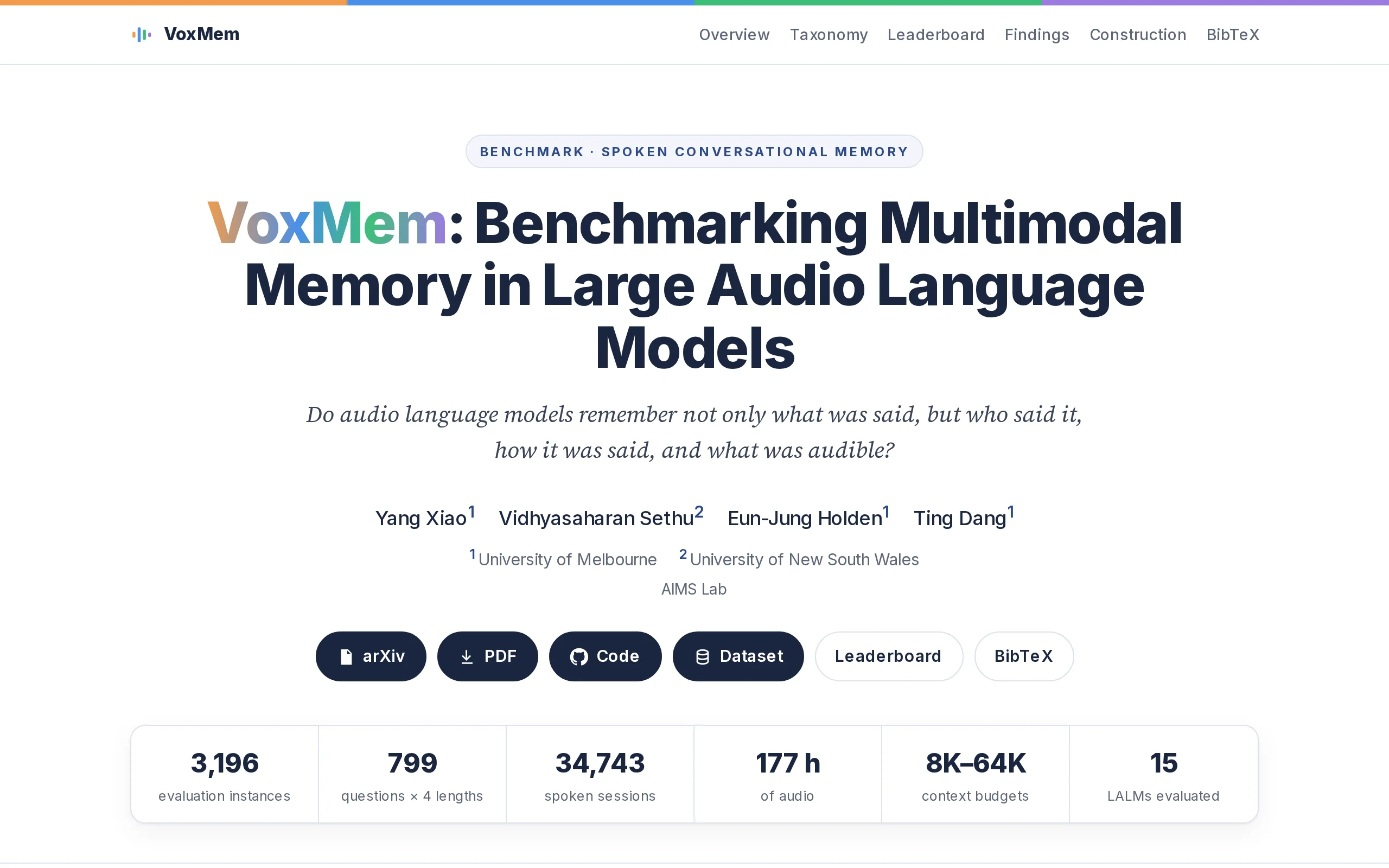
VoxMem – An Open-Source Audio Large Model Memory Benchmark from the University of Melbourne and Others
VoxMem is an audio large model memory benchmark introduced jointly by the research team from the University of Melbourne and the University of New South Wales. This benchmark pioneers a two-dimensiona...
EmbeddingGemma 2 – Review of Google's Open-Source Native Multimodal Embedding Model
EmbeddingGemma 2 is an open-source native multimodal Embedding model developed by Google, built upon the Gemma 4 architecture. It unifies five modalities—text, code, images, video, and audio—into a si...
MAI-Transcribe-2-Streaming: In-Depth Evaluation of Microsoft's Real-Time Streaming Speech-to-Text Model
MAI-Transcribe-2-Streaming is Microsoft's first real-time streaming speech-to-text model, capable of continuously outputting text while speech is being delivered. It supports 60 languages and automati...
© All Rights Reserved. Some content on this site is partially generated by AI with human review.